Thinking Like an Economist (Microeconomics) | Microeconomics | Trường Đại học Quốc tế, Đại học Quốc gia Thành phố Hồ Chí Minh
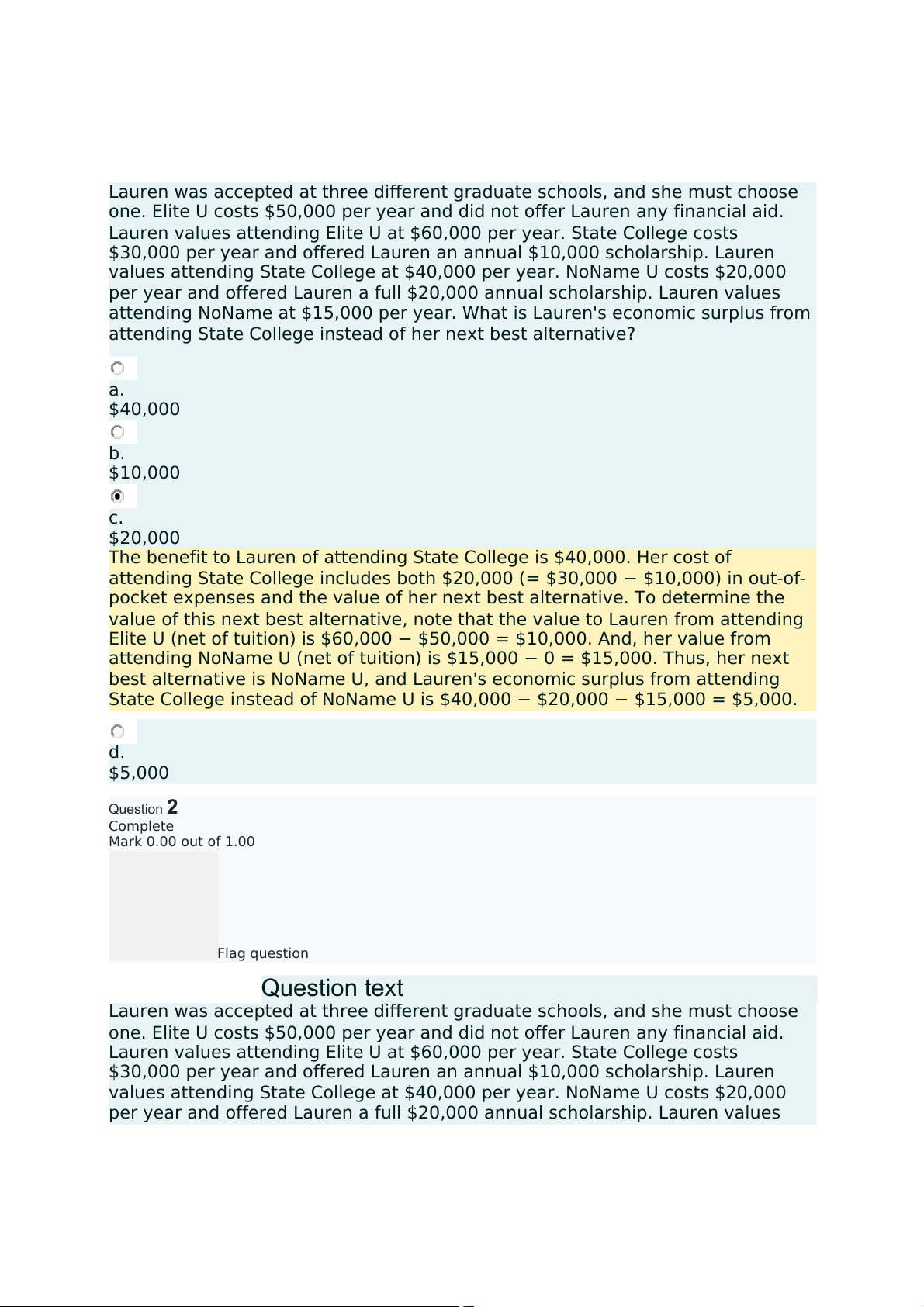
Lauren was accepted at three different graduate schools, and she must choose one. Elite U costs $50,000 per year and did not offer Lauren any financial aid. Lauren values attending Elite U at $60,000 per year. State College costs $30,000 per year and offered Lauren an annual $10,000 scholarship. Lauren values attending State College at $40,000 per year. NoName U costs $20,000 per year and offered Lauren a full $20,000 annual scholarship. Lauren values attending NoName at $15,000 per year. What is Lauren's economic surplus from attending State College instead of her next best alternative? Tài liệu được sưu tầm và soạn thảo dưới dạng file PDF để gửi tới các bạn cùng tham khảo, ôn tập đầy đủ kiến thức, chuẩn bị cho các buổi học thật tốt. Mời bạn đọc đón xem!
Môn: Microeconomics 635 tài liệu
Trường: Trường Đại học Quốc tế, Đại học Quốc gia Thành phố Hồ Chí Minh 1.9 K tài liệu
Tác giả:


Preview text:
Lauren was accepted at three different graduate schools, and she must choose
one. Elite U costs $50,000 per year and did not offer Lauren any financial aid.
Lauren values attending Elite U at $60,000 per year. State College costs
$30,000 per year and offered Lauren an annual $10,000 scholarship. Lauren
values attending State College at $40,000 per year. NoName U costs $20,000
per year and offered Lauren a full $20,000 annual scholarship. Lauren values
attending NoName at $15,000 per year. What is Lauren's economic surplus from
attending State College instead of her next best alternative? a. $40,000 b. $10,000 c. $20,000
The benefit to Lauren of attending State College is $40,000. Her cost of
attending State College includes both $20,000 (= $30,000 − $10,000) in out-of-
pocket expenses and the value of her next best alternative. To determine the
value of this next best alternative, note that the value to Lauren from attending
Elite U (net of tuition) is $60,000 − $50,000 = $10,000. And, her value from
attending NoName U (net of tuition) is $15,000 − 0 = $15,000. Thus, her next
best alternative is NoName U, and Lauren's economic surplus from attending
State College instead of NoName U is $40,000 − $20,000 − $15,000 = $5,000. d. $5,000 Question2 Complete Mark 0.00 out of 1.00 Flag question Questiontext
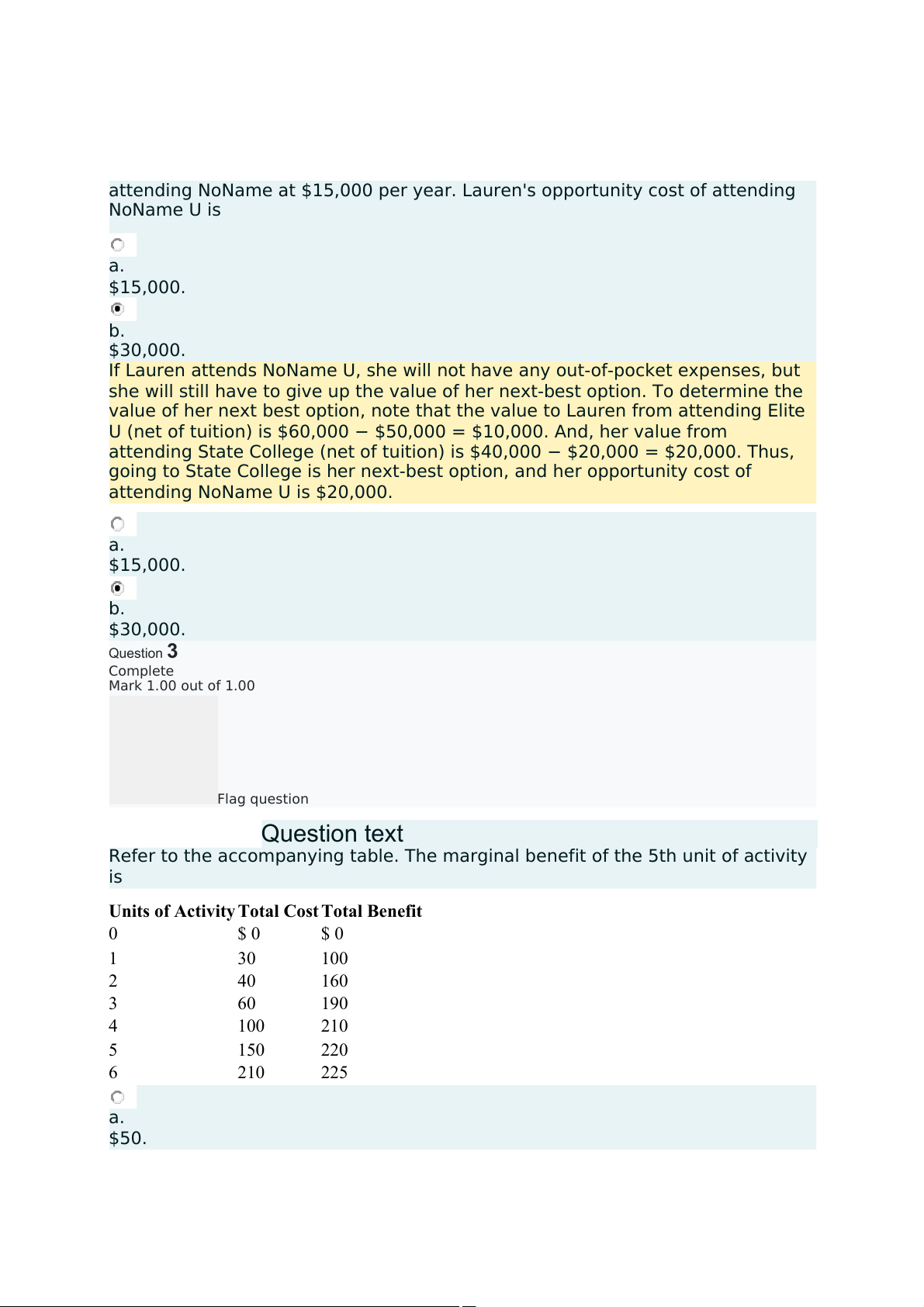
Lauren was accepted at three different graduate schools, and she must choose
one. Elite U costs $50,000 per year and did not offer Lauren any financial aid.
Lauren values attending Elite U at $60,000 per year. State College costs
$30,000 per year and offered Lauren an annual $10,000 scholarship. Lauren
values attending State College at $40,000 per year. NoName U costs $20,000
per year and offered Lauren a full $20,000 annual scholarship. Lauren values
attending NoName at $15,000 per year. Lauren's opportunity cost of attending NoName U is a. $15,000. b. $30,000.
If Lauren attends NoName U, she will not have any out-of-pocket expenses, but
she will still have to give up the value of her next-best option. To determine the
value of her next best option, note that the value to Lauren from attending Elite
U (net of tuition) is $60,000 − $50,000 = $10,000. And, her value from
attending State College (net of tuition) is $40,000 − $20,000 = $20,000. Thus,
going to State College is her next-best option, and her opportunity cost of attending NoName U is $20,000. a. $15,000. b. $30,000. Question3 Complete Mark 1.00 out of 1.00 Flag question Questiontext
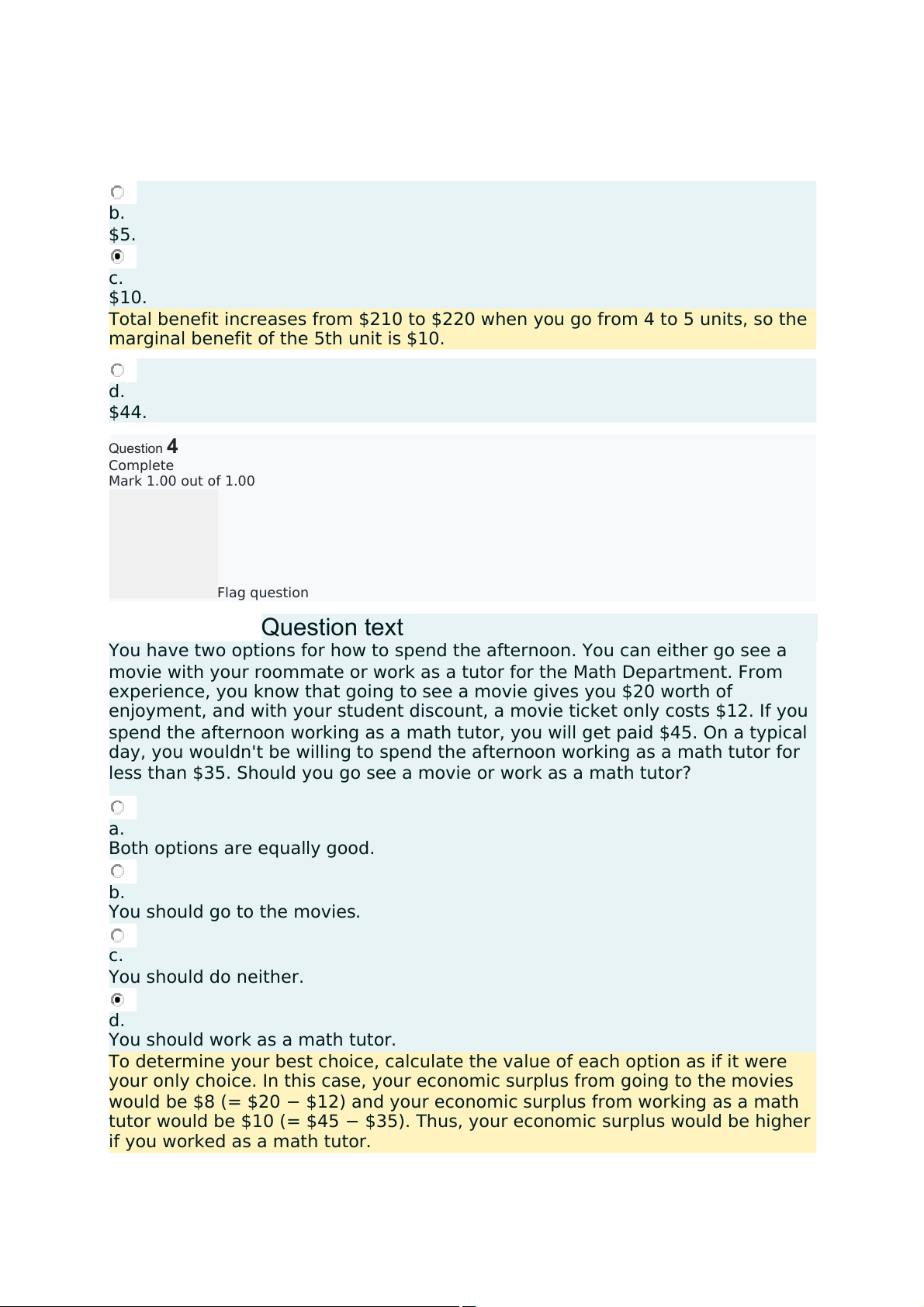
Refer to the accompanying table. The marginal benefit of the 5th unit of activity is
Units of Activity Total Cost Total Benefit 0 $ 0 $ 0 1 30 100 2 40 160 3 60 190 4 100 210 5 150 220 6 210 225 a. $50. b. $5. c. $10.
Total benefit increases from $210 to $220 when you go from 4 to 5 units, so the
marginal benefit of the 5th unit is $10. d. $44. Question4 Complete Mark 1.00 out of 1.00 Flag question Questiontext
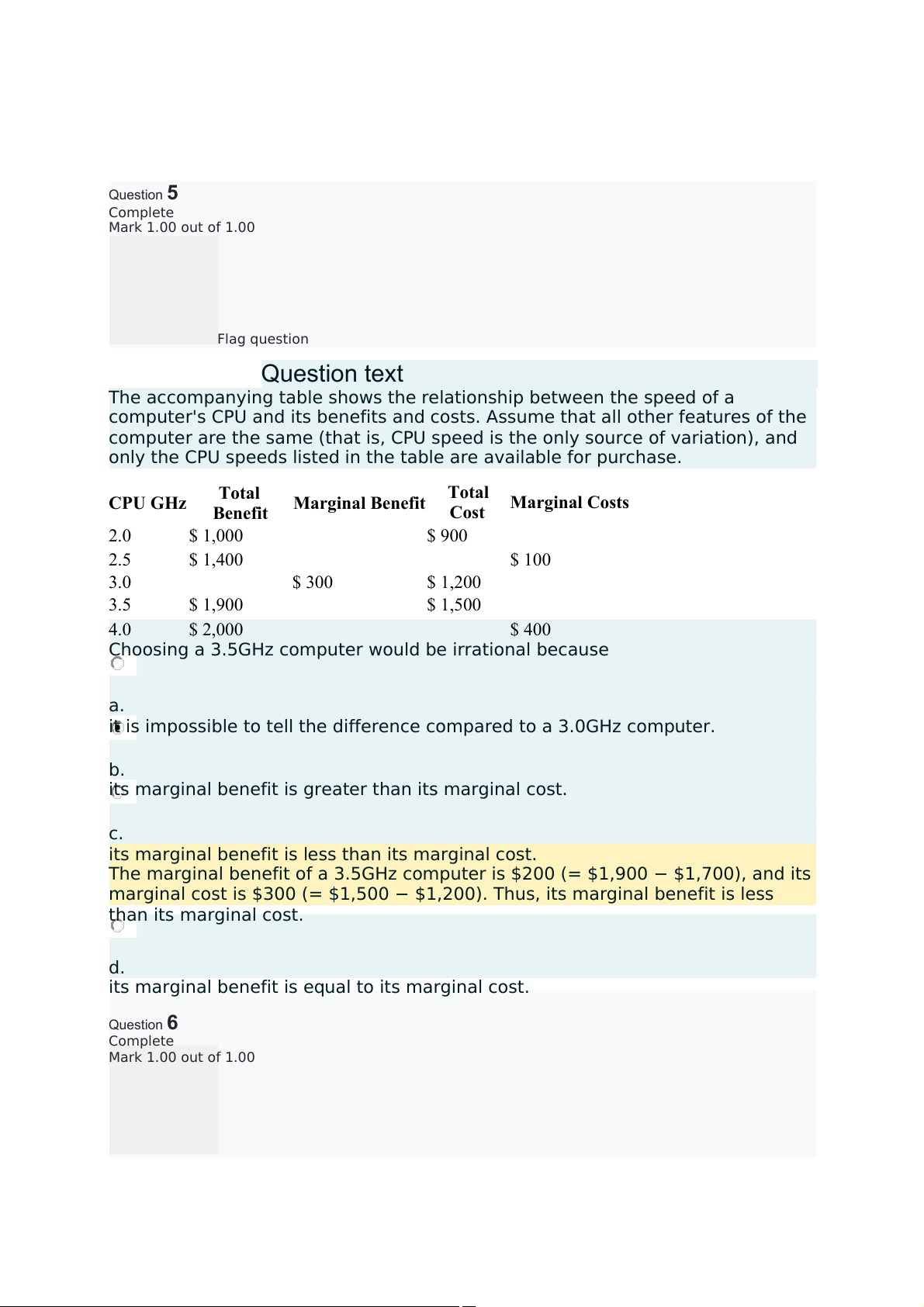
You have two options for how to spend the afternoon. You can either go see a
movie with your roommate or work as a tutor for the Math Department. From
experience, you know that going to see a movie gives you $20 worth of
enjoyment, and with your student discount, a movie ticket only costs $12. If you
spend the afternoon working as a math tutor, you will get paid $45. On a typical
day, you wouldn't be willing to spend the afternoon working as a math tutor for
less than $35. Should you go see a movie or work as a math tutor? a. Both options are equally good. b. You should go to the movies. c. You should do neither. d.
You should work as a math tutor.
To determine your best choice, calculate the value of each option as if it were
your only choice. In this case, your economic surplus from going to the movies
would be $8 (= $20 − $12) and your economic surplus from working as a math
tutor would be $10 (= $45 − $35). Thus, your economic surplus would be higher if you worked as a math tutor. Question5 Complete Mark 1.00 out of 1.00 Flag question Questiontext
The accompanying table shows the relationship between the speed of a
computer's CPU and its benefits and costs. Assume that all other features of the
computer are the same (that is, CPU speed is the only source of variation), and
only the CPU speeds listed in the table are available for purchase. Total Total CPU GHz Marginal Benefit Marginal Costs Benefit Cost 2.0 $ 1,000 $ 900 2.5 $ 1,400 $ 100 3.0 $ 300 $ 1,200 3.5 $ 1,900 $ 1,500 4.0 $ 2,000 $ 400
Choosing a 3.5GHz computer would be irrational because a.
it is impossible to tell the difference compared to a 3.0GHz computer. b.
its marginal benefit is greater than its marginal cost. c.
its marginal benefit is less than its marginal cost.
The marginal benefit of a 3.5GHz computer is $200 (= $1,900 − $1,700), and its
marginal cost is $300 (= $1,500 − $1,200). Thus, its marginal benefit is less than its marginal cost. d.
its marginal benefit is equal to its marginal cost. Question6 Complete Mark 1.00 out of 1.00 Flag question Questiontext
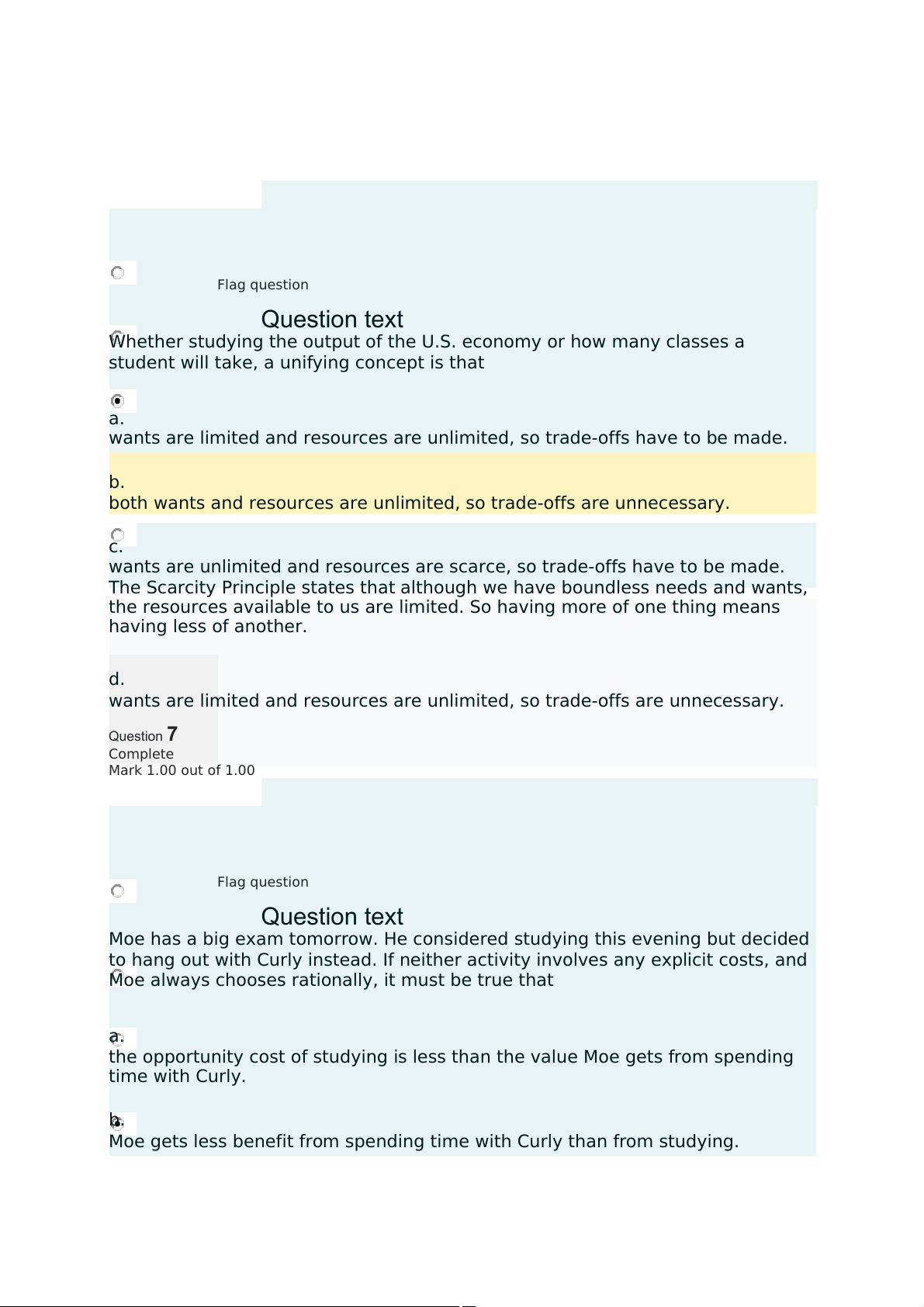
Whether studying the output of the U.S. economy or how many classes a
student will take, a unifying concept is that a.
wants are limited and resources are unlimited, so trade-offs have to be made. b.
both wants and resources are unlimited, so trade-offs are unnecessary. c.
wants are unlimited and resources are scarce, so trade-offs have to be made.
The Scarcity Principle states that although we have boundless needs and wants,
the resources available to us are limited. So having more of one thing means having less of another. d.
wants are limited and resources are unlimited, so trade-offs are unnecessary. Question7 Complete Mark 1.00 out of 1.00 Flag question Questiontext
Moe has a big exam tomorrow. He considered studying this evening but decided
to hang out with Curly instead. If neither activity involves any explicit costs, and
Moe always chooses rationally, it must be true that a.
the opportunity cost of studying is less than the value Moe gets from spending time with Curly. b.
Moe gets less benefit from spending time with Curly than from studying. c.
the opportunity cost of studying is greater than the value Moe gets from spending time with Curly. d.
Moe gets more benefit from spending time with Curly than from studying.
If Moe rationally chooses to spend time with Curly, then his benefit of spending
time with Curly must outweigh his cost. Given that neither activity involves any
explicit costs, the opportunity cost of spending time with Curly equals the
benefit of studying. Thus, if Moe rationally chooses to spend time with Curly, it
must be the case that his benefit from spending time with Curly is greater than his benefit from studying. Question8 Complete Mark 1.00 out of 1.00 Flag question Questiontext
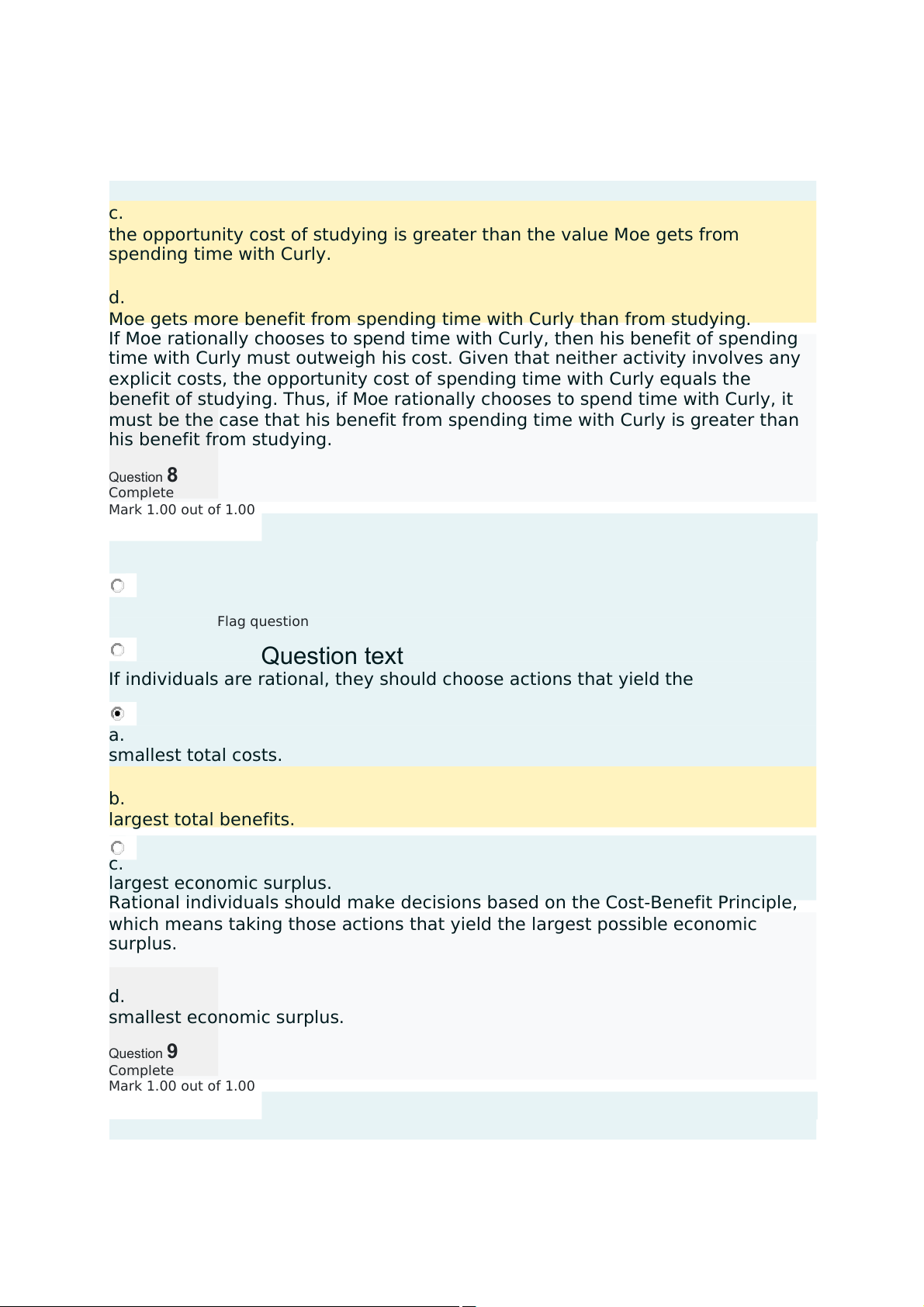
If individuals are rational, they should choose actions that yield the a. smallest total costs. b. largest total benefits. c. largest economic surplus.
Rational individuals should make decisions based on the Cost-Benefit Principle,
which means taking those actions that yield the largest possible economic surplus. d. smallest economic surplus. Question9 Complete Mark 1.00 out of 1.00 Flag question Questiontext
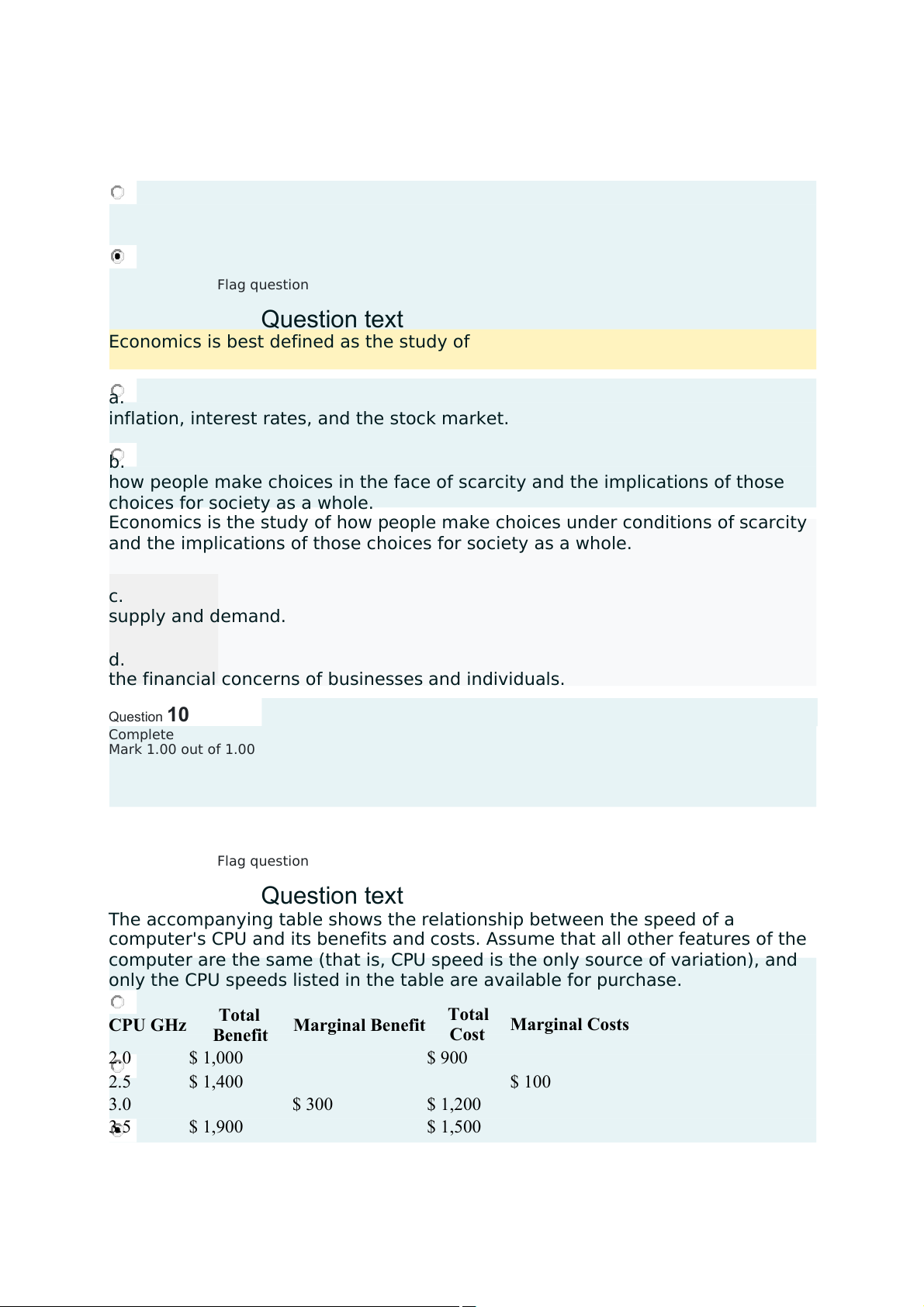
Economics is best defined as the study of a.
inflation, interest rates, and the stock market. b.
how people make choices in the face of scarcity and the implications of those
choices for society as a whole.
Economics is the study of how people make choices under conditions of scarcity
and the implications of those choices for society as a whole. c. supply and demand. d.
the financial concerns of businesses and individuals. Question10 Complete Mark 1.00 out of 1.00 Flag question Questiontext
The accompanying table shows the relationship between the speed of a
computer's CPU and its benefits and costs. Assume that all other features of the
computer are the same (that is, CPU speed is the only source of variation), and
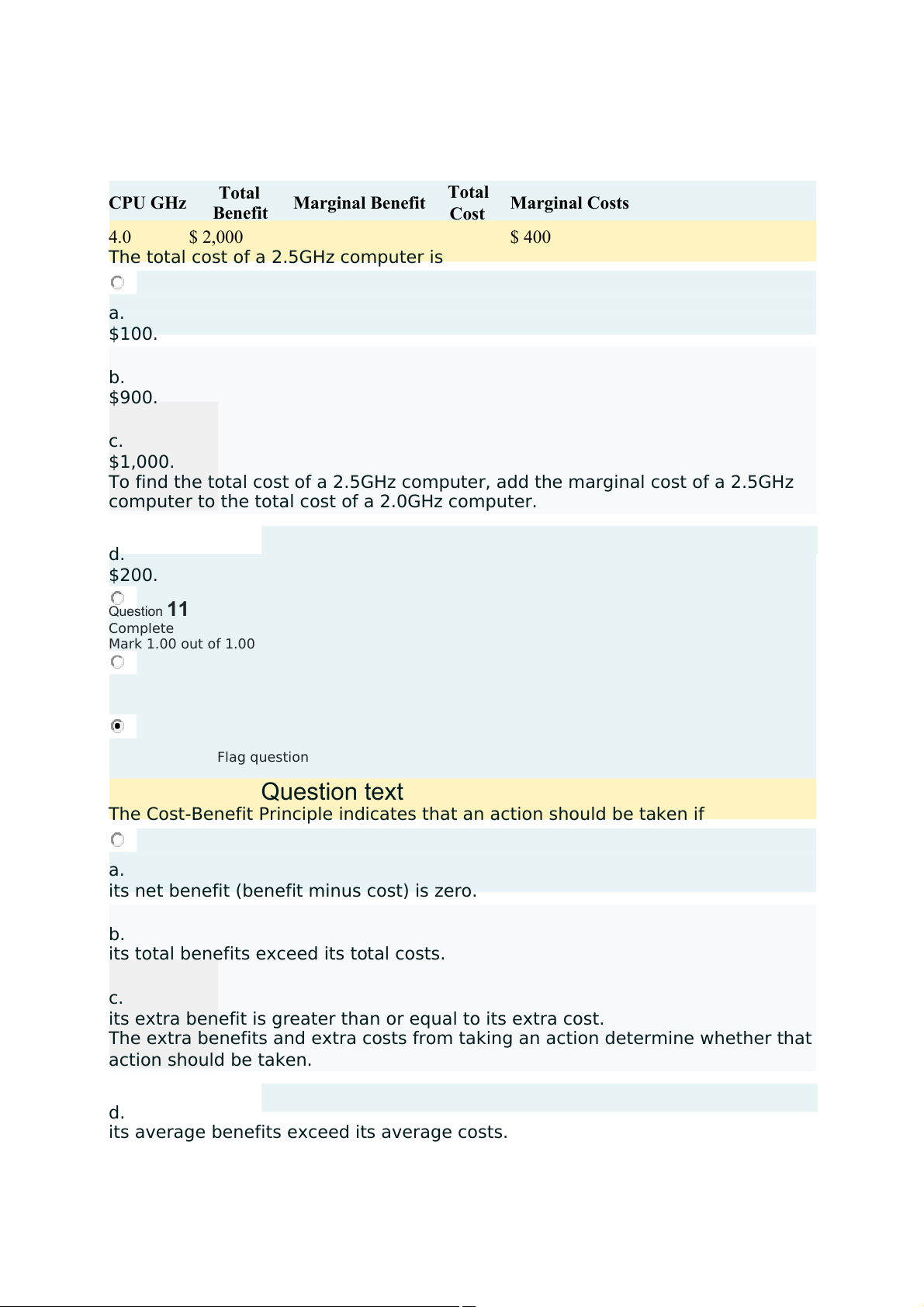
only the CPU speeds listed in the table are available for purchase. Total Total CPU GHz Marginal Benefit Marginal Costs Benefit Cost 2.0 $ 1,000 $ 900 2.5 $ 1,400 $ 100 3.0 $ 300 $ 1,200 3.5 $ 1,900 $ 1,500 Total Total CPU GHz Marginal Benefit Marginal Costs Benefit Cost 4.0 $ 2,000 $ 400
The total cost of a 2.5GHz computer is a. $100. b. $900. c. $1,000.
To find the total cost of a 2.5GHz computer, add the marginal cost of a 2.5GHz
computer to the total cost of a 2.0GHz computer. d. $200. Question11 Complete Mark 1.00 out of 1.00 Flag question Questiontext
The Cost-Benefit Principle indicates that an action should be taken if a.
its net benefit (benefit minus cost) is zero. b.
its total benefits exceed its total costs. c.
its extra benefit is greater than or equal to its extra cost.
The extra benefits and extra costs from taking an action determine whether that action should be taken. d.
its average benefits exceed its average costs. Question12 Complete Mark 1.00 out of 1.00 Flag question Questiontext
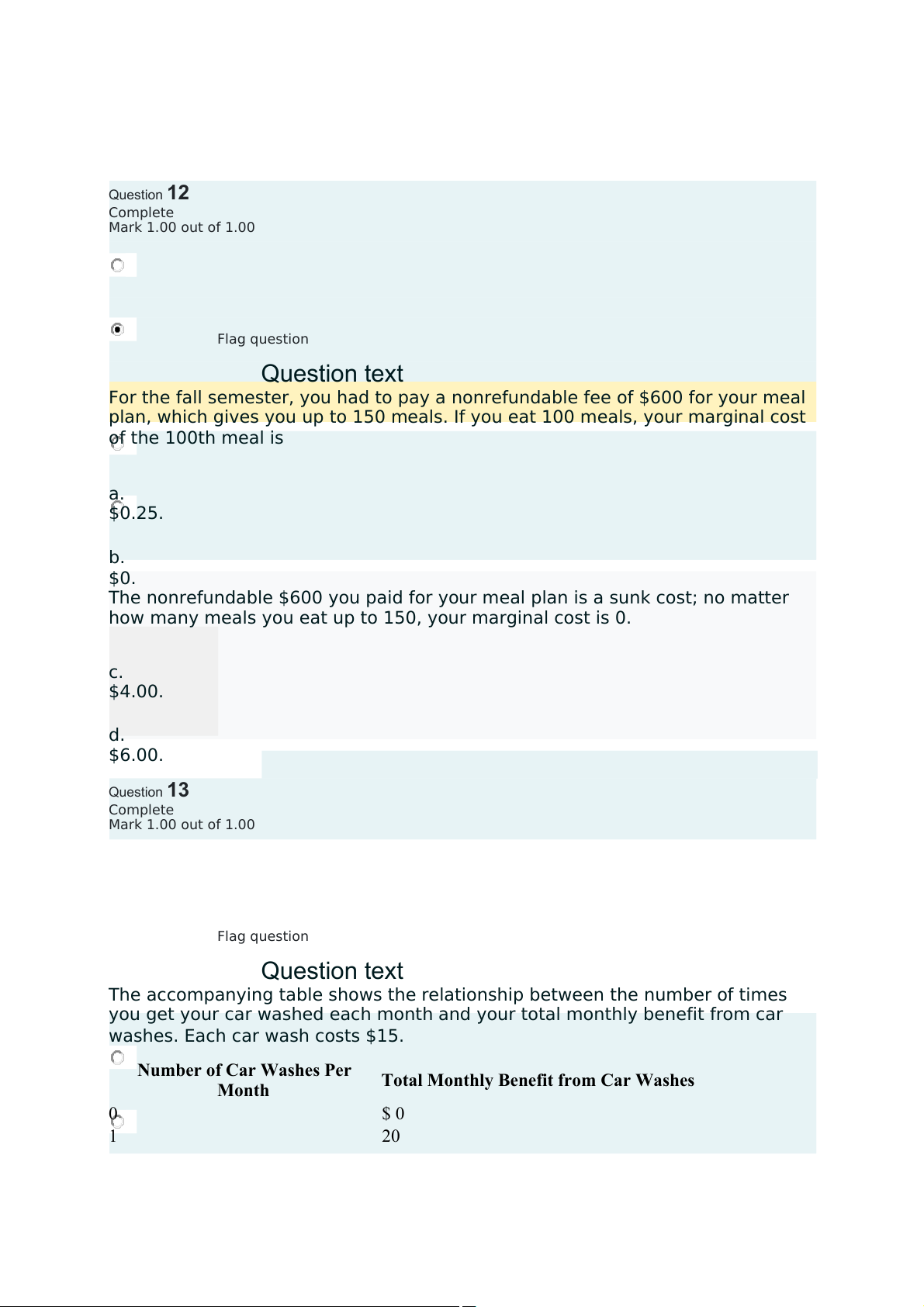
For the fall semester, you had to pay a nonrefundable fee of $600 for your meal
plan, which gives you up to 150 meals. If you eat 100 meals, your marginal cost of the 100th meal is a. $0.25. b. $0.
The nonrefundable $600 you paid for your meal plan is a sunk cost; no matter
how many meals you eat up to 150, your marginal cost is 0. c. $4.00. d. $6.00. Question13 Complete Mark 1.00 out of 1.00 Flag question Questiontext
The accompanying table shows the relationship between the number of times
you get your car washed each month and your total monthly benefit from car
washes. Each car wash costs $15.
Number of Car Washes Per
Total Monthly Benefit from Car Washes Month 0 $ 0 1 20
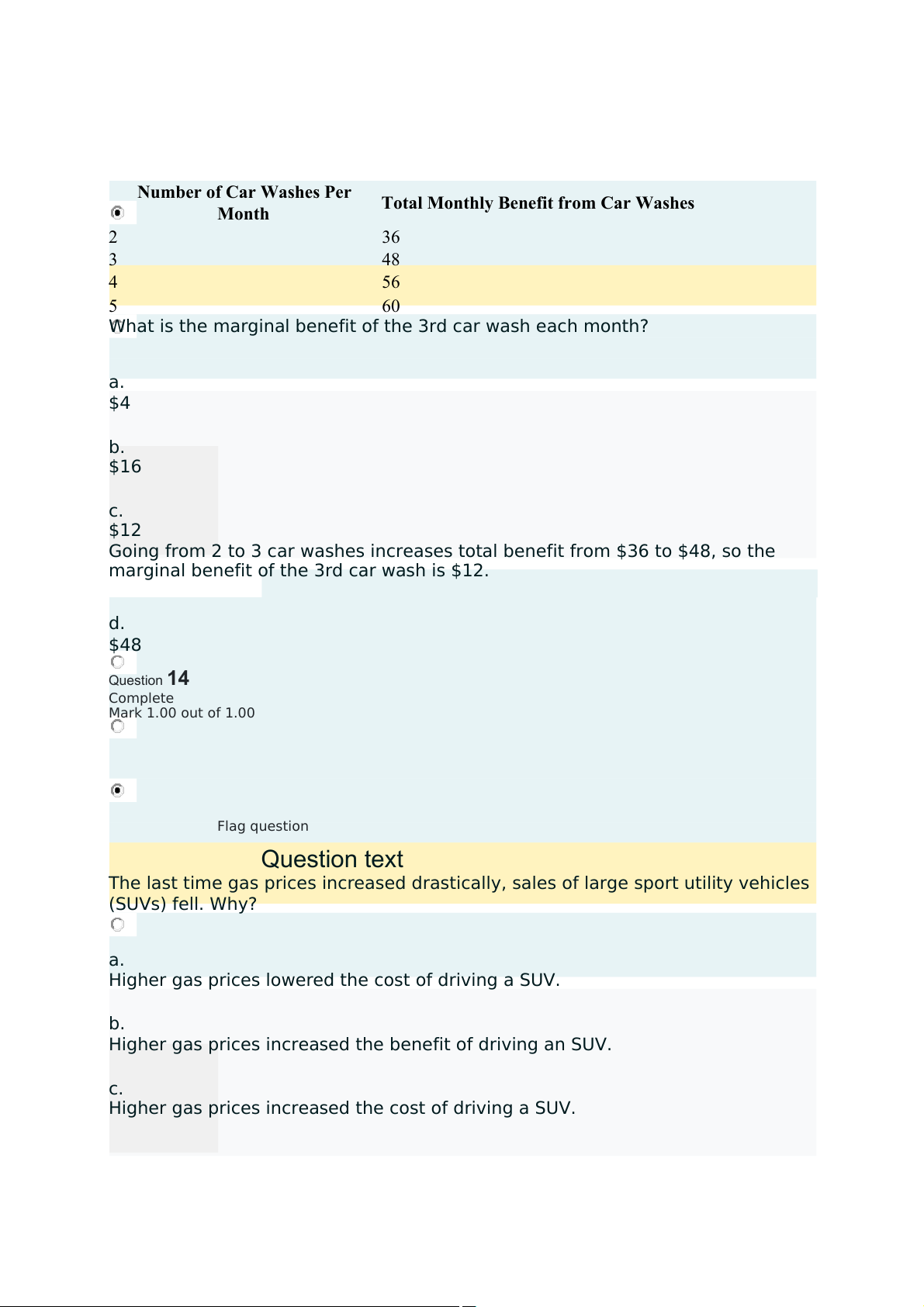
Number of Car Washes Per
Total Monthly Benefit from Car Washes Month 2 36 3 48 4 56 5 60
What is the marginal benefit of the 3rd car wash each month? a. $4 b. $16 c. $12
Going from 2 to 3 car washes increases total benefit from $36 to $48, so the
marginal benefit of the 3rd car wash is $12. d. $48 Question14 Complete Mark 1.00 out of 1.00 Flag question Questiontext
The last time gas prices increased drastically, sales of large sport utility vehicles (SUVs) fell. Why? a.
Higher gas prices lowered the cost of driving a SUV. b.
Higher gas prices increased the benefit of driving an SUV. c.
Higher gas prices increased the cost of driving a SUV.
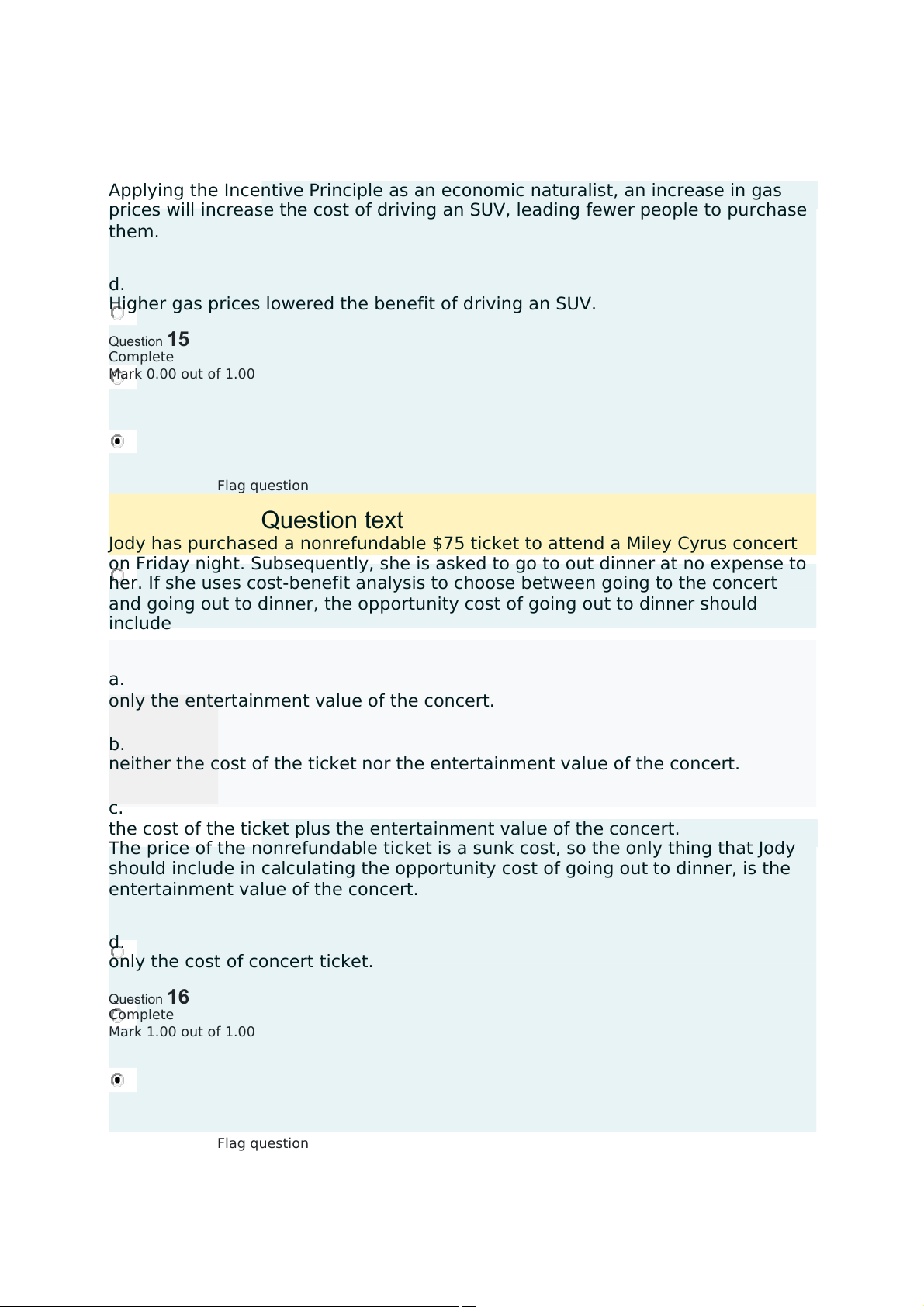
Applying the Incentive Principle as an economic naturalist, an increase in gas
prices will increase the cost of driving an SUV, leading fewer people to purchase them. d.
Higher gas prices lowered the benefit of driving an SUV. Question15 Complete Mark 0.00 out of 1.00 Flag question Questiontext
Jody has purchased a nonrefundable $75 ticket to attend a Miley Cyrus concert
on Friday night. Subsequently, she is asked to go to out dinner at no expense to
her. If she uses cost-benefit analysis to choose between going to the concert
and going out to dinner, the opportunity cost of going out to dinner should include a.
only the entertainment value of the concert. b.
neither the cost of the ticket nor the entertainment value of the concert. c.
the cost of the ticket plus the entertainment value of the concert.
The price of the nonrefundable ticket is a sunk cost, so the only thing that Jody
should include in calculating the opportunity cost of going out to dinner, is the
entertainment value of the concert. d.
only the cost of concert ticket. Question16 Complete Mark 1.00 out of 1.00 Flag question Questiontext
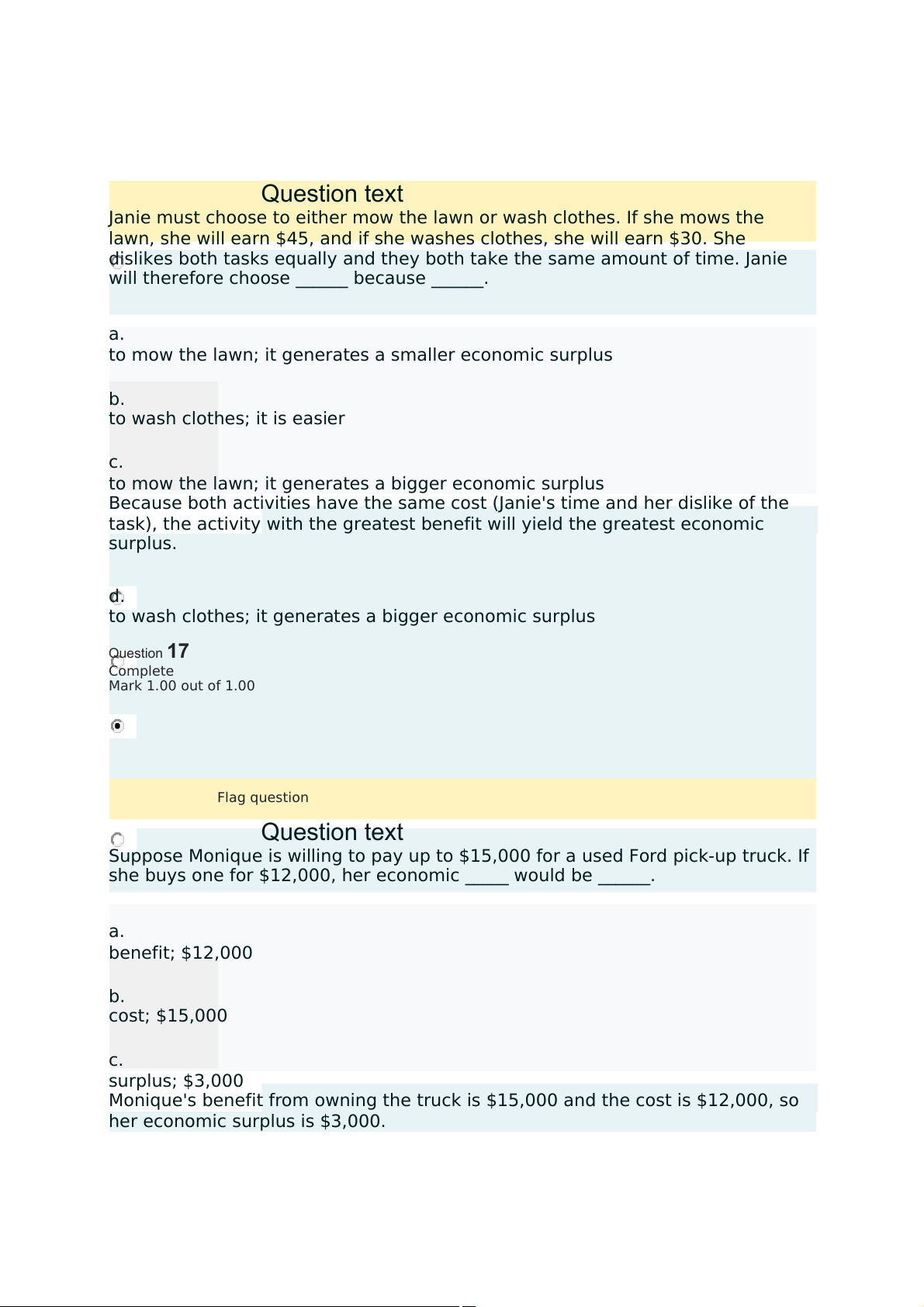
Janie must choose to either mow the lawn or wash clothes. If she mows the
lawn, she will earn $45, and if she washes clothes, she will earn $30. She
dislikes both tasks equally and they both take the same amount of time. Janie
will therefore choose ______ because ______. a.
to mow the lawn; it generates a smaller economic surplus b. to wash clothes; it is easier c.
to mow the lawn; it generates a bigger economic surplus
Because both activities have the same cost (Janie's time and her dislike of the
task), the activity with the greatest benefit will yield the greatest economic surplus. d.
to wash clothes; it generates a bigger economic surplus Question17 Complete Mark 1.00 out of 1.00 Flag question Questiontext
Suppose Monique is willing to pay up to $15,000 for a used Ford pick-up truck. If
she buys one for $12,000, her economic _____ would be ______. a. benefit; $12,000 b. cost; $15,000 c. surplus; $3,000
Monique's benefit from owning the truck is $15,000 and the cost is $12,000, so
her economic surplus is $3,000. d. surplus; $12,000 Question18 Complete Mark 1.00 out of 1.00 Flag question Questiontext
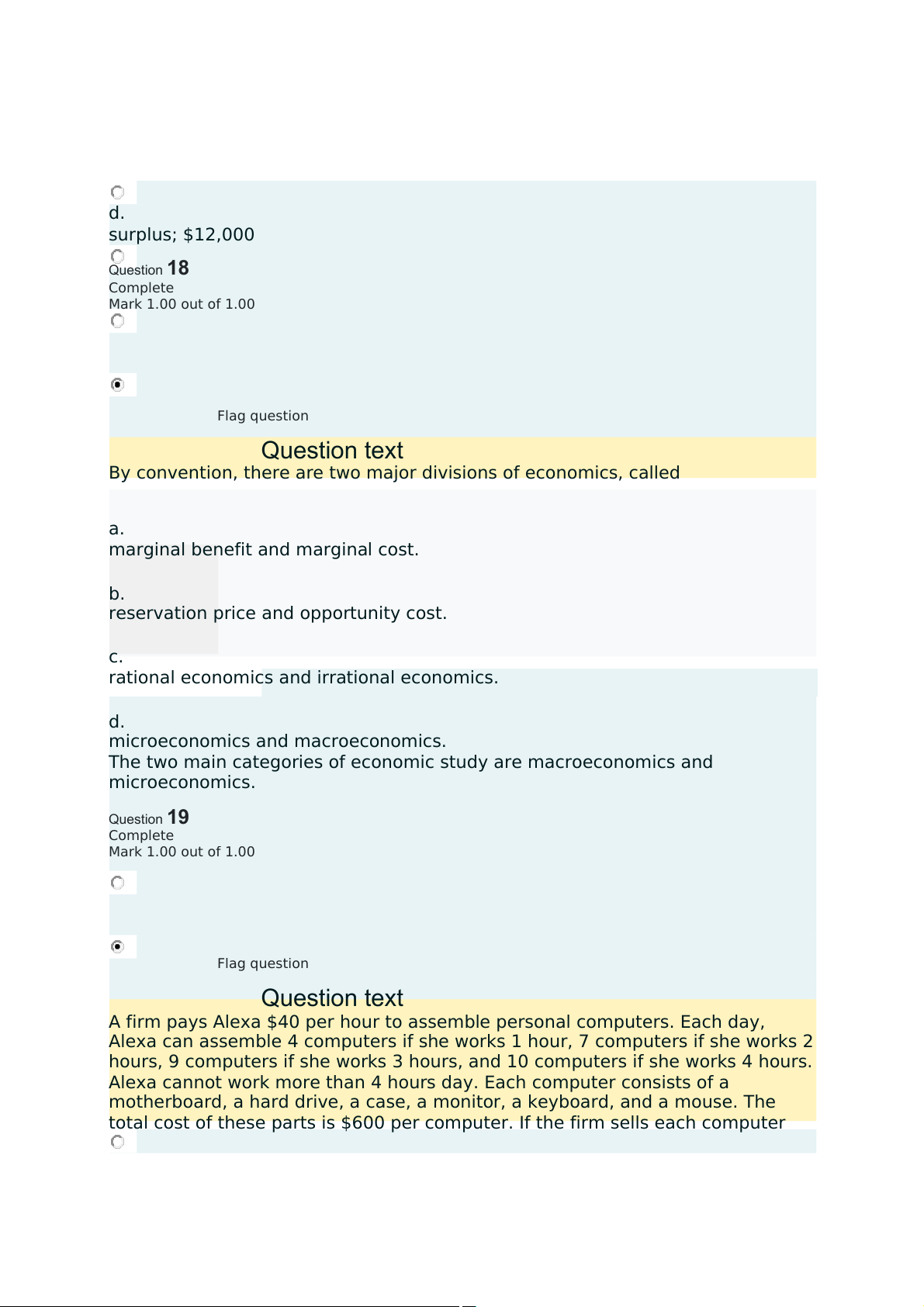
By convention, there are two major divisions of economics, called a.
marginal benefit and marginal cost. b.
reservation price and opportunity cost. c.
rational economics and irrational economics. d.
microeconomics and macroeconomics.
The two main categories of economic study are macroeconomics and microeconomics. Question19 Complete Mark 1.00 out of 1.00 Flag question Questiontext
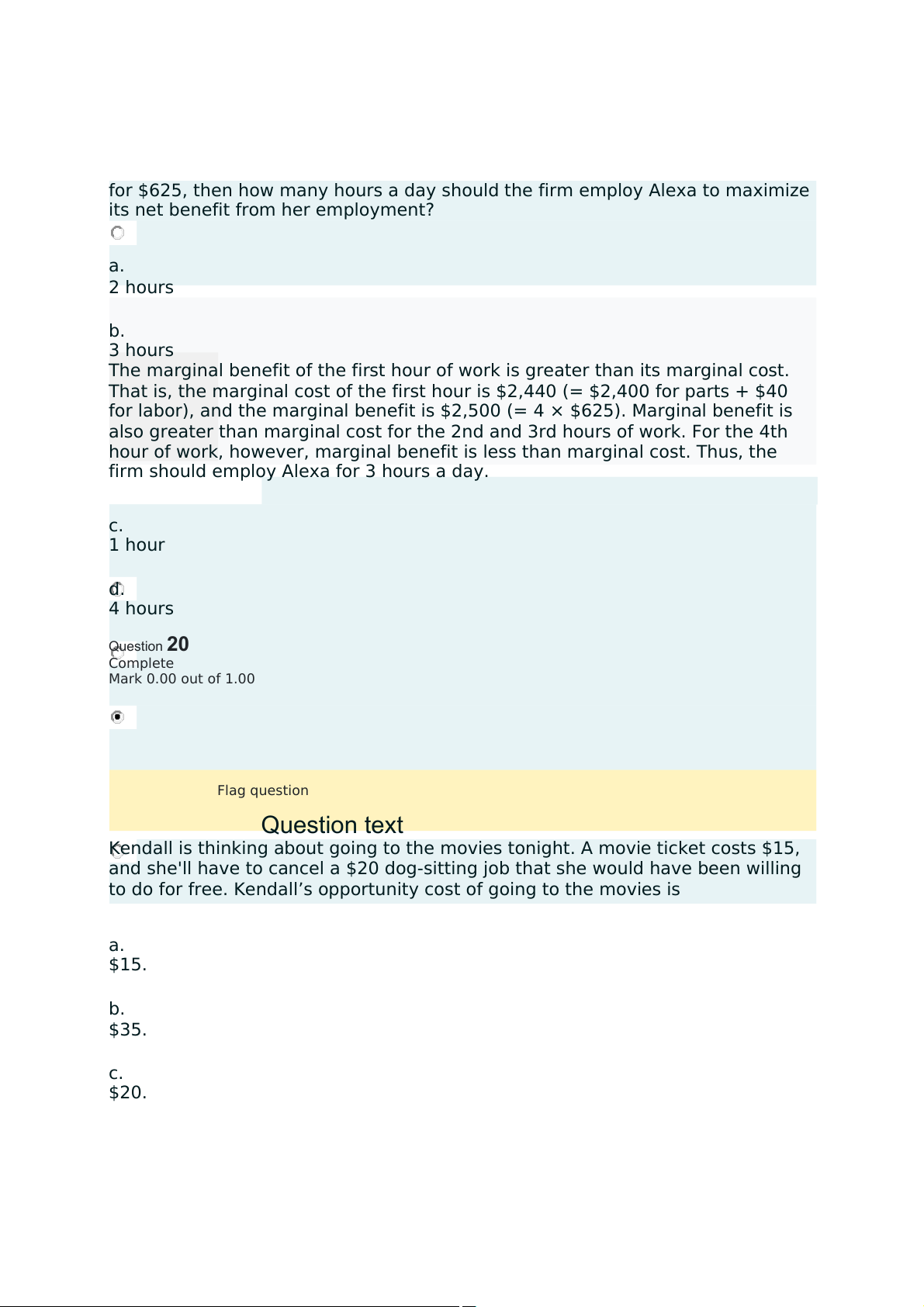
A firm pays Alexa $40 per hour to assemble personal computers. Each day,
Alexa can assemble 4 computers if she works 1 hour, 7 computers if she works 2
hours, 9 computers if she works 3 hours, and 10 computers if she works 4 hours.
Alexa cannot work more than 4 hours day. Each computer consists of a
motherboard, a hard drive, a case, a monitor, a keyboard, and a mouse. The
total cost of these parts is $600 per computer. If the firm sells each computer
for $625, then how many hours a day should the firm employ Alexa to maximize
its net benefit from her employment? a. 2 hours b. 3 hours
The marginal benefit of the first hour of work is greater than its marginal cost.
That is, the marginal cost of the first hour is $2,440 (= $2,400 for parts + $40
for labor), and the marginal benefit is $2,500 (= 4 × $625). Marginal benefit is
also greater than marginal cost for the 2nd and 3rd hours of work. For the 4th
hour of work, however, marginal benefit is less than marginal cost. Thus, the
firm should employ Alexa for 3 hours a day. c. 1 hour d. 4 hours Question20 Complete Mark 0.00 out of 1.00 Flag question Questiontext
Kendall is thinking about going to the movies tonight. A movie ticket costs $15,
and she'll have to cancel a $20 dog-sitting job that she would have been willing
to do for free. Kendall’s opportunity cost of going to the movies is a. $15. b. $35. c. $20.
Opportunity cost includes both implicit costs and explicit costs. If she goes to
the movies, Kendall will give up the gross earnings from the dog-sitting job plus the cost of the ticket. d. $5.
Tài liệu liên quan:
-

Chương 3: độ co giãn và các nhân tố ảnh hưởng | Microeconomics | Trường Đại học Quốc tế, Đại học Quốc gia Thành phố Hồ Chí Minh
5 3 -
Microeconomics Syllabus | Microeconomics | Trường Đại học Quốc tế, Đại học Quốc gia Thành phố Hồ Chí Minh
5 3 -
Microeconomics Course Syllabus & Assessment Details | Microeconomics | Trường Đại học Quốc tế, Đại học Quốc gia Thành phố Hồ Chí Minh
5 3 -
Assignment 3 - Elasticity MCQs and Key Concepts | Microeconomics | Trường Đại học Quốc tế, Đại học Quốc gia Thành phố Hồ Chí Minh
4 2 -
Assignment 2 - Economic Equilibrium Analysis of Fridges and Motorcycles | Microeconomics | Trường Đại học Quốc tế, Đại học Quốc gia Thành phố Hồ Chí Minh
4 2