Thuyết trình kinh tế vi mô: Taxes & Market Outcomes Analysis | Microeconomics | Trường Đại học Quốc tế, Đại học Quốc gia Thành phố Hồ Chí Minh
Example: Suppose the local government passes a law requiring sellers of ice-cream cones to send $0.50 to the government of every cone they sell. To answer this question, we can follow the three steps in Chapter 4 for analyzing supply and demand 1. Step One: We decide whether the law affects the supply curve or the demand curve 2. Step Two: We decide which way the curve shifts 3. Step Three: We examine how the shift affects the equilibrium price and quantity. Tài liệu được sưu tầm và soạn thảo dưới dạng file PDF để gửi tới các bạn cùng tham khảo, ôn tập đầy đủ kiến thức, chuẩn bị cho các buổi học thật tốt. Mời bạn đọc đón xem!
Môn: Microeconomics 635 tài liệu
Trường: Trường Đại học Quốc tế, Đại học Quốc gia Thành phố Hồ Chí Minh 1.9 K tài liệu
Tác giả:

Preview text:
I How Taxes on Sellers affect Market Outcomes Example:
Suppose the local government passes a law requiring sellers of ice-cream cones to
send $0.50 to the government of every cone they sell. To answer this question, we
can follow the three steps in Chapter 4 for analyzing supply and demand
1. Step One: We decide whether the law affects the supply curve or the demand curve
2. Step Two: We decide which way the curve shifts
3. Step Three: We examine how the shift affects the equilibrium price and quantity
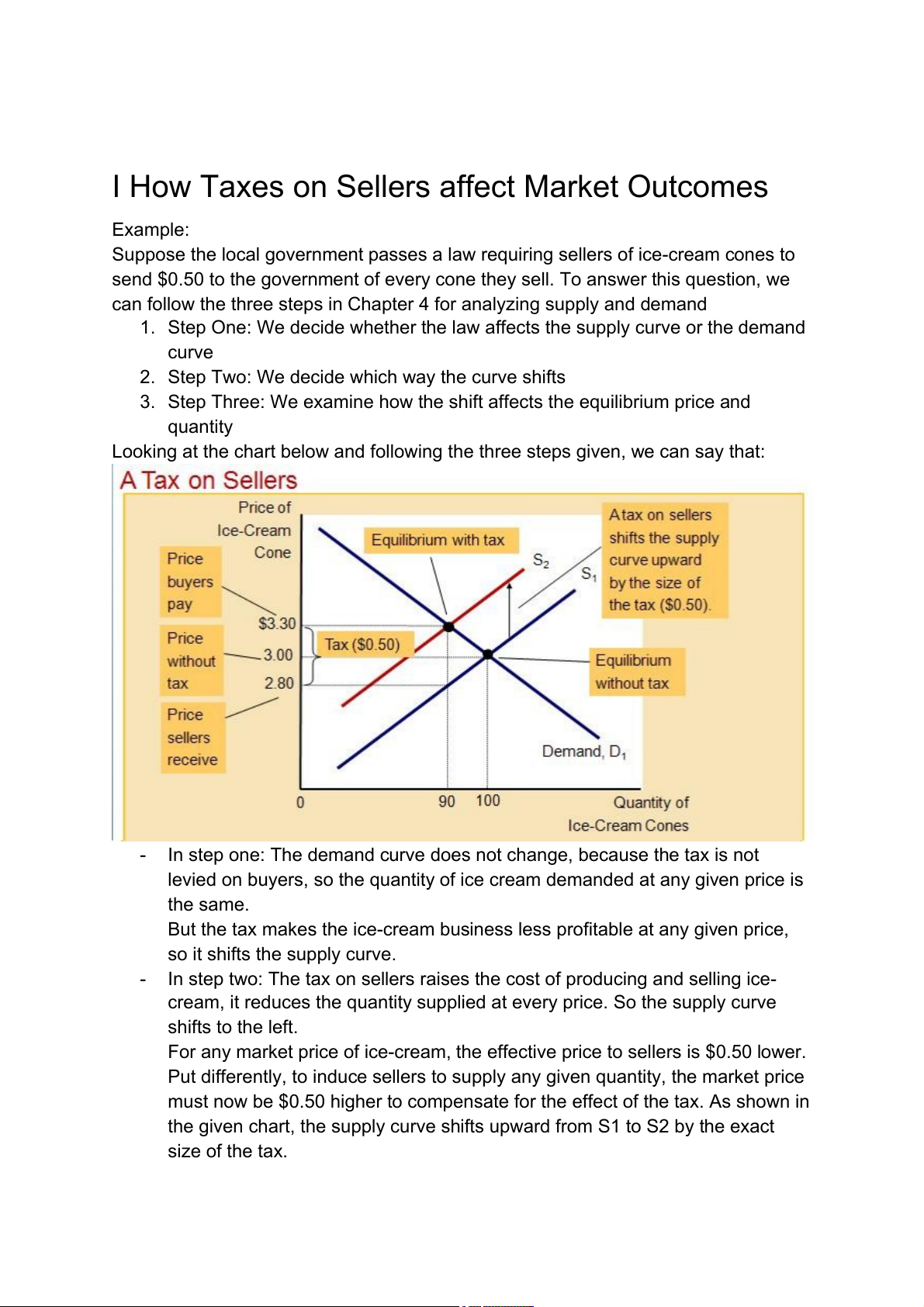
Looking at the chart below and following the three steps given, we can say that: -
In step one: The demand curve does not change, because the tax is not
levied on buyers, so the quantity of ice cream demanded at any given price is the same.
But the tax makes the ice-cream business less profitable at any given price,
so it shifts the supply curve. -
In step two: The tax on sellers raises the cost of producing and selling ice-
cream, it reduces the quantity supplied at every price. So the supply curve shifts to the left.
For any market price of ice-cream, the effective price to sellers is $0.50 lower.
Put differently, to induce sellers to supply any given quantity, the market price
must now be $0.50 higher to compensate for the effect of the tax. As shown in
the given chart, the supply curve shifts upward from S1 to S2 by the exact size of the tax. -
In step three: After having determined how the supply curve shifts, we can
now compare the initial and the new equilibriums. The chart shows that the
equilibrium price of the ice-cream rises from $3.00 to $3.30, and the
equilibrium quantity falls from 100 to 90 cones. Because sellers sell less and
buyers buy less in the new equilibrium, the tax reduces the size of the ice- cream market.
Implications: Because the market price rises from $3.00 to $3.30 when the tax is
introduced, buyers pay $0.30 more for each ice-cream cone than they did without the
tax. Thus, the tax makes buyers worse off.
What sellers get to keep after paying the tax is only $2.80 compared with $3.00
before the tax. Thus, the tax also makes sellers worse off.
Taxes discourage market activity. When a good is taxed, the quantity of good
sold is smaller in the new equilibrium.
Buyers and sellers share the burden of taxes. In the new equilibrium, buyers
pay more for the good, and sellers receive less.
II. How taxes on buyers affect market outcomes
Suppose that our local government passes a law requiring buyers of ice-cream
cones to send $0.50 to the government for each ice-cream cone they buy. We follow
3 steps to investigate the effects of this law.
1. Step one: We decide whether the law affects the supply curve or demand
curve. The initial impact of the tax is on the demand for ice cream
2. Step two: We determine the direction of the shift.
3. Step three: Having determined how the demand curve shifts, we can now see
the effect of the tax by comparing the initial equilibrium and the new equilibrium.
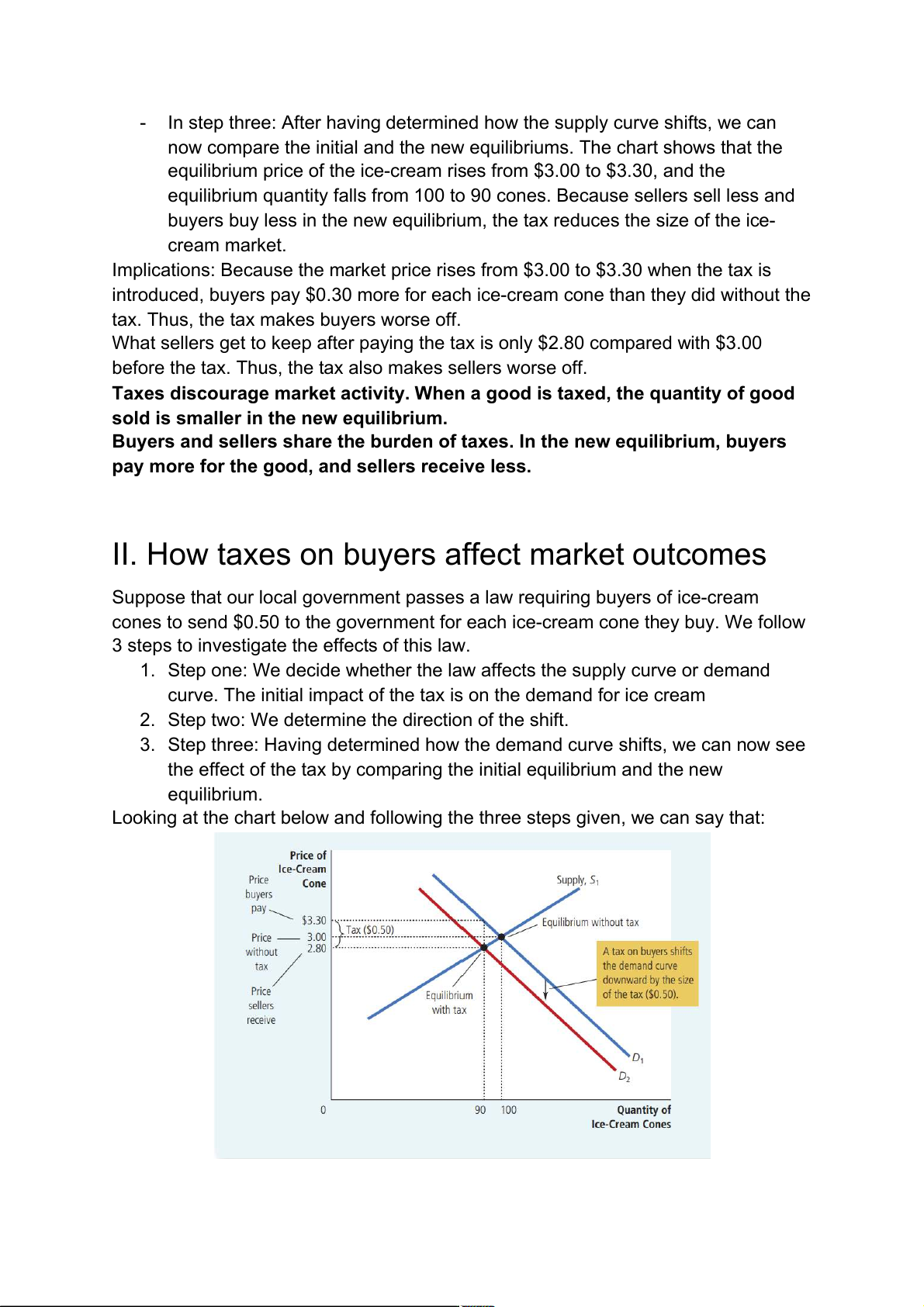
Looking at the chart below and following the three steps given, we can say that: -
In step one: The supply curve is not affected because, for any given price of
ice cream, sellers have the same incentive to provide ice cream to the market.
By contrast, buyers now have to pay a tax to the government (as well as the
price to the sellers) whenever they buy ice cream. Thus, the tax shifts the demand curve for ice cream. -
In step two: Because the tax on buyers makes buying ice cream less
attractive, buyers demand a smaller quantity of ice cream at every price. We
can, in this case, be precise about how much the curve shifts. Because of the
$0.50 tax levied on buyers, the effective price to buyers is now $0.50 higher
than the market price whatever the market price happens to be.
For example, if the market price of a cone happened to be $2.00,
the effective price to buyers would be $2.50. Because buyers look at their total
cost including the tax, they demand a quantity of ice cream as if the market
price were $0.50 higher than it actually is. In other words, to induce buyers to
demand any given quantity, the market price must now be $0.50 lower to
make up for the effect of the tax. Thus, the tax shifts the demand downward
by the exact size of the tax ($0.50). -
In step three: Having determined how the demand shifts, we can now see the
effect of the tax by comparing the initial equilibrium and the new equilibrium.
You can see that the equilibrium price of ice cream falls from $3.00 to $2.00
and the equilibrium quantity falls from 100 to 90 cones. Because sellers sell
less and buyers buy less in the new equilibrium, the tax on ice cream reduces
the size of the ice cream market.
=> mplicationI: Who pays the tax? -
Buyers and sellers share the tax burden: Because the market price falls from
$3.00 to $2.80 when the tax is introduced, sellers receive $0.20 less for each
ice cream cone than they did without ($2.80) but the effectively including the
tax rises from $3.00 before the tax to $3.30 with the tax ($2.80 + $0.50 =
$3.30). Thus, the tax also makes buyers worse off. => Sum up: -
Taxes discourage market activity. When a good is taxed, the quantity of the
good sold is smaller in the new equilibrium. -
Buyers and sellers share the burden of taxes. In the new equilibrium, buyers
pay more for the good, and sellers receive less. QUESTION
1. How does a tax on consumers affect demand?
Placing a tax on a good, shifts the supply curve to the left. It leads to a fall in demand
and higher price. However, the impact of a tax depends on the elasticity of demand.
If demand is inelastic, a higher tax will cause only a small fall in demand
2. How does taxes influence consumer decisions and buying power?
Besides altering the equilibrium price, which takes demand into account, sales tax
also impacts consumers' buying power. When sales tax rates are high, consumers
spend more money on taxes and have less to spend on additional goods.
III. ELASTICITY AND TAX INCIDENCE
As we know it, Tax incidence is the manner in which the tax burden is divided
between buyers and sellers. But it is rarely shared equally.
Depending on the circumstance, the burden of tax can fall more on consumers or on
producers. The tax incidence depends on the relative price elasticity of supply and
demand. When supply is more elastic than demand, buyers bear most of the tax
burden. When demand is more elastic than supply, producers bear most of the cost
of the tax. In the case of cigarettes, for example, demand is inelastic—because
cigarettes are an addictive substance—and taxes are mainly passed along to
consumers in the form of higher prices.
Typically, the incidence, or burden, of a tax falls both on the consumers and
producers of the taxed good. But if we want to predict which group will bear most of
the burden, all we need to do is examine the elasticity of demand and supply. In the
tobacco example above, the tax burden falls on the most inelastic side of the market.
If demand is more inelastic than supply, consumers bear most of the tax burden. But,
if supply is more inelastic than demand, sellers bear most of the tax burden.
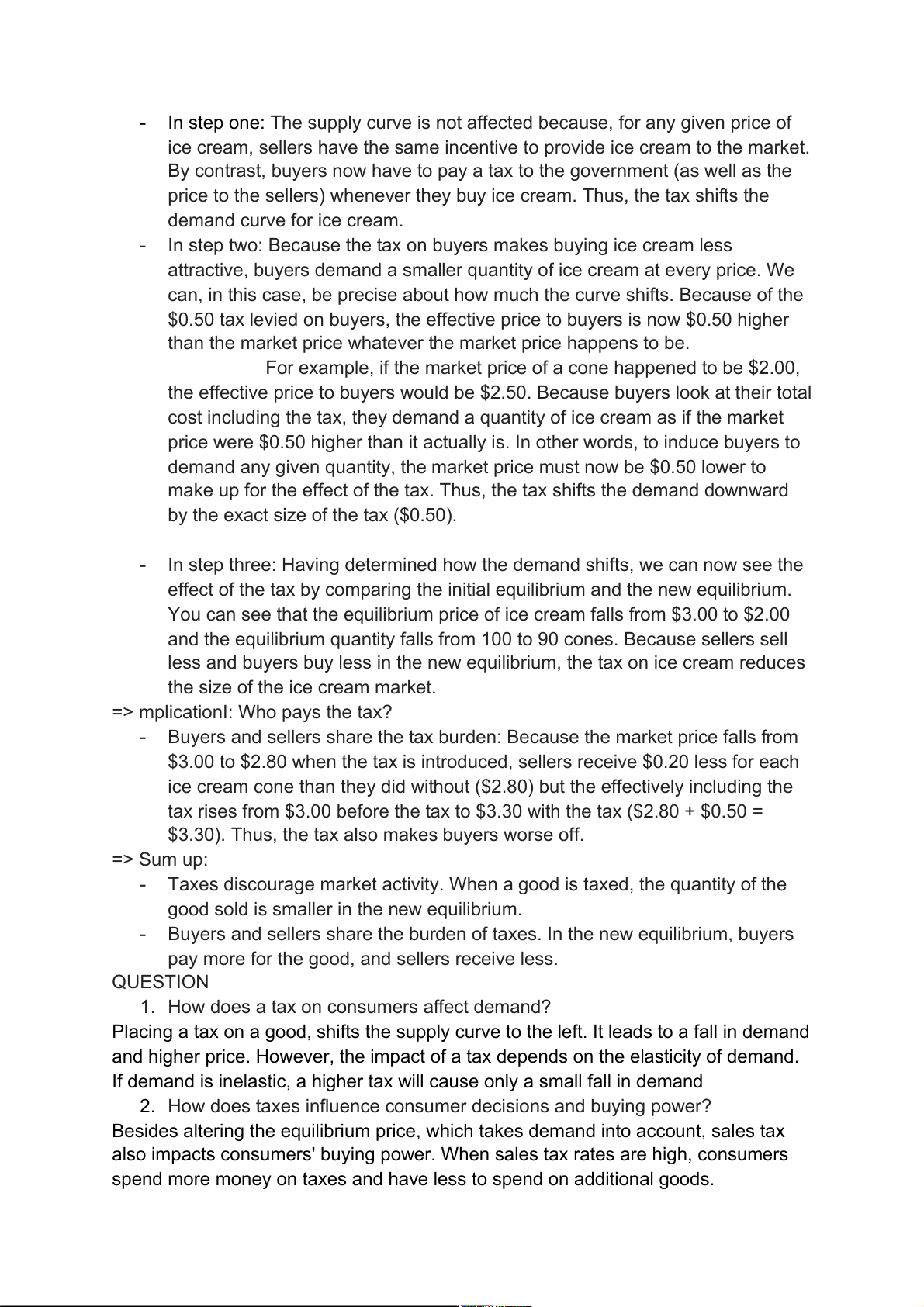
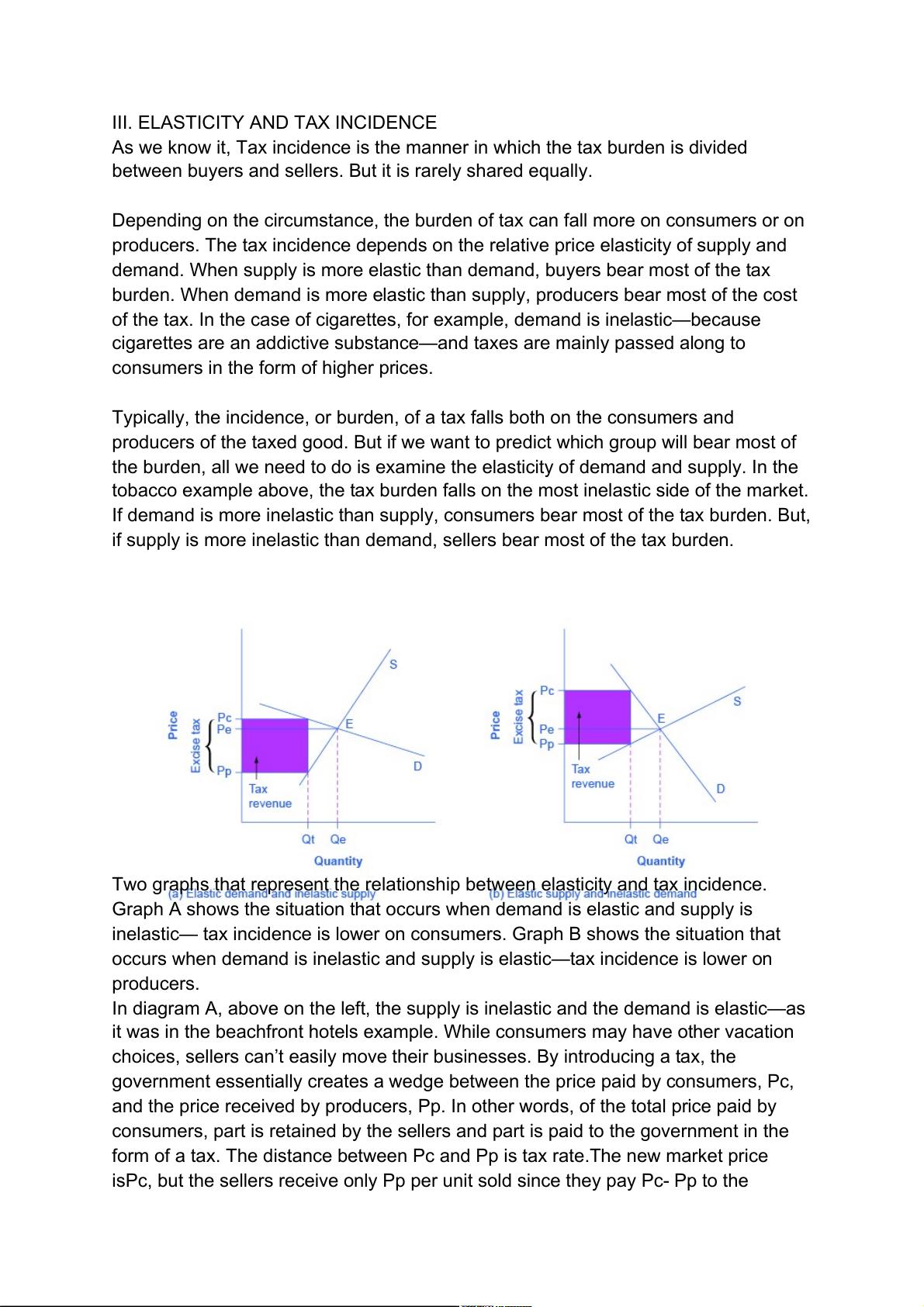
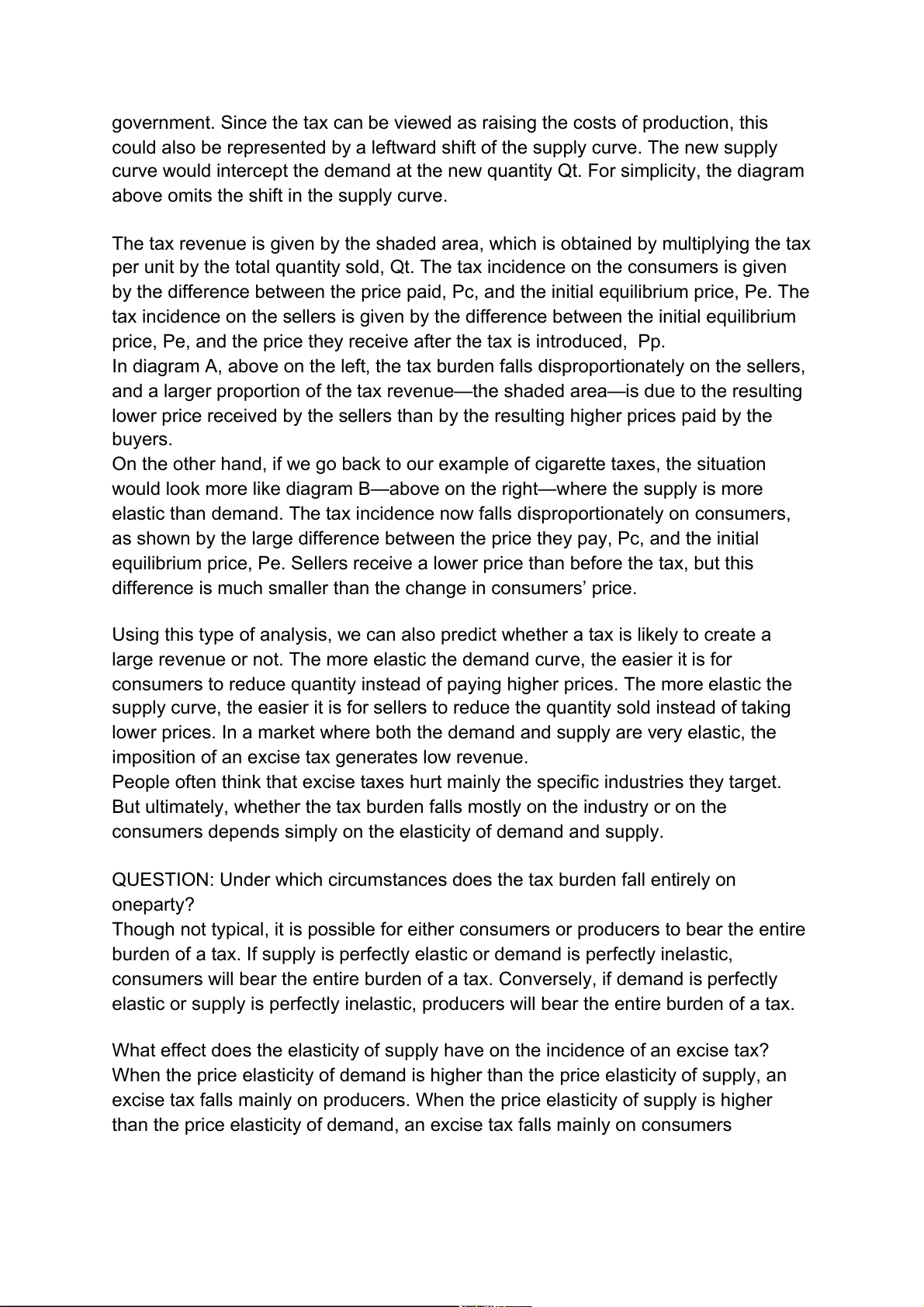
Two graphs that represent the relationship between elasticity and tax incidence.
Graph A shows the situation that occurs when demand is elastic and supply is
inelastic— tax incidence is lower on consumers. Graph B shows the situation that
occurs when demand is inelastic and supply is elastic—tax incidence is lower on producers.
In diagram A, above on the left, the supply is inelastic and the demand is elastic—as
it was in the beachfront hotels example. While consumers may have other vacation
choices, sellers can’t easily move their businesses. By introducing a tax, the
government essentially creates a wedge between the price paid by consumers, Pc,
and the price received by producers, Pp. In other words, of the total price paid by
consumers, part is retained by the sellers and part is paid to the government in the
form of a tax. The distance between Pc and Pp is tax rate.The new market price
isPc, but the sellers receive only Pp per unit sold since they pay Pc- Pp to the
government. Since the tax can be viewed as raising the costs of production, this
could also be represented by a leftward shift of the supply curve. The new supply
curve would intercept the demand at the new quantity Qt. For simplicity, the diagram
above omits the shift in the supply curve.
The tax revenue is given by the shaded area, which is obtained by multiplying the tax
per unit by the total quantity sold, Qt. The tax incidence on the consumers is given
by the difference between the price paid, Pc, and the initial equilibrium price, Pe. The
tax incidence on the sellers is given by the difference between the initial equilibrium
price, Pe, and the price they receive after the tax is introduced, Pp.
In diagram A, above on the left, the tax burden falls disproportionately on the sellers,
and a larger proportion of the tax revenue—the shaded area—is due to the resulting
lower price received by the sellers than by the resulting higher prices paid by the buyers.
On the other hand, if we go back to our example of cigarette taxes, the situation
would look more like diagram B—above on the right—where the supply is more
elastic than demand. The tax incidence now falls disproportionately on consumers,
as shown by the large difference between the price they pay, Pc, and the initial
equilibrium price, Pe. Sellers receive a lower price than before the tax, but this
difference is much smaller than the change in consumers’ price.
Using this type of analysis, we can also predict whether a tax is likely to create a
large revenue or not. The more elastic the demand curve, the easier it is for
consumers to reduce quantity instead of paying higher prices. The more elastic the
supply curve, the easier it is for sellers to reduce the quantity sold instead of taking
lower prices. In a market where both the demand and supply are very elastic, the
imposition of an excise tax generates low revenue.
People often think that excise taxes hurt mainly the specific industries they target.
But ultimately, whether the tax burden falls mostly on the industry or on the
consumers depends simply on the elasticity of demand and supply.
QUESTION: Under which circumstances does the tax burden fall entirely on oneparty?
Though not typical, it is possible for either consumers or producers to bear the entire
burden of a tax. If supply is perfectly elastic or demand is perfectly inelastic,
consumers will bear the entire burden of a tax. Conversely, if demand is perfectly
elastic or supply is perfectly inelastic, producers will bear the entire burden of a tax.
What effect does the elasticity of supply have on the incidence of an excise tax?
When the price elasticity of demand is higher than the price elasticity of supply, an
excise tax falls mainly on producers. When the price elasticity of supply is higher
than the price elasticity of demand, an excise tax falls mainly on consumers
Tài liệu liên quan:
-
Chương 3: độ co giãn và các nhân tố ảnh hưởng | Microeconomics | Trường Đại học Quốc tế, Đại học Quốc gia Thành phố Hồ Chí Minh
5 3 -
Microeconomics Syllabus | Microeconomics | Trường Đại học Quốc tế, Đại học Quốc gia Thành phố Hồ Chí Minh
5 3 -
Microeconomics Course Syllabus & Assessment Details | Microeconomics | Trường Đại học Quốc tế, Đại học Quốc gia Thành phố Hồ Chí Minh
5 3 -
Assignment 3 - Elasticity MCQs and Key Concepts | Microeconomics | Trường Đại học Quốc tế, Đại học Quốc gia Thành phố Hồ Chí Minh
5 3 -
Assignment 2 - Economic Equilibrium Analysis of Fridges and Motorcycles | Microeconomics | Trường Đại học Quốc tế, Đại học Quốc gia Thành phố Hồ Chí Minh
5 3