Trắc nghiệm Đề Cương ôn tập | Microeconomics | Trường Đại học Quốc tế, Đại học Quốc gia Thành phố Hồ Chí Minh
Trắc nghiệm đề 1 1. HRM does not include ________ a.retirement of employees b.training of employees c. manpower planning d. maintenance of accounts 2. Which of the following programmes once installed must be continued on a permanent basis. a. Job evaluation b. Recruitment c. Training & Development d. All of the above. Tài liệu được sưu tầm và soạn thảo dưới dạng file PDF để gửi tới các bạn cùng tham khảo, ôn tập đầy đủ kiến thức, chuẩn bị cho các buổi học thật tốt. Mời bạn đọc đón xem!
Môn: Microeconomics 635 tài liệu
Trường: Trường Đại học Quốc tế, Đại học Quốc gia Thành phố Hồ Chí Minh 1.9 K tài liệu
Tác giả:




Preview text:
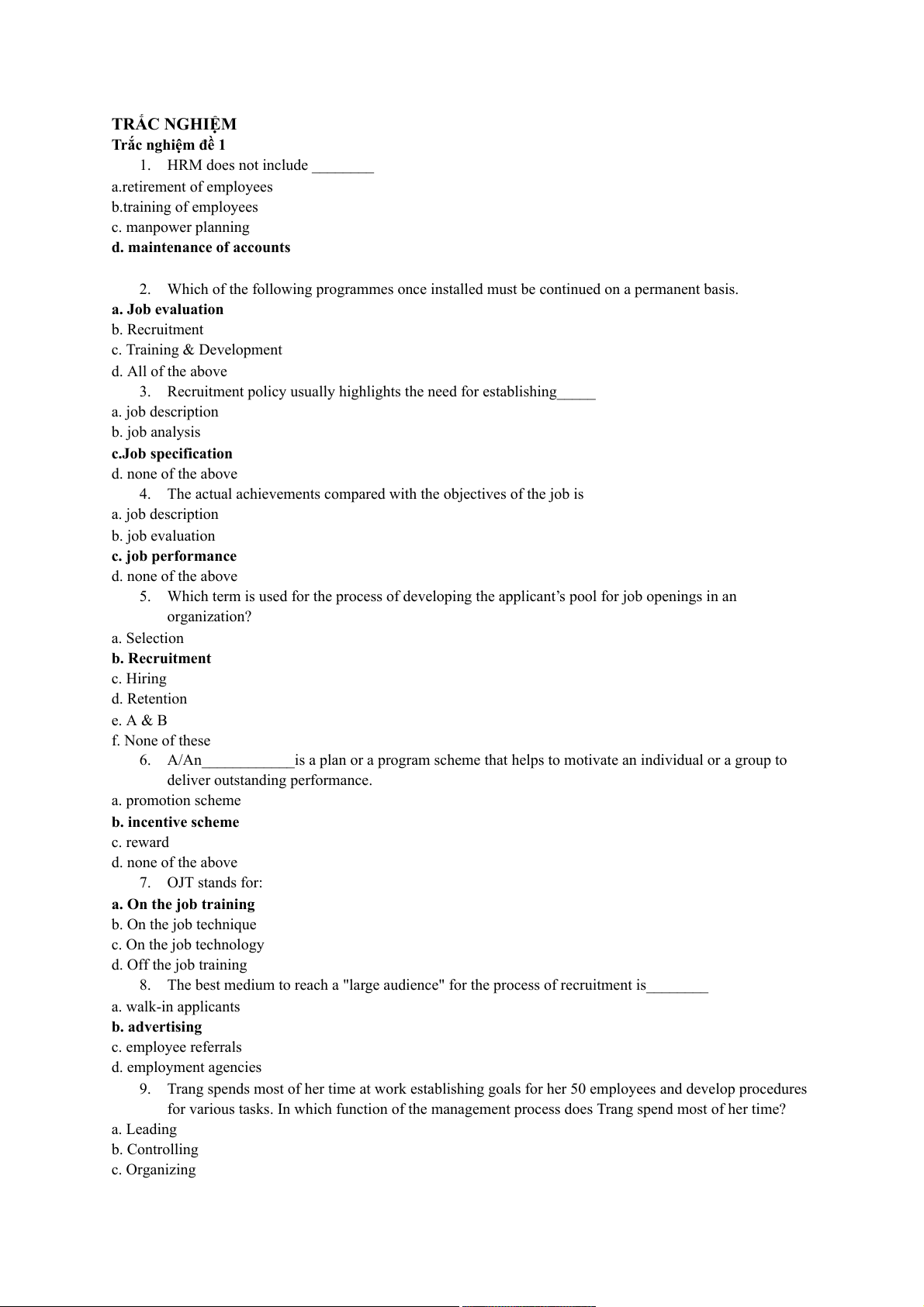
TRẮC NGHIỆM Trắc nghiệm đề 1
1. HRM does not include ________ a.retirement of employees b.training of employees c. manpower planning d. maintenance of accounts
2. Which of the following programmes once installed must be continued on a permanent basis. a. Job evaluation b. Recruitment c. Training & Development d. All of the above
3. Recruitment policy usually highlights the need for establishing_____ a. job description b. job analysis c.Job specification d. none of the above
4. The actual achievements compared with the objectives of the job is a. job description b. job evaluation c. job performance d. none of the above
5. Which term is used for the process of developing the applicant’s pool for job openings in an organization? a. Selection b. Recruitment c. Hiring d. Retention e. A & B f. None of these
6. A/An____________is a plan or a program scheme that helps to motivate an individual or a group to
deliver outstanding performance. a. promotion scheme b. incentive scheme c. reward d. none of the above 7. OJT stands for: a. On the job training b. On the job technique c. On the job technology d. Off the job training
8. The best medium to reach a "large audience" for the process of recruitment is________ a. walk-in applicants b. advertising c. employee referrals d. employment agencies
9. Trang spends most of her time at work establishing goals for her 50 employees and develop procedures
for various tasks. In which function of the management process does Trang spend most of her time? a. Leading b. Controlling c. Organizing d. Planning
10. Which of the following best explains why HRM is important for all managers?
a. Technological changes and global competition require clear organizational charts
b. Sophisticated accounting controls are supported by HR managers
c. An enthusiastic labor force is likely to provide financial support for local unions
d. Investing in human capital enables managers to achieve results for the firms Trắc nghiệm đề 2
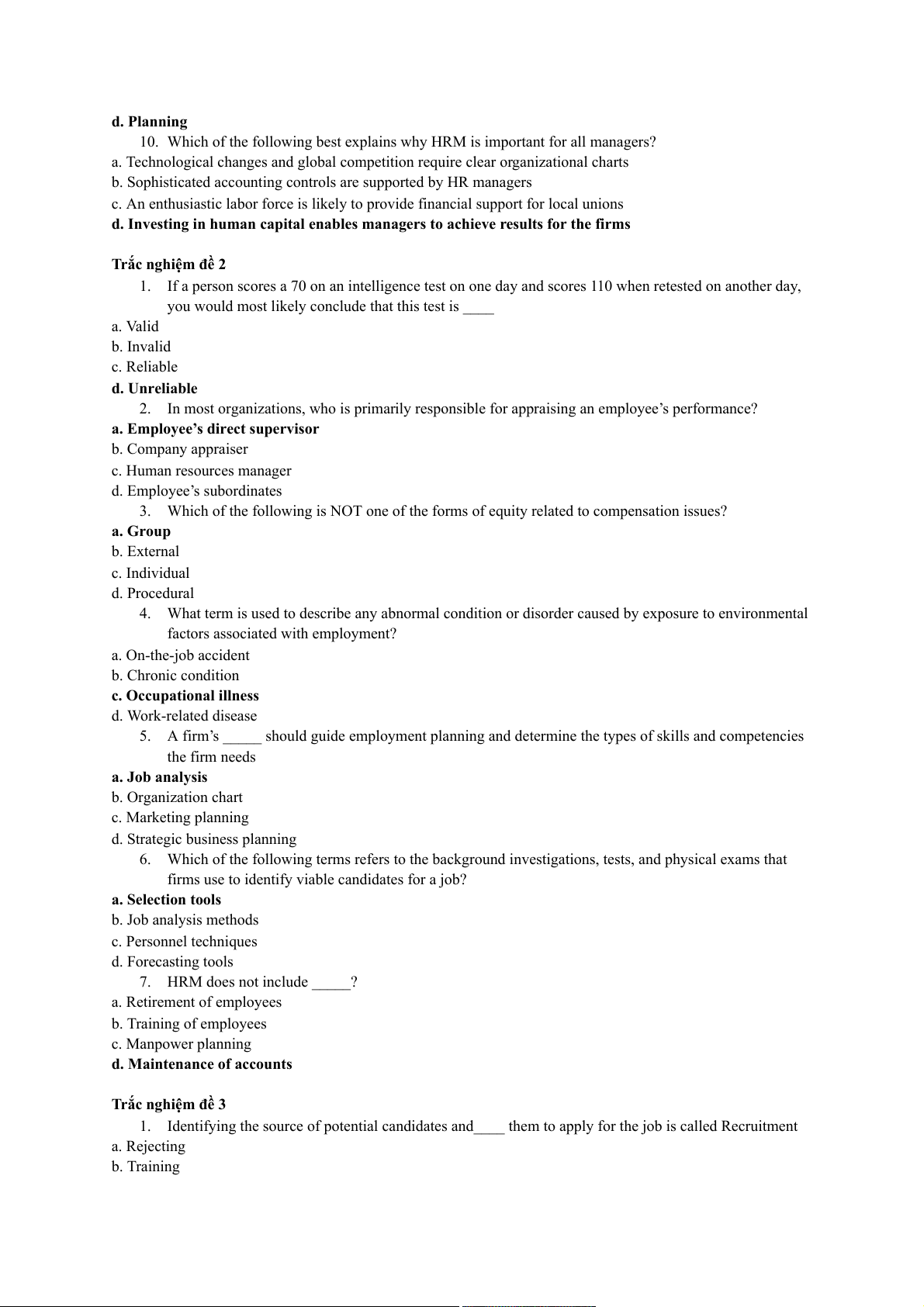
1. If a person scores a 70 on an intelligence test on one day and scores 110 when retested on another day,
you would most likely conclude that this test is ____ a. Valid b. Invalid c. Reliable d. Unreliable
2. In most organizations, who is primarily responsible for appraising an employee’s performance?
a. Employee’s direct supervisor b. Company appraiser c. Human resources manager d. Employee’s subordinates
3. Which of the following is NOT one of the forms of equity related to compensation issues? a. Group b. External c. Individual d. Procedural
4. What term is used to describe any abnormal condition or disorder caused by exposure to environmental
factors associated with employment? a. On-the-job accident b. Chronic condition c. Occupational illness d. Work-related disease
5. A firm’s _____ should guide employment planning and determine the types of skills and competencies the firm needs a. Job analysis b. Organization chart c. Marketing planning
d. Strategic business planning
6. Which of the following terms refers to the background investigations, tests, and physical exams that
firms use to identify viable candidates for a job? a. Selection tools b. Job analysis methods c. Personnel techniques d. Forecasting tools
7. HRM does not include _____? a. Retirement of employees b. Training of employees c. Manpower planning d. Maintenance of accounts Trắc nghiệm đề 3
1. Identifying the source of potential candidates and____ them to apply for the job is called Recruitment a. Rejecting b. Training c. Attracting d. All of the above
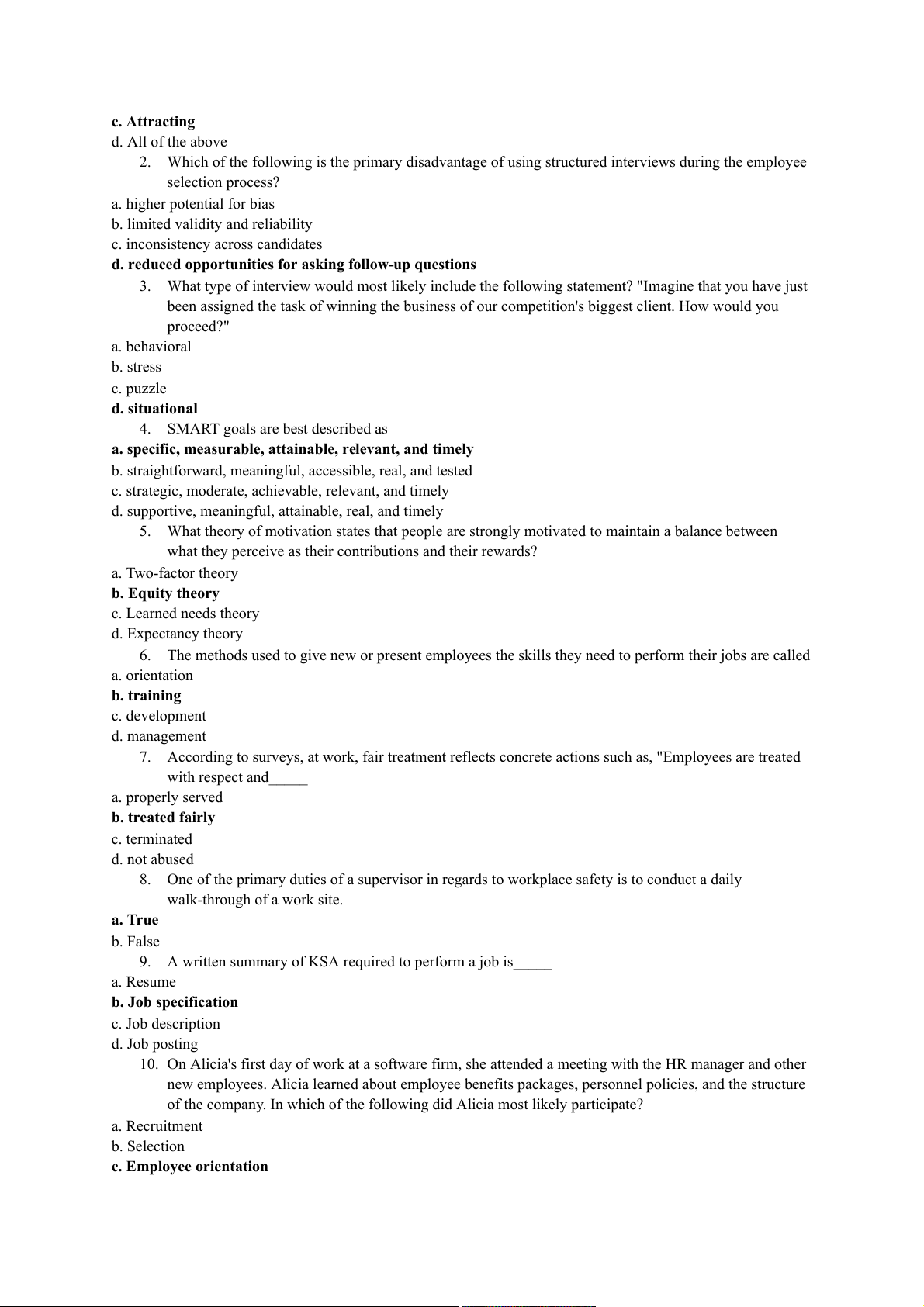
2. Which of the following is the primary disadvantage of using structured interviews during the employee selection process? a. higher potential for bias
b. limited validity and reliability
c. inconsistency across candidates
d. reduced opportunities for asking follow-up questions
3. What type of interview would most likely include the following statement? "Imagine that you have just
been assigned the task of winning the business of our competition's biggest client. How would you proceed?" a. behavioral b. stress c. puzzle d. situational
4. SMART goals are best described as
a. specific, measurable, attainable, relevant, and timely
b. straightforward, meaningful, accessible, real, and tested
c. strategic, moderate, achievable, relevant, and timely
d. supportive, meaningful, attainable, real, and timely
5. What theory of motivation states that people are strongly motivated to maintain a balance between
what they perceive as their contributions and their rewards? a. Two-factor theory b. Equity theory c. Learned needs theory d. Expectancy theory
6. The methods used to give new or present employees the skills they need to perform their jobs are called a. orientation b. training c. development d. management
7. According to surveys, at work, fair treatment reflects concrete actions such as, "Employees are treated with respect and_____ a. properly served b. treated fairly c. terminated d. not abused
8. One of the primary duties of a supervisor in regards to workplace safety is to conduct a daily walk-through of a work site. a. True b. False
9. A written summary of KSA required to perform a job is_____ a. Resume b. Job specification c. Job description d. Job posting
10. On Alicia's first day of work at a software firm, she attended a meeting with the HR manager and other
new employees. Alicia learned about employee benefits packages, personnel policies, and the structure
of the company. In which of the following did Alicia most likely participate? a. Recruitment b. Selection c. Employee orientation d. Employee development Trắc nghiệm đề 4
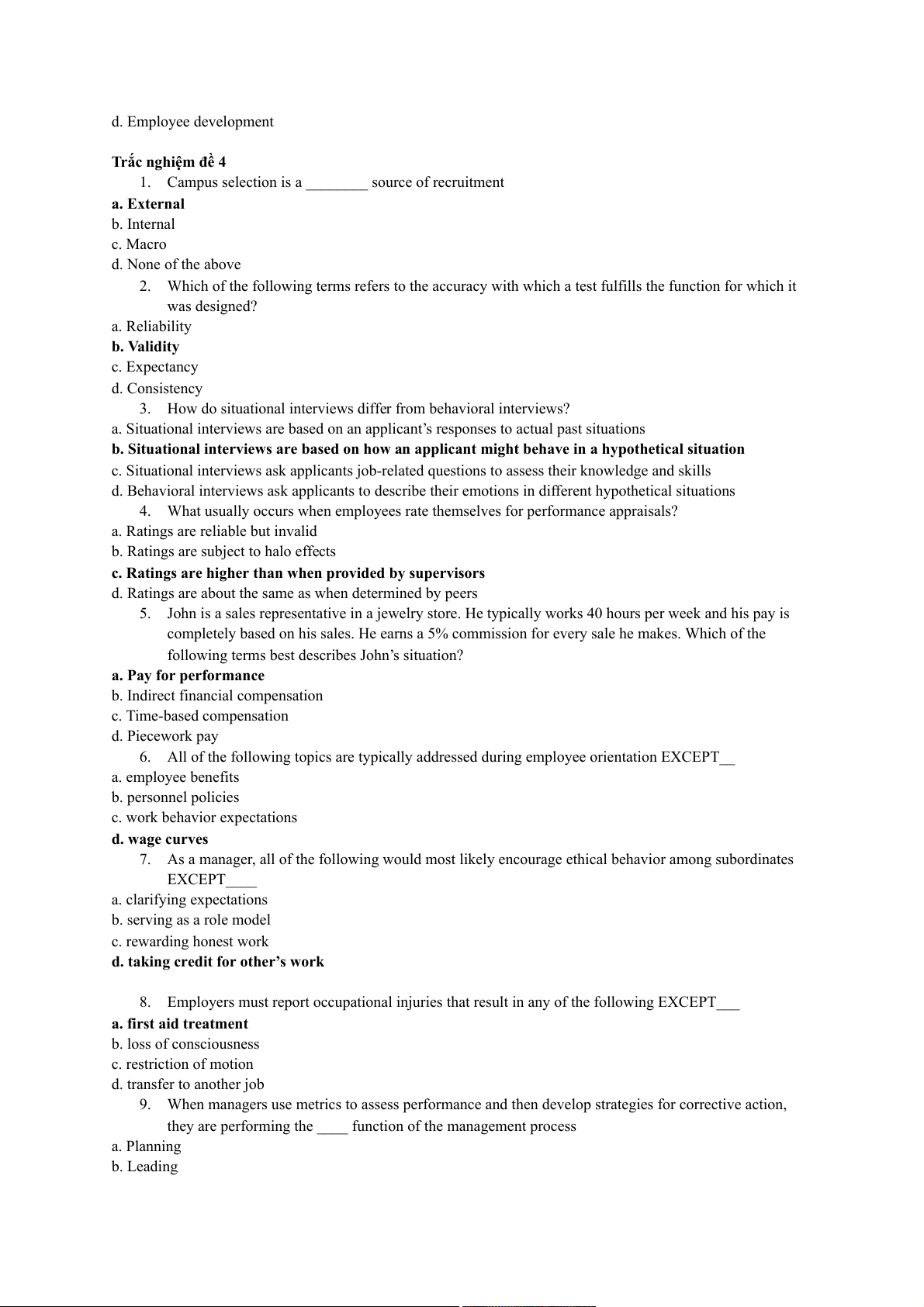
1. Campus selection is a ________ source of recruitment a. External b. Internal c. Macro d. None of the above
2. Which of the following terms refers to the accuracy with which a test fulfills the function for which it was designed? a. Reliability b. Validity c. Expectancy d. Consistency
3. How do situational interviews differ from behavioral interviews?
a. Situational interviews are based on an applicant’s responses to actual past situations
b. Situational interviews are based on how an applicant might behave in a hypothetical situation
c. Situational interviews ask applicants job-related questions to assess their knowledge and skills
d. Behavioral interviews ask applicants to describe their emotions in different hypothetical situations
4. What usually occurs when employees rate themselves for performance appraisals?
a. Ratings are reliable but invalid
b. Ratings are subject to halo effects
c. Ratings are higher than when provided by supervisors
d. Ratings are about the same as when determined by peers
5. John is a sales representative in a jewelry store. He typically works 40 hours per week and his pay is
completely based on his sales. He earns a 5% commission for every sale he makes. Which of the
following terms best describes John’s situation? a. Pay for performance
b. Indirect financial compensation c. Time-based compensation d. Piecework pay
6. All of the following topics are typically addressed during employee orientation EXCEPT__ a. employee benefits b. personnel policies c. work behavior expectations d. wage curves
7. As a manager, all of the following would most likely encourage ethical behavior among subordinates EXCEPT____ a. clarifying expectations b. serving as a role model c. rewarding honest work
d. taking credit for other’s work
8. Employers must report occupational injuries that result in any of the following EXCEPT___ a. first aid treatment b. loss of consciousness c. restriction of motion d. transfer to another job
9. When managers use metrics to assess performance and then develop strategies for corrective action,
they are performing the ____ function of the management process a. Planning b. Leading c. Controlling d. Organizing
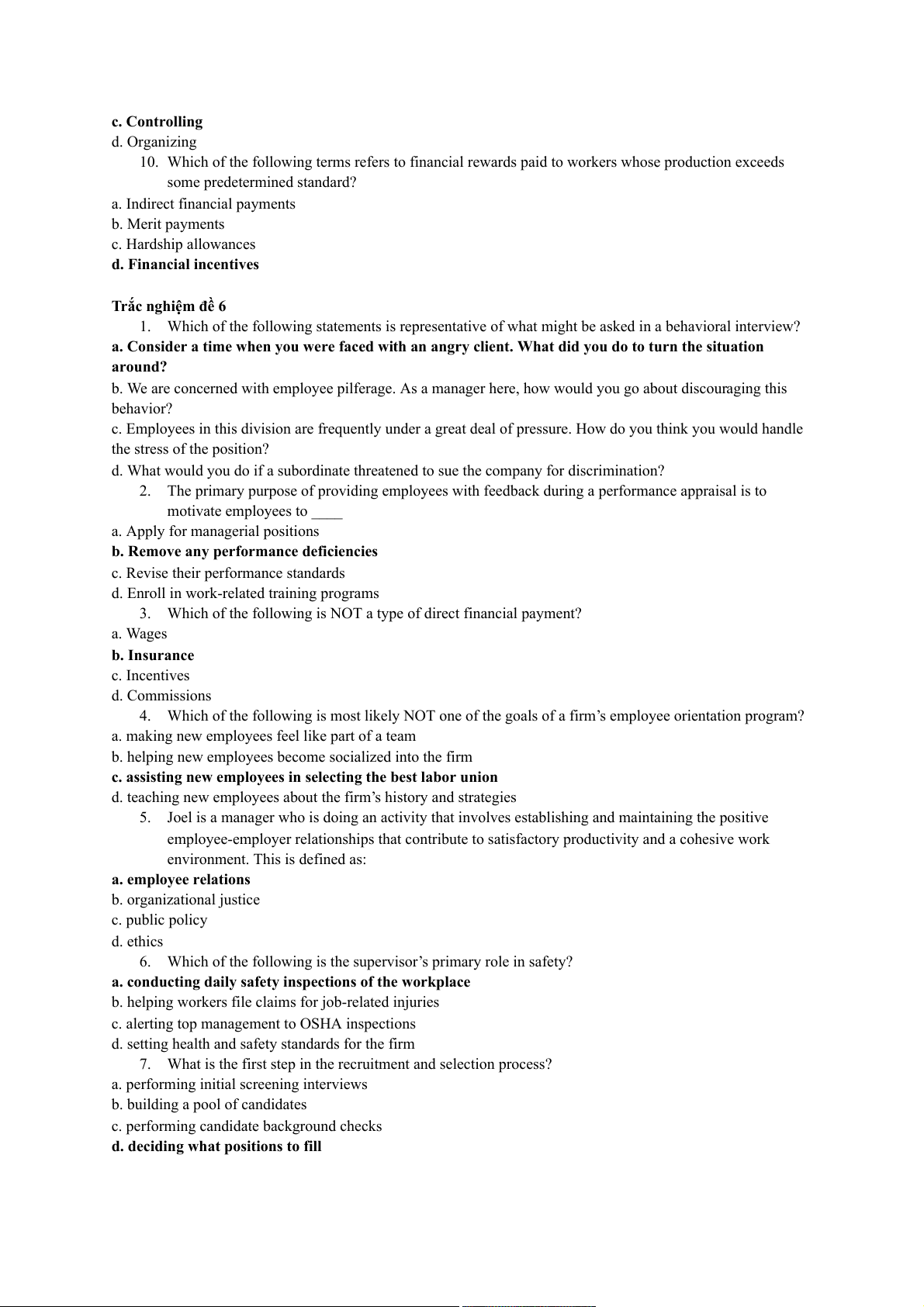
10. Which of the following terms refers to financial rewards paid to workers whose production exceeds some predetermined standard?
a. Indirect financial payments b. Merit payments c. Hardship allowances d. Financial incentives Trắc nghiệm đề 6
1. Which of the following statements is representative of what might be asked in a behavioral interview?
a. Consider a time when you were faced with an angry client. What did you do to turn the situation around?
b. We are concerned with employee pilferage. As a manager here, how would you go about discouraging this behavior?
c. Employees in this division are frequently under a great deal of pressure. How do you think you would handle the stress of the position?
d. What would you do if a subordinate threatened to sue the company for discrimination?
2. The primary purpose of providing employees with feedback during a performance appraisal is to motivate employees to ____
a. Apply for managerial positions
b. Remove any performance deficiencies
c. Revise their performance standards
d. Enroll in work-related training programs
3. Which of the following is NOT a type of direct financial payment? a. Wages b. Insurance c. Incentives d. Commissions
4. Which of the following is most likely NOT one of the goals of a firm’s employee orientation program?
a. making new employees feel like part of a team
b. helping new employees become socialized into the firm
c. assisting new employees in selecting the best labor union
d. teaching new employees about the firm’s history and strategies
5. Joel is a manager who is doing an activity that involves establishing and maintaining the positive
employee-employer relationships that contribute to satisfactory productivity and a cohesive work
environment. This is defined as: a. employee relations b. organizational justice c. public policy d. ethics
6. Which of the following is the supervisor’s primary role in safety?
a. conducting daily safety inspections of the workplace
b. helping workers file claims for job-related injuries
c. alerting top management to OSHA inspections
d. setting health and safety standards for the firm
7. What is the first step in the recruitment and selection process?
a. performing initial screening interviews
b. building a pool of candidates
c. performing candidate background checks
d. deciding what positions to fill
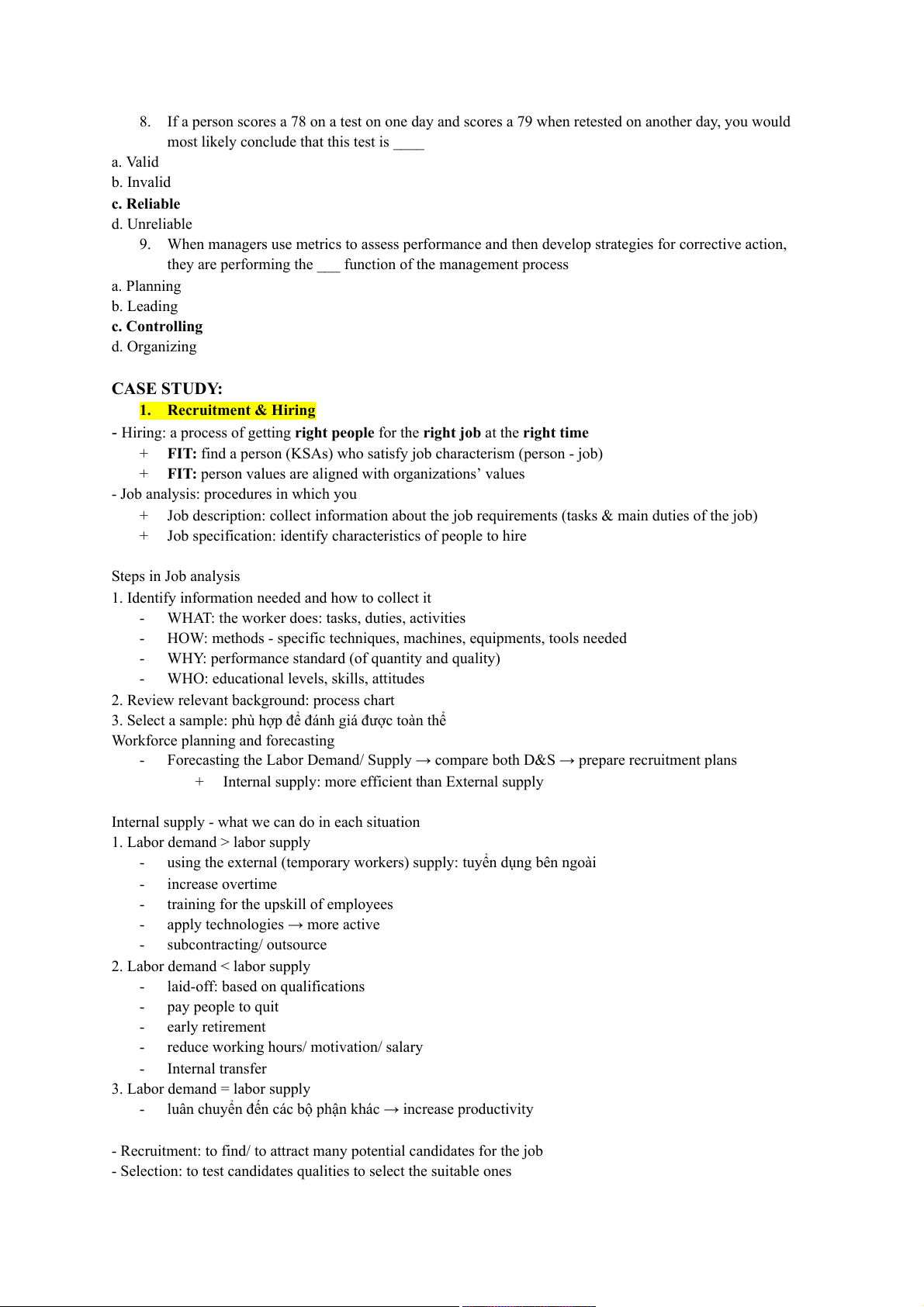
8. If a person scores a 78 on a test on one day and scores a 79 when retested on another day, you would
most likely conclude that this test is ____ a. Valid b. Invalid c. Reliable d. Unreliable
9. When managers use metrics to assess performance and then develop strategies for corrective action,
they are performing the ___ function of the management process a. Planning b. Leading c. Controlling d. Organizing CASE STUDY: 1. Recruitment & Hiring
- Hiring: a process of getting right people for the right job at the right time
+ FIT: find a person (KSAs) who satisfy job characterism (person - job)
+ FIT: person values are aligned with organizations’ values
- Job analysis: procedures in which you
+ Job description: collect information about the job requirements (tasks & main duties of the job)
+ Job specification: identify characteristics of people to hire Steps in Job analysis
1. Identify information needed and how to collect it -
WHAT: the worker does: tasks, duties, activities -
HOW: methods - specific techniques, machines, equipments, tools needed -
WHY: performance standard (of quantity and quality) -
WHO: educational levels, skills, attitudes
2. Review relevant background: process chart
3. Select a sample: phù hợp để đánh giá được toàn thể
Workforce planning and forecasting -
Forecasting the Labor Demand/ Supply → compare both D&S → prepare recruitment plans
+ Internal supply: more efficient than External supply
Internal supply - what we can do in each situation
1. Labor demand > labor supply -
using the external (temporary workers) supply: tuyển dụng bên ngoài - increase overtime -
training for the upskill of employees -
apply technologies → more active - subcontracting/ outsource
2. Labor demand < labor supply -
laid-off: based on qualifications - pay people to quit - early retirement -
reduce working hours/ motivation/ salary - Internal transfer
3. Labor demand = labor supply -
luân chuyển đến các bộ phận khác → increase productivity
- Recruitment: to find/ to attract many potential candidates for the job
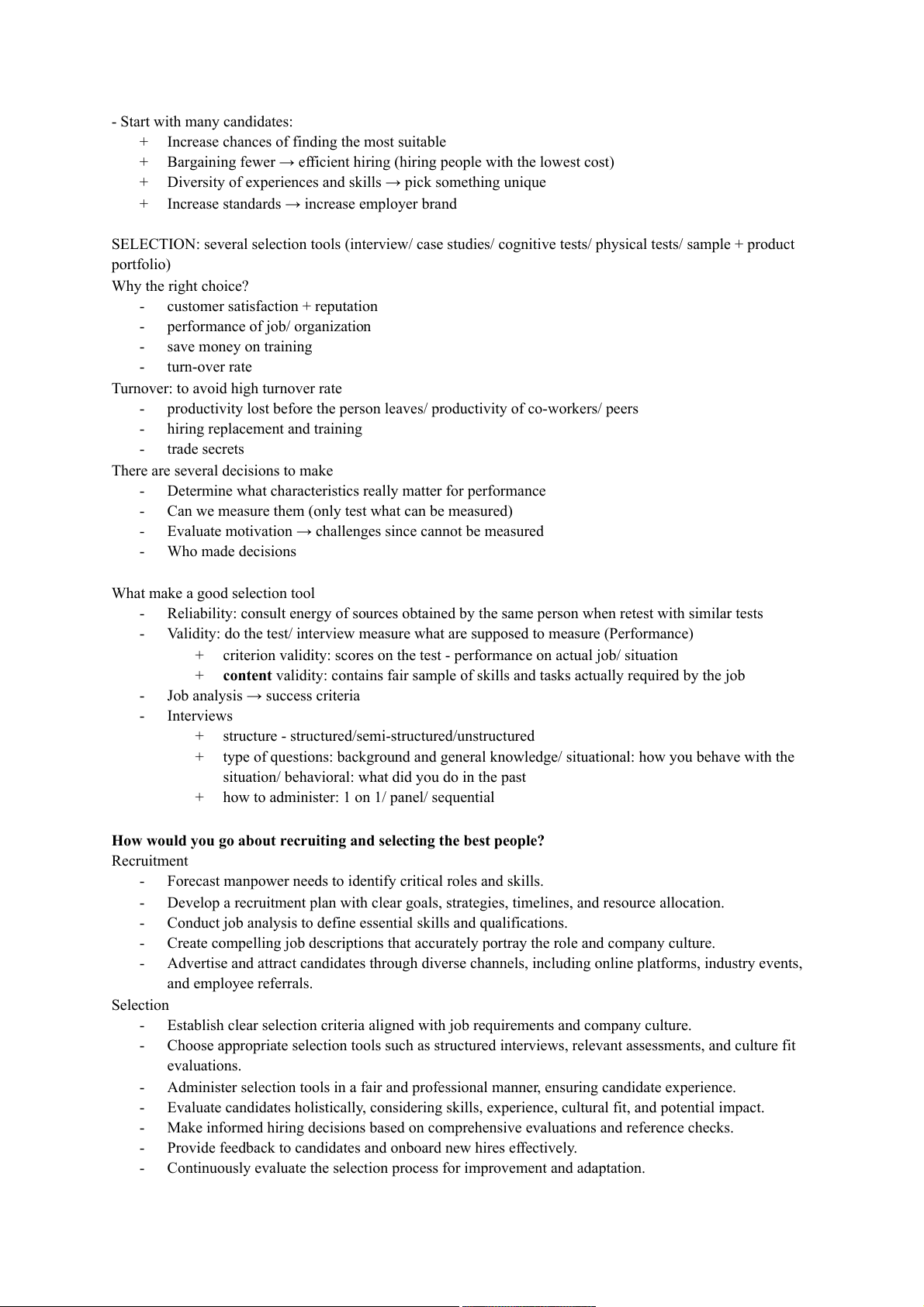
- Selection: to test candidates qualities to select the suitable ones - Start with many candidates:
+ Increase chances of finding the most suitable
+ Bargaining fewer → efficient hiring (hiring people with the lowest cost)
+ Diversity of experiences and skills → pick something unique
+ Increase standards → increase employer brand
SELECTION: several selection tools (interview/ case studies/ cognitive tests/ physical tests/ sample + product portfolio) Why the right choice? -
customer satisfaction + reputation -
performance of job/ organization - save money on training - turn-over rate
Turnover: to avoid high turnover rate -
productivity lost before the person leaves/ productivity of co-workers/ peers -
hiring replacement and training - trade secrets
There are several decisions to make -
Determine what characteristics really matter for performance -
Can we measure them (only test what can be measured) -
Evaluate motivation → challenges since cannot be measured - Who made decisions
What make a good selection tool -
Reliability: consult energy of sources obtained by the same person when retest with similar tests -
Validity: do the test/ interview measure what are supposed to measure (Performance)
+ criterion validity: scores on the test - performance on actual job/ situation
+ content validity: contains fair sample of skills and tasks actually required by the job -
Job analysis → success criteria - Interviews
+ structure - structured/semi-structured/unstructured
+ type of questions: background and general knowledge/ situational: how you behave with the
situation/ behavioral: what did you do in the past
+ how to administer: 1 on 1/ panel/ sequential
How would you go about recruiting and selecting the best people? Recruitment -
Forecast manpower needs to identify critical roles and skills. -
Develop a recruitment plan with clear goals, strategies, timelines, and resource allocation. -
Conduct job analysis to define essential skills and qualifications. -
Create compelling job descriptions that accurately portray the role and company culture. -
Advertise and attract candidates through diverse channels, including online platforms, industry events, and employee referrals. Selection -
Establish clear selection criteria aligned with job requirements and company culture. -
Choose appropriate selection tools such as structured interviews, relevant assessments, and culture fit evaluations. -
Administer selection tools in a fair and professional manner, ensuring candidate experience. -
Evaluate candidates holistically, considering skills, experience, cultural fit, and potential impact. -
Make informed hiring decisions based on comprehensive evaluations and reference checks. -
Provide feedback to candidates and onboard new hires effectively. -
Continuously evaluate the selection process for improvement and adaptation.
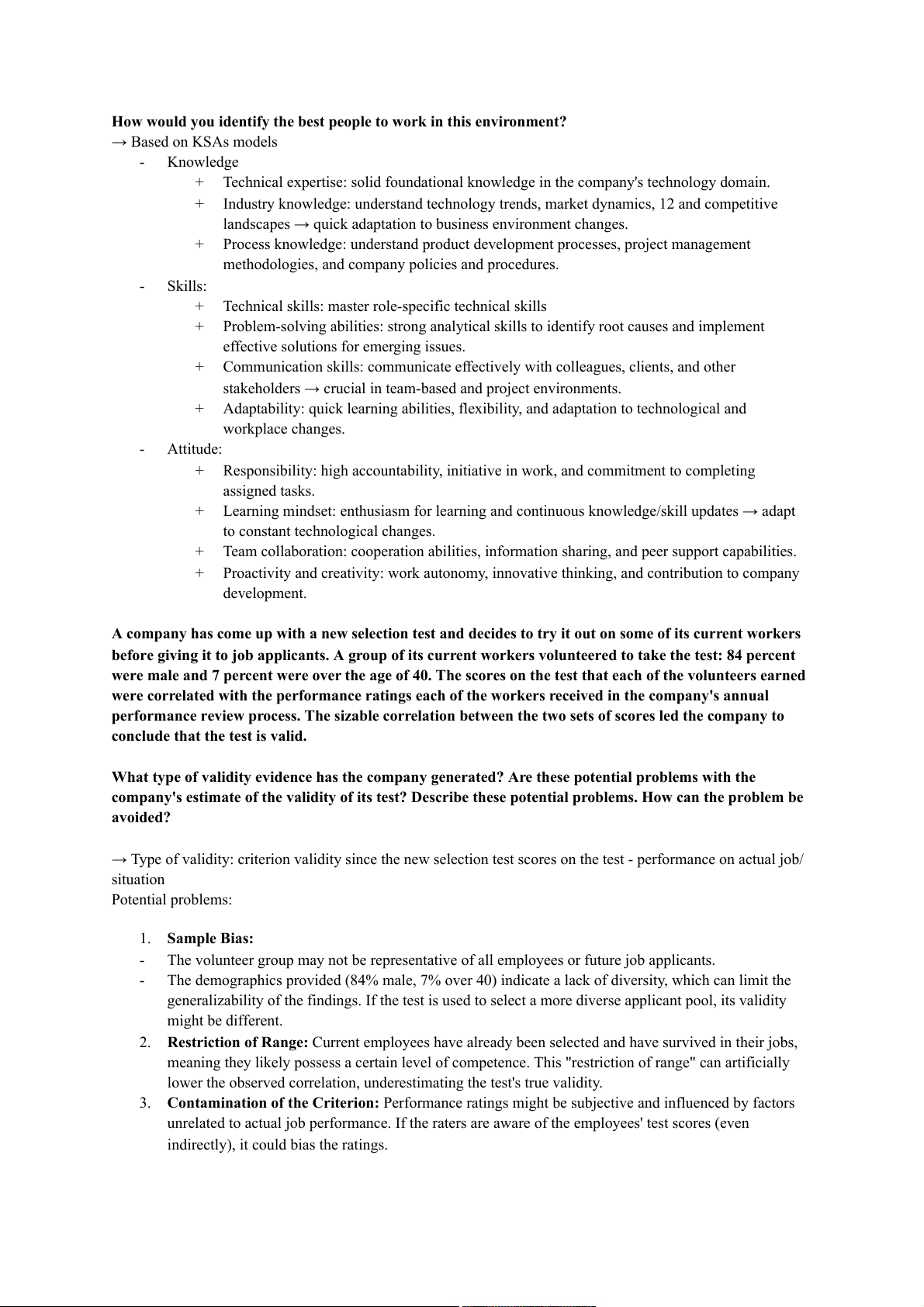
How would you identify the best people to work in this environment? → Based on KSAs models - Knowledge
+ Technical expertise: solid foundational knowledge in the company's technology domain.
+ Industry knowledge: understand technology trends, market dynamics, 12 and competitive
landscapes → quick adaptation to business environment changes.
+ Process knowledge: understand product development processes, project management
methodologies, and company policies and procedures. - Skills:
+ Technical skills: master role-specific technical skills
+ Problem-solving abilities: strong analytical skills to identify root causes and implement
effective solutions for emerging issues.
+ Communication skills: communicate effectively with colleagues, clients, and other
stakeholders → crucial in team-based and project environments.
+ Adaptability: quick learning abilities, flexibility, and adaptation to technological and workplace changes. - Attitude:
+ Responsibility: high accountability, initiative in work, and commitment to completing assigned tasks.
+ Learning mindset: enthusiasm for learning and continuous knowledge/skill updates → adapt
to constant technological changes.
+ Team collaboration: cooperation abilities, information sharing, and peer support capabilities.
+ Proactivity and creativity: work autonomy, innovative thinking, and contribution to company development.
A company has come up with a new selection test and decides to try it out on some of its current workers
before giving it to job applicants. A group of its current workers volunteered to take the test: 84 percent
were male and 7 percent were over the age of 40. The scores on the test that each of the volunteers earned
were correlated with the performance ratings each of the workers received in the company's annual
performance review process. The sizable correlation between the two sets of scores led the company to
conclude that the test is valid.
What type of validity evidence has the company generated? Are these potential problems with the
company's estimate of the validity of its test? Describe these potential problems. How can the problem be avoided?
→ Type of validity: criterion validity since the new selection test scores on the test - performance on actual job/ situation Potential problems: 1. Sample Bias: -
The volunteer group may not be representative of all employees or future job applicants. -
The demographics provided (84% male, 7% over 40) indicate a lack of diversity, which can limit the
generalizability of the findings. If the test is used to select a more diverse applicant pool, its validity might be different.
2. Restriction of Range: Current employees have already been selected and have survived in their jobs,
meaning they likely possess a certain level of competence. This "restriction of range" can artificially
lower the observed correlation, underestimating the test's true validity.
3. Contamination of the Criterion: Performance ratings might be subjective and influenced by factors
unrelated to actual job performance. If the raters are aware of the employees' test scores (even
indirectly), it could bias the ratings.
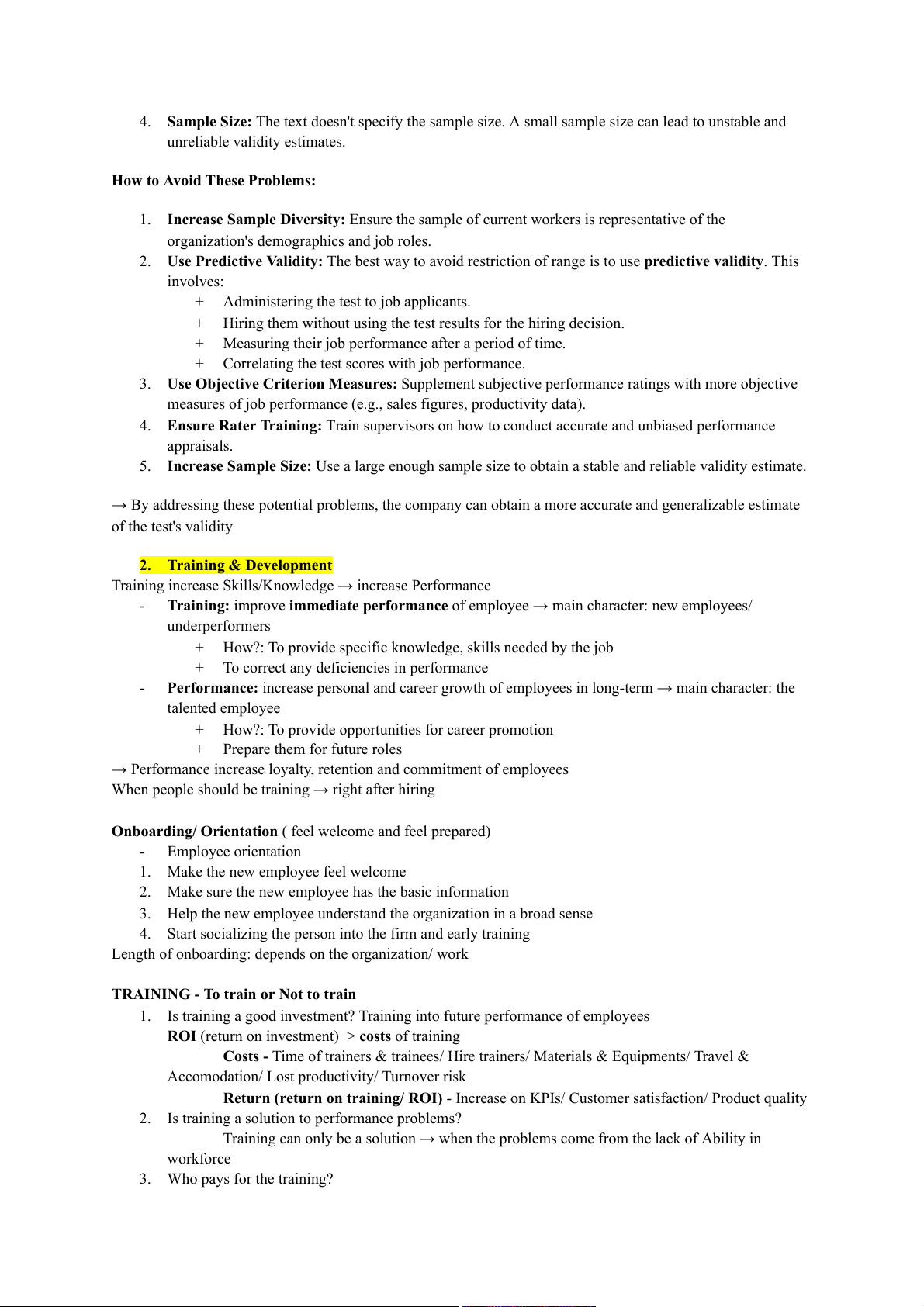
4. Sample Size: The text doesn't specify the sample size. A small sample size can lead to unstable and
unreliable validity estimates. How to Avoid These Problems:
1. Increase Sample Diversity: Ensure the sample of current workers is representative of the
organization's demographics and job roles.
2. Use Predictive Validity: The best way to avoid restriction of range is to use predictive validity. This involves:
+ Administering the test to job applicants.
+ Hiring them without using the test results for the hiring decision.
+ Measuring their job performance after a period of time.
+ Correlating the test scores with job performance.
3. Use Objective Criterion Measures: Supplement subjective performance ratings with more objective
measures of job performance (e.g., sales figures, productivity data).
4. Ensure Rater Training: Train supervisors on how to conduct accurate and unbiased performance appraisals.
5. Increase Sample Size: Use a large enough sample size to obtain a stable and reliable validity estimate.
→ By addressing these potential problems, the company can obtain a more accurate and generalizable estimate of the test's validity 2. Training & Development
Training increase Skills/Knowledge → increase Performance -
Training: improve immediate performance of employee → main character: new employees/ underperformers
+ How?: To provide specific knowledge, skills needed by the job
+ To correct any deficiencies in performance -
Performance: increase personal and career growth of employees in long-term → main character: the talented employee
+ How?: To provide opportunities for career promotion
+ Prepare them for future roles
→ Performance increase loyalty, retention and commitment of employees
When people should be training → right after hiring
Onboarding/ Orientation ( feel welcome and feel prepared) - Employee orientation
1. Make the new employee feel welcome
2. Make sure the new employee has the basic information
3. Help the new employee understand the organization in a broad sense
4. Start socializing the person into the firm and early training
Length of onboarding: depends on the organization/ work
TRAINING - To train or Not to train
1. Is training a good investment? Training into future performance of employees
ROI (return on investment) > costs of training
Costs - Time of trainers & trainees/ Hire trainers/ Materials & Equipments/ Travel &
Accomodation/ Lost productivity/ Turnover risk
Return (return on training/ ROI) - Increase on KPIs/ Customer satisfaction/ Product quality
2. Is training a solution to performance problems?
Training can only be a solution → when the problems come from the lack of Ability in workforce 3. Who pays for the training?
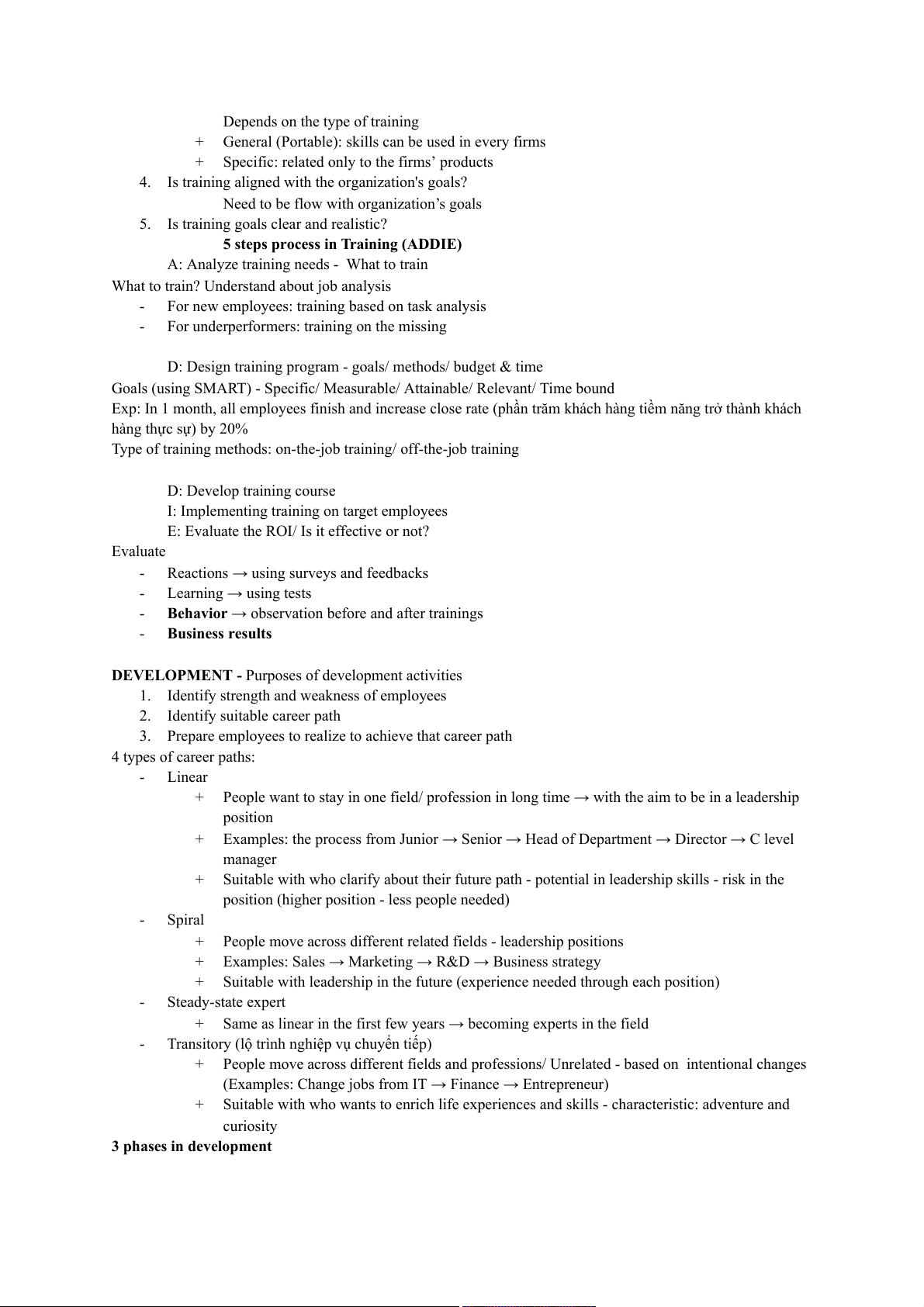
Depends on the type of training
+ General (Portable): skills can be used in every firms
+ Specific: related only to the firms’ products
4. Is training aligned with the organization's goals?
Need to be flow with organization’s goals
5. Is training goals clear and realistic?
5 steps process in Training (ADDIE)
A: Analyze training needs - What to train
What to train? Understand about job analysis -
For new employees: training based on task analysis -
For underperformers: training on the missing
D: Design training program - goals/ methods/ budget & time
Goals (using SMART) - Specific/ Measurable/ Attainable/ Relevant/ Time bound
Exp: In 1 month, all employees finish and increase close rate (phần trăm khách hàng tiềm năng trở thành khách hàng thực sự) by 20%
Type of training methods: on-the-job training/ off-the-job training D: Develop training course
I: Implementing training on target employees
E: Evaluate the ROI/ Is it effective or not? Evaluate -
Reactions → using surveys and feedbacks - Learning → using tests -
Behavior → observation before and after trainings - Business results
DEVELOPMENT - Purposes of development activities
1. Identify strength and weakness of employees
2. Identify suitable career path
3. Prepare employees to realize to achieve that career path 4 types of career paths: - Linear
+ People want to stay in one field/ profession in long time → with the aim to be in a leadership position
+ Examples: the process from Junior → Senior → Head of Department → Director → C level manager
+ Suitable with who clarify about their future path - potential in leadership skills - risk in the
position (higher position - less people needed) - Spiral
+ People move across different related fields - leadership positions
+ Examples: Sales → Marketing → R&D → Business strategy
+ Suitable with leadership in the future (experience needed through each position) - Steady-state expert
+ Same as linear in the first few years → becoming experts in the field -
Transitory (lộ trình nghiệp vụ chuyển tiếp)
+ People move across different fields and professions/ Unrelated - based on intentional changes
(Examples: Change jobs from IT → Finance → Entrepreneur)
+ Suitable with who wants to enrich life experiences and skills - characteristic: adventure and curiosity 3 phases in development
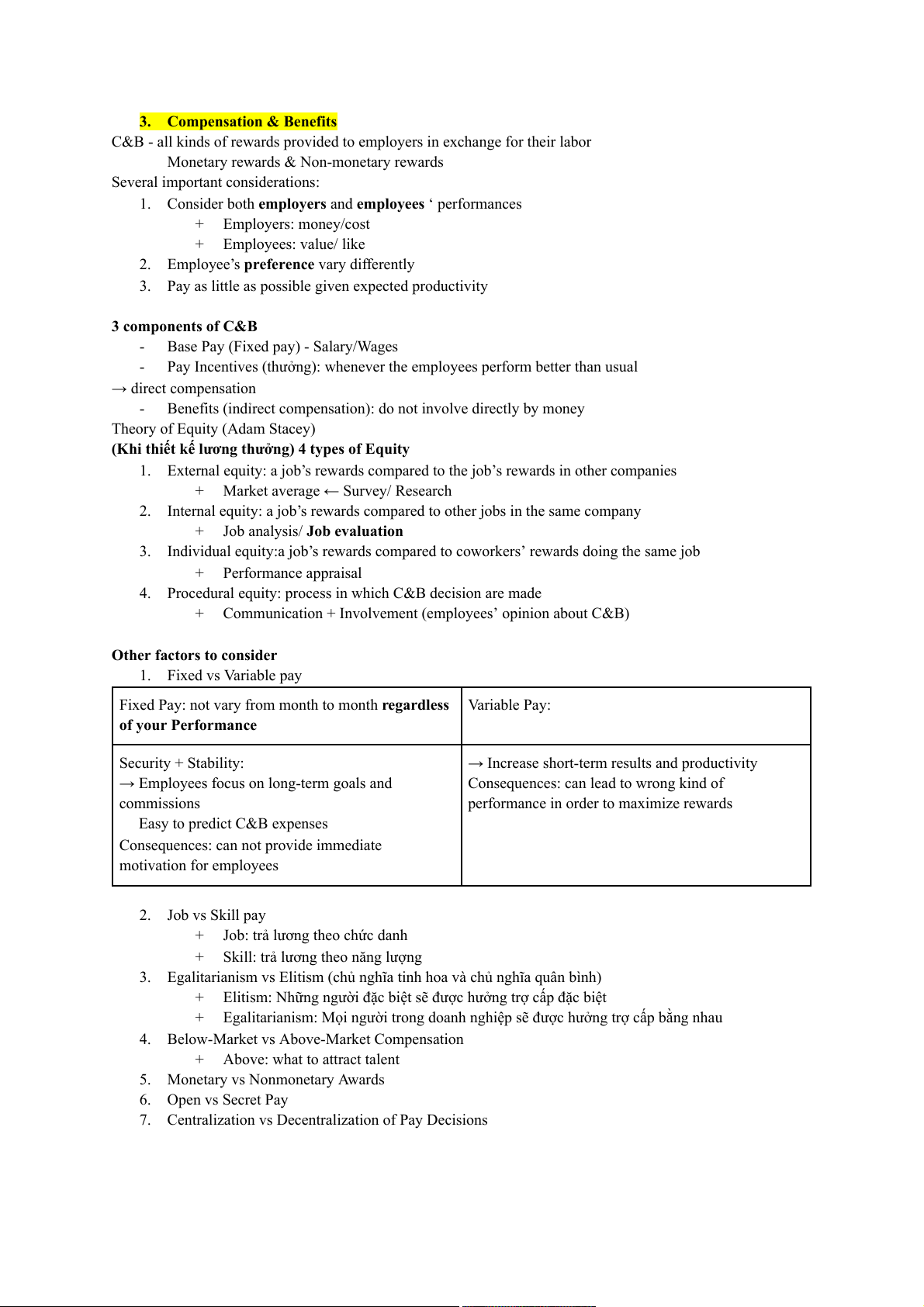
3. Compensation & Benefits
C&B - all kinds of rewards provided to employers in exchange for their labor
Monetary rewards & Non-monetary rewards
Several important considerations:
1. Consider both employers and employees ‘ performances + Employers: money/cost + Employees: value/ like
2. Employee’s preference vary differently
3. Pay as little as possible given expected productivity 3 components of C&B -
Base Pay (Fixed pay) - Salary/Wages -
Pay Incentives (thưởng): whenever the employees perform better than usual → direct compensation -
Benefits (indỉrect compensation): do not involve directly by money
Theory of Equity (Adam Stacey)
(Khi thiết kế lương thưởng) 4 types of Equity
1. External equity: a job’s rewards compared to the job’s rewards in other companies
+ Market average ← Survey/ Research
2. Internal equity: a job’s rewards compared to other jobs in the same company
+ Job analysis/ Job evaluation
3. Individual equity:a job’s rewards compared to coworkers’ rewards doing the same job + Performance appraisal
4. Procedural equity: process in which C&B decision are made
+ Communication + Involvement (employees’ opinion about C&B) Other factors to consider 1. Fixed vs Variable pay
Fixed Pay: not vary from month to month regardless Variable Pay: of your Performance Security + Stability:
→ Increase short-term results and productivity
→ Employees focus on long-term goals and
Consequences: can lead to wrong kind of commissions
performance in order to maximize rewards
Easy to predict C&B expenses
Consequences: can not provide immediate motivation for employees 2. Job vs Skill pay
+ Job: trả lương theo chức danh
+ Skill: trả lương theo năng lượng
3. Egalitarianism vs Elitism (chủ nghĩa tinh hoa và chủ nghĩa quân bình)
+ Elitism: Những người đặc biệt sẽ được hưởng trợ cấp đặc biệt
+ Egalitarianism: Mọi người trong doanh nghiệp sẽ được hưởng trợ cấp bằng nhau
4. Below-Market vs Above-Market Compensation
+ Above: what to attract talent
5. Monetary vs Nonmonetary Awards 6. Open vs Secret Pay
7. Centralization vs Decentralization of Pay Decisions
One observer argues that external equity should always be the primary concern in compensation, noting
that it attracts the best employees and prevents the top performers from leaving. Do you agree? (Provide your reasonings)
The idea that external equity should always be the primary concern in compensation is debatable. While external
equity is undoubtedly important, it shouldn't necessarily overshadow all other considerations. Here's a breakdown of my reasoning:
Arguments for the Importance of External Equity: -
Attracting Top Talent: Offering competitive salaries and benefits compared to other organizations in
the same industry and location is crucial for attracting highly skilled and sought-after employees. -
Retaining Top Performers: If employees feel underpaid compared to their market value, they are
more likely to seek employment elsewhere. This is especially true for top performers who are confident
in their abilities and have more job options. -
Maintaining a Positive Employer Brand: Paying fair market value enhances the company's
reputation as a desirable employer.
Reasons Why External Equity Shouldn't Always Be the Primary Concern: - Internal Equity:
+ It's equally important to ensure fairness within the organization. Employees in similar roles
with similar skills and experience should be compensated equitably.
+ Disparities in pay can lead to dissatisfaction, resentment, and decreased morale, even if external equity is addressed. -
Organizational Strategy and Goals:
+ Compensation should align with the company's specific goals and priorities. If a company
prioritizes teamwork and collaboration, its compensation structure should reward those
behaviors, even if it means deviating slightly from pure external equity. -
Company Financial Health: A company's ability to pay is a significant factor.
→ While attracting and retaining talent is essential, the company must also be financially sustainable. - Cost of Living:
+ External equity is often compared within a specific geographic area.
+ Compensation should also consider the local cost of living, which can vary significantly. -
Employee Value and Contribution:
+ While market value is a factor, an employee's unique skills, experience, and contributions to
the company should also be considered.
+ Performance-based pay and merit increases can help to reward high-achievers, even if their
base salary is in line with the market.
Conclusion: External equity is a critical component of a successful compensation strategy. However, it should
be balanced with internal equity, organizational goals, financial considerations, and individual employee value.
A holistic approach to compensation that considers all these factors will likely lead to a more engaged,
motivated, and productive workforce in the long run. 4. Performance appraisal
What criteria do you think should be used to measure team performance? Should individual performance still be measured? Why or why not?
What? Appraisal: to evaluate/to assess/ to review
Performance: results/ KPIs (contribution) + Job-related KSAs + behaviors
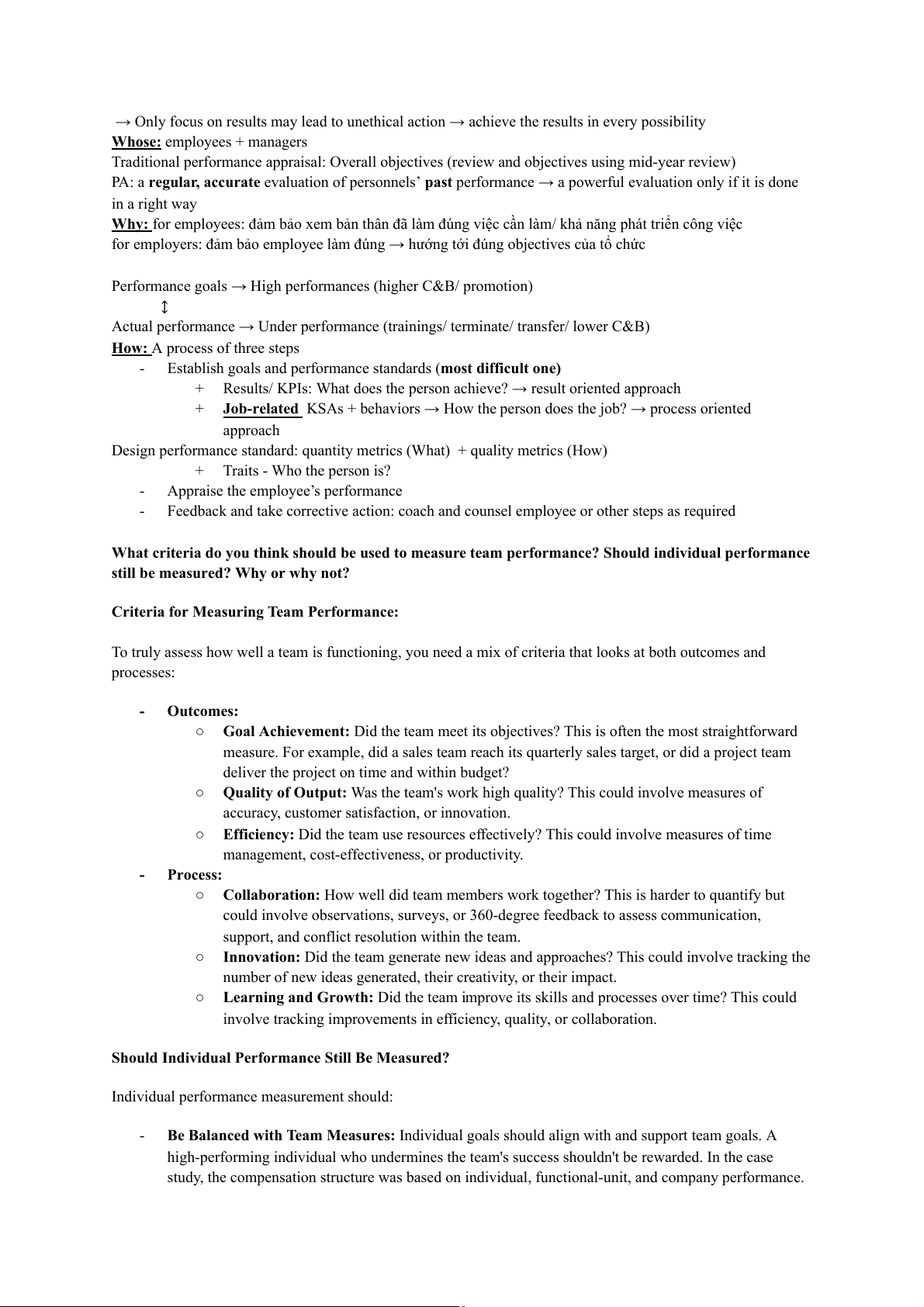
→ Only focus on results may lead to unethical action → achieve the results in every possibility Whose: employees + managers
Traditional performance appraisal: Overall objectives (review and objectives using mid-year review)
PA: a regular, accurate evaluation of personnels’ past performance → a powerful evaluation only if it is done in a right way
Why: for employees: đảm bảo xem bản thân đã làm đúng việc cần làm/ khả năng phát triển công việc
for employers: đảm bảo employee làm đúng → hướng tới đúng objectives của tổ chức
Performance goals → High performances (higher C&B/ promotion) ↕
Actual performance → Under performance (trainings/ terminate/ transfer/ lower C&B) How: A process of three steps -
Establish goals and performance standards (most difficult one)
+ Results/ KPIs: What does the person achieve? → result oriented approach
+ Job-related KSAs + behaviors → How the person does the job? → process oriented approach
Design performance standard: quantity metrics (What) + quality metrics (How) + Traits - Who the person is? -
Appraise the employee’s performance -
Feedback and take corrective action: coach and counsel employee or other steps as required
What criteria do you think should be used to measure team performance? Should individual performance
still be measured? Why or why not?
Criteria for Measuring Team Performance:
To truly assess how well a team is functioning, you need a mix of criteria that looks at both outcomes and processes: - Outcomes:
○ Goal Achievement: Did the team meet its objectives? This is often the most straightforward
measure. For example, did a sales team reach its quarterly sales target, or did a project team
deliver the project on time and within budget?
○ Quality of Output: Was the team's work high quality? This could involve measures of
accuracy, customer satisfaction, or innovation.
○ Efficiency: Did the team use resources effectively? This could involve measures of time
management, cost-effectiveness, or productivity. - Process:
○ Collaboration: How well did team members work together? This is harder to quantify but
could involve observations, surveys, or 360-degree feedback to assess communication,
support, and conflict resolution within the team.
○ Innovation: Did the team generate new ideas and approaches? This could involve tracking the
number of new ideas generated, their creativity, or their impact.
○ Learning and Growth: Did the team improve its skills and processes over time? This could
involve tracking improvements in efficiency, quality, or collaboration.
Should Individual Performance Still Be Measured?
Individual performance measurement should: -
Be Balanced with Team Measures: Individual goals should align with and support team goals. A
high-performing individual who undermines the team's success shouldn't be rewarded. In the case
study, the compensation structure was based on individual, functional-unit, and company performance. -
Focus on Contribution to the Team: Individual assessments should consider how the person's actions
helped or hindered the team. This could include:
○ Supporting teammates: Sharing knowledge, providing assistance, and offering encouragement.
○ Taking on responsibilities: Completing assigned tasks effectively and reliably.
○ Communicating effectively: Sharing information clearly and respectfully. -
Provide Constructive Feedback: Individual feedback should focus on development and improvement,
helping the person enhance their skills and contribute more effectively to the team. -
Differentiate Roles: Recognize that different roles have different contributions. A team leader might
be assessed more on their ability to facilitate the team, while a technical expert might be assessed more on their individual skills.
Why This Balanced Approach Is Important: -
Encourages Collaboration: Emphasizing team goals promotes teamwork and shared responsibility. -
Prevents Free-Riding: Individual accountability ensures that everyone contributes their fair share. -
Promotes Development: Individual feedback helps people grow and improve, benefiting both the individual and the team. -
Aligns with Organizational Goals: Tying both individual and team performance to organizational
objectives ensures that everyone is working towards the same overall vision
5. Maintaining positive employee relations
What? Employee relation - all the management activity that aim to develop and maintain positive relationship
(among employees & employees - employers) at workplace Why? - directly impact working moral - impact on productivity - commitment and turnover rate
How? methods for improving employee relations - Ensuring fair treatment:
+ respect: to make employees contribution are recognized
+ equity: recognize the uniqueness of individuals → may lead to misunderstanding of favoritism
equality: everyone is the same regardless of individuals’ dif ≠ ference
+ consistency: same individuals with same circumstances → same treatment - Communication programs
+ What is communication: exchange of information
Giao tiếp trong tổ chức: good relationship → lower employees to communicate with upper managers
↓ downward flows: decision/ strategies/ instruction/ orders
↑ upward flows: feedbacks/ suggestion/ ideas/ proposals horizontal flows
Một số kênh để giao tiếp trong nội bộ công ty: social media platforms, emails, intranet, town hall meeting, etc. -
Employee recognition programs: nhân viên của tháng/ thưởng -
Employee involvement programs: nhân viên được tham gia vào việc ra quyết định/ đóng góp ý kiến -
Conflict resolution: giải quyết mâu thuẫn - một công ty nên có cơ chế tốt → giải quyết mâu thuẫn
Ethics: doing (actions) the right things - usually determined by moral standards (mindset & beliefs) → sustainable growth
Deontological: intentions - based on moral standards
Utilitarian approach: consequences → to increase happiness and decrease suffering of most people
→ make sure to have ethical reasons for your behavior
Make decisions in ethical dilemma situations
1. Gather all relevant major: context/ fact/ stakeholders/ consequences
2. Explain possible options: what are possible options (short/ long term effect of each options)
3. Evaluate each solution based on ethical approaches - Deontological - Utilitarian
→ the two decisions are not neutrally exclusive
4. Consider the legal standards (in business) → based on personal values
Causes → consists of three causes → high percentage of having unethical behavior 1. Bad Apples - people
2. Bad cases: situations - serious on less serious situation 3. Bad barrels - environment → How to avoid (solutions)
1. Reduce job related pressure
2. Walk the talk: the role model of managers - nói những gì mình làm
3. Have ethics policies and codes 4. Enforce the rules 5. Encourage whistleblowers 6. Foster the right culture 7. Hire right 8. Use ethics training 9. Use rewards and discipline
10. Institute employee privacy policies
Millions of people use social networking Web sites, such as Facebook and MySpace, to share personal
information, including photos and videos with their friends.
Should companies use social networking Web sites as a communications tool to build employee
net-works? What are the advantages and the disadvantages of using social networking Web sites as
informal communication channels for employees? Advantages: -
Enhanced connectivity: Facilitates seamless communication among employees, fostering a sense of
community within the organization. -
Collaboration opportunities: Encourages teamwork by enabling the sharing of ideas, resources, and
project updates across departments and locations. -
Accessibility: Familiar platforms make it easy for employees to engage without requiring extensive training. -
Informal communication: Provides an avenue for casual interactions, strengthening interpersonal
relationships and boosting morale. -
Employee engagement: Promotes inclusivity and increases employees' sense of connection to the organization. Disadvantages: -
Privacy concerns: The sharing of personal and professional information might lead to risks related to
data protection and confidentiality. -
Boundary issues: Mixing professional communication with personal social networking activities could
create unnecessary complications. -
Productivity challenges: Non-work-related content can distract employees and reduce efficiency in the workplace. - : Informal comm Risk to professionalism
unication could occasionally be misinterpreted, impacting workplace decorum. -
Security vulnerabilities: External social networking platforms may expose company information to potential breaches or misuse
6. Occupational health & safety Why? is it priority -
Preserve HR (absenteeism, etc.) - Legal obligation
Three issues of → minimize occupational
Level 1: Occupational accidents → injuries and loss of life Level 2: Diseases Level 3: Illnesses → Causes:
+ Unsafe working conditions (physical working condition/ working climate)
+ Unsafe acts (inoperative safety devices, throwing materials, unsafe speeds, lifting improperly) + Chance occurrence
→ Reduce the chance of happening: - Regular inspection How to prevent accidents - Posters & incentives -
Set specific goals (tỷ lệ xảy ra tai nạn dưới bao nhiêu phần trăm) - Establish a safety policy - Personal protective equipment - Screening individuals - Resources regarding OSH - Safety training …
Workplace health-related problems: Air quality, chemicals & industrials hygiene/ alcoholism & substance
abuse/ job stress/ computers & ergonomic health/ infectious disease/ workplace smoking
Why is it necessary to manage unsafe acts in addition to unsafe conditions at the workplace? Why do you
think employees engage in unsafe acts despite knowing it may cause accidents?
Necessary to manage unsafe acts and unsafe conditions: -
Comprehensive safety: Unsafe acts can lead to accidents even in a safe environment. -
Human factors: Addressing behavior is as important as fixing environmental hazards. -
Prevention: Minimizing risks from both sources ensures a safer workplace.
Reasons why employees engage in unsafe acts: -
Pressure to meet deadlines: Cutting corners to save time or boost efficiency. -
Complacency: Underestimating risks due to familiarity with tasks. -
Lack of training: Insufficient awareness of consequences. -
Peer influence: Unsafe behaviors normalized by workplace culture. -
Perception of low risk: Belief that "it won’t happen to me
Examine how performance management can enhance employee productivity and organizational success.
Discuss the key components of an effective performance management system, and explain how HR
professionals can align performance goals with overall business objectives.
How Performance Management Enhances Productivity & Success: -
Clarity of expectations increases focus and reduces confusion. -
Goal alignment connects individual work to organizational purpose. -
Feedback and development improve employee skills and performance. -
Recognition and rewards motivate and maintain high performance. -
Improved organizational performance results from productive employees. -
Attracts and retains talent by offering growth opportunities -
Helps organizations adapt to change through goal adjustments.
Key Components of an Effective System: -
SMART goal setting provides clear objectives. -
Performance measurement tracks and evaluates employee work. -
Regular and constructive feedback aids employee development. -
Performance appraisals formally evaluate performance over time. -
Development planning creates plans for skill improvement. -
Rewards and recognition motivate and reinforce desired behaviors.
How HR Aligns Performance Goals with Business Objectives: -
Understands the organization's strategic goals. -
Translates strategic goals into team and individual goals. -
Communicates how individual goals support organizational success. -
Monitors and evaluates the performance management system. -
Adapts performance goals and systems to evolving business needs.
BrightWave Inc., a growing digital marketing agency, has been facing high turnover among its sales team.
Building long-term client relationships is a critical aspect of a company's strategy. To address the high
turnover rate issue, the company wants to design an incentive program that will motivate employees,
increase retention, and align with company goals. Currently, the sales team's compensation is based on a
base salary with quarterly bonuses tied solely to individual sales targets with minimum benefits as
required by the laws. Analyze the pros and cons of Brightwave’s current incentive structure.
Current Incentive Structure:Base salary/ Quarterly bonuses tied solely to individual sales targets/ Minimum benefits as required by law Pros: -
Simple and Easy to Understand: Tying bonuses directly to individual sales targets is straightforward.
Salespeople can easily see the direct correlation between their efforts and their earnings. -
Motivates Individual Performance: The structure can drive individual sales efforts and encourage
competition among salespeople to achieve their targets. -
Cost Control: Base salary provides a fixed cost for the company, and bonuses are only paid when sales
targets are met, which can help control expenses. Cons: -
Neglects Long-Term Goals: The emphasis on quarterly individual sales targets can lead salespeople to
prioritize short-term gains over building long-term client relationships, which is a critical aspect of the company's strategy. -
Discourages Collaboration: Focusing solely on individual targets can discourage teamwork and
knowledge sharing among salespeople. They may be less likely to help each other if it means
potentially jeopardizing their own bonuses. -
High Turnover: The high turnover rate suggests that the current incentive structure is not effective in
retaining salespeople. This could be due to factors such as:
○ Lack of emphasis on relationship building
○ Insufficient rewards for long-term success
○ Limited opportunities for growth and development -
Limited Employee Value: Only providing the minimum benefits required by law may signal to
employees that they are not highly valued, which can negatively impact morale and retention.
Tài liệu liên quan:
-

Chương 3: độ co giãn và các nhân tố ảnh hưởng | Microeconomics | Trường Đại học Quốc tế, Đại học Quốc gia Thành phố Hồ Chí Minh
5 3 -
Microeconomics Syllabus | Microeconomics | Trường Đại học Quốc tế, Đại học Quốc gia Thành phố Hồ Chí Minh
5 3 -
Microeconomics Course Syllabus & Assessment Details | Microeconomics | Trường Đại học Quốc tế, Đại học Quốc gia Thành phố Hồ Chí Minh
5 3 -
Assignment 3 - Elasticity MCQs and Key Concepts | Microeconomics | Trường Đại học Quốc tế, Đại học Quốc gia Thành phố Hồ Chí Minh
5 3 -

Assignment 2 - Economic Equilibrium Analysis of Fridges and Motorcycles | Microeconomics | Trường Đại học Quốc tế, Đại học Quốc gia Thành phố Hồ Chí Minh
5 3