Trade Basics and False Statements Analysis | Microeconomics | Trường Đại học Quốc tế, Đại học Quốc gia Thành phố Hồ Chí Minh
If Ha can produce more math problems per hour and more book reports per hour than Hieu can, then Ha cannot gain from trading math problems and book reports with . False. Ha can still gain from trading math problems and book reports with Hieu because there is a possibility that Ha are more efficient on time aspect, but the quality of the works done by Ha may not be as good as Hieu, so, when trading, she can relize weakness of her works and she can improve. Tài liệu được sưu tầm và soạn thảo dưới dạng file PDF để gửi tới các bạn cùng tham khảo, ôn tập đầy đủ kiến thức, chuẩn bị cho các buổi học thật tốt. Mời bạn đọc đón xem!
Môn: Microeconomics 635 tài liệu
Trường: Trường Đại học Quốc tế, Đại học Quốc gia Thành phố Hồ Chí Minh 1.9 K tài liệu
Tác giả:




Preview text:
Seminar 1.1: Trade By Le Thanh Ha
Type I: True/False question (give a brief explanation)
1. If Ha can produce more math problems per hour and more book reports per hour
than Hieu can, then Ha cannot gain from trading math problems and book reports with .
False. Ha can still gain from trading math problems and book reports with Hieu
because there is a possibility that Ha are more efficient on time aspect, but the
quality of the works done by Ha may not be as good as Hieu, so, when trading, she
can relize weakness of her works and she can improve.
2. It is possible for the U.S. to gain from trade with Germany even if it takes U.S.
workers fewer hours to produce every good than it takes German workers.
True. According to comparative advantage, the US can gain from German because
consumers can gain access to a wide range of goods at lower price, simulation
innovaton and competition, also the German may have the materials, resources to
produce the goods, which makes their goods more productivity than produce that
goods in the US. Thus, instead of the US workers produce that ones, they can trade
it and spend time doing others tasks suitable with their strength.
3. Trade allows a country to consume outside its production possibilities frontier.
True. PPF present the maximum possible combinations of goods and services that
can be produced by its given resoures and technology. Through trade, a country can
specialise in producing goods that can enable comparative advantage and trade for
the less effective goods. so after trading, they can have a possiblity to consume outside PPF
4. Opportunity cost refers to how many inputs a producer requires to produce a good.
False. Opportunity cost is the value of the next best alternative forgone when
making decision. Opportunity cost of an item is what you give up to get that item.
5. For a country producing two goods, the opportunity cost of one good will be the
inverse of the opportunity cost of the other good.
True. In the concept of PPF, the cost of one good is the inverse of the opportunity
cost of the other good, showing the trade-offs
6. Ha can make a bird house in 3 hours and he can make a bird feeder in 1 hour. The
opportunity cost to Ha of making a bird house is 1/3 bird feeder.
False. The opportunity cost of Ha making a bird house is what Ha get up making a
bird feeder to get that, or it can be said that OC is the value of the next best
alternative forgone. The time it takes to make a bird house is 3 hours, while the
times taking to make a bird feeder idd 1 hour, so the OC of Ha making a bird house is a full bird feeder.
7. If one producer has the absolute advantage in the production of all goods, then that
same producer will have the comparative advantage in the production of all goods as well.
False. A producer has Absolute advantage means he can produce goods using fewer
inputs than another, comparative advantage means he can produce goods with lower
opportunity cost. However, has the absolutely advantage doesn’t mean he also has
the comparative advantage because there are maybe prodcuers who have more
comparative advantage in on or more goods
8. In an economy consisting of two people producing two goods, it is possible for one
person to have the absolute advantage and the comparative advantage in both goods.
False. Although it is possible for one person to have an absolute advantage in both
goods, it is impossible for one person to have a comparative advantage in both
goods. Because the OC of producing one good is the reverse of the OC of the other
9. Ha can edit 2 pages in one minute and he can type 80 words in one minute. Nam
can edit 1 page in one minute and she can type 100 words in one minute. Ha has an
absolute advantage and a comparative advantage in editing, Nam has an absolute
advantage and a comparative advantage in typing.
True. Absolutely advantage means a producer has the ability to produce goods using
fewer inputs, while comparative advantage means producing with lower opportunity
cost. Ha can edit 2 pages while Nam can edit only 1, instead of spend one minute to
typing, Ha can use that time to edit, so Ha has the absolutely advantage and
comparative in editing. Ha can type 80 words/minute while Nam can type 100
words/minute, so Nam has the absolute advantage in typing.
10. The principle of comparative advantage states that, regardless of the price at which
trade takes place, everyone will benefit from trade if they specialize in the
production of the good for which they have a comparative advantage.
False. For both parties to gain from trade, the price at which they trade must lie between their OC.
11. Trade allows a person to obtain goods at prices that are less than that person's
opportunity cost because each person specializes in the activity for which he or she
has the lower opportunity cost.
True. According to comparative advantage, a producer will specialize in producing
the good that he has a lower OC, by this, the production would perform efficiently.
Then, he can trade the surplus of the goods he produce to receive
12. Some countries win in international trade, while other countries lose.
False. Trade allows all countries to achieve greater properity. Because the gain from
trade are based on comparative advantage.
13. For international trade to benefit a country, it must benefit all citizens of that country.
False. International trade can make some individuals worse off, even as it makes the
country as a whole better off. For example, when the US exports food and imports
cars, the impact on farmers is not the same as the impact on an American autoworker.
Type II: Discussion questions
Type III: Multiple Choice
1. When can two countries gain from trading two goods?
a. when the first country can only produce the first good and the second country can only produce the second good
b. when the first country can produce both goods, but can only produce the second
good at great cost, and the second country can produce both goods, but can only
produce the first good at great cost
c. when the first country is better at producing both goods and the second country is worse at producing both goods
d. Two countries could gain from trading two goods under all of the above conditions.
2. Hieu grows flowers and makes ceramic vases. Ha also grows flowers and makes
ceramic vases, but Hieu is better at producing both goods. In this case, trade could a. benefit both Hieu and Ha. b. benefit Ha, but not Hieu. c. benefit Hieu, but not Ha.
d. benefit neither Hieu nor Ha.
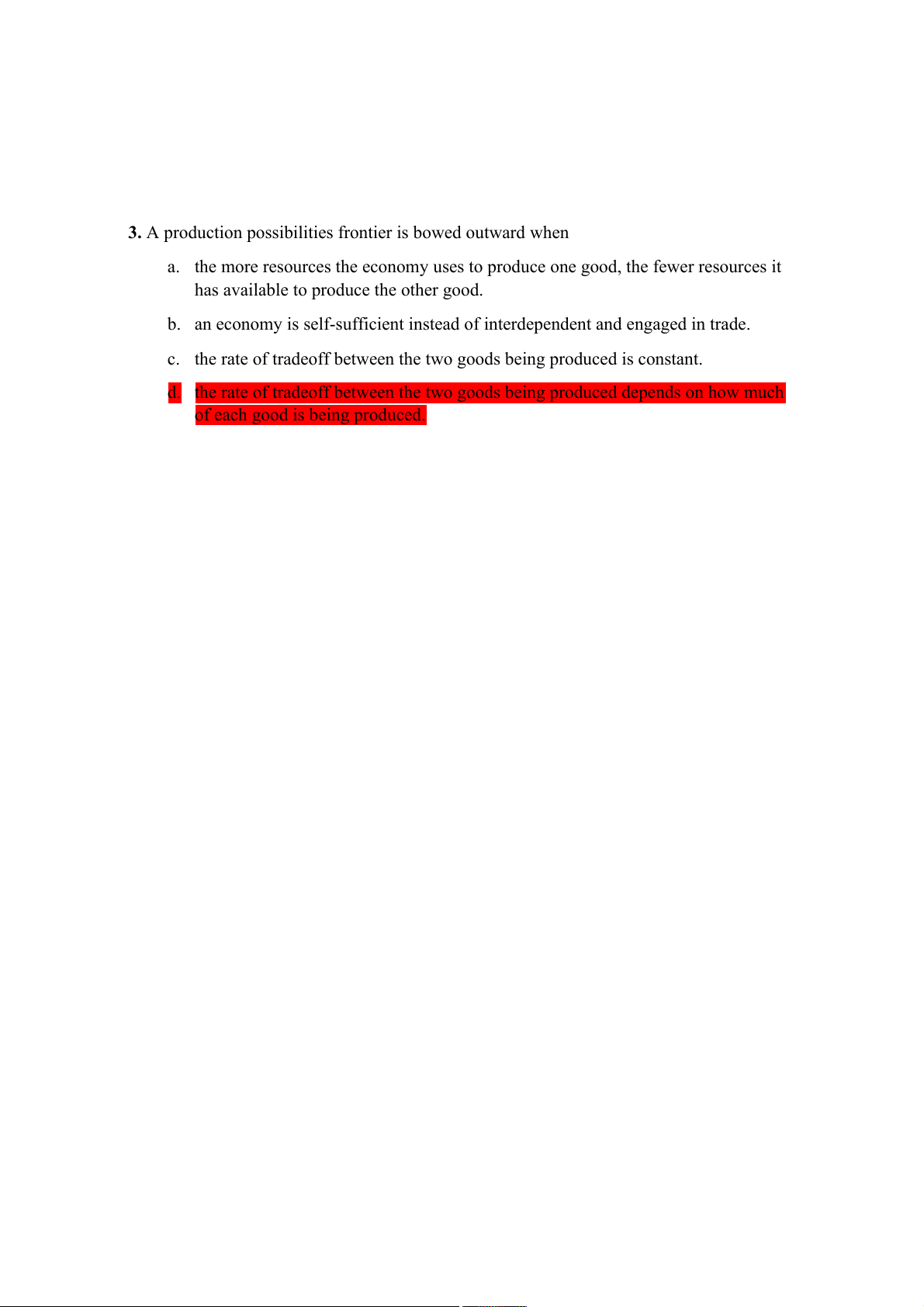
3. A production possibilities frontier is bowed outward when
a. the more resources the economy uses to produce one good, the fewer resources it
has available to produce the other good.
b. an economy is self-sufficient instead of interdependent and engaged in trade.
c. the rate of tradeoff between the two goods being produced is constant.
d. the rate of tradeoff between the two goods being produced depends on how much
of each good is being produced.
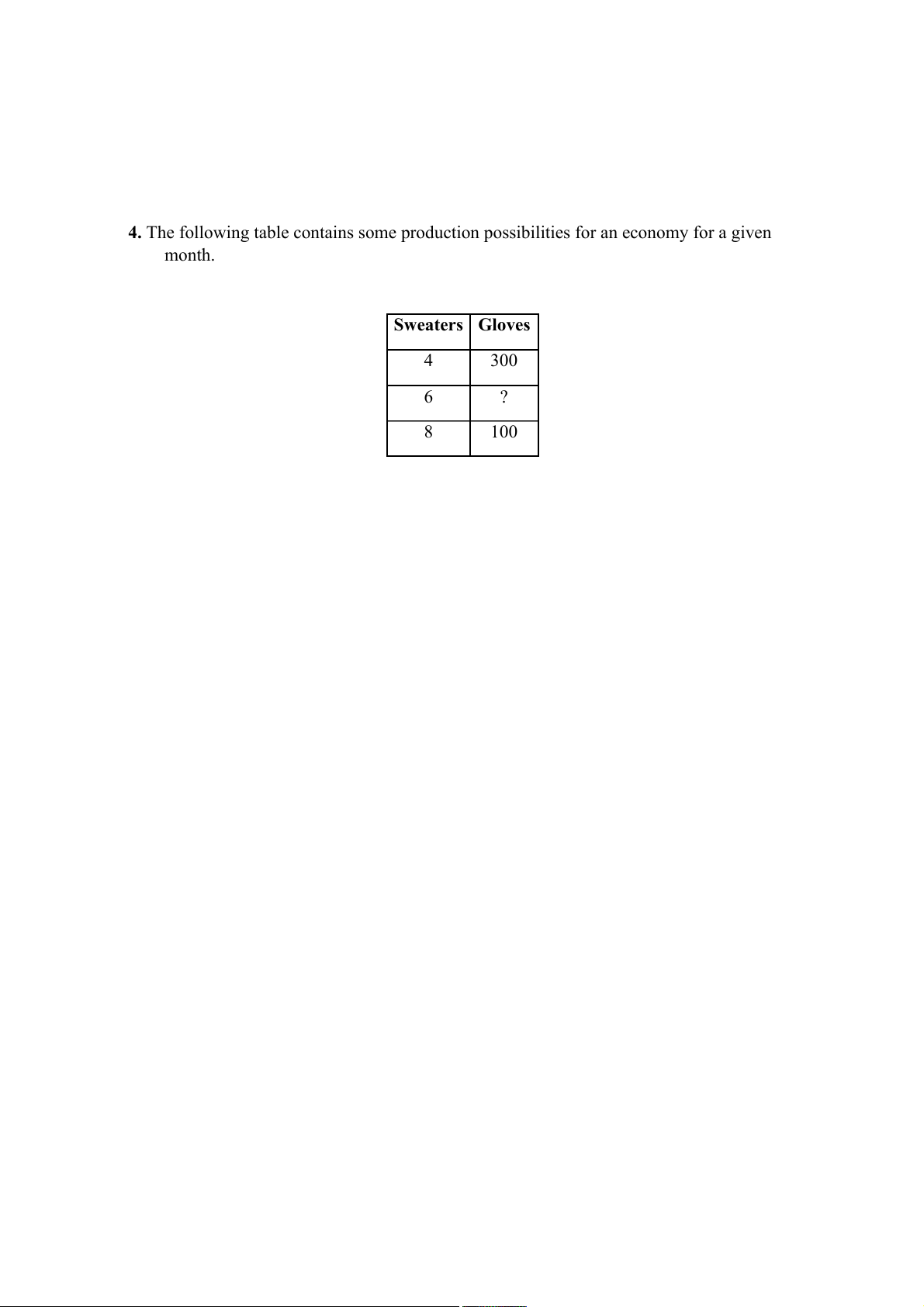
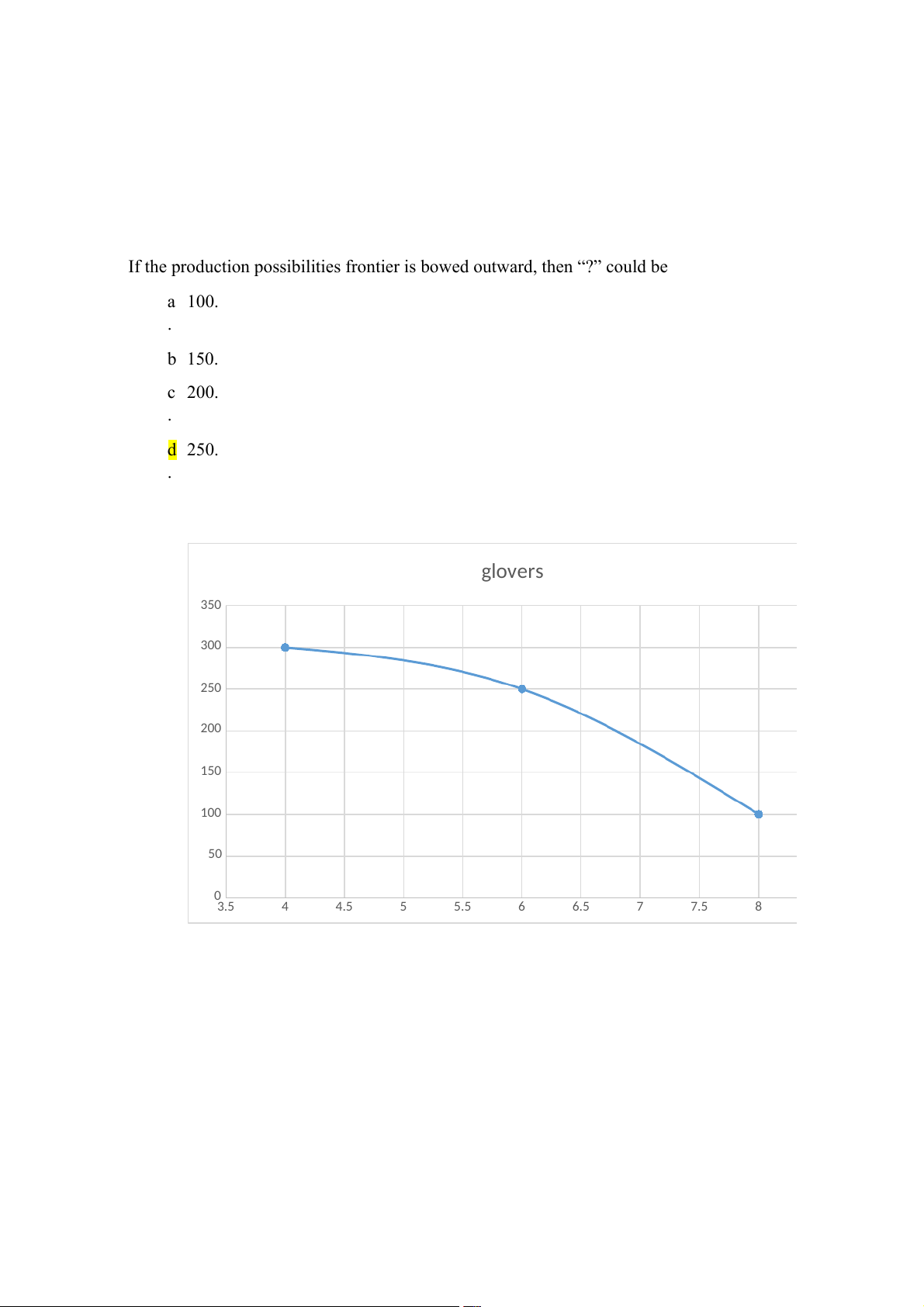
4. The following table contains some production possibilities for an economy for a given month. Sweaters Gloves 4 300 6 ? 8 100
If the production possibilities frontier is bowed outward, then “?” could be a 100. . b 150. c 200. . d 250. . glovers 350 300 250 200 150 100 50 03.5 4 4.5 5 5.5 6 6.5 7 7.5 8
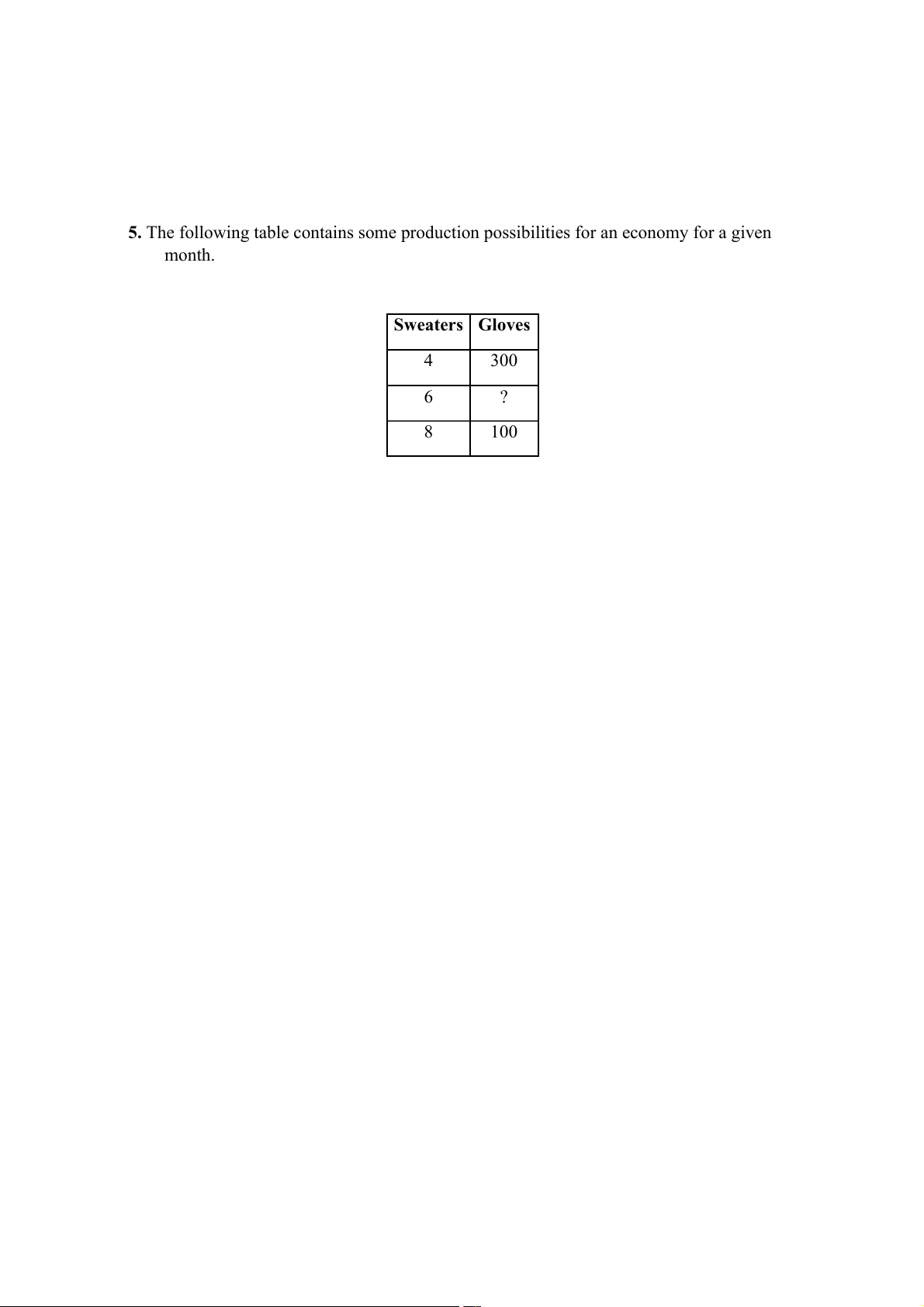
5. The following table contains some production possibilities for an economy for a given month. Sweaters Gloves 4 300 6 ? 8 100
If the production possibilities frontier is a straight line, then “?” must be a. 100. b. 150. c. 200. d. 250.
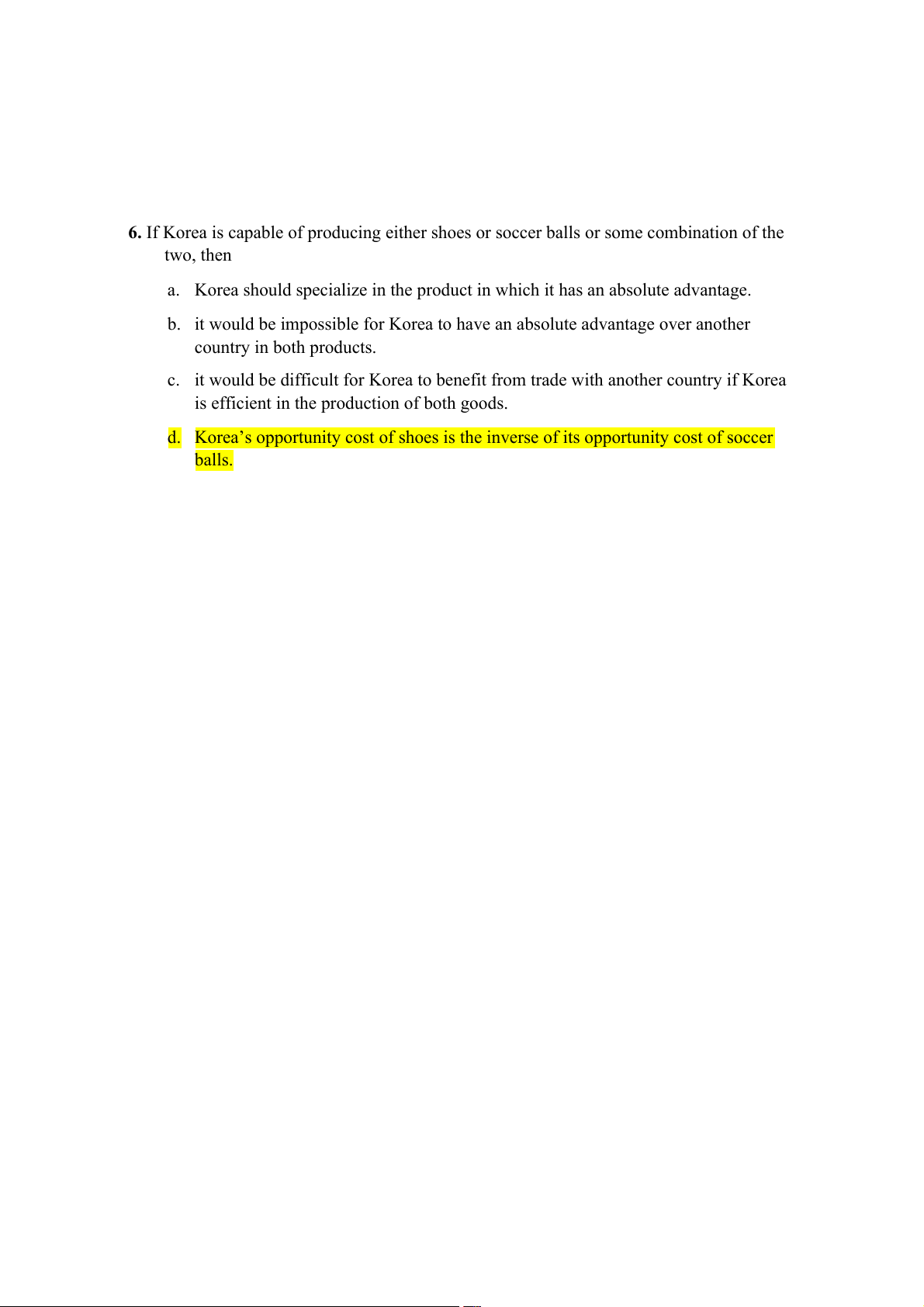
6. If Korea is capable of producing either shoes or soccer balls or some combination of the two, then
a. Korea should specialize in the product in which it has an absolute advantage.
b. it would be impossible for Korea to have an absolute advantage over another country in both products.
c. it would be difficult for Korea to benefit from trade with another country if Korea
is efficient in the production of both goods.
d. Korea’s opportunity cost of shoes is the inverse of its opportunity cost of soccer balls.
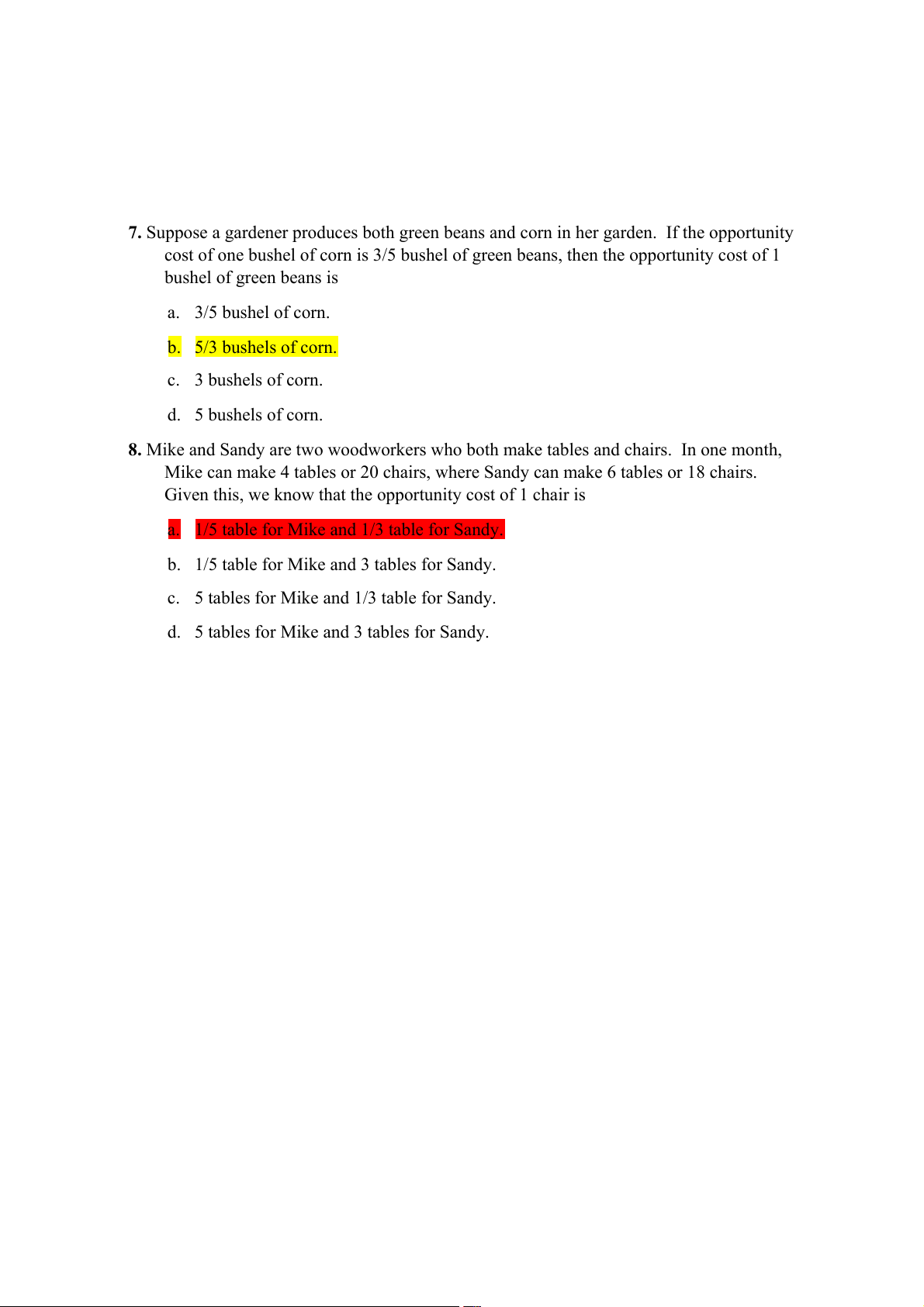
7. Suppose a gardener produces both green beans and corn in her garden. If the opportunity
cost of one bushel of corn is 3/5 bushel of green beans, then the opportunity cost of 1 bushel of green beans is a. 3/5 bushel of corn. b. 5/3 bushels of corn. c. 3 bushels of corn. d. 5 bushels of corn.
8. Mike and Sandy are two woodworkers who both make tables and chairs. In one month,
Mike can make 4 tables or 20 chairs, where Sandy can make 6 tables or 18 chairs.
Given this, we know that the opportunity cost of 1 chair is
a. 1/5 table for Mike and 1/3 table for Sandy.
b. 1/5 table for Mike and 3 tables for Sandy.
c. 5 tables for Mike and 1/3 table for Sandy.
d. 5 tables for Mike and 3 tables for Sandy.
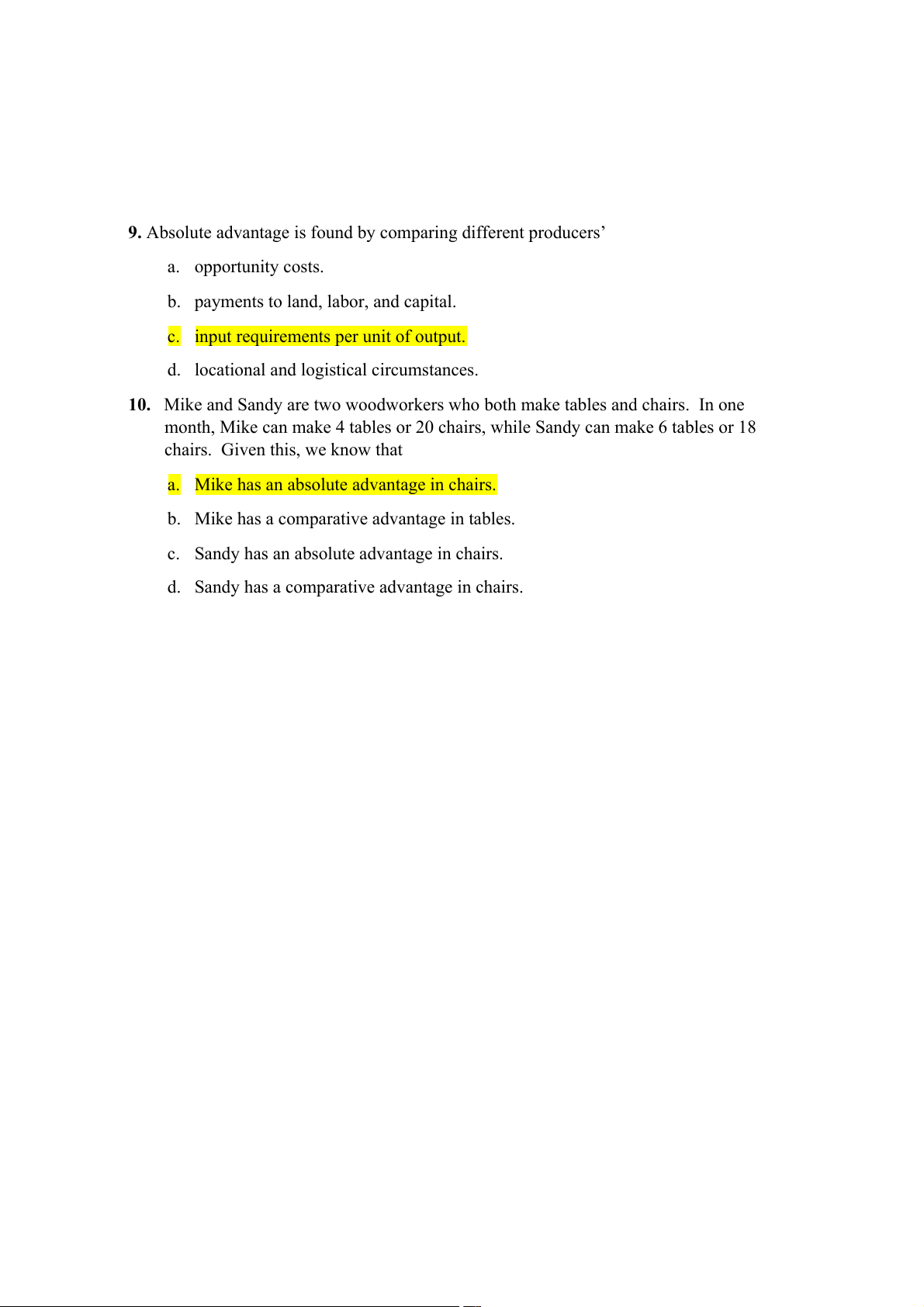
9. Absolute advantage is found by comparing different producers’ a. opportunity costs.
b. payments to land, labor, and capital.
c. input requirements per unit of output.
d. locational and logistical circumstances.
10. Mike and Sandy are two woodworkers who both make tables and chairs. In one
month, Mike can make 4 tables or 20 chairs, while Sandy can make 6 tables or 18
chairs. Given this, we know that
a. Mike has an absolute advantage in chairs.
b. Mike has a comparative advantage in tables.
c. Sandy has an absolute advantage in chairs.
d. Sandy has a comparative advantage in chairs.
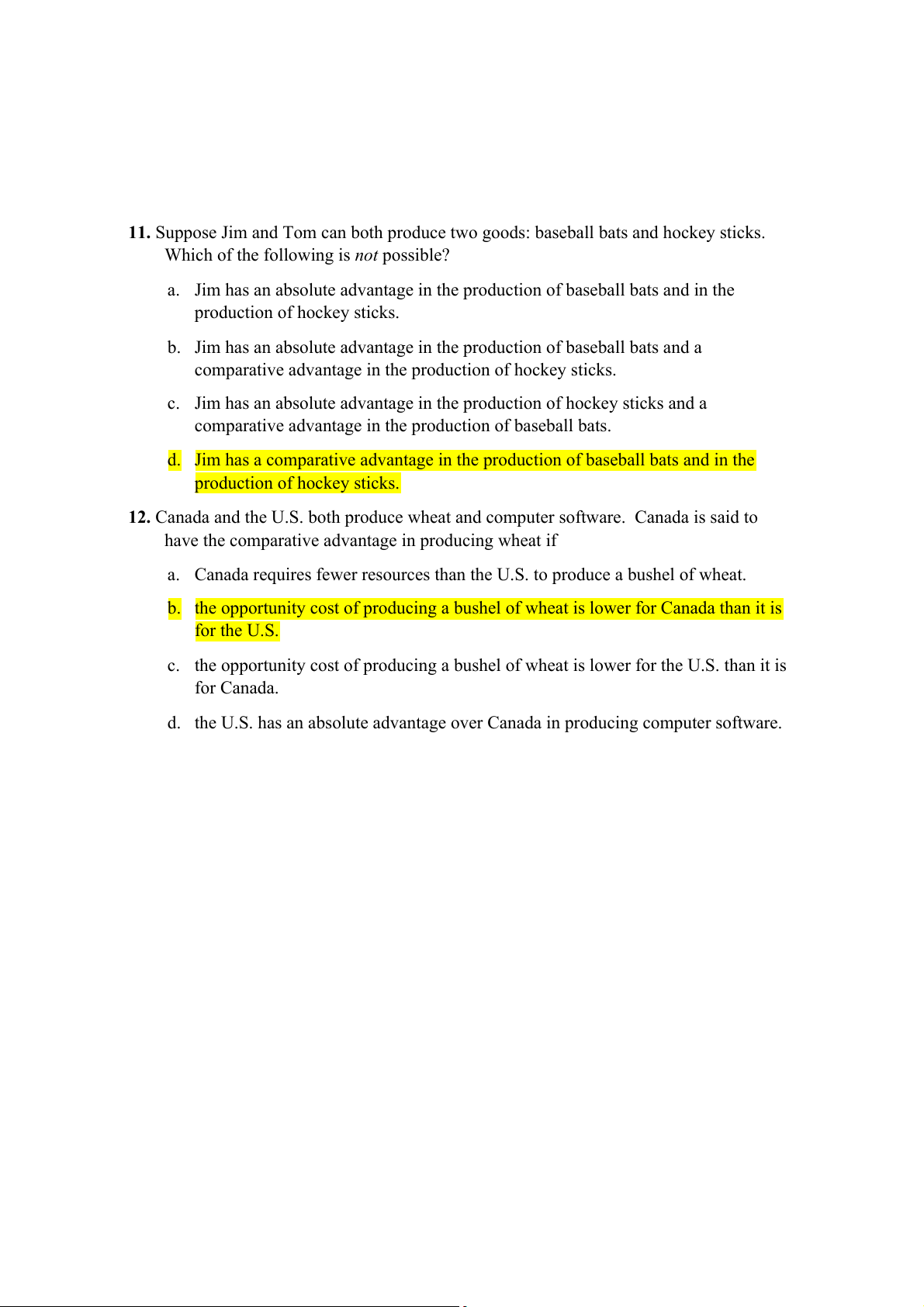
11. Suppose Jim and Tom can both produce two goods: baseball bats and hockey sticks.
Which of the following is not possible?
a. Jim has an absolute advantage in the production of baseball bats and in the production of hockey sticks.
b. Jim has an absolute advantage in the production of baseball bats and a
comparative advantage in the production of hockey sticks.
c. Jim has an absolute advantage in the production of hockey sticks and a
comparative advantage in the production of baseball bats.
d. Jim has a comparative advantage in the production of baseball bats and in the production of hockey sticks.
12. Canada and the U.S. both produce wheat and computer software. Canada is said to
have the comparative advantage in producing wheat if
a. Canada requires fewer resources than the U.S. to produce a bushel of wheat.
b. the opportunity cost of producing a bushel of wheat is lower for Canada than it is for the U.S.
c. the opportunity cost of producing a bushel of wheat is lower for the U.S. than it is for Canada.
d. the U.S. has an absolute advantage over Canada in producing computer software.
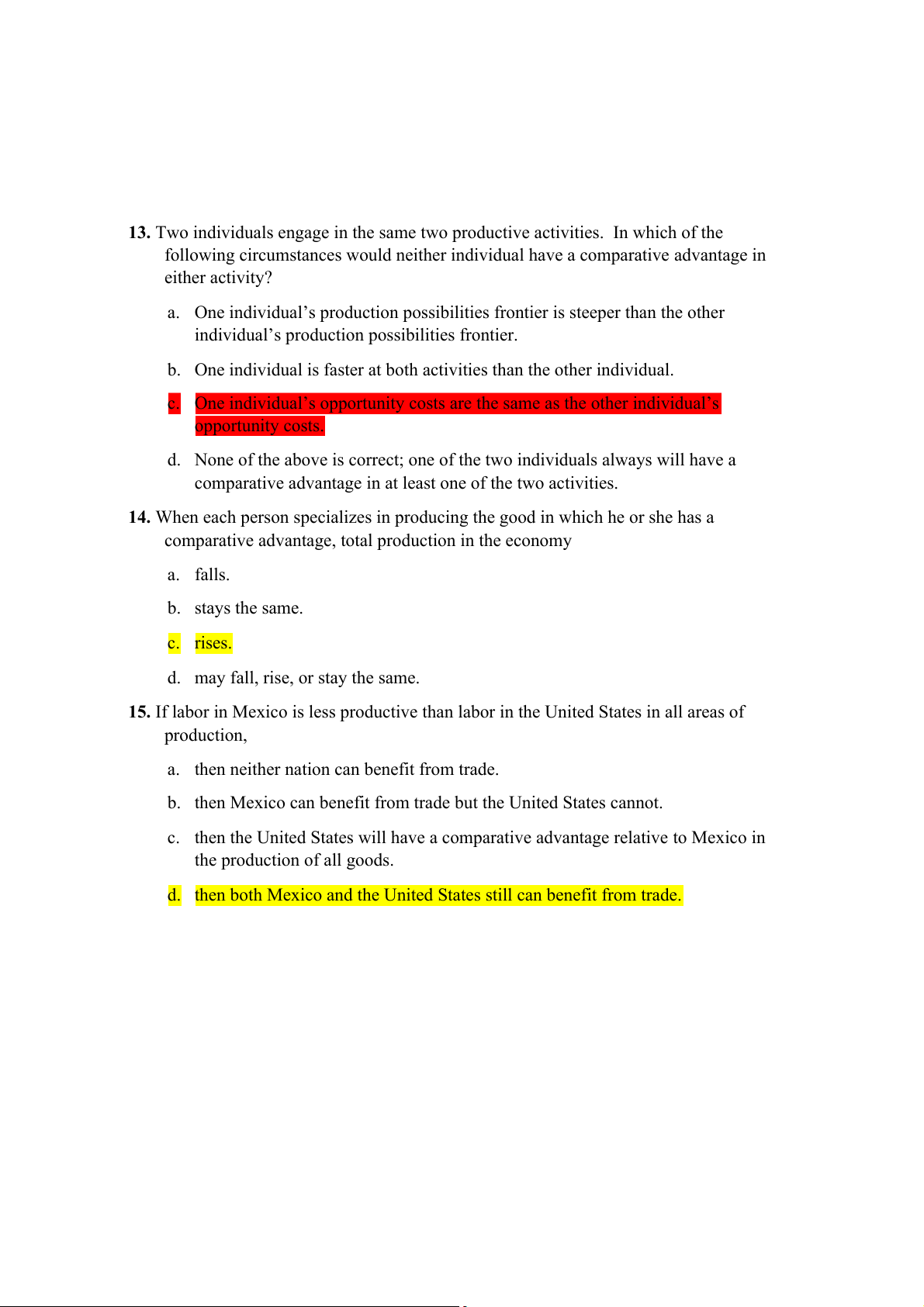
13. Two individuals engage in the same two productive activities. In which of the
following circumstances would neither individual have a comparative advantage in either activity?
a. One individual’s production possibilities frontier is steeper than the other
individual’s production possibilities frontier.
b. One individual is faster at both activities than the other individual.
c. One individual’s opportunity costs are the same as the other individual’s opportunity costs.
d. None of the above is correct; one of the two individuals always will have a
comparative advantage in at least one of the two activities.
14. When each person specializes in producing the good in which he or she has a
comparative advantage, total production in the economy a. falls. b. stays the same. c. rises.
d. may fall, rise, or stay the same.
15. If labor in Mexico is less productive than labor in the United States in all areas of production,
a. then neither nation can benefit from trade.
b. then Mexico can benefit from trade but the United States cannot.
c. then the United States will have a comparative advantage relative to Mexico in the production of all goods.
d. then both Mexico and the United States still can benefit from trade.
Tài liệu liên quan:
-
Chương 3: độ co giãn và các nhân tố ảnh hưởng | Microeconomics | Trường Đại học Quốc tế, Đại học Quốc gia Thành phố Hồ Chí Minh
3 2 -
Microeconomics Syllabus | Microeconomics | Trường Đại học Quốc tế, Đại học Quốc gia Thành phố Hồ Chí Minh
3 2 -
Microeconomics Course Syllabus & Assessment Details | Microeconomics | Trường Đại học Quốc tế, Đại học Quốc gia Thành phố Hồ Chí Minh
3 2 -
Assignment 3 - Elasticity MCQs and Key Concepts | Microeconomics | Trường Đại học Quốc tế, Đại học Quốc gia Thành phố Hồ Chí Minh
3 2 -
Assignment 2 - Economic Equilibrium Analysis of Fridges and Motorcycles | Microeconomics | Trường Đại học Quốc tế, Đại học Quốc gia Thành phố Hồ Chí Minh
3 2