True/False Questions and Economic Concepts Analysis | Microeconomics | Trường Đại học Quốc tế, Đại học Quốc gia Thành phố Hồ Chí Minh
In a market economy, supply and demand determine both the quantity of each good produced and the price at which it is sold. T 2. In a competitive market, the quantity of each good produced and the price at which it is sold are not determined by any single buyer or seller. F 3. The law of demand states that, other things equal, when the price of a good rises, the quantity demanded of the good rises, and when the price falls, the quantity demanded falls. F. Tài liệu được sưu tầm và soạn thảo dưới dạng file PDF để gửi tới các bạn cùng tham khảo, ôn tập đầy đủ kiến thức, chuẩn bị cho các buổi học thật tốt. Mời bạn đọc đón xem!
Môn: Microeconomics 635 tài liệu
Trường: Trường Đại học Quốc tế, Đại học Quốc gia Thành phố Hồ Chí Minh 1.9 K tài liệu
Tác giả:

Preview text:
Seminar 2 By Le Thanh Ha
Type I: True/False question (give a brief explanation)
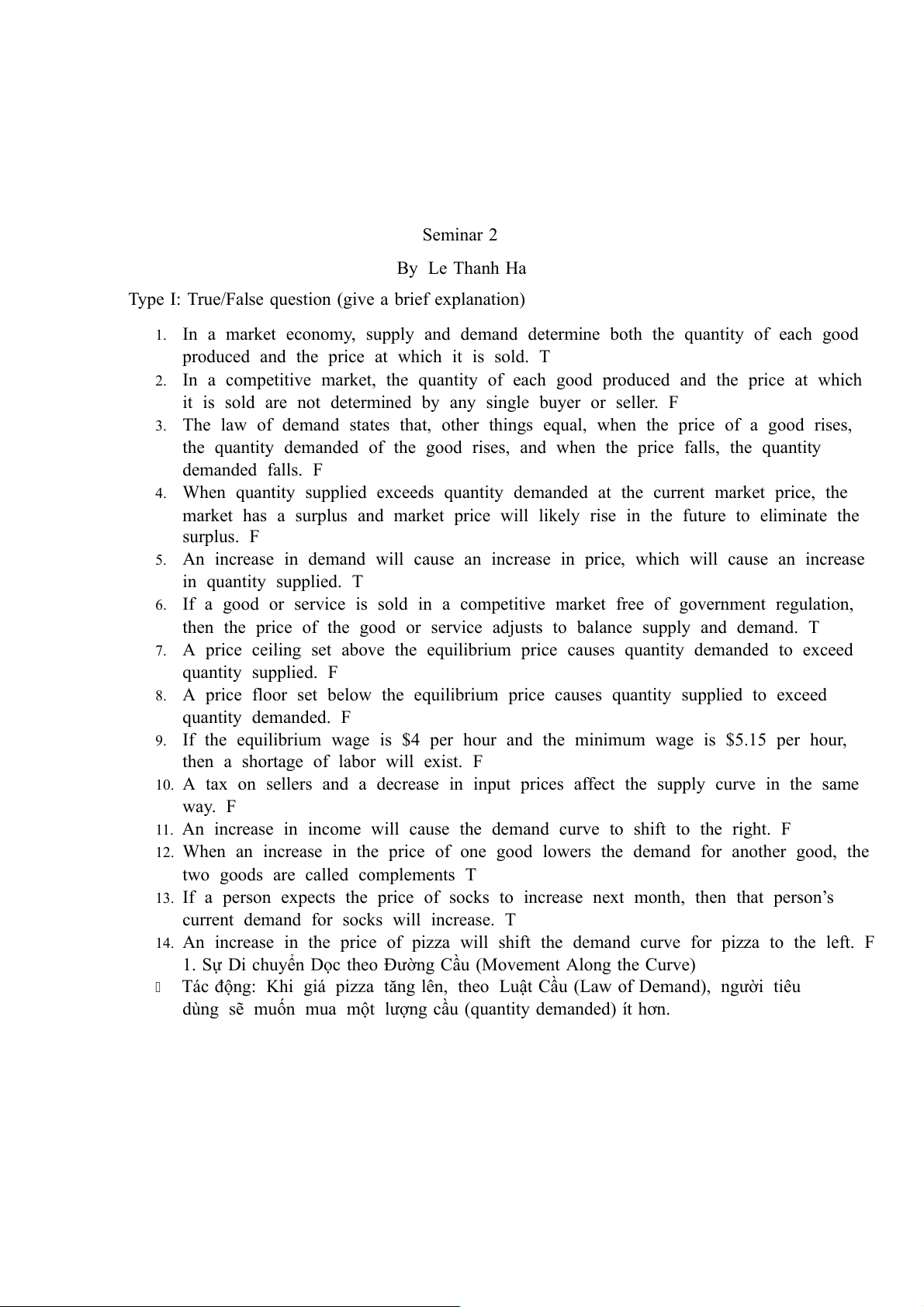
1. In a market economy, supply and demand determine both the quantity of each good
produced and the price at which it is sold. T
2. In a competitive market, the quantity of each good produced and the price at which
it is sold are not determined by any single buyer or seller. F
3. The law of demand states that, other things equal, when the price of a good rises,
the quantity demanded of the good rises, and when the price falls, the quantity demanded falls. F
4. When quantity supplied exceeds quantity demanded at the current market price, the
market has a surplus and market price will likely rise in the future to eliminate the surplus. F
5. An increase in demand will cause an increase in price, which will cause an increase in quantity supplied. T
6. If a good or service is sold in a competitive market free of government regulation,
then the price of the good or service adjusts to balance supply and demand. T
7. A price ceiling set above the equilibrium price causes quantity demanded to exceed quantity supplied. F
8. A price floor set below the equilibrium price causes quantity supplied to exceed quantity demanded. F
9. If the equilibrium wage is $4 per hour and the minimum wage is $5.15 per hour,
then a shortage of labor will exist. F
10. A tax on sellers and a decrease in input prices affect the supply curve in the same way. F
11. An increase in income will cause the demand curve to shift to the right. F
12. When an increase in the price of one good lowers the demand for another good, the
two goods are called complements T
13. If a person expects the price of socks to increase next month, then that person’s
current demand for socks will increase. T
14. An increase in the price of pizza will shift the demand curve for pizza to the left. F
1. Sự Di chuyển Dọc theo Đường Cầu (Movement Along the Curve)
Tác động: Khi giá pizza tăng lên, theo Luật
Cầu (Law of Demand), người tiêu
dùng sẽ muốn mua một lượng cầu (quantity demanded) ít hơn.
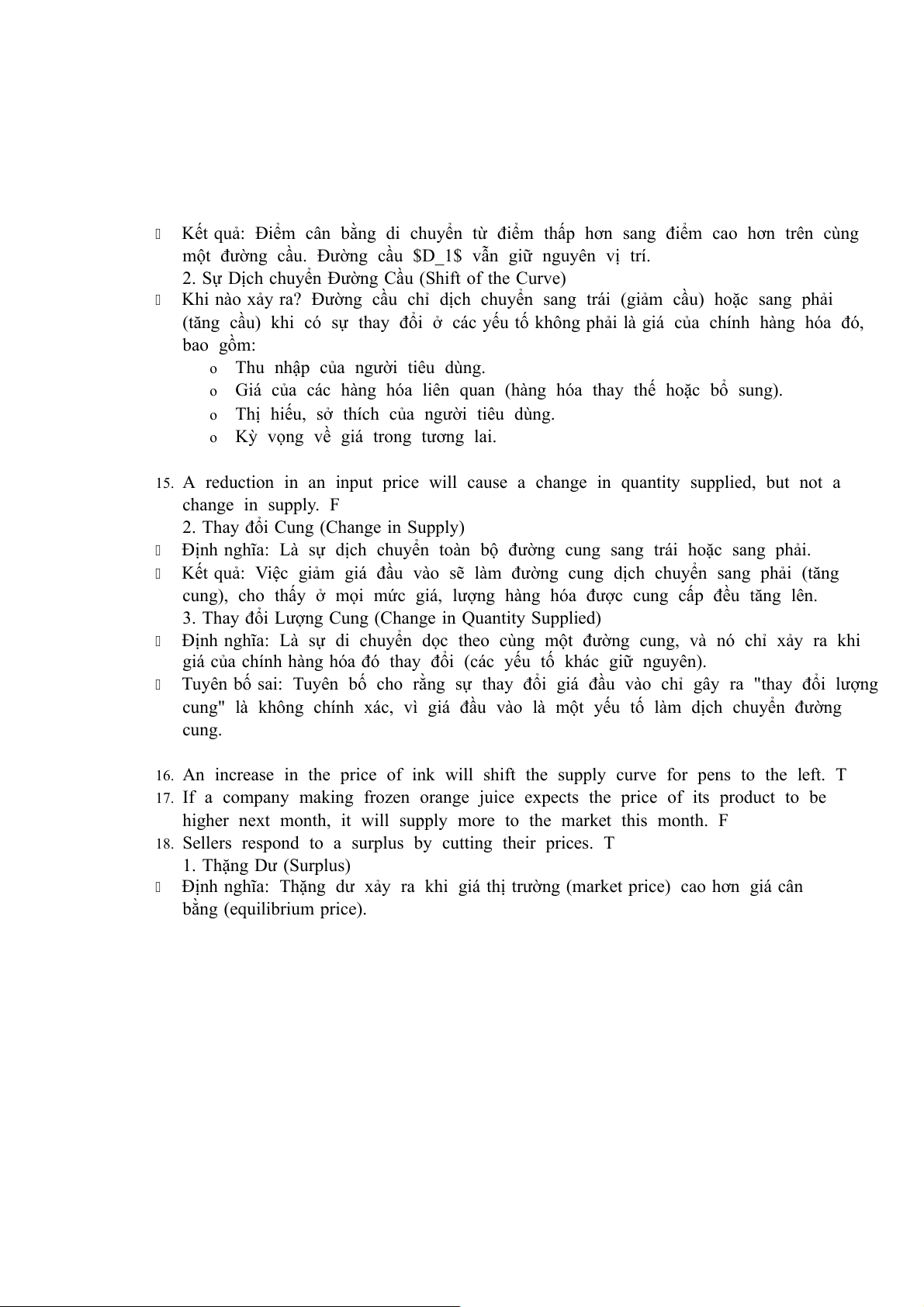
Kết quả: Điểm cân bằng di chuyển từ điểm thấp hơn sang điểm cao hơn trên cùng
một đường cầu. Đường cầu $D_1$ vẫn giữ nguyên vị trí.
2. Sự Dịch chuyển Đường Cầu (Shift of the Curve)
Khi nào xảy ra? Đường cầu chỉ dịch chuyển sang trái (giảm cầu) hoặc sang phải
(tăng cầu) khi có sự thay đổi ở các yếu tố không phải là giá của chính hàng hóa đó, bao gồm: o
Thu nhập của người tiêu dùng. o
Giá của các hàng hóa liên quan (hàng hóa thay thế hoặc bổ sung). o
Thị hiếu, sở thích của người tiêu dùng. o
Kỳ vọng về giá trong tương lai.
15. A reduction in an input price will cause a change in quantity supplied, but not a change in supply. F
2. Thay đổi Cung (Change in Supply)
Định nghĩa: Là sự dịch chuyển toàn bộ đường cung sang trái hoặc sang phải.
Kết quả: Việc giảm giá đầu vào sẽ làm đường cung dịch chuyển sang phải (tăng
cung), cho thấy ở mọi mức giá, lượng hàng hóa được cung cấp đều tăng lên.
3. Thay đổi Lượng Cung (Change in Quantity Supplied)
Định nghĩa: Là sự di chuyển dọc theo cùng một đường cung, và nó chỉ xảy ra khi
giá của chính hàng hóa đó thay đổi (các yếu tố khác giữ nguyên).
Tuyên bố sai: Tuyên bố cho rằng sự thay đổi giá đầu vào chỉ gây ra "thay đổi lượng
cung" là không chính xác, vì giá đầu vào là một yếu tố làm dịch chuyển đường cung.
16. An increase in the price of ink will shift the supply curve for pens to the left. T
17. If a company making frozen orange juice expects the price of its product to be
higher next month, it will supply more to the market this month. F
18. Sellers respond to a surplus by cutting their prices. T
1. Thặng Dư (Surplus)
Định nghĩa: Thặng dư xảy ra khi giá thị trường (market price) cao hơn giá cân
bằng (equilibrium price).
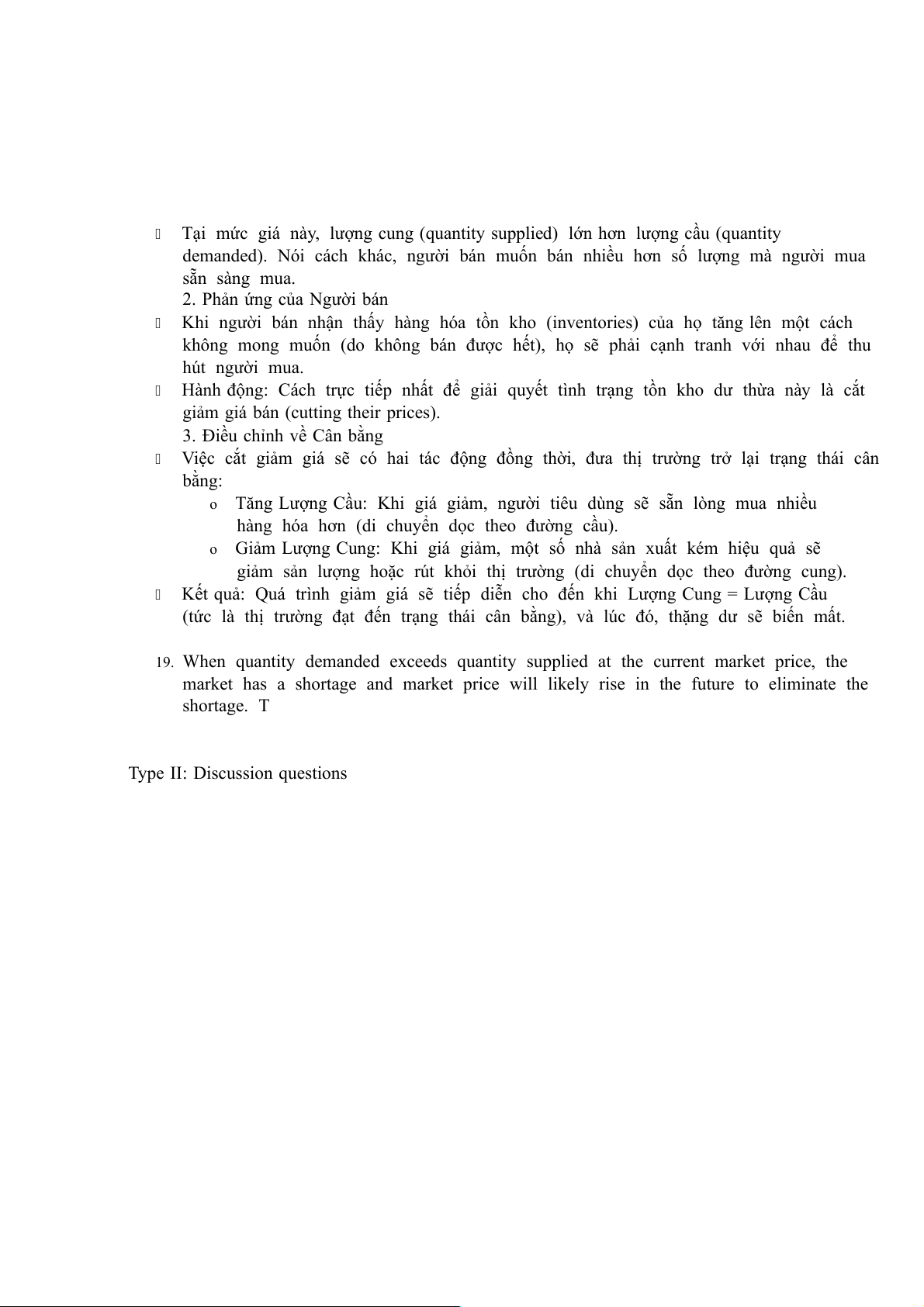
Tại mức giá này, lượng cung (quantity supplied) lớn hơn lượng cầu (quantity
demanded). Nói cách khác, người bán muốn bán nhiều hơn số lượng mà người mua sẵn sàng mua.
2. Phản ứng của Người bán
Khi người bán nhận thấy hàng hóa tồn kho (inventories) của họ tăng lên một cách
không mong muốn (do không bán được hết), họ sẽ phải cạnh tranh với nhau để thu hút người mua.
Hành động: Cách trực tiếp nhất để giải quyết tình trạng tồn kho dư thừa này là cắt
giảm giá bán (cutting their prices).
3. Điều chỉnh về Cân bằng
Việc cắt giảm giá sẽ có hai tác động đồng thời, đưa thị trường trở lại trạng thái cân bằng: o
Tăng Lượng Cầu: Khi giá giảm, người tiêu dùng sẽ sẵn lòng mua nhiều
hàng hóa hơn (di chuyển dọc theo đường cầu). o
Giảm Lượng Cung: Khi giá giảm, một số nhà sản xuất kém hiệu quả sẽ
giảm sản lượng hoặc rút khỏi thị trường (di chuyển dọc theo đường cung).
Kết quả: Quá trình giảm giá sẽ tiếp diễn cho đến khi Lượng
Cung = Lượng Cầu
(tức là thị trường đạt đến trạng thái cân bằng), và lúc đó, thặng dư sẽ biến mất.
19. When quantity demanded exceeds quantity supplied at the current market price, the
market has a shortage and market price will likely rise in the future to eliminate the shortage. T
Type II: Discussion questions
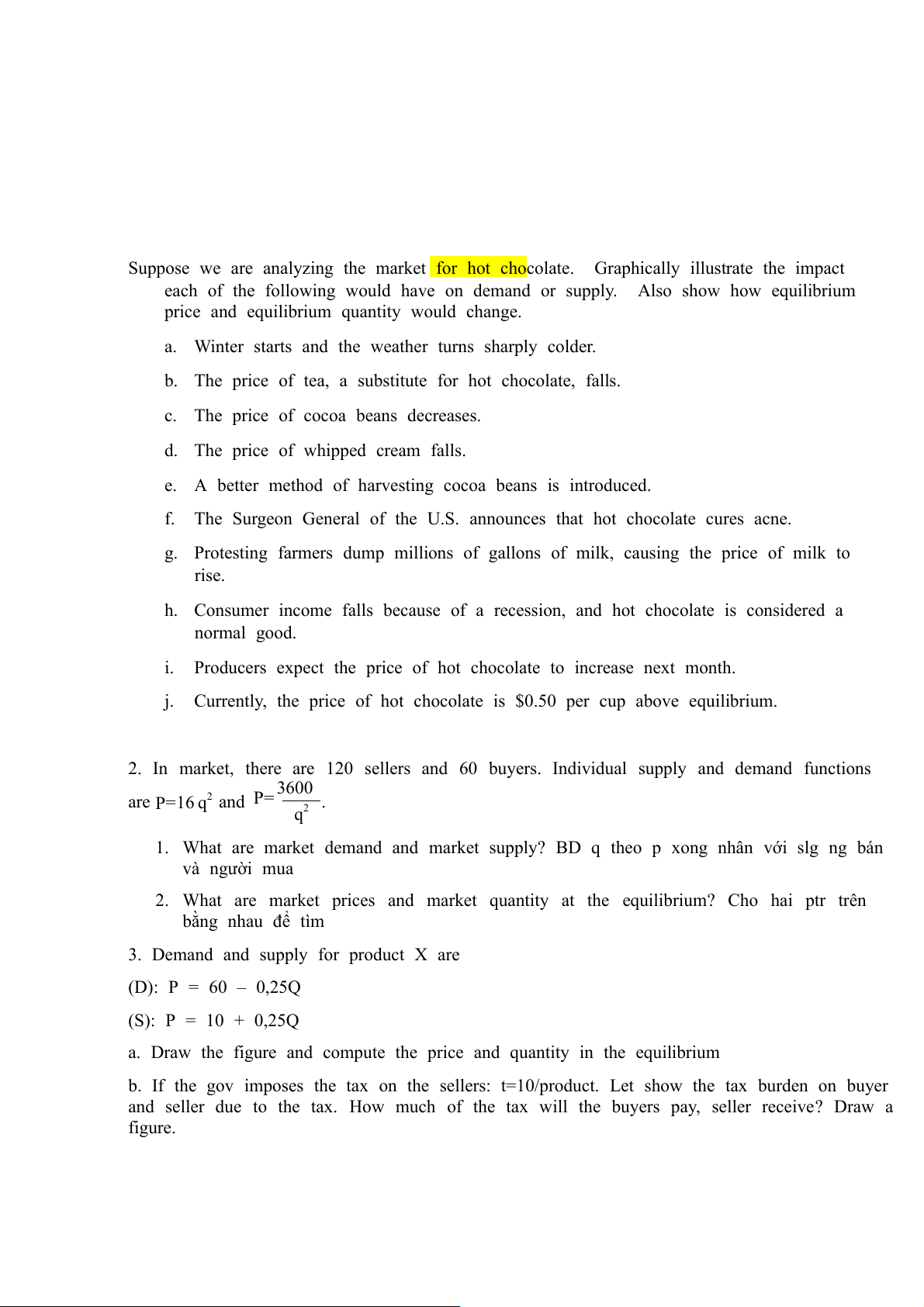
Suppose we are analyzing the market for hot chocolate. Graphically illustrate the impact
each of the following would have on demand or supply. Also show how equilibrium
price and equilibrium quantity would change.
a. Winter starts and the weather turns sharply colder.
b. The price of tea, a substitute for hot chocolate, falls.
c. The price of cocoa beans decreases.
d. The price of whipped cream falls.
e. A better method of harvesting cocoa beans is introduced.
f. The Surgeon General of the U.S. announces that hot chocolate cures acne.
g. Protesting farmers dump millions of gallons of milk, causing the price of milk to rise.
h. Consumer income falls because of a recession, and hot chocolate is considered a normal good. i.
Producers expect the price of hot chocolate to increase next month. j.
Currently, the price of hot chocolate is $0.50 per cup above equilibrium.
2. In market, there are 120 sellers and 60 buyers. Individual supply and demand functions 3600 are P=16 q2 and P= q2 .
1. What are market demand and market supply? BD q theo p xong nhân với slg ng bán và người mua
2. What are market prices and market quantity at the equilibrium? Cho hai ptr trên bằng nhau để tìm
3. Demand and supply for product X are (D): P = 60 – 0,25Q (S): P = 10 + 0,25Q
a. Draw the figure and compute the price and quantity in the equilibrium
b. If the gov imposes the tax on the sellers: t=10/product. Let show the tax burden on buyer
and seller due to the tax. How much of the tax will the buyers pay, seller receive? Draw a figure.
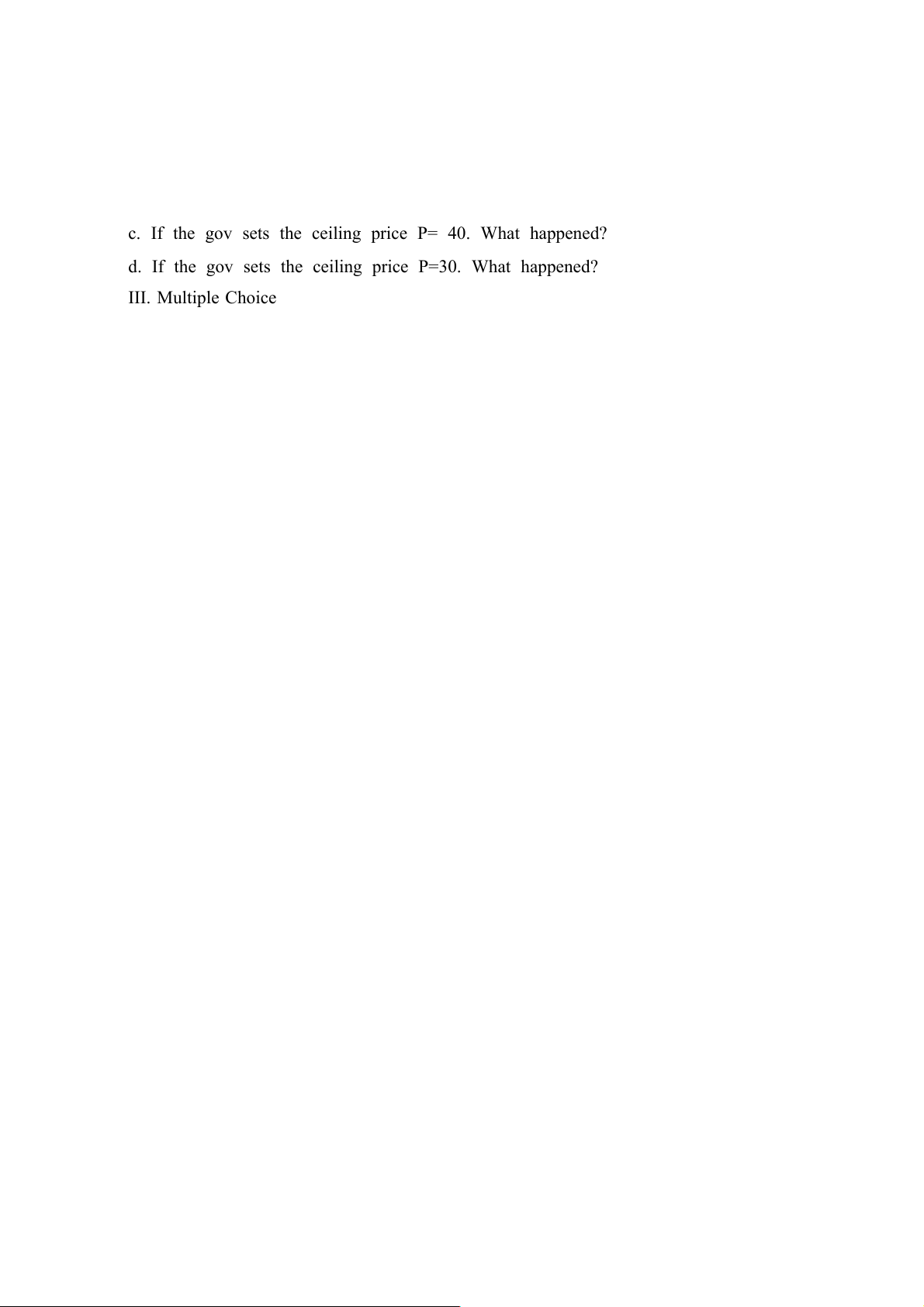
c. If the gov sets the ceiling price P= 40. What happened?
d. If the gov sets the ceiling price P=30. What happened?
III. Multiple Choice
Tài liệu liên quan:
-
Chương 3: độ co giãn và các nhân tố ảnh hưởng | Microeconomics | Trường Đại học Quốc tế, Đại học Quốc gia Thành phố Hồ Chí Minh
5 3 -
Microeconomics Syllabus | Microeconomics | Trường Đại học Quốc tế, Đại học Quốc gia Thành phố Hồ Chí Minh
5 3 -
Microeconomics Course Syllabus & Assessment Details | Microeconomics | Trường Đại học Quốc tế, Đại học Quốc gia Thành phố Hồ Chí Minh
5 3 -
Assignment 3 - Elasticity MCQs and Key Concepts | Microeconomics | Trường Đại học Quốc tế, Đại học Quốc gia Thành phố Hồ Chí Minh
5 3 -
Assignment 2 - Economic Equilibrium Analysis of Fridges and Motorcycles | Microeconomics | Trường Đại học Quốc tế, Đại học Quốc gia Thành phố Hồ Chí Minh
5 3