True/False Questions on Economic Policies and Market Structures | Microeconomics | Trường Đại học Quốc tế, Đại học Quốc gia Thành phố Hồ Chí Minh
Pigouvian taxes and subsidies can help eliminate the deadweight loss created by externalities in the market. (Vẽ 2 đồ thị hoặc viết: Taxes on goods with negative externalities can make consumers pay the full social cost of the good, while subsidies can be used to encourage the consumption of goods with positive externalities. In both cases, they lead to a socially efÏcient market consumption. Tài liệu được sưu tầm và soạn thảo dưới dạng file PDF để gửi tới các bạn cùng tham khảo, ôn tập đầy đủ kiến thức, chuẩn bị cho các buổi học thật tốt. Mời bạn đọc đón xem!
Môn: Microeconomics 635 tài liệu
Trường: Trường Đại học Quốc tế, Đại học Quốc gia Thành phố Hồ Chí Minh 1.9 K tài liệu
Tác giả:

Preview text:
SET 1 + Code 1001
1. FALSE. A market-based policy creates an economic incentive for firms to
deal with their externalities at a lower cost to society. In contrast, a
command-and-control policy may be more expensive, as it requires hiring
regulators to monitor and enforce compliance with regulations.
(Xem lại Chap. 10, Public Policies to deal with Externalities, xem kĩ ví dụ 2 firms)
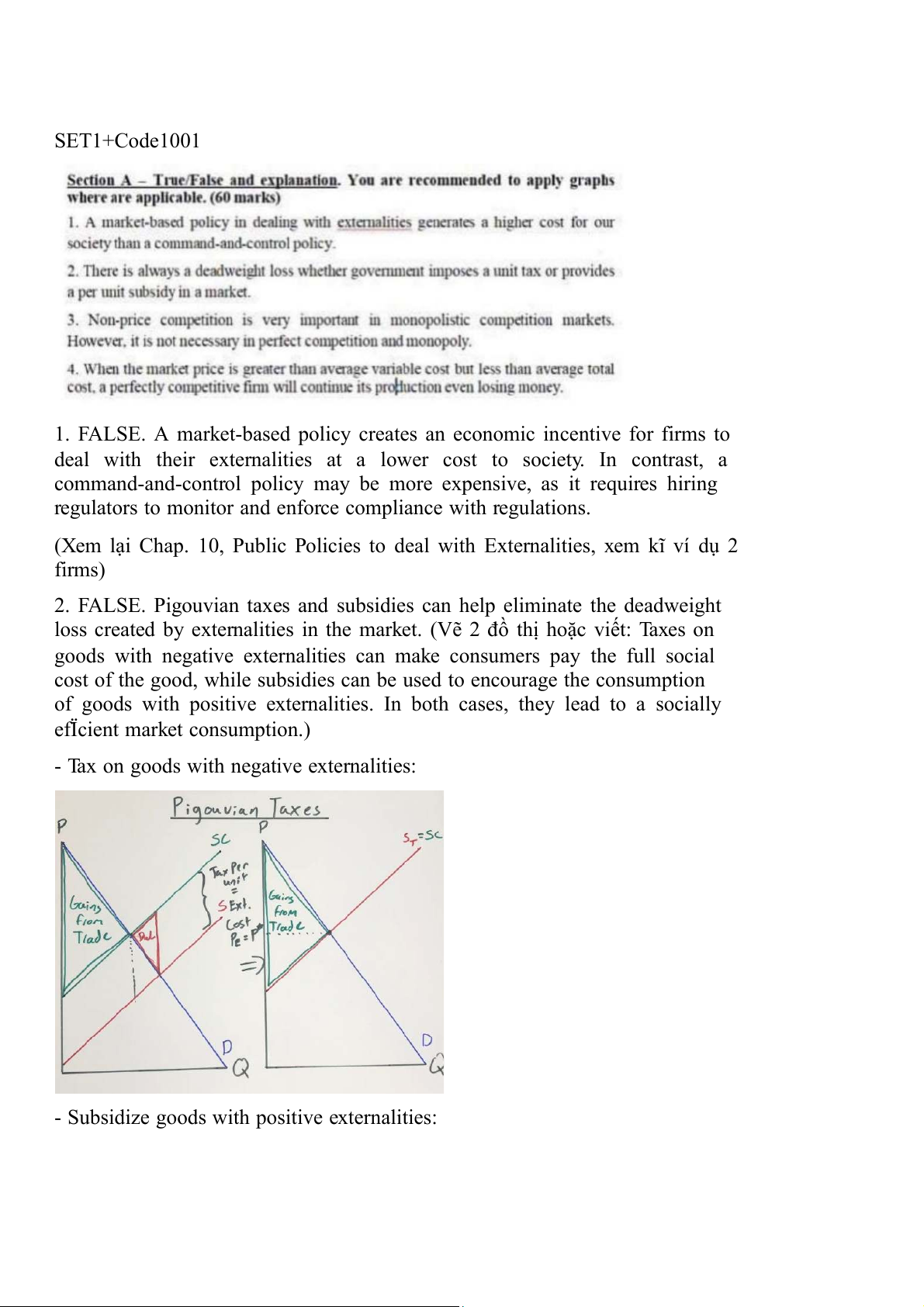
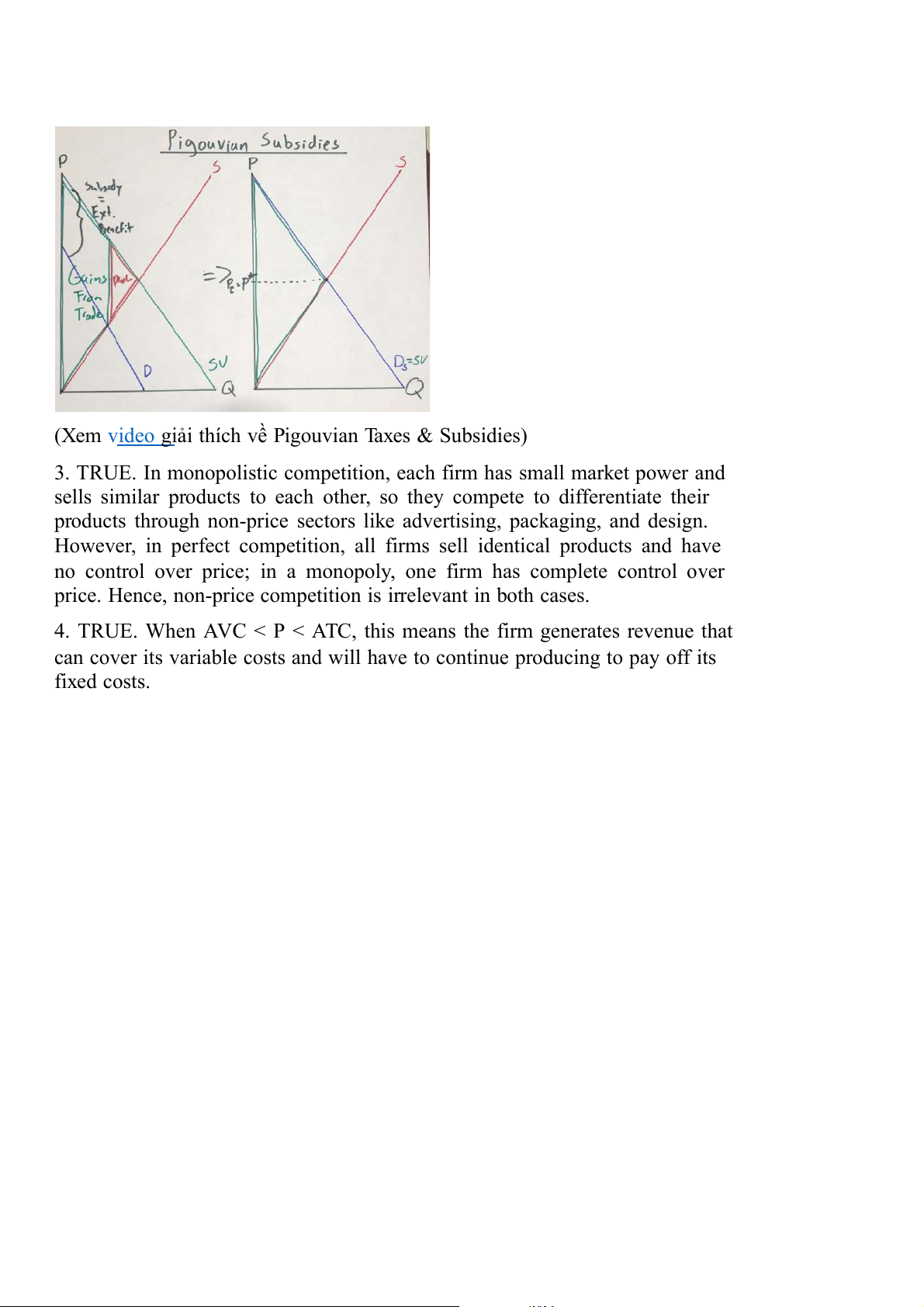
2. FALSE. Pigouvian taxes and subsidies can help eliminate the deadweight
loss created by externalities in the market. (Vẽ 2 đồ thị hoặc viết: Taxes on
goods with negative externalities can make consumers pay the full social
cost of the good, while subsidies can be used to encourage the consumption
of goods with positive externalities. In both cases, they lead to a socially efÏcient market consumption.)
- Tax on goods with negative externalities:
- Subsidize goods with positive externalities:
(Xem video giải thích về Pigouvian Taxes & Subsidies)
3. TRUE. In monopolistic competition, each firm has small market power and
sells similar products to each other, so they compete to differentiate their
products through non-price sectors like advertising, packaging, and design.
However, in perfect competition, all firms sell identical products and have
no control over price; in a monopoly, one firm has complete control over
price. Hence, non-price competition is irrelevant in both cases.
4. TRUE. When AVC < P < ATC, this means the firm generates revenue that
can cover its variable costs and will have to continue producing to pay off its fixed costs. Code 12
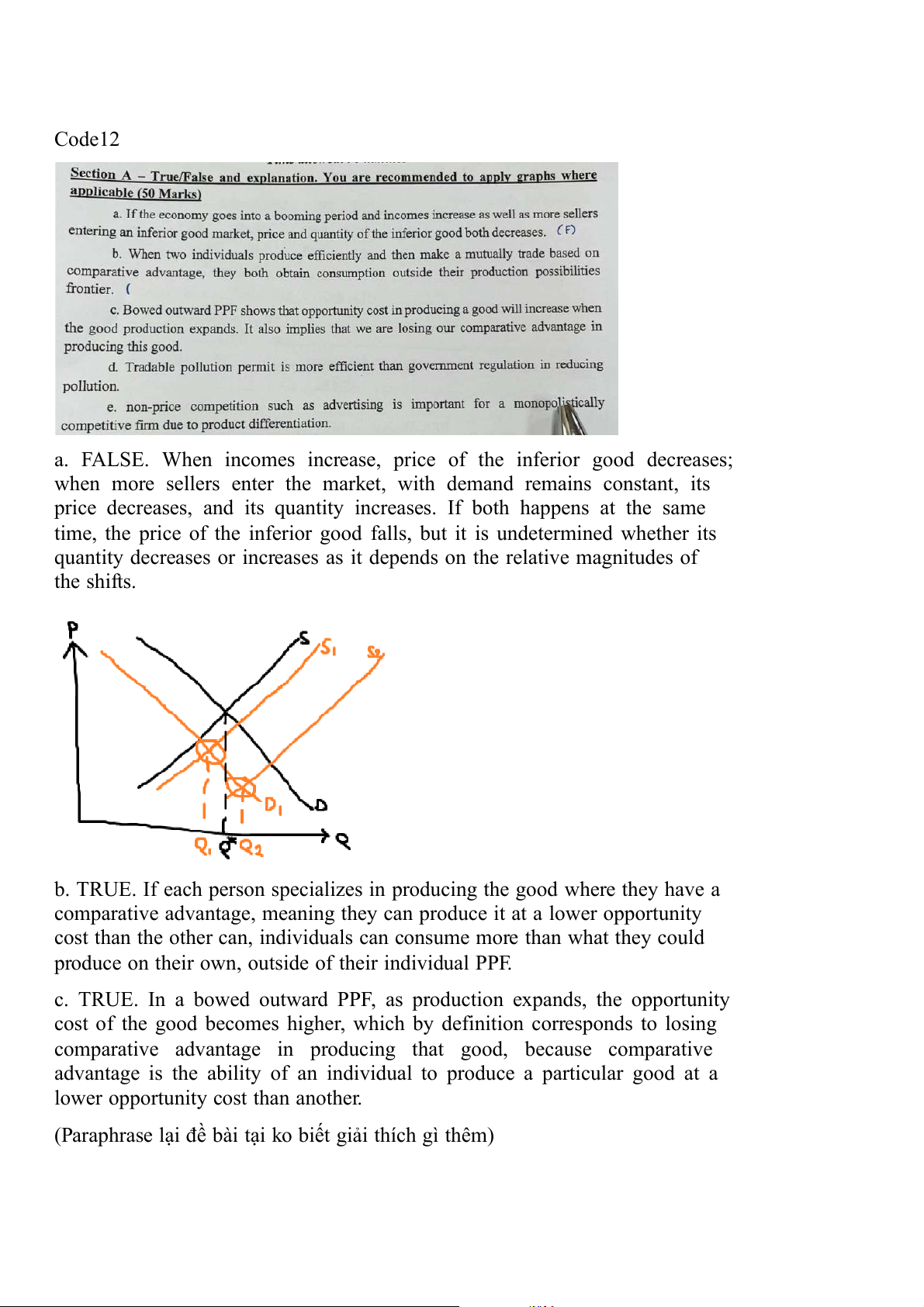
a. FALSE. When incomes increase, price of the inferior good decreases;
when more sellers enter the market, with demand remains constant, its
price decreases, and its quantity increases. If both happens at the same
time, the price of the inferior good falls, but it is undetermined whether its
quantity decreases or increases as it depends on the relative magnitudes of the shifts.
b. TRUE. If each person specializes in producing the good where they have a
comparative advantage, meaning they can produce it at a lower opportunity
cost than the other can, individuals can consume more than what they could
produce on their own, outside of their individual PPF.
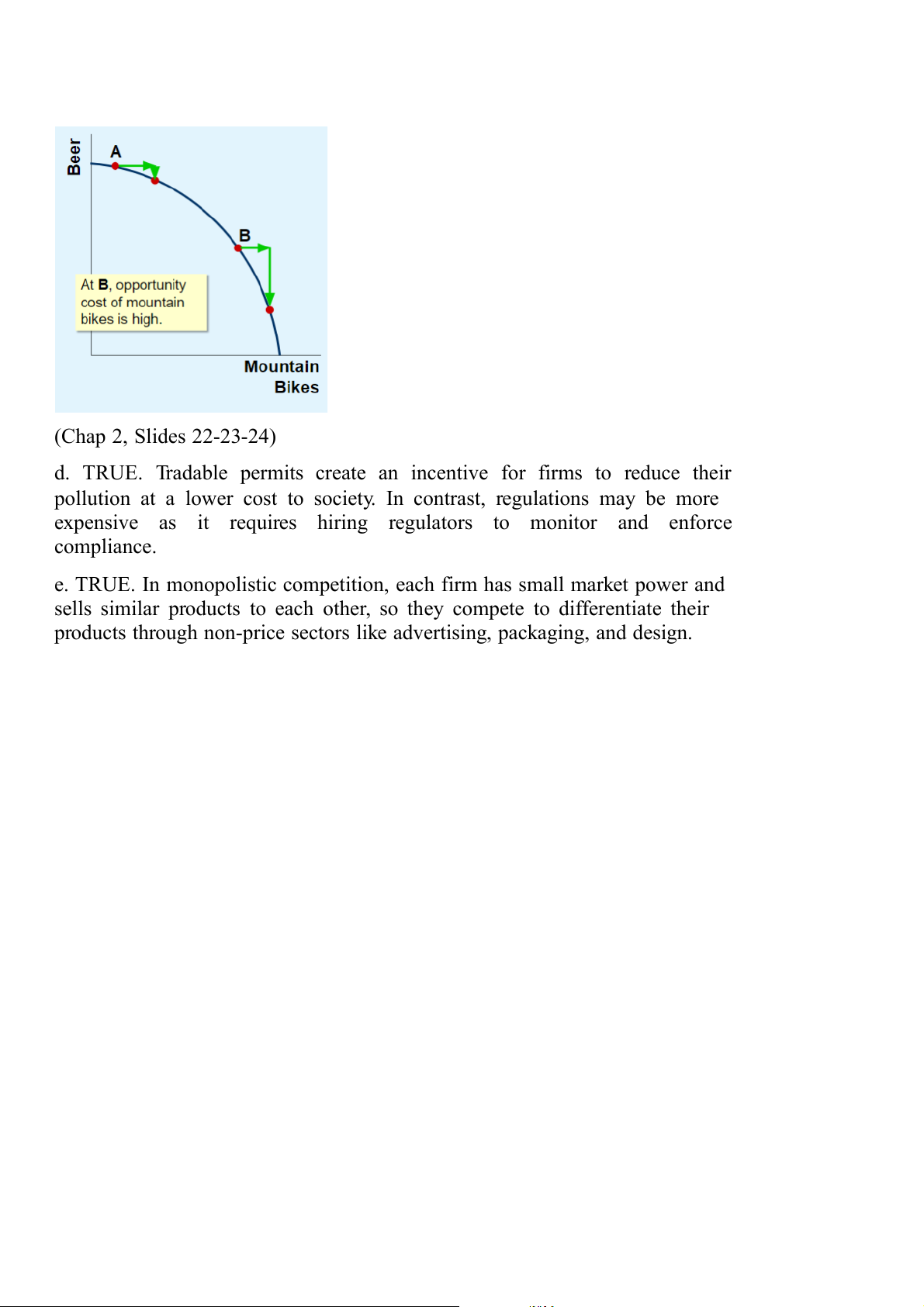
c. TRUE. In a bowed outward PPF, as production expands, the opportunity
cost of the good becomes higher, which by definition corresponds to losing
comparative advantage in producing that good, because comparative
advantage is the ability of an individual to produce a particular good at a
lower opportunity cost than another.
(Paraphrase lại đề bài tại ko biết giải thích gì thêm) (Chap 2, Slides 22-23-24)
d. TRUE. Tradable permits create an incentive for firms to reduce their
pollution at a lower cost to society. In contrast, regulations may be more
expensive as it requires hiring regulators to monitor and enforce compliance.
e. TRUE. In monopolistic competition, each firm has small market power and
sells similar products to each other, so they compete to differentiate their
products through non-price sectors like advertising, packaging, and design.
Code 04 / Code 10
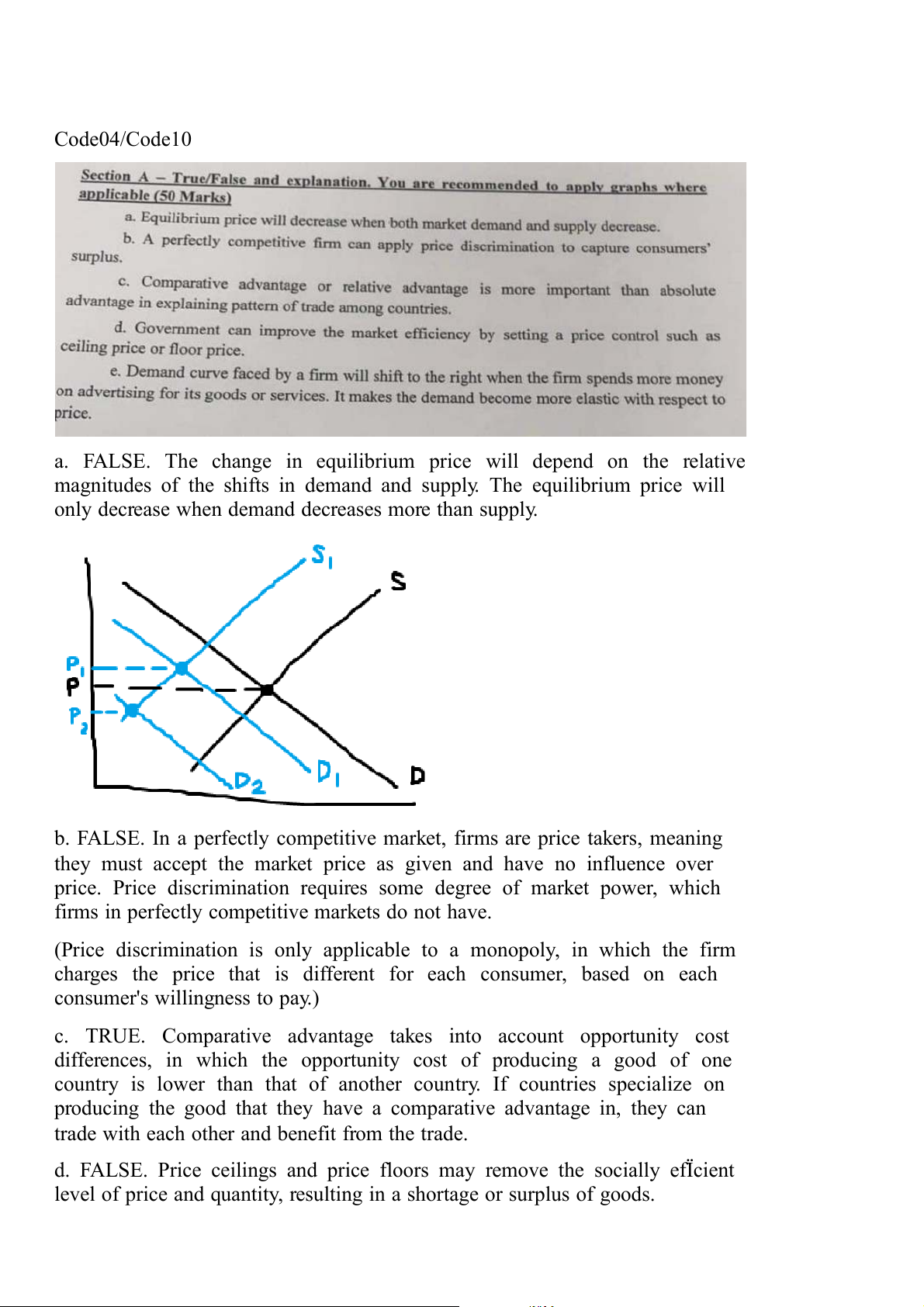
a. FALSE. The change in equilibrium price will depend on the relative
magnitudes of the shifts in demand and supply. The equilibrium price will
only decrease when demand decreases more than supply.
b. FALSE. In a perfectly competitive market, firms are price takers, meaning
they must accept the market price as given and have no influence over
price. Price discrimination requires some degree of market power, which
firms in perfectly competitive markets do not have.
(Price discrimination is only applicable to a monopoly, in which the firm
charges the price that is different for each consumer, based on each
consumer's willingness to pay.)
c. TRUE. Comparative advantage takes into account opportunity cost
differences, in which the opportunity cost of producing a good of one
country is lower than that of another country. If countries specialize on
producing the good that they have a comparative advantage in, they can
trade with each other and benefit from the trade.
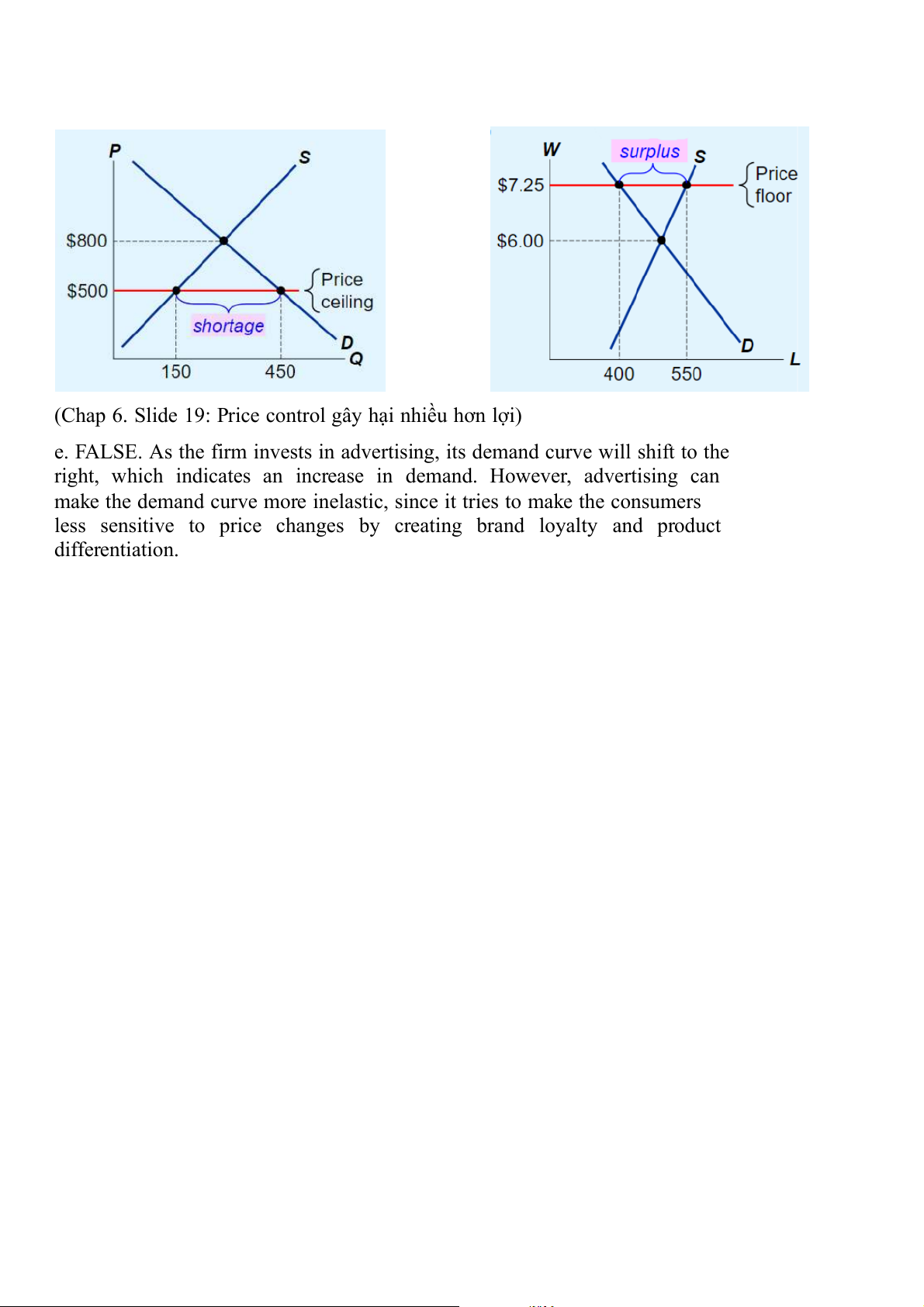
d. FALSE. Price ceilings and price floors may remove the socially efÏcient
level of price and quantity, resulting in a shortage or surplus of goods.
(Chap 6. Slide 19: Price control gây hại nhiều hơn lợi)
e. FALSE. As the firm invests in advertising, its demand curve will shift to the
right, which indicates an increase in demand. However, advertising can
make the demand curve more inelastic, since it tries to make the consumers
less sensitive to price changes by creating brand loyalty and product differentiation. Code 05
a. FALSE. Comparative advantage takes into account opportunity cost
differences, in which the opportunity cost of producing a good of one
country is lower than that of another country. If countries specialize in
producing the good that they have a comparative advantage in, they can
trade with each other and benefit from the trade.
b. FALSE. When incomes fall, the demand for inferior good increases; when
more sellers enter the inferior good market, price decreases and quantity
increases (assuming that demand is constant). If both happens at the same
time, the effect on price and quantity will depend on the relative
magnitudes of these shifts; thus, it is undetermined.
(relative magnitudes of these shifts = how much the demand curve and the supply curve shift)
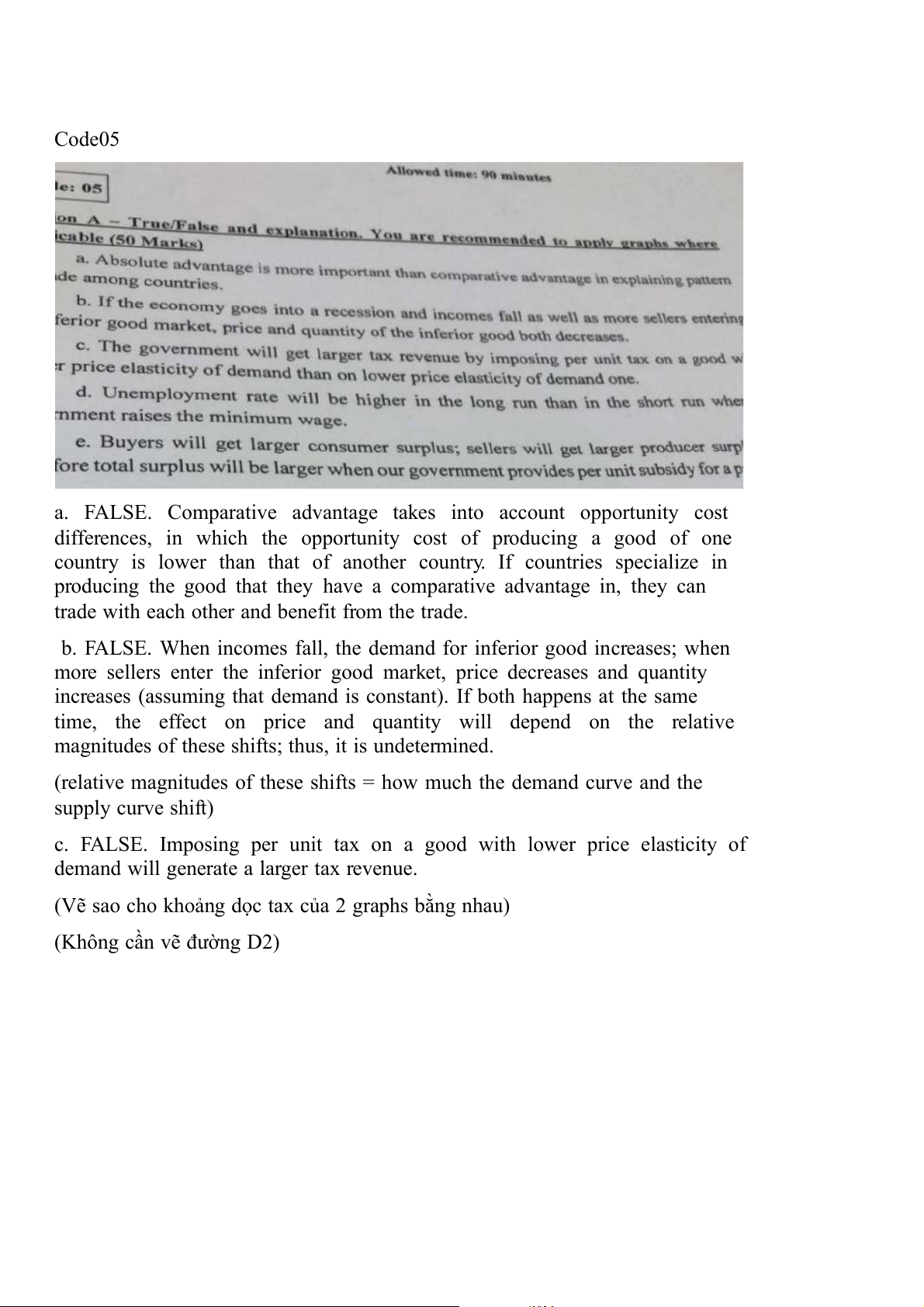
c. FALSE. Imposing per unit tax on a good with lower price elasticity of
demand will generate a larger tax revenue.
(Vẽ sao cho khoảng dọc tax của 2 graphs bằng nhau)
(Không cần vẽ đường D2)
d. FALSE. Raising the minimum wage may lead to additional unemployment
in the short run, but its effects in the long run is unclear.
(Wage raised => Incomes rise => Price rises => Inflation => Unemployment)
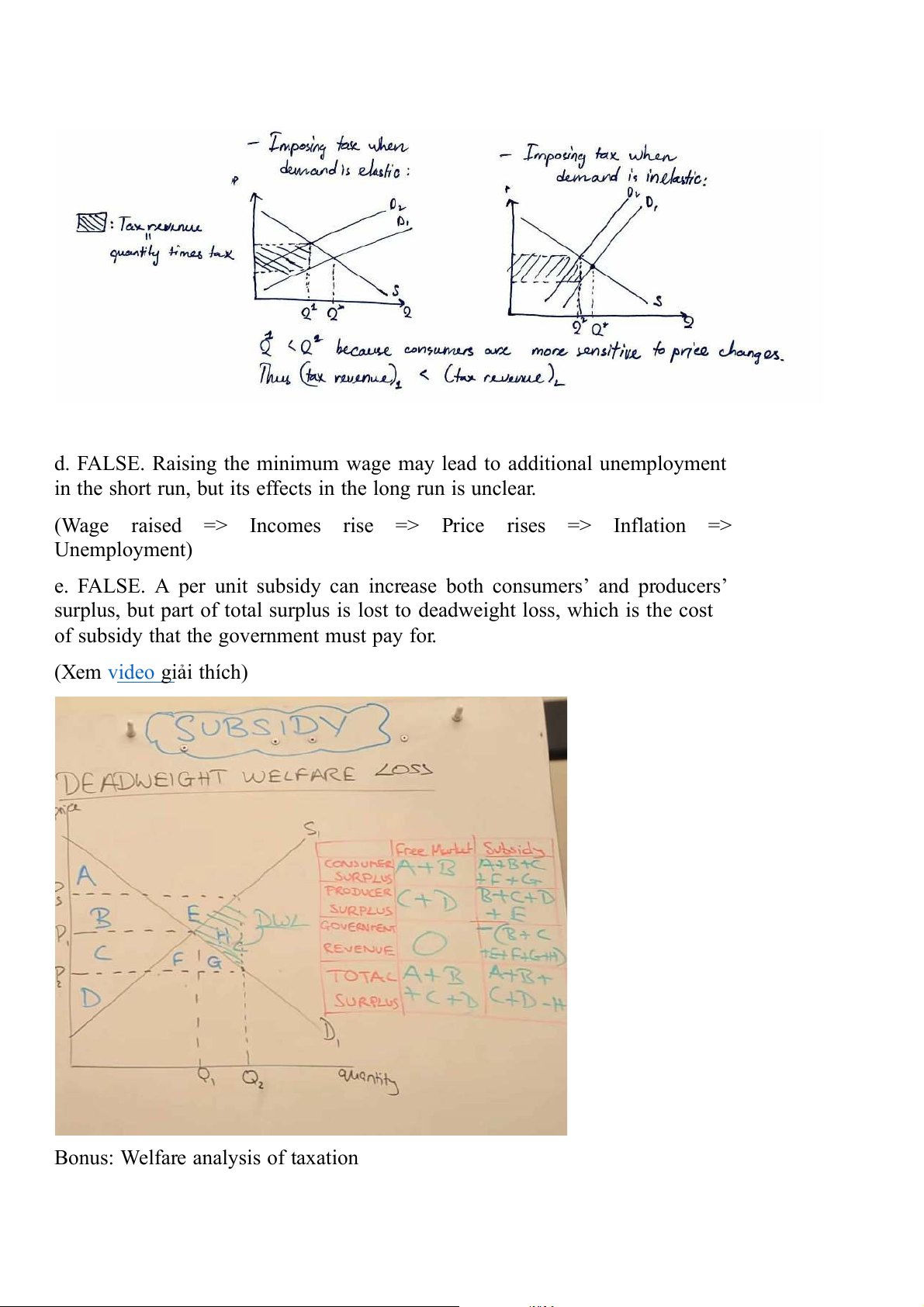
e. FALSE. A per unit subsidy can increase both consumers’ and producers’
surplus, but part of total surplus is lost to deadweight loss, which is the cost
of subsidy that the government must pay for. (Xem video giải thích)
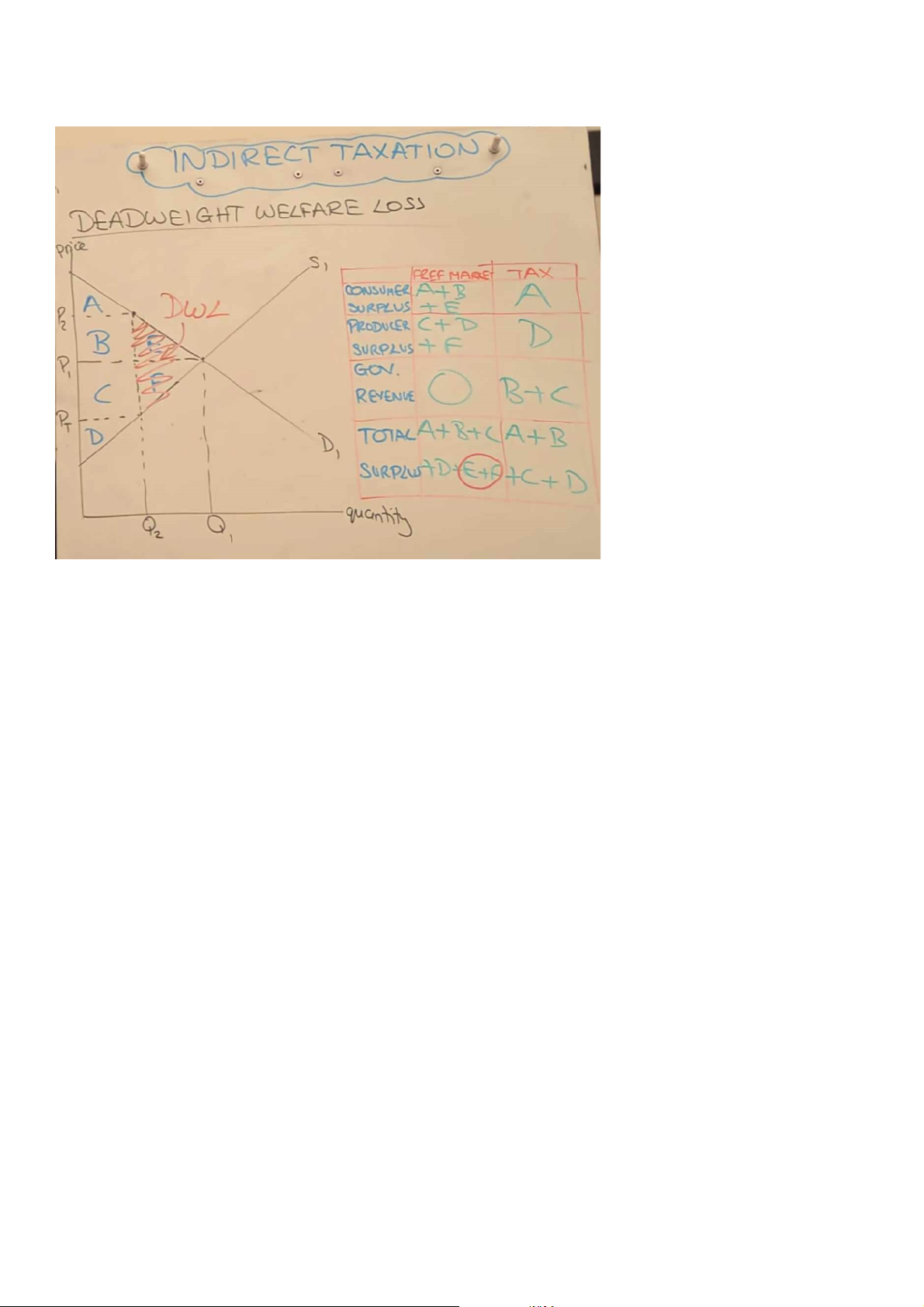
Bonus: Welfare analysis of taxation Code 11
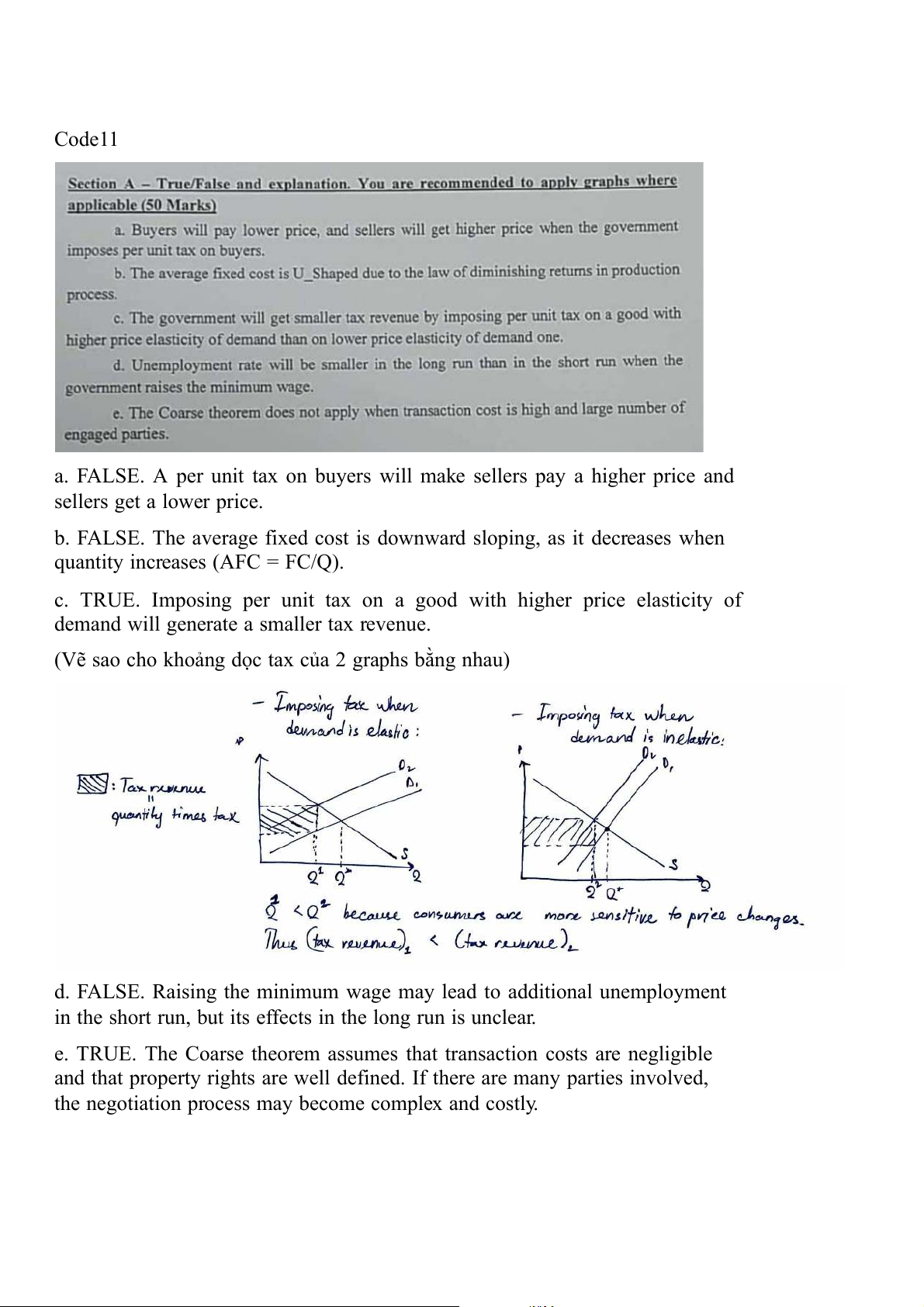
a. FALSE. A per unit tax on buyers will make sellers pay a higher price and sellers get a lower price.
b. FALSE. The average fixed cost is downward sloping, as it decreases when
quantity increases (AFC = FC/Q).
c. TRUE. Imposing per unit tax on a good with higher price elasticity of
demand will generate a smaller tax revenue.
(Vẽ sao cho khoảng dọc tax của 2 graphs bằng nhau)
d. FALSE. Raising the minimum wage may lead to additional unemployment
in the short run, but its effects in the long run is unclear.
e. TRUE. The Coarse theorem assumes that transaction costs are negligible
and that property rights are well defined. If there are many parties involved,
the negotiation process may become complex and costly.
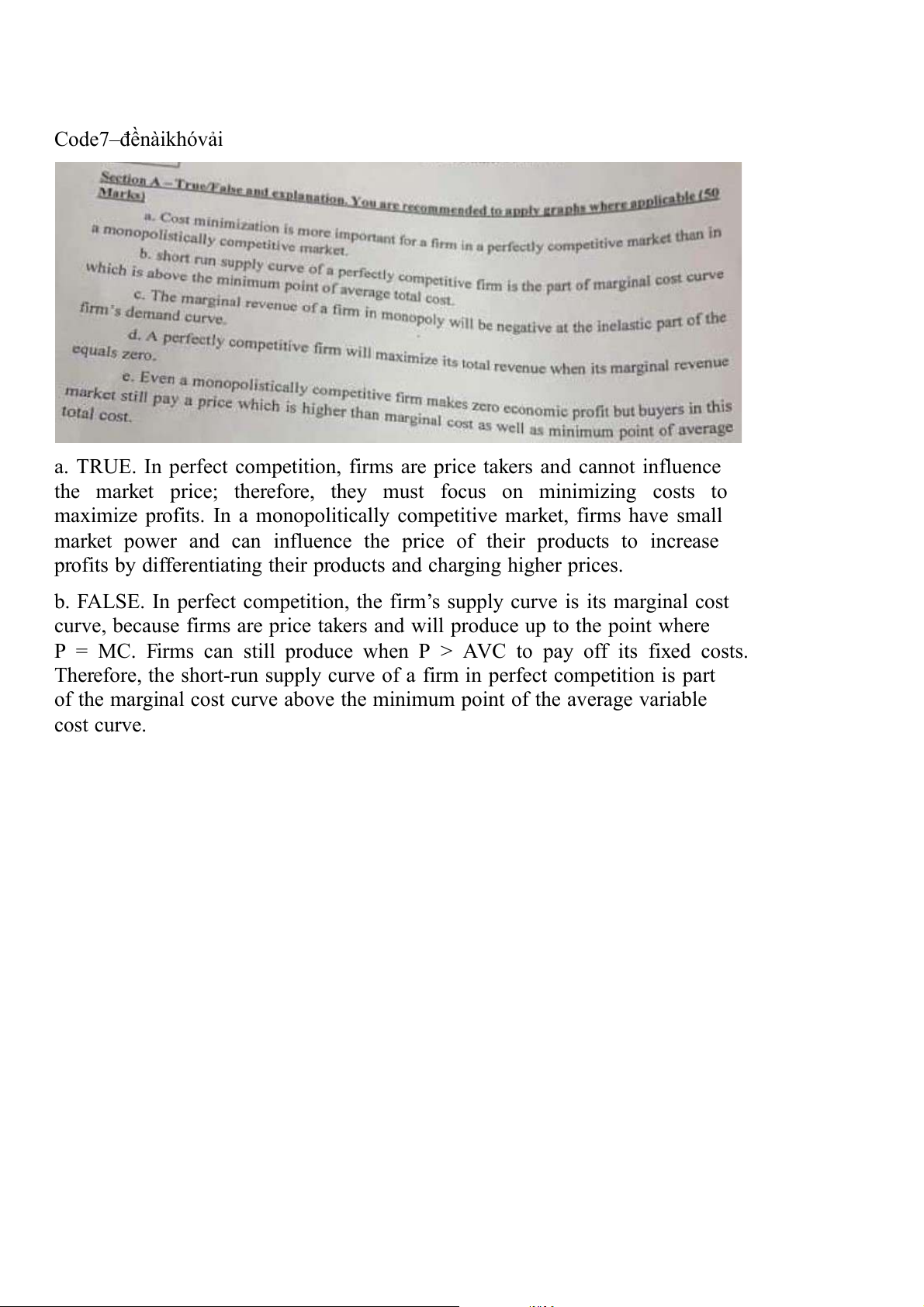
Code 7 – đề nài khó vải
a. TRUE. In perfect competition, firms are price takers and cannot influence
the market price; therefore, they must focus on minimizing costs to
maximize profits. In a monopolitically competitive market, firms have small
market power and can influence the price of their products to increase
profits by differentiating their products and charging higher prices.
b. FALSE. In perfect competition, the firm’s supply curve is its marginal cost
curve, because firms are price takers and will produce up to the point where
P = MC. Firms can still produce when P > AVC to pay off its fixed costs.
Therefore, the short-run supply curve of a firm in perfect competition is part
of the marginal cost curve above the minimum point of the average variable cost curve.
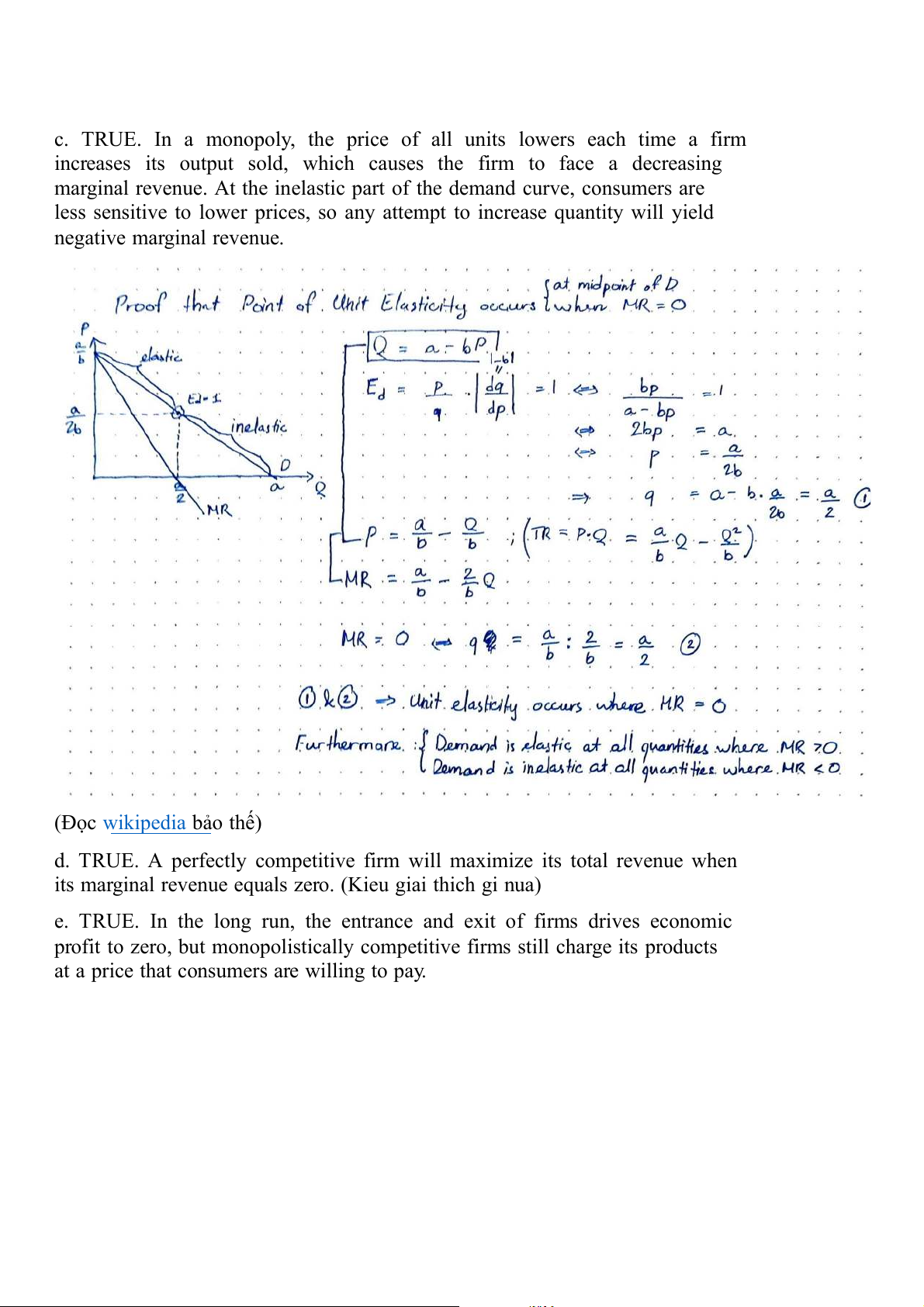
c. TRUE. In a monopoly, the price of all units lowers each time a firm
increases its output sold, which causes the firm to face a decreasing
marginal revenue. At the inelastic part of the demand curve, consumers are
less sensitive to lower prices, so any attempt to increase quantity will yield negative marginal revenue. (Đọc wikipedia bảo thế)
d. TRUE. A perfectly competitive firm will maximize its total revenue when
its marginal revenue equals zero. (Kieu giai thich gi nua)
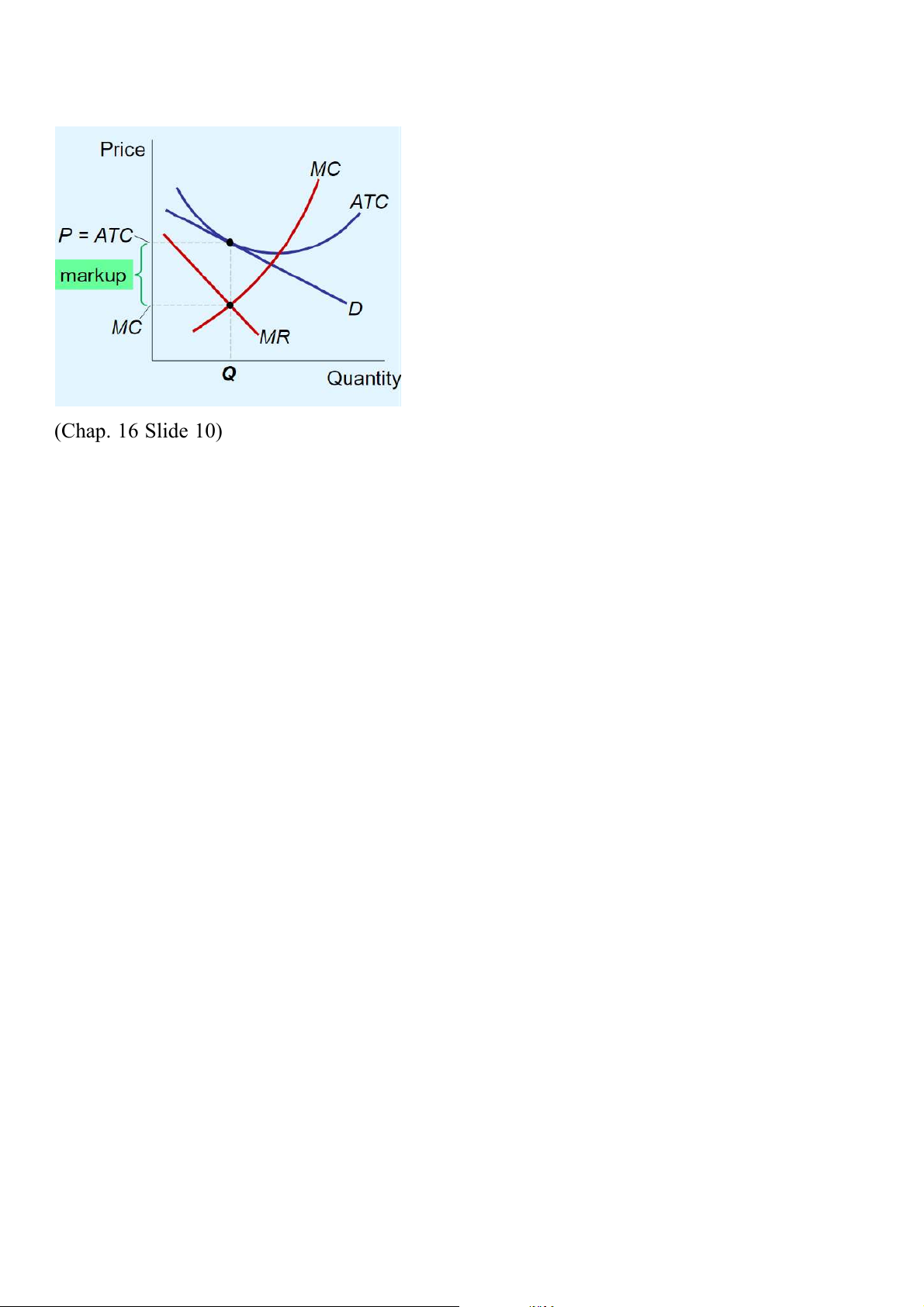
e. TRUE. In the long run, the entrance and exit of firms drives economic
profit to zero, but monopolistically competitive firms still charge its products
at a price that consumers are willing to pay. (Chap. 16 Slide 10)
Tài liệu liên quan:
-

Chương 3: độ co giãn và các nhân tố ảnh hưởng | Microeconomics | Trường Đại học Quốc tế, Đại học Quốc gia Thành phố Hồ Chí Minh
4 2 -
Microeconomics Syllabus | Microeconomics | Trường Đại học Quốc tế, Đại học Quốc gia Thành phố Hồ Chí Minh
4 2 -
Microeconomics Course Syllabus & Assessment Details | Microeconomics | Trường Đại học Quốc tế, Đại học Quốc gia Thành phố Hồ Chí Minh
4 2 -
Assignment 3 - Elasticity MCQs and Key Concepts | Microeconomics | Trường Đại học Quốc tế, Đại học Quốc gia Thành phố Hồ Chí Minh
4 2 -
Assignment 2 - Economic Equilibrium Analysis of Fridges and Motorcycles | Microeconomics | Trường Đại học Quốc tế, Đại học Quốc gia Thành phố Hồ Chí Minh
4 2