Tutorial Questions 3 - Microeconomics Concepts | Microeconomics | Trường Đại học Quốc tế, Đại học Quốc gia Thành phố Hồ Chí Minh
Table 1 shows the quantities of corn and beef that a farm can produce in a year. Draw a graph of the farm’s PPF. Mark on the graph: Tài liệu được sưu tầm và soạn thảo dưới dạng file PDF với mục đích hỗ trợ học tập và tham khảo. Nội dung tài liệu được trình bày rõ ràng, dễ tiếp cận, phù hợp cho việc ôn tập và củng cố kiến thức trong quá trình học đại học. Đây sẽ là nguồn tư liệu hữu ích giúp các bạn sinh viên chuẩn bị tốt hơn cho các buổi học, đồng thời mở rộng thêm hiểu biết về môn học. Hy vọng tài liệu này sẽ mang lại nhiều giá trị và hỗ trợ các bạn trong hành trình học tập. Mời bạn đọc cùng tham khảo!
Môn: Microeconomics 635 tài liệu
Trường: Trường Đại học Quốc tế, Đại học Quốc gia Thành phố Hồ Chí Minh 1.9 K tài liệu
Tác giả:


Preview text:
Tutorial Questions 3
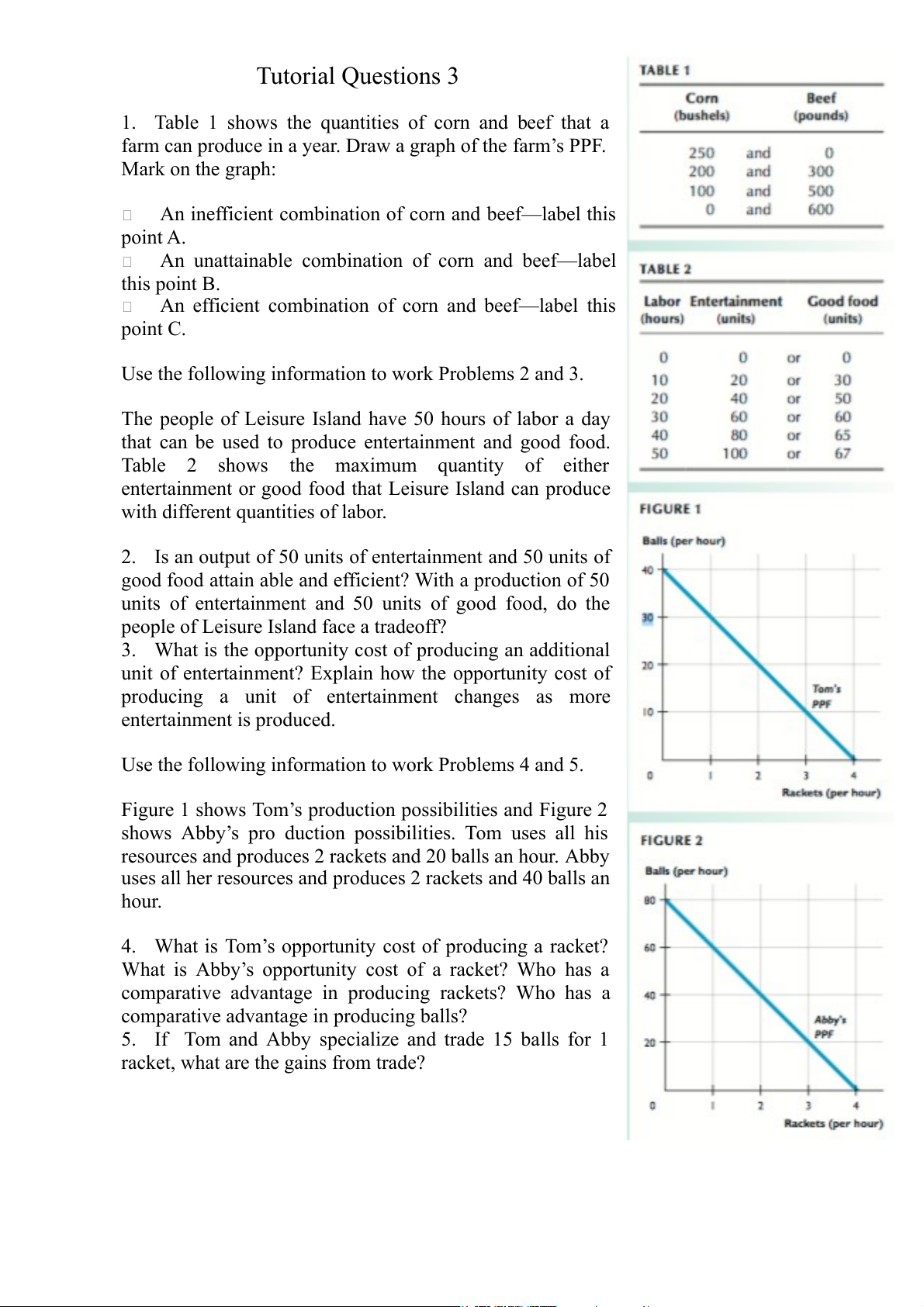
1. Table 1 shows the quantities of corn and beef that a
farm can produce in a year. Draw a graph of the farm’s PPF. Mark on the graph:
An inefficient combination of corn and beef—label this point A.
An unattainable combination of corn and beef—label this point B.
An efficient combination of corn and beef—label this point C.
Use the following information to work Problems 2 and 3.
The people of Leisure Island have 50 hours of labor a day
that can be used to produce entertainment and good food.
Table 2 shows the maximum quantity of either
entertainment or good food that Leisure Island can produce
with different quantities of labor.
2. Is an output of 50 units of entertainment and 50 units of
good food attain able and efficient? With a production of 50
units of entertainment and 50 units of good food, do the
people of Leisure Island face a tradeoff?
3. What is the opportunity cost of producing an additional
unit of entertainment? Explain how the opportunity cost of
producing a unit of entertainment changes as more entertainment is produced.
Use the following information to work Problems 4 and 5.
Figure 1 shows Tom’s production possibilities and Figure 2
shows Abby’s pro duction possibilities. Tom uses all his
resources and produces 2 rackets and 20 balls an hour. Abby
uses all her resources and produces 2 rackets and 40 balls an hour.
4. What is Tom’s opportunity cost of producing a racket?
What is Abby’s opportunity cost of a racket? Who has a
comparative advantage in producing rackets? Who has a
comparative advantage in producing balls?
5. If Tom and Abby specialize and trade 15 balls for 1
racket, what are the gains from trade? Multiple Choice Quiz
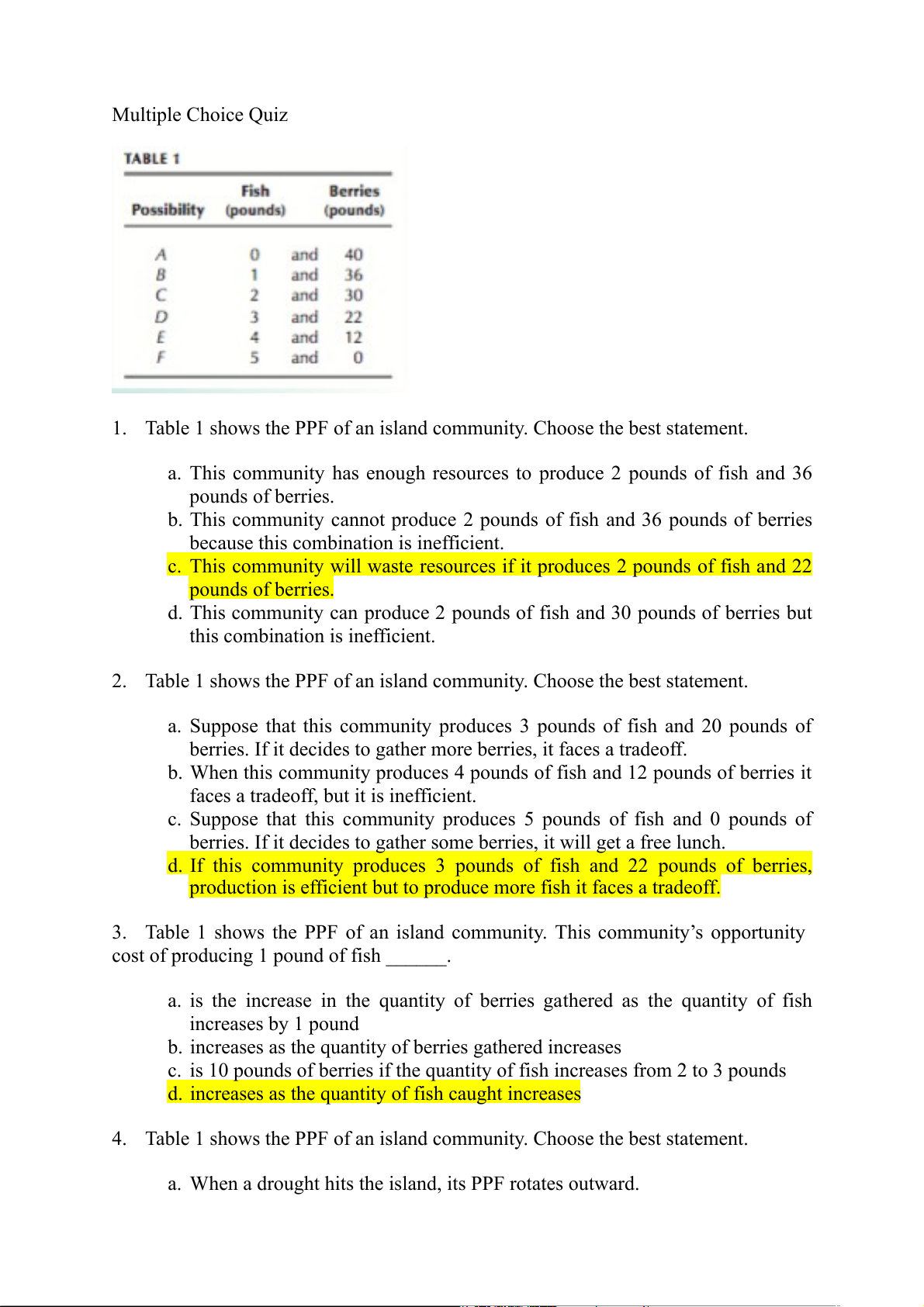
1. Table 1 shows the PPF of an island community. Choose the best statement.
a. This community has enough resources to produce 2 pounds of fish and 36 pounds of berries.
b. This community cannot produce 2 pounds of fish and 36 pounds of berries
because this combination is inefficient.
c. This community will waste resources if it produces 2 pounds of fish and 22 pounds of berries.
d. This community can produce 2 pounds of fish and 30 pounds of berries but
this combination is inefficient.
2. Table 1 shows the PPF of an island community. Choose the best statement.
a. Suppose that this community produces 3 pounds of fish and 20 pounds of
berries. If it decides to gather more berries, it faces a tradeoff.
b. When this community produces 4 pounds of fish and 12 pounds of berries it
faces a tradeoff, but it is inefficient.
c. Suppose that this community produces 5 pounds of fish and 0 pounds of
berries. If it decides to gather some berries, it will get a free lunch.
d. If this community produces 3 pounds of fish and 22 pounds of berries,
production is efficient but to produce more fish it faces a tradeoff. 3. Table 1 shows the PPF of
an island community. This community’s opportunity
cost of producing 1 pound of fish ______.
a. is the increase in the quantity of berries gathered as the quantity of fish increases by 1 pound
b. increases as the quantity of berries gathered increases
c. is 10 pounds of berries if the quantity of fish increases from 2 to 3 pounds
d. increases as the quantity of fish caught increases
4. Table 1 shows the PPF of an island community. Choose the best statement.
a. When a drought hits the island, its PPF rotates outward.
b. When the islanders discover a better way of catching fish, the island’s PPF rotates outward.
c. When islanders reduce the time they spend gathering berries, the PPF rotates inward.
d. If the islanders decide to spend more time gathering berries but continue to
spend the same amount of time fishing, they face a tradeoff.
5. Mary makes 10 pies and 20 cakes a day and her opportunity cost of producing a
cake is 2 pies. Tim makes 20 pies and 10 cakes a day and his opportunity cost of
producing a cake is 4 pies. If Mary and Tim specialize in producing the good in which
they have a comparative advantage, ______. a. Mary produces only pies
b. Tim produces both pies and cakes
c. Mary produces only cakes while Tim produces only pies
d. Tim produces only cakes while Mary produces only pies In the News
Loss of honeybees is less but still a threat
Honeybees are crucial for the pollination of almonds in California’s Central Valley. During
2008, 30 percent of U.S. honeybees died. Source: USA Today, May 20, 2009
Explain how this loss of honeybees affected the Central Valley’s PPF.
Obama drives up miles-per-gallon requirements
Emissions from all new vehicles must be cut from 354 grams to 250 grams. To meet this
new standard, the price of a new vehicle will rise by $1,300. Source: USA Today, May 20, 2009
Calculate the opportunity cost of reducing the emission level by 1 gram.
With big boost from sugar cane, Brazil is satisfying its fuel needs
Brazil is almost self-sufficient in ethanol. Brazilian ethanol is made from sugar and costs
83¢ per gallon whereas U.S. ethanol, made from corn, costs $1.14 per gallon. The United
States does not import ethanol.
Source: The New York Times, April 12, 2006
Which country has a comparative advantage in producing ethanol? Explain why both the
United States and Brazil can gain from specialization and trade.
Tài liệu liên quan:
-
Chương 3: độ co giãn và các nhân tố ảnh hưởng | Microeconomics | Trường Đại học Quốc tế, Đại học Quốc gia Thành phố Hồ Chí Minh
4 2 -
Microeconomics Syllabus | Microeconomics | Trường Đại học Quốc tế, Đại học Quốc gia Thành phố Hồ Chí Minh
4 2 -
Microeconomics Course Syllabus & Assessment Details | Microeconomics | Trường Đại học Quốc tế, Đại học Quốc gia Thành phố Hồ Chí Minh
4 2 -
Assignment 3 - Elasticity MCQs and Key Concepts | Microeconomics | Trường Đại học Quốc tế, Đại học Quốc gia Thành phố Hồ Chí Minh
4 2 -
Assignment 2 - Economic Equilibrium Analysis of Fridges and Motorcycles | Microeconomics | Trường Đại học Quốc tế, Đại học Quốc gia Thành phố Hồ Chí Minh
4 2