Tutorial Questions 7: Consumer Surplus & Utility Maximization | Microeconomics | Trường Đại học Quốc tế, Đại học Quốc gia Thành phố Hồ Chí Minh
Consumer surplus measures the benefit to buyers of participating in a market. It is measured as the amount a buyer is willing to pay for a good minus the amount a buyer actually pays for it. For an individual purchase, consumer surplus is the difference between the willingness to pay, as shown on the demand curve, and the market price. For the market, total consumer surplus is the area under the demand curve and above the price, from the origin to the quantity purchased. Tài liệu được sưu tầm và soạn thảo dưới dạng file PDF để gửi tới các bạn cùng tham khảo, ôn tập đầy đủ kiến thức, chuẩn bị cho các buổi học thật tốt. Mời bạn đọc đón xem!
Môn: Microeconomics 635 tài liệu
Trường: Trường Đại học Quốc tế, Đại học Quốc gia Thành phố Hồ Chí Minh 1.9 K tài liệu
Tác giả:

Preview text:
Tutorial Questions 7 ANS A. Short anwers 1.
a) Consumer surplus measures the benefit to buyers of participating in a market. It is
measured as the amount a buyer is willing to pay for a good minus the amount a buyer
actually pays for it. For an individual purchase, consumer surplus is the difference between
the willingness to pay, as shown on the demand curve, and the market price. For the market,
total consumer surplus is the area under the demand curve and above the price, from the
origin to the quantity purchased.
b) Because the demand curve shows the maximum amount buyers are willing to pay for a
given market quantity, the price given by the demand curve represents the willingness to pay of the marginal buyer.
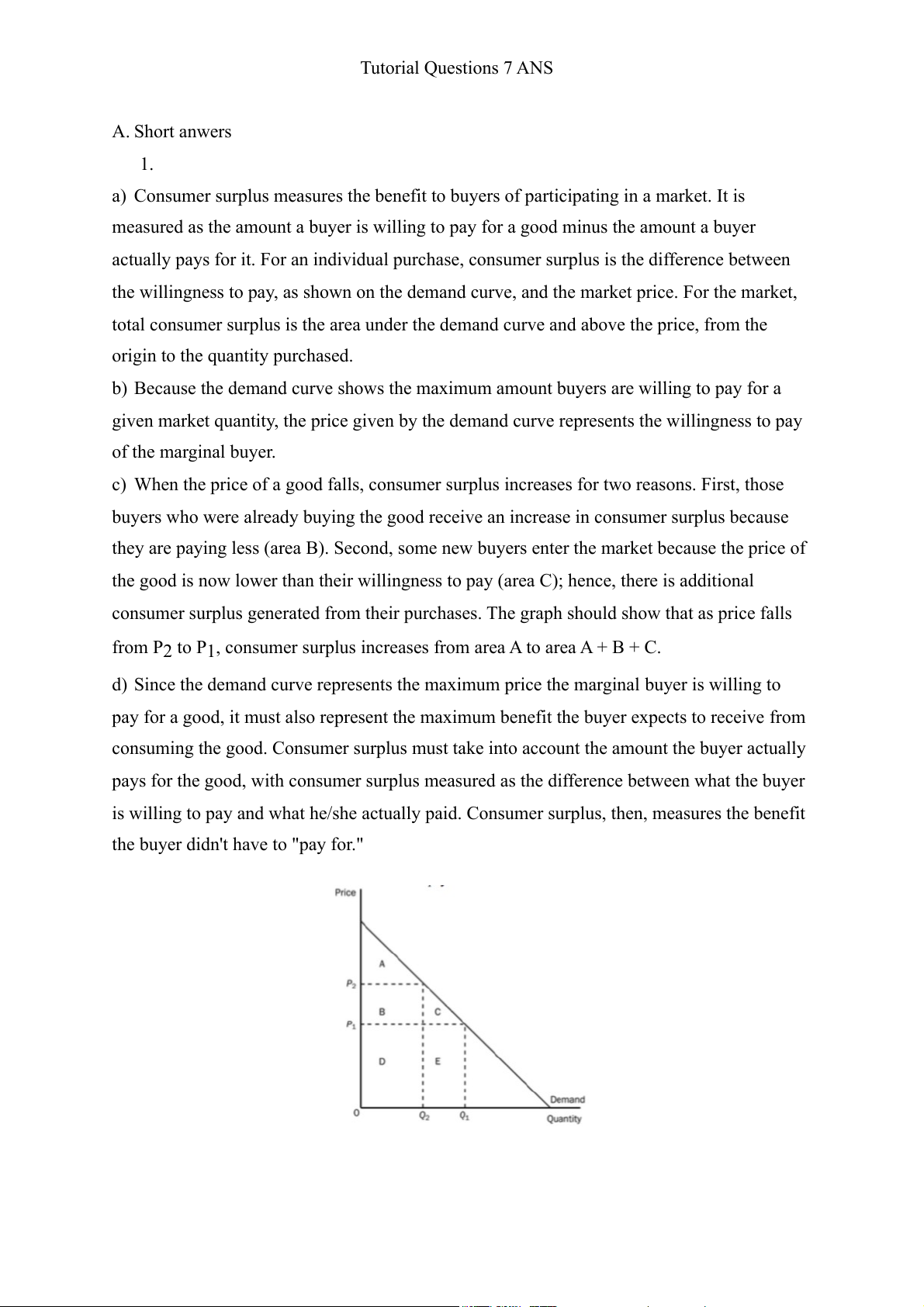
c) When the price of a good falls, consumer surplus increases for two reasons. First, those
buyers who were already buying the good receive an increase in consumer surplus because
they are paying less (area B). Second, some new buyers enter the market because the price of
the good is now lower than their willingness to pay (area C); hence, there is additional
consumer surplus generated from their purchases. The graph should show that as price falls from P to P 2
, consumer surplus increases from area 1 A to area A + B + C.
d) Since the demand curve represents the maximum price the marginal buyer is willing to
pay for a good, it must also represent the maximum benefit the buyer expects to receive from
consuming the good. Consumer surplus must take into account the amount the buyer actually
pays for the good, with consumer surplus measured as the difference between what the buyer
is willing to pay and what he/she actually paid. Consumer surplus, then, measures the benefit
the buyer didn't have to "pay for." 2. Abc
a) Jerry can afford 3 magazines and no burgers; 2 magazines and 2 burgers; 1 magazine and
4 burgers; no magazines and 6 burgers.
b) The relative price of a magazine is the number of burgers that Jerry must forgo to get 1
magazine, which equals the price of a magazine divided by the price of a burger, or 2 burgers per magazine.
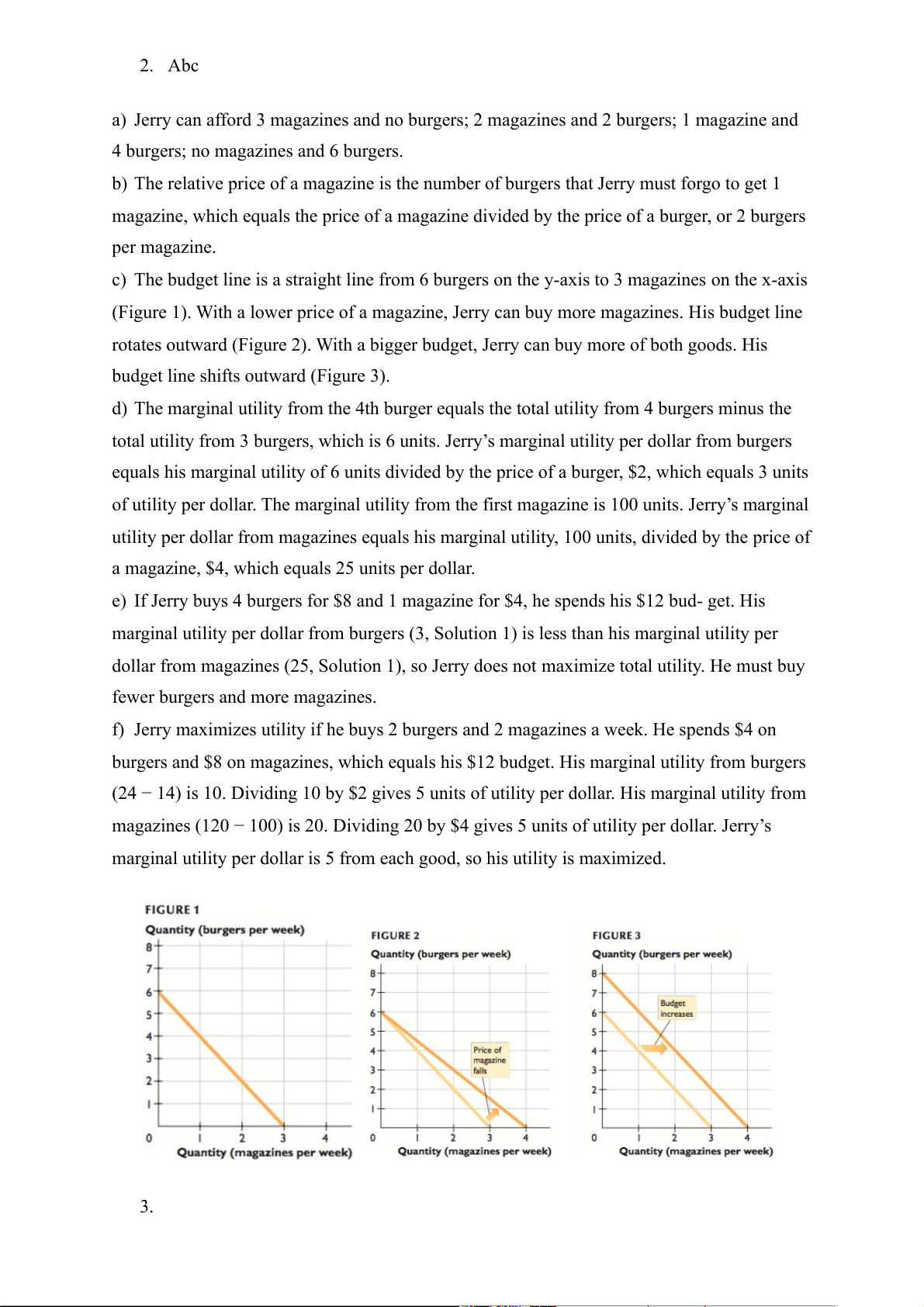
c) The budget line is a straight line from 6 burgers on the y-axis to 3 magazines on the x-axis
(Figure 1). With a lower price of a magazine, Jerry can buy more magazines. His budget line
rotates outward (Figure 2). With a bigger budget, Jerry can buy more of both goods. His
budget line shifts outward (Figure 3).
d) The marginal utility from the 4th burger equals the total utility from 4 burgers minus the
total utility from 3 burgers, which is 6 units. Jerry’s marginal utility per dollar from burgers
equals his marginal utility of 6 units divided by the price of a burger, $2, which equals 3 units
of utility per dollar. The marginal utility from the first magazine is 100 units. Jerry’s marginal
utility per dollar from magazines equals his marginal utility, 100 units, divided by the price of
a magazine, $4, which equals 25 units per dollar.
e) If Jerry buys 4 burgers for $8 and 1 magazine for $4, he spends his $12 bud- get. His
marginal utility per dollar from burgers (3, Solution 1) is less than his marginal utility per
dollar from magazines (25, Solution 1), so Jerry does not maximize total utility. He must buy
fewer burgers and more magazines.
f) Jerry maximizes utility if he buys 2 burgers and 2 magazines a week. He spends $4 on
burgers and $8 on magazines, which equals his $12 budget. His marginal utility from burgers
(24 − 14) is 10. Dividing 10 by $2 gives 5 units of utility per dollar. His marginal utility from
magazines (120 − 100) is 20. Dividing 20 by $4 gives 5 units of utility per dollar. Jerry’s
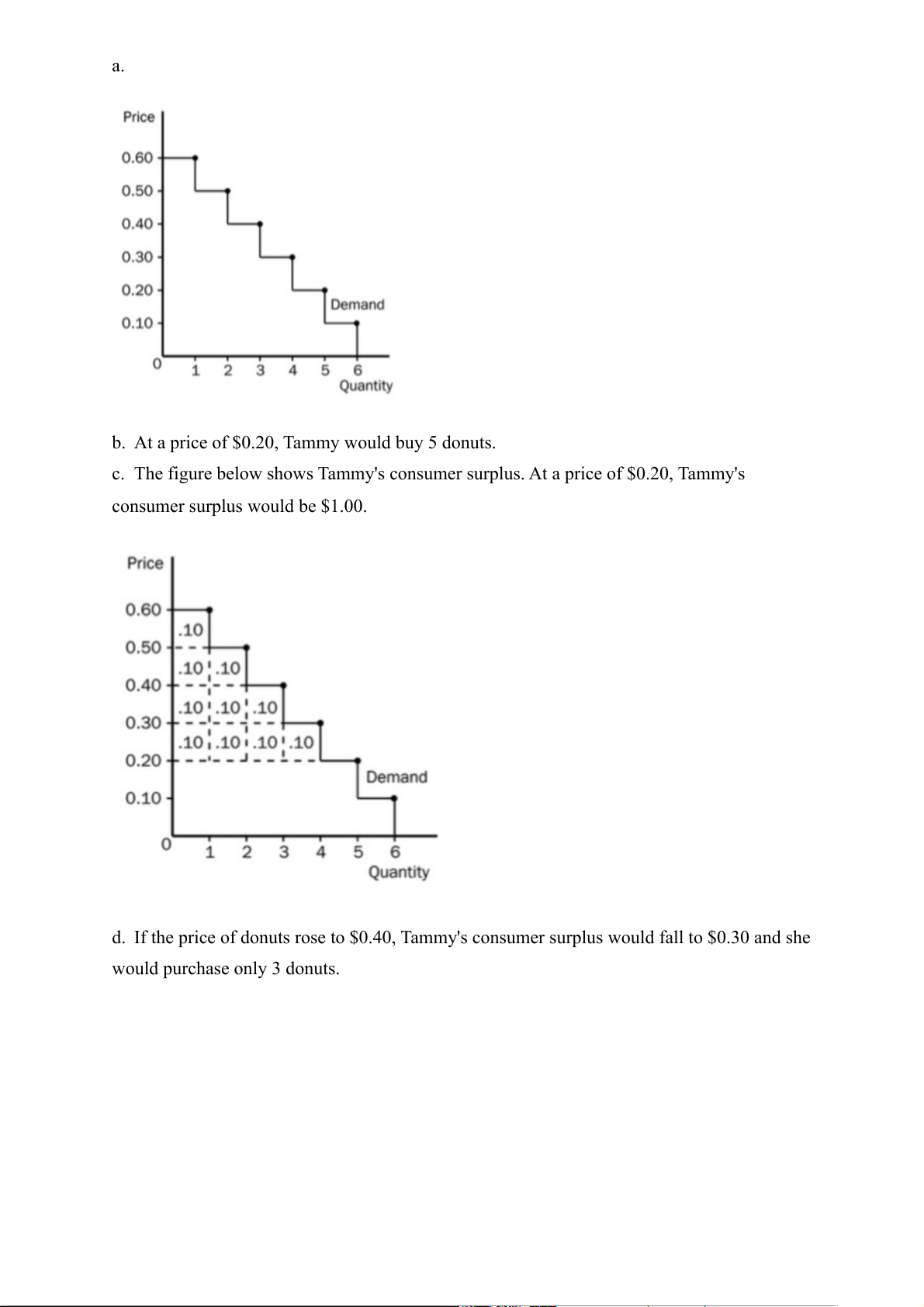
marginal utility per dollar is 5 from each good, so his utility is maximized. 3. a.
b. At a price of $0.20, Tammy would buy 5 donuts.
c. The figure below shows Tammy's consumer surplus. At a price of $0.20, Tammy's
consumer surplus would be $1.00.
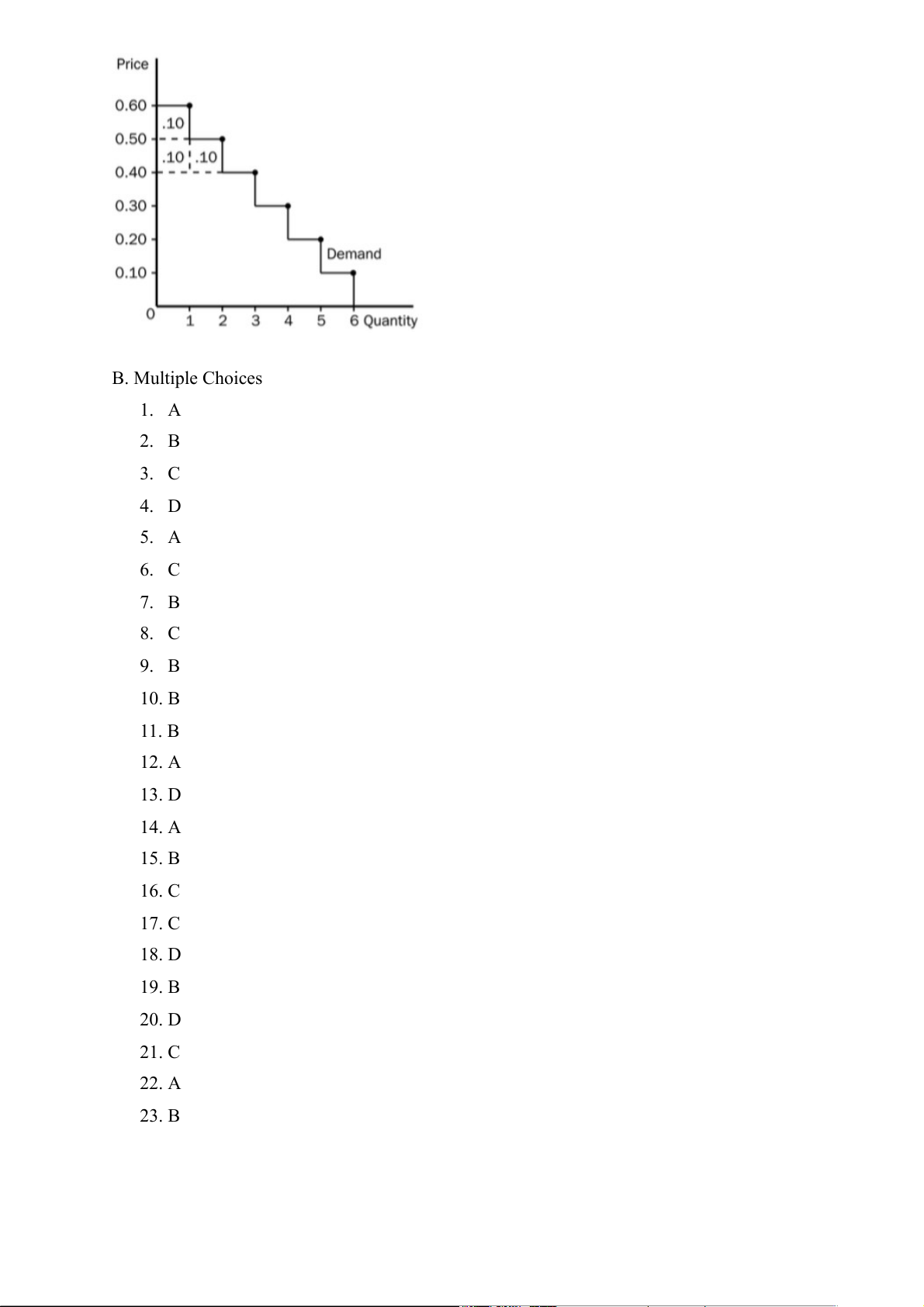
d. If the price of donuts rose to $0.40, Tammy's consumer surplus would fall to $0.30 and she would purchase only 3 donuts. B. Multiple Choices 1. A 2. B 3. C 4. D 5. A 6. C 7. B 8. C 9. B 10. B 11. B 12. A 13. D 14. A 15. B 16. C 17. C 18. D 19. B 20. D 21. C 22. A 23. B
Tài liệu liên quan:
-
Chương 3: độ co giãn và các nhân tố ảnh hưởng | Microeconomics | Trường Đại học Quốc tế, Đại học Quốc gia Thành phố Hồ Chí Minh
4 2 -
Microeconomics Syllabus | Microeconomics | Trường Đại học Quốc tế, Đại học Quốc gia Thành phố Hồ Chí Minh
4 2 -
Microeconomics Course Syllabus & Assessment Details | Microeconomics | Trường Đại học Quốc tế, Đại học Quốc gia Thành phố Hồ Chí Minh
4 2 -
Assignment 3 - Elasticity MCQs and Key Concepts | Microeconomics | Trường Đại học Quốc tế, Đại học Quốc gia Thành phố Hồ Chí Minh
4 2 -
Assignment 2 - Economic Equilibrium Analysis of Fridges and Motorcycles | Microeconomics | Trường Đại học Quốc tế, Đại học Quốc gia Thành phố Hồ Chí Minh
4 2