Type I & II Questions on Market Economics | Microeconomics | Trường Đại học Quốc tế, Đại học Quốc gia Thành phố Hồ Chí Minh
In a market economy, supply and demand determine both the quantity of each good produced and the price at which it is sold. True: in a market economy, the interaction of supply and demand determines the equilibrium price and quantity of goods. Market forces allocate resources efficiently without central planning. 2. In a competitive market, the quantity of each good produced and the price at which it is sold are not determined by any single buyer or seller. Tài liệu được sưu tầm và soạn thảo dưới dạng file PDF để gửi tới các bạn cùng tham khảo, ôn tập đầy đủ kiến thức, chuẩn bị cho các buổi học thật tốt. Mời bạn đọc đón xem!
Môn: Microeconomics 635 tài liệu
Trường: Trường Đại học Quốc tế, Đại học Quốc gia Thành phố Hồ Chí Minh 1.9 K tài liệu
Tác giả:


Preview text:
Seminar 2 By Le Thanh Ha
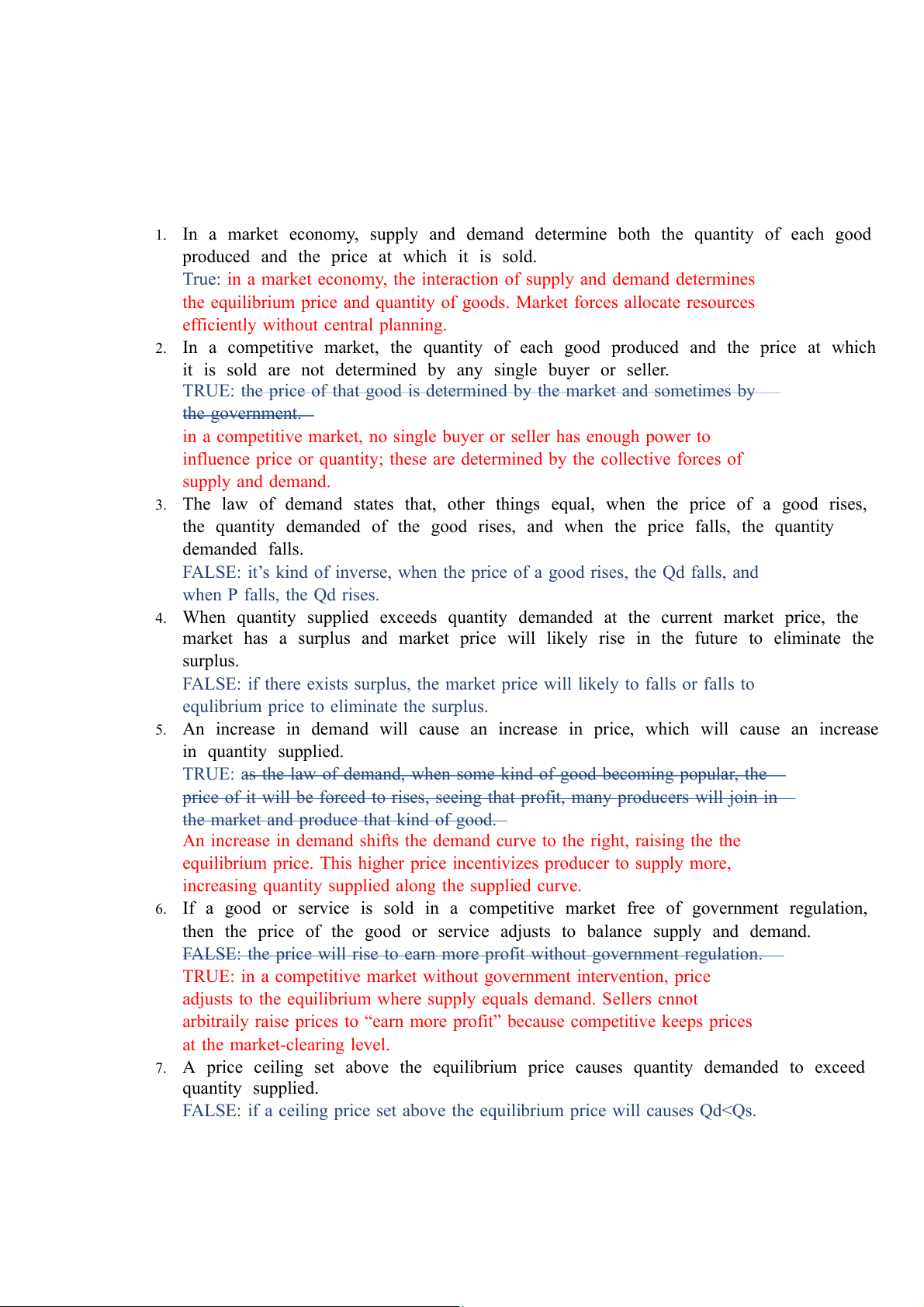
Type I: True/False question (give a brief explanation)
1. In a market economy, supply and demand determine both the quantity of each good
produced and the price at which it is sold.
True: in a market economy, the interaction of supply and demand determines
the equilibrium price and quantity of goods. Market forces allocate resources
efficiently without central planning.
2. In a competitive market, the quantity of each good produced and the price at which
it is sold are not determined by any single buyer or seller.
TRUE: the price of that good is determined by the market and sometimes by the government.
in a competitive market, no single buyer or seller has enough power to
influence price or quantity; these are determined by the collective forces of
supply and demand.
3. The law of demand states that, other things equal, when the price of a good rises,
the quantity demanded of the good rises, and when the price falls, the quantity demanded falls.
FALSE: it’s kind of inverse, when the price of a good rises, the Qd falls, and
when P falls, the Qd rises.
4. When quantity supplied exceeds quantity demanded at the current market price, the
market has a surplus and market price will likely rise in the future to eliminate the surplus.
FALSE: if there exists surplus, the market price will likely to falls or falls to
equlibrium price to eliminate the surplus.
5. An increase in demand will cause an increase in price, which will cause an increase in quantity supplied.
TRUE: as the law of demand, when some kind of good becoming popular, the
price of it will be forced to rises, seeing that profit, many producers will join in
the market and produce that kind of good.
An increase in demand shifts the demand curve to the right, raising the the
equilibrium price. This higher price incentivizes producer to supply more,
increasing quantity supplied along the supplied curve.
6. If a good or service is sold in a competitive market free of government regulation,
then the price of the good or service adjusts to balance supply and demand.
FALSE: the price will rise to earn more profit without government regulation.
TRUE: in a competitive market without government intervention, price
adjusts to the equilibrium where supply equals demand. Sellers cnnot
arbitraily raise prices to “earn more profit” because competitive keeps prices
at the market-clearing level.
7. A price ceiling set above the equilibrium price causes quantity demanded to exceed quantity supplied.
FALSE: if a ceiling price set above the equilibrium price will causes Qd
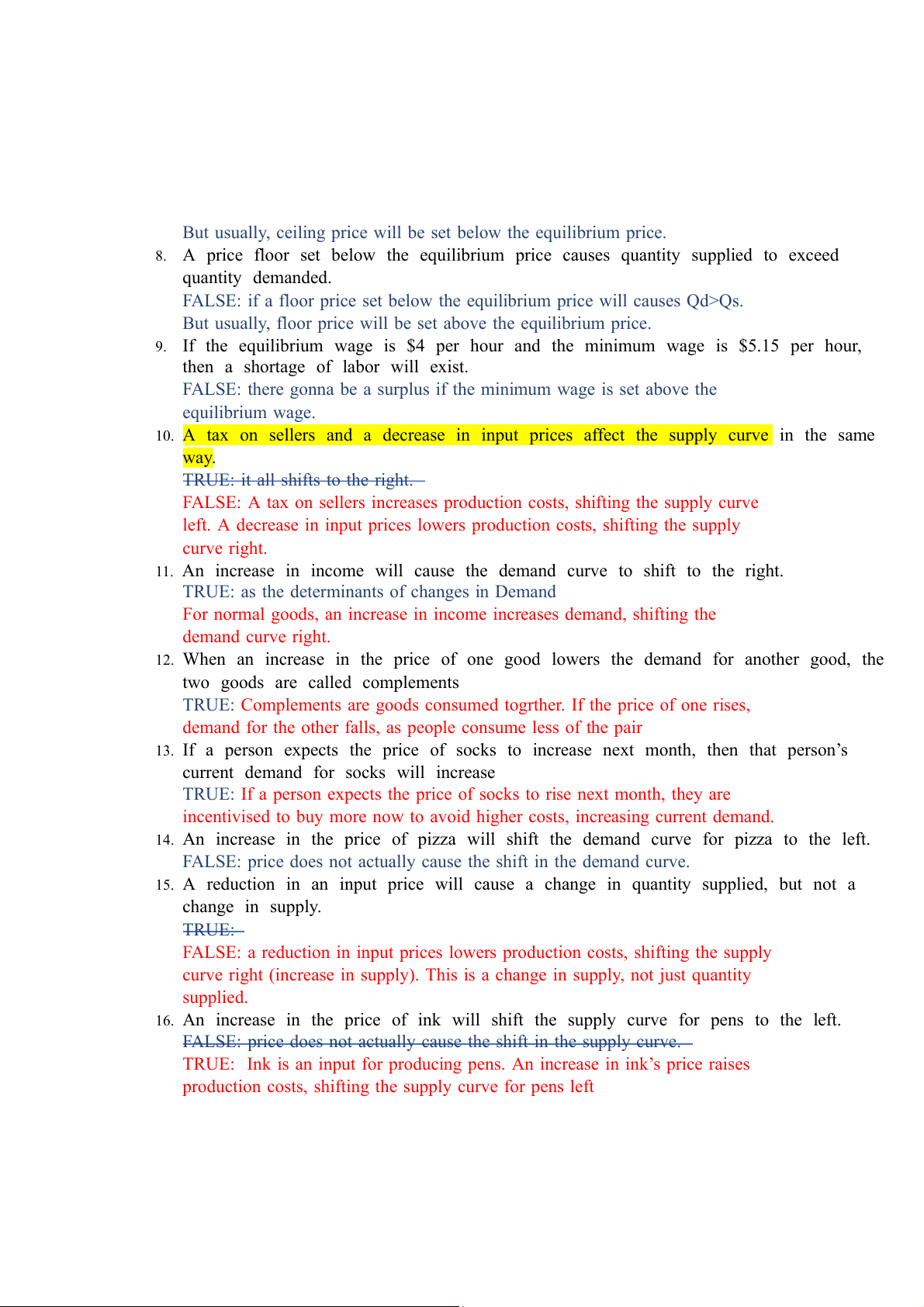
But usually, ceiling price will be set below the equilibrium price.
8. A price floor set below the equilibrium price causes quantity supplied to exceed quantity demanded.
FALSE: if a floor price set below the equilibrium price will causes Qd>Qs.
But usually, floor price will be set above the equilibrium price.
9. If the equilibrium wage is $4 per hour and the minimum wage is $5.15 per hour,
then a shortage of labor will exist.
FALSE: there gonna be a surplus if the minimum wage is set above the
equilibrium wage.
10. A tax on sellers and a decrease in input prices affect the supply curve in the same way.
TRUE: it all shifts to the right.
FALSE: A tax on sellers increases production costs, shifting the supply curve
left. A decrease in input prices lowers production costs, shifting the supply
curve right.
11. An increase in income will cause the demand curve to shift to the right.
TRUE: as the determinants of changes in Demand
For normal goods, an increase in income increases demand, shifting the
demand curve right.
12. When an increase in the price of one good lowers the demand for another good, the
two goods are called complements
TRUE: Complements are goods consumed togrther. If the price of one rises,
demand for the other falls, as people consume less of the pair
13. If a person expects the price of socks to increase next month, then that person’s
current demand for socks will increase
TRUE: If a person expects the price of socks to rise next month, they are
incentivised to buy more now to avoid higher costs, increasing current demand.
14. An increase in the price of pizza will shift the demand curve for pizza to the left.
FALSE: price does not actually cause the shift in the demand curve.
15. A reduction in an input price will cause a change in quantity supplied, but not a change in supply. TRUE:
FALSE: a reduction in input prices lowers production costs, shifting the supply
curve right (increase in supply). This is a change in supply, not just quantity supplied.
16. An increase in the price of ink will shift the supply curve for pens to the left.
FALSE: price does not actually cause the shift in the supply curve.
TRUE: Ink is an input for producing pens. An increase in ink’s price raises
production costs, shifting the supply curve for pens left
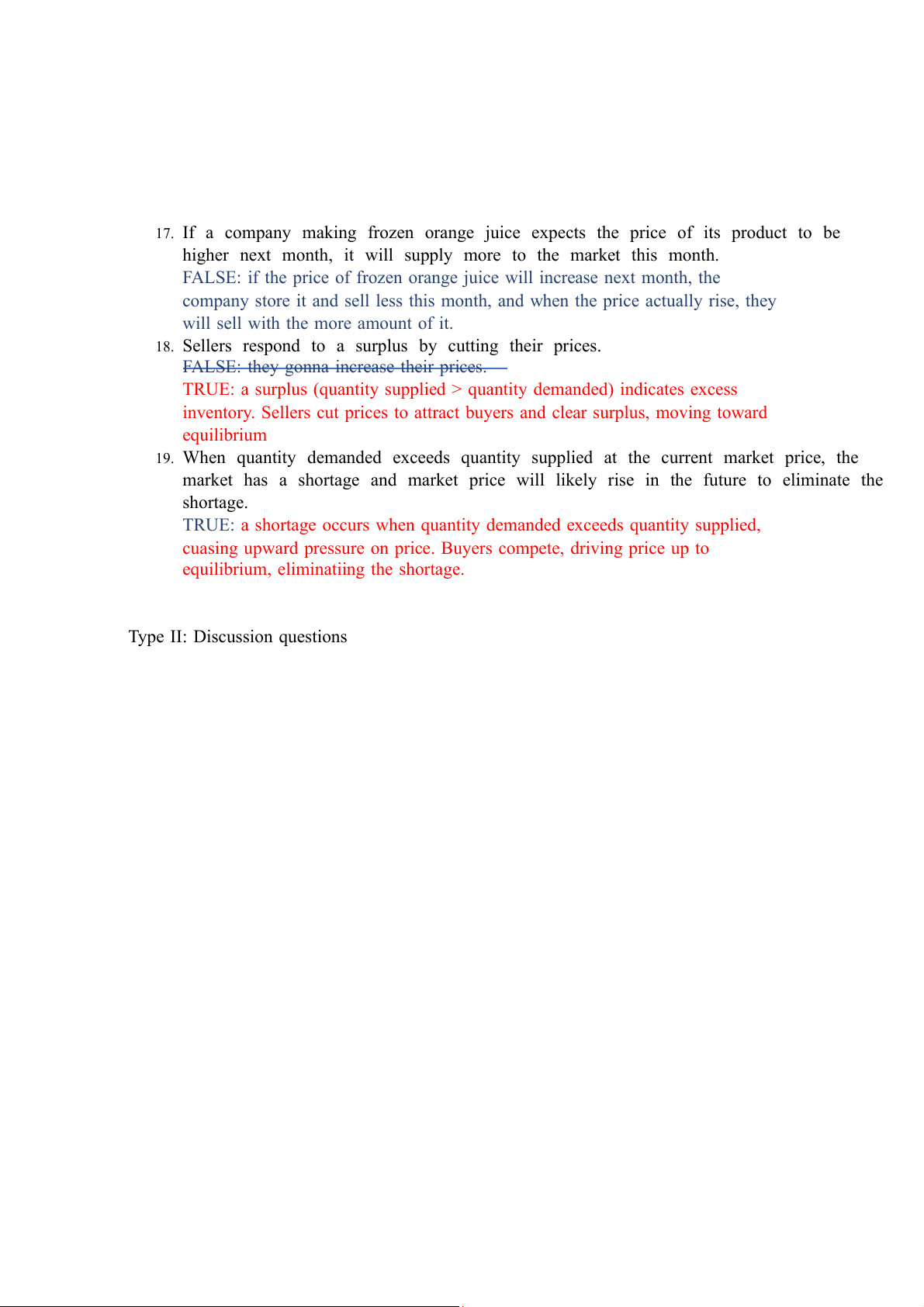
17. If a company making frozen orange juice expects the price of its product to be
higher next month, it will supply more to the market this month.
FALSE: if the price of frozen orange juice will increase next month, the
company store it and sell less this month, and when the price actually rise, they
will sell with the more amount of it.
18. Sellers respond to a surplus by cutting their prices.
FALSE: they gonna increase their prices.
TRUE: a surplus (quantity supplied > quantity demanded) indicates excess
inventory. Sellers cut prices to attract buyers and clear surplus, moving toward equilibrium
19. When quantity demanded exceeds quantity supplied at the current market price, the
market has a shortage and market price will likely rise in the future to eliminate the shortage.
TRUE: a shortage occurs when quantity demanded exceeds quantity supplied,
cuasing upward pressure on price. Buyers compete, driving price up to
equilibrium, eliminatiing the shortage.
Type II: Discussion questions
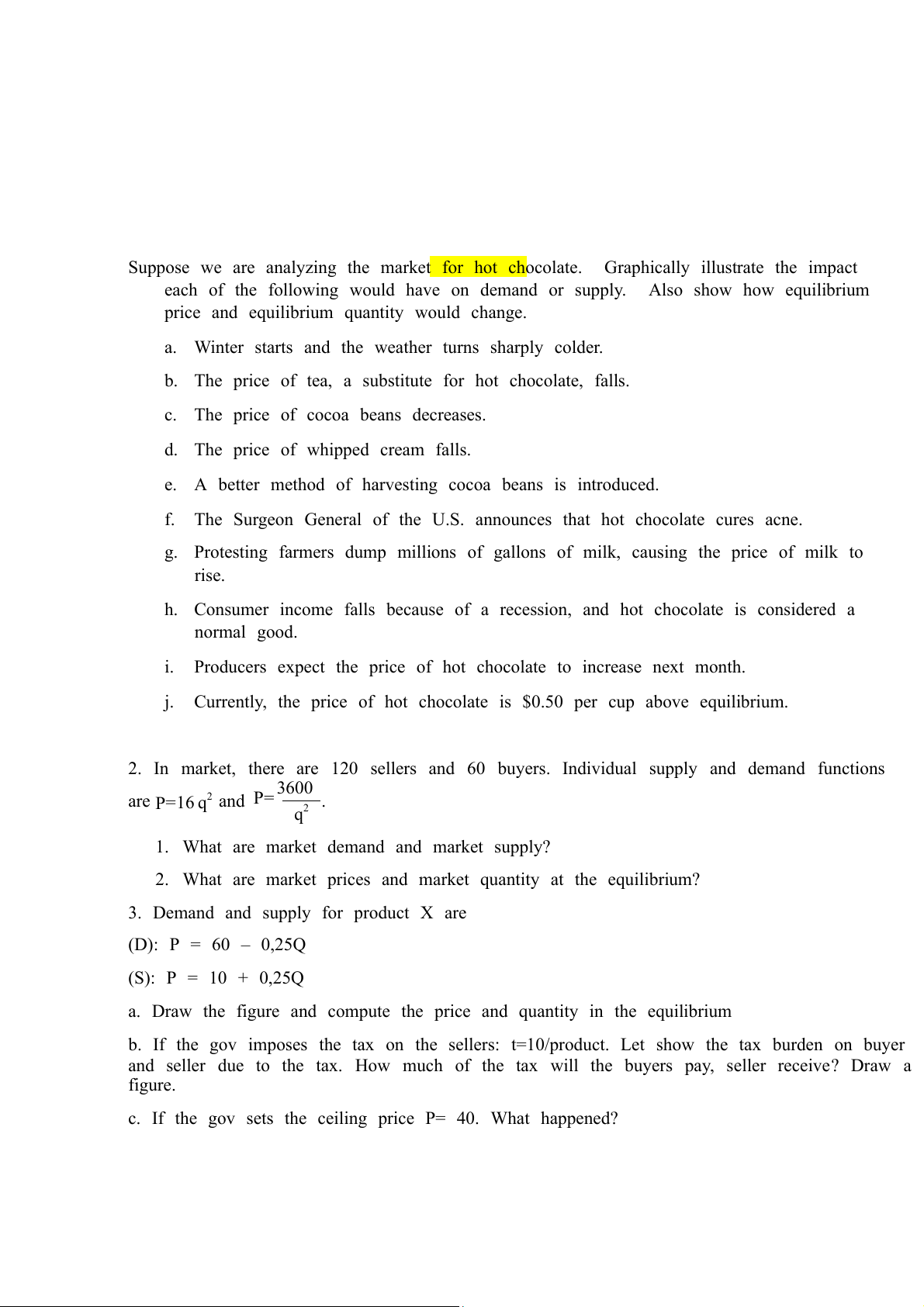
Suppose we are analyzing the market for hot chocolate. Graphically illustrate the impact
each of the following would have on demand or supply. Also show how equilibrium
price and equilibrium quantity would change.
a. Winter starts and the weather turns sharply colder.
b. The price of tea, a substitute for hot chocolate, falls.
c. The price of cocoa beans decreases.
d. The price of whipped cream falls.
e. A better method of harvesting cocoa beans is introduced.
f. The Surgeon General of the U.S. announces that hot chocolate cures acne.
g. Protesting farmers dump millions of gallons of milk, causing the price of milk to rise.
h. Consumer income falls because of a recession, and hot chocolate is considered a normal good. i.
Producers expect the price of hot chocolate to increase next month. j.
Currently, the price of hot chocolate is $0.50 per cup above equilibrium.
2. In market, there are 120 sellers and 60 buyers. Individual supply and demand functions 3600 are P=16 q2 and P= . q2
1. What are market demand and market supply?
2. What are market prices and market quantity at the equilibrium?
3. Demand and supply for product X are (D): P = 60 – 0,25Q (S): P = 10 + 0,25Q
a. Draw the figure and compute the price and quantity in the equilibrium
b. If the gov imposes the tax on the sellers: t=10/product. Let show the tax burden on buyer
and seller due to the tax. How much of the tax will the buyers pay, seller receive? Draw a figure.
c. If the gov sets the ceiling price P= 40. What happened?
d. If the gov sets the ceiling price P=30. What happened?
III. Multiple Choice
1. The law of demand states that, other things equal,
a. an increase in price causes quantity demanded to increase.
b. an increase in price causes quantity demanded to decrease.
c. an increase in quantity demanded causes price to increase.
d. an increase in quantity demanded causes price to decrease. 2. The market demand curve
a. is found by vertically adding the individual demand curves. b. slopes upward.
c. represents the sum of the prices that all the buyers are willing to pay for a given quantity of good.
d. represents the sum of the quantities demanded by all the buyers at each price of the good.
3. To obtain the market demand curve for a product, sum the individual demand curves a. vertically. b. diagonally. c. horizontally. d. and then average them.
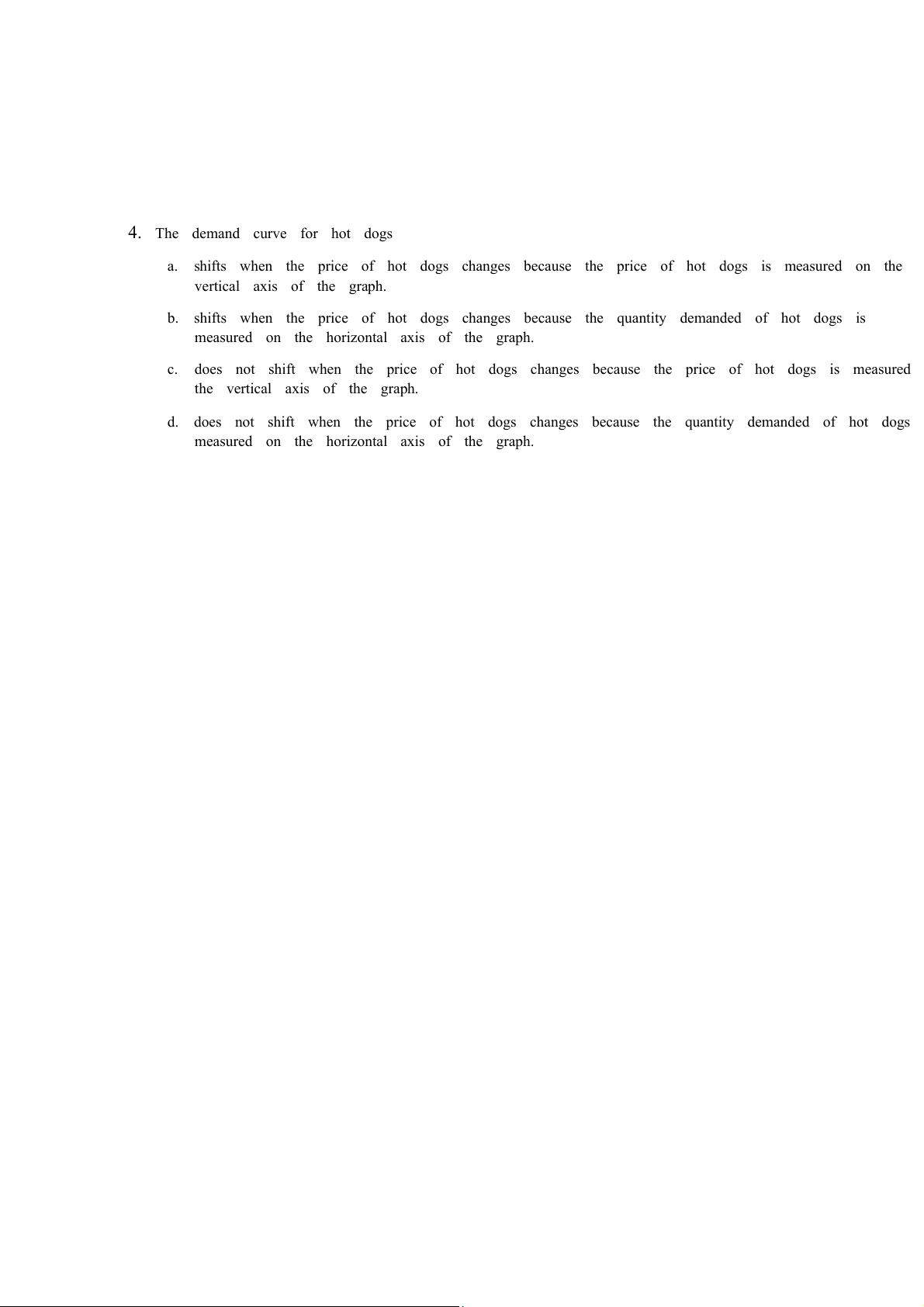
4. The demand curve for hot dogs
a. shifts when the price of hot dogs changes because the price of hot dogs is measured on the vertical axis of the graph.
b. shifts when the price of hot dogs changes because the quantity demanded of hot dogs is
measured on the horizontal axis of the graph.
c. does not shift when the price of hot dogs changes because the price of hot dogs is measured
the vertical axis of the graph.
d. does not shift when the price of hot dogs changes because the quantity demanded of hot dogs
measured on the horizontal axis of the graph.
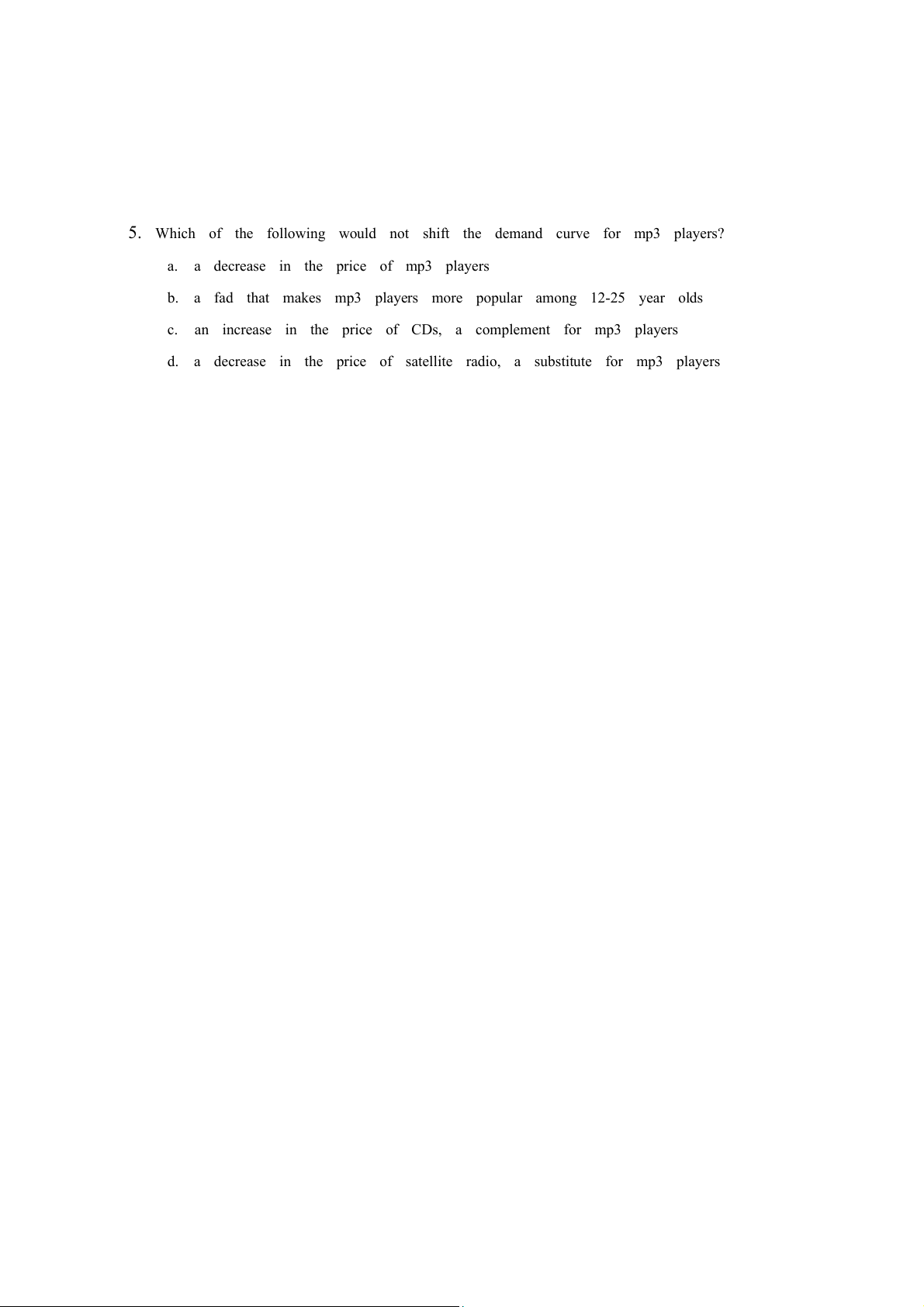
5. Which of the following would not shift the demand curve for mp3 players?
a. a decrease in the price of mp3 players
b. a fad that makes mp3 players more popular among 12-25 year olds
c. an increase in the price of CDs, a complement for mp3 players
d. a decrease in the price of satellite radio, a substitute for mp3 players
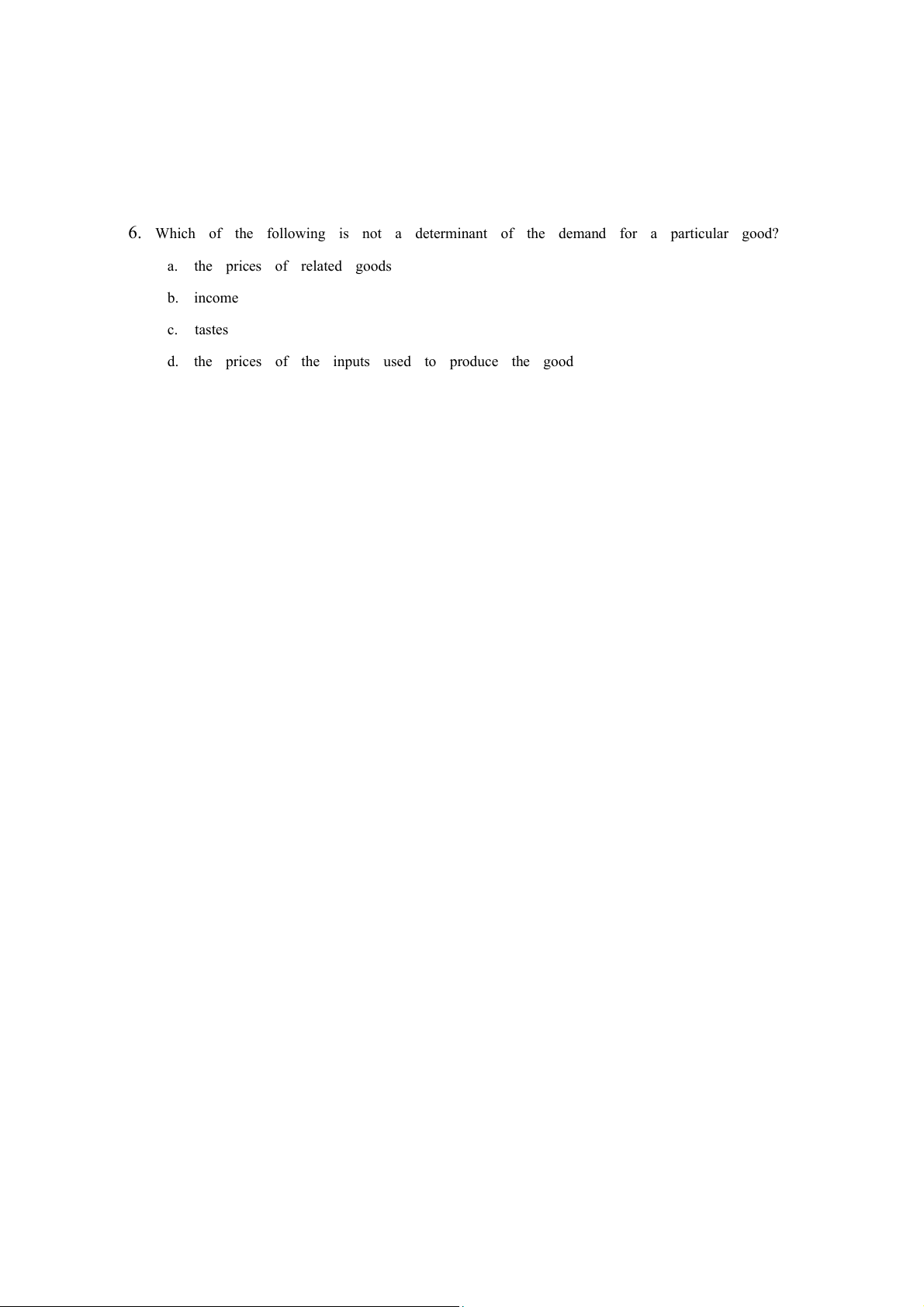
6. Which of the following is not a determinant of the demand for a particular good? a. the prices of related goods b. income c. tastes
d. the prices of the inputs used to produce the good
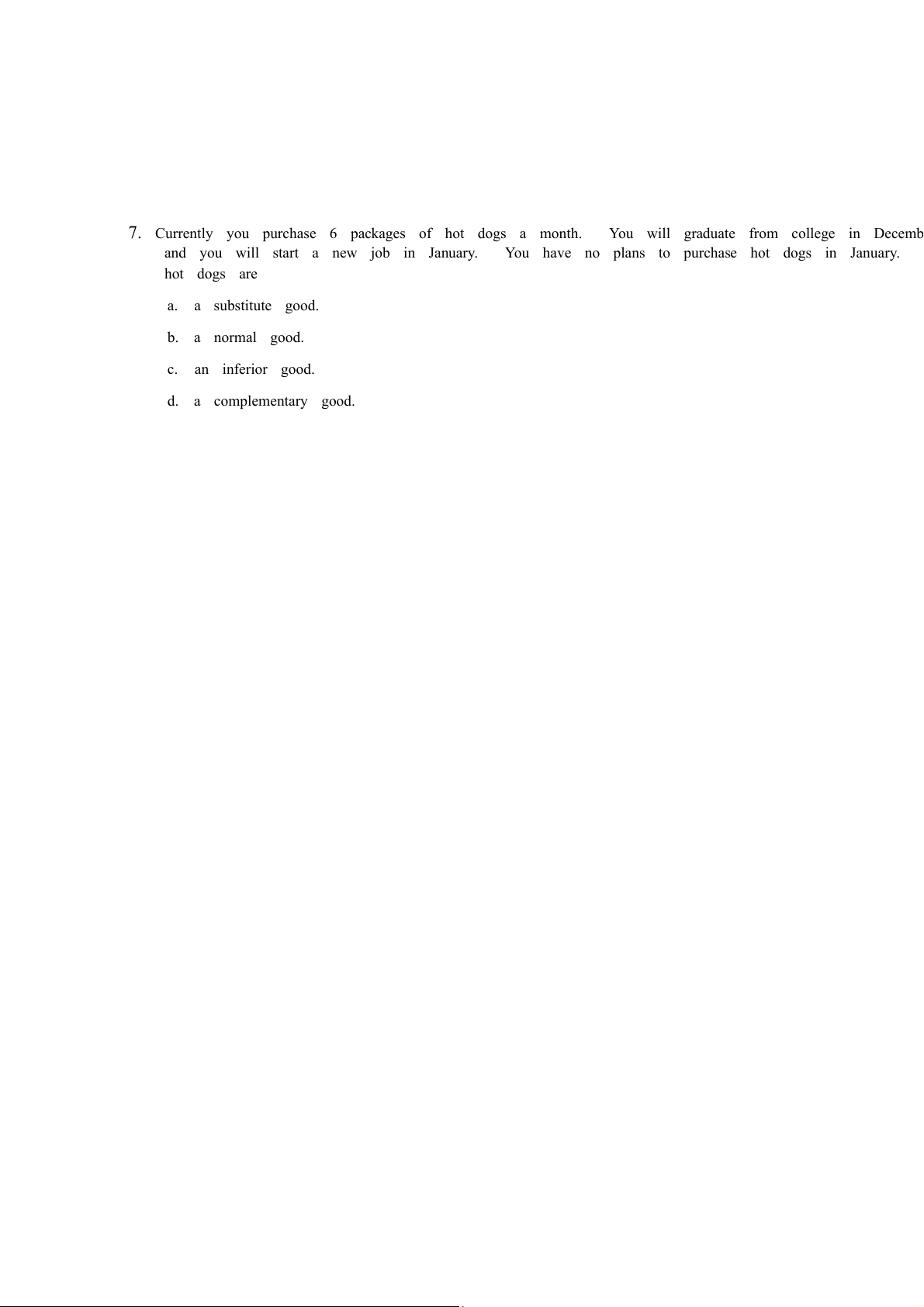
7. Currently you purchase 6 packages of hot dogs a month. You will graduate from college in Decemb
and you will start a new job in January. You have no plans to purchase hot dogs in January. hot dogs are a. a substitute good. b. a normal good. c. an inferior good. d. a complementary good.
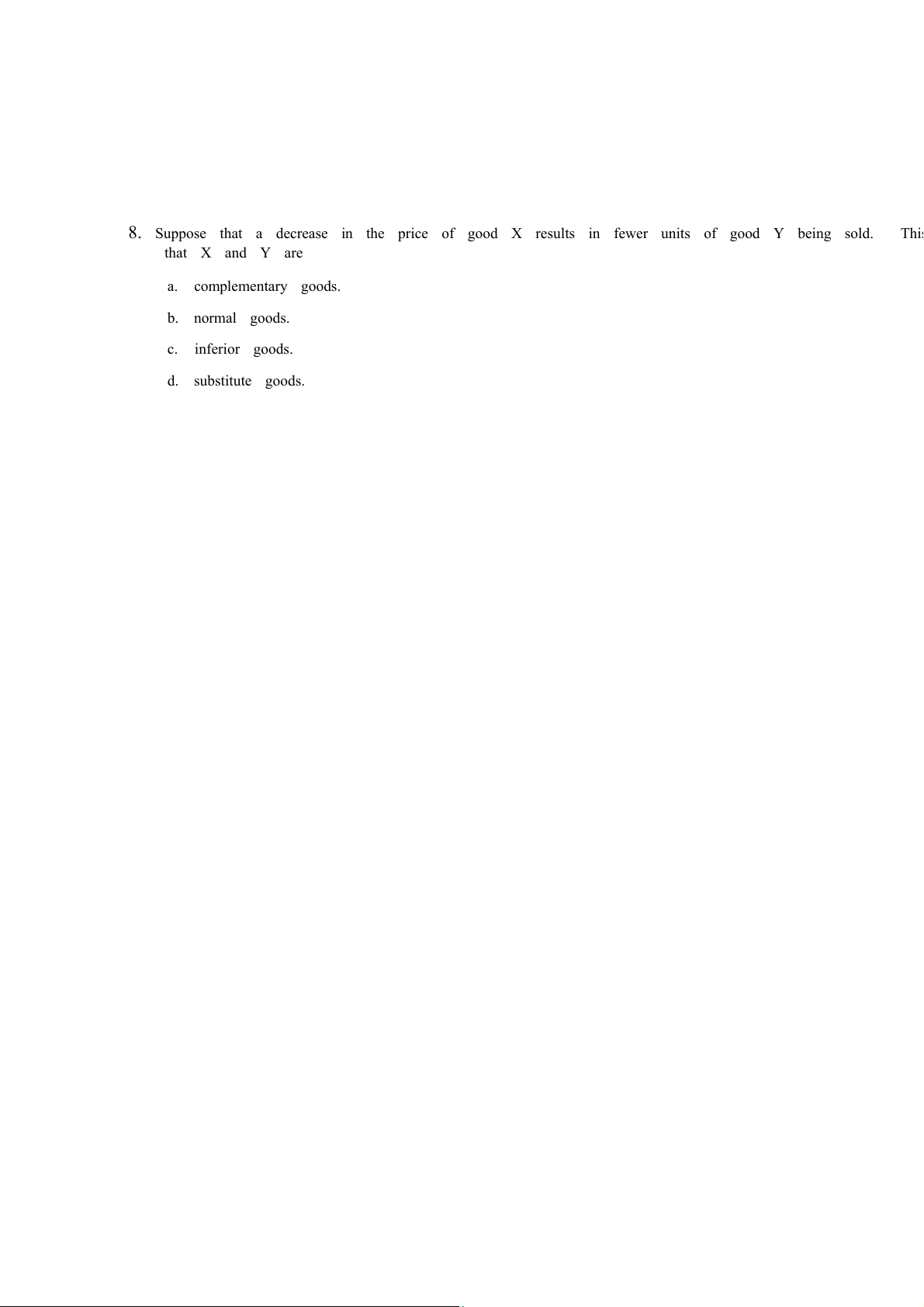
8. Suppose that a decrease in the price of good X results in fewer units of good Y being sold. This that X and Y are a. complementary goods. b. normal goods. c. inferior goods. d. substitute goods.
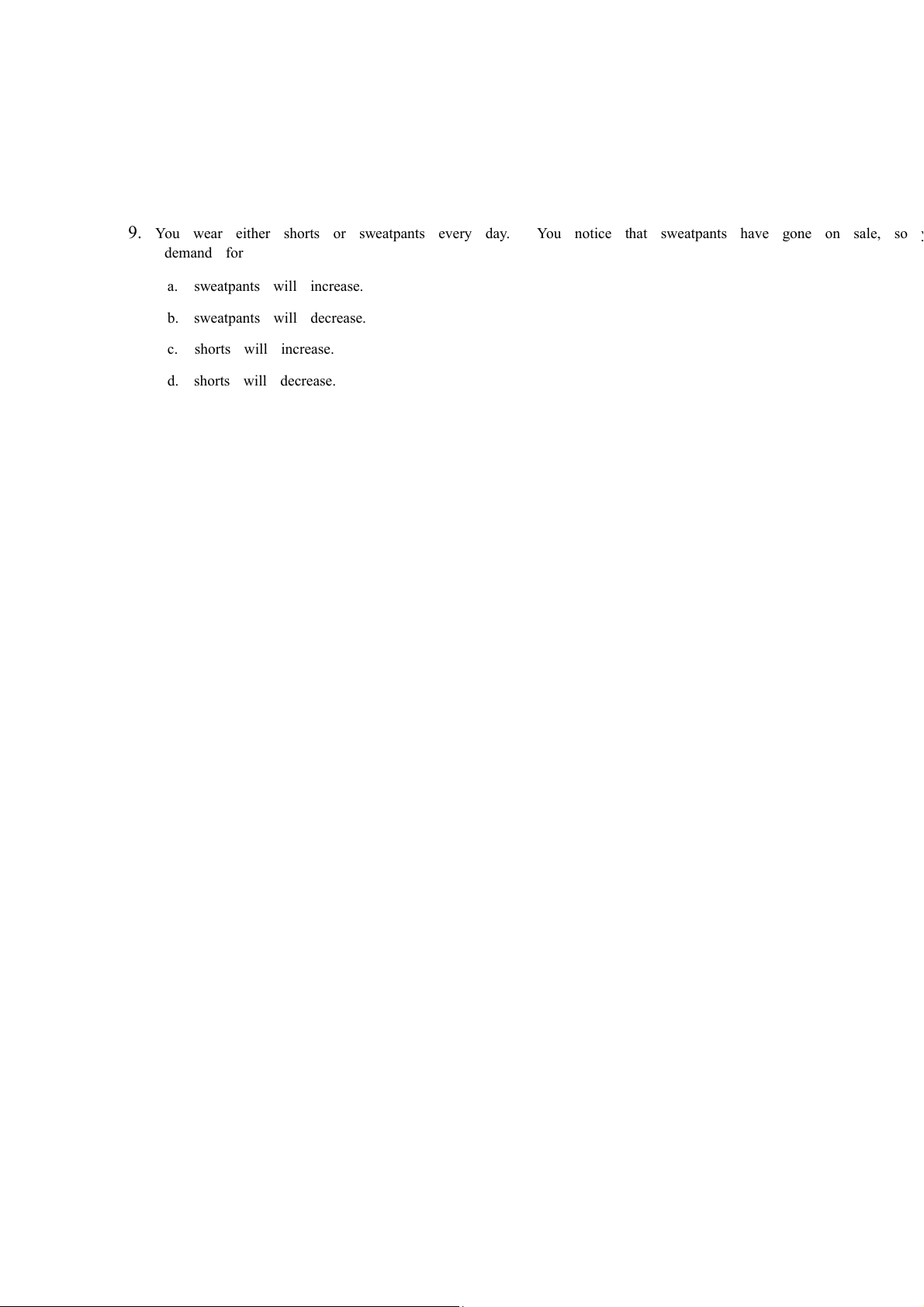
9. You wear either shorts or sweatpants every day. You notice that sweatpants have gone on sale, so y demand for a. sweatpants will increase. b. sweatpants will decrease. c. shorts will increase. d. shorts will decrease.
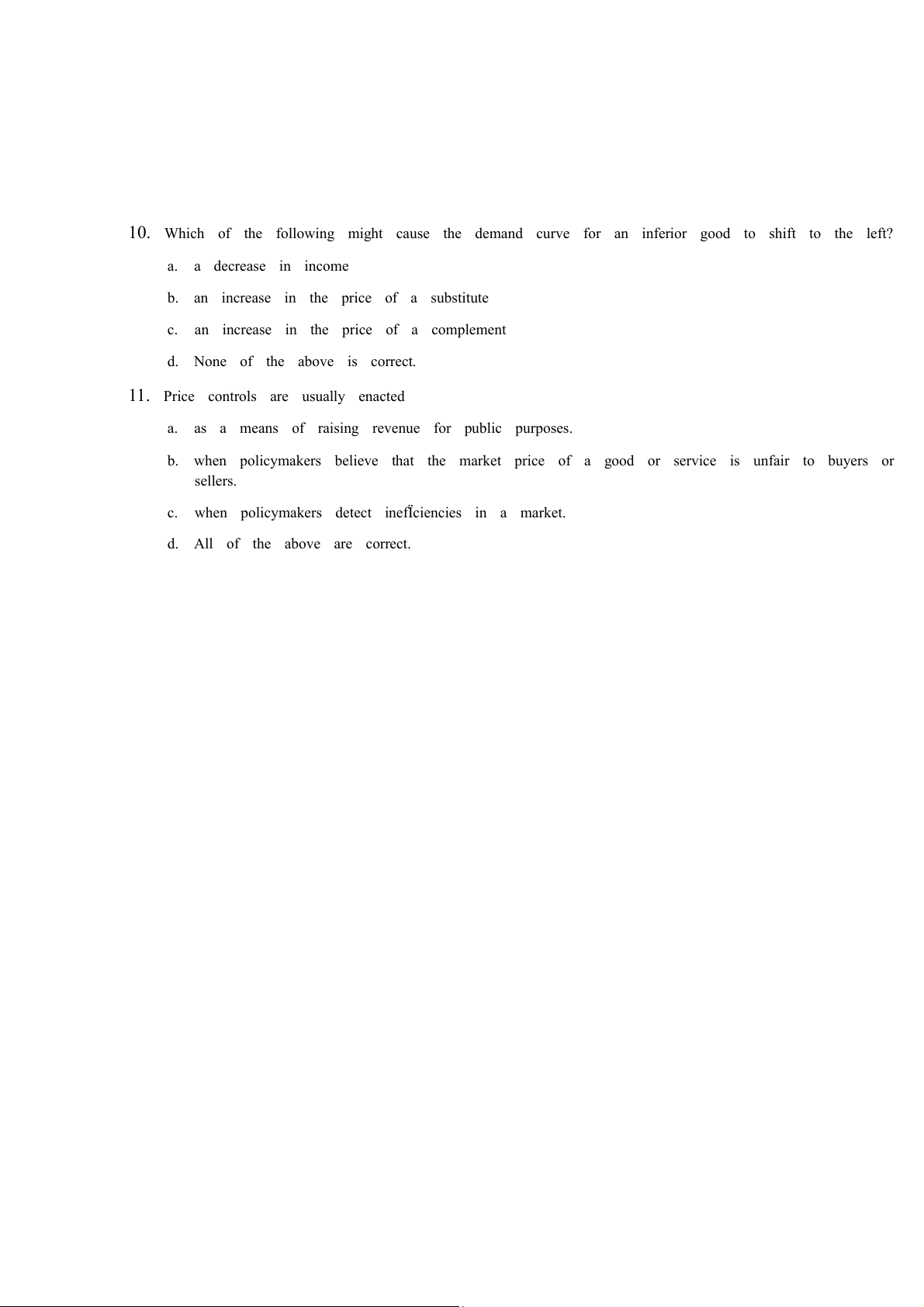
10. Which of the following might cause the demand curve for an inferior good to shift to the left? a. a decrease in income
b. an increase in the price of a substitute
c. an increase in the price of a complement
d. None of the above is correct.
11. Price controls are usually enacted
a. as a means of raising revenue for public purposes.
b. when policymakers believe that the market price of a good or service is unfair to buyers or sellers.
c. when policymakers detect inefÏciencies in a market.
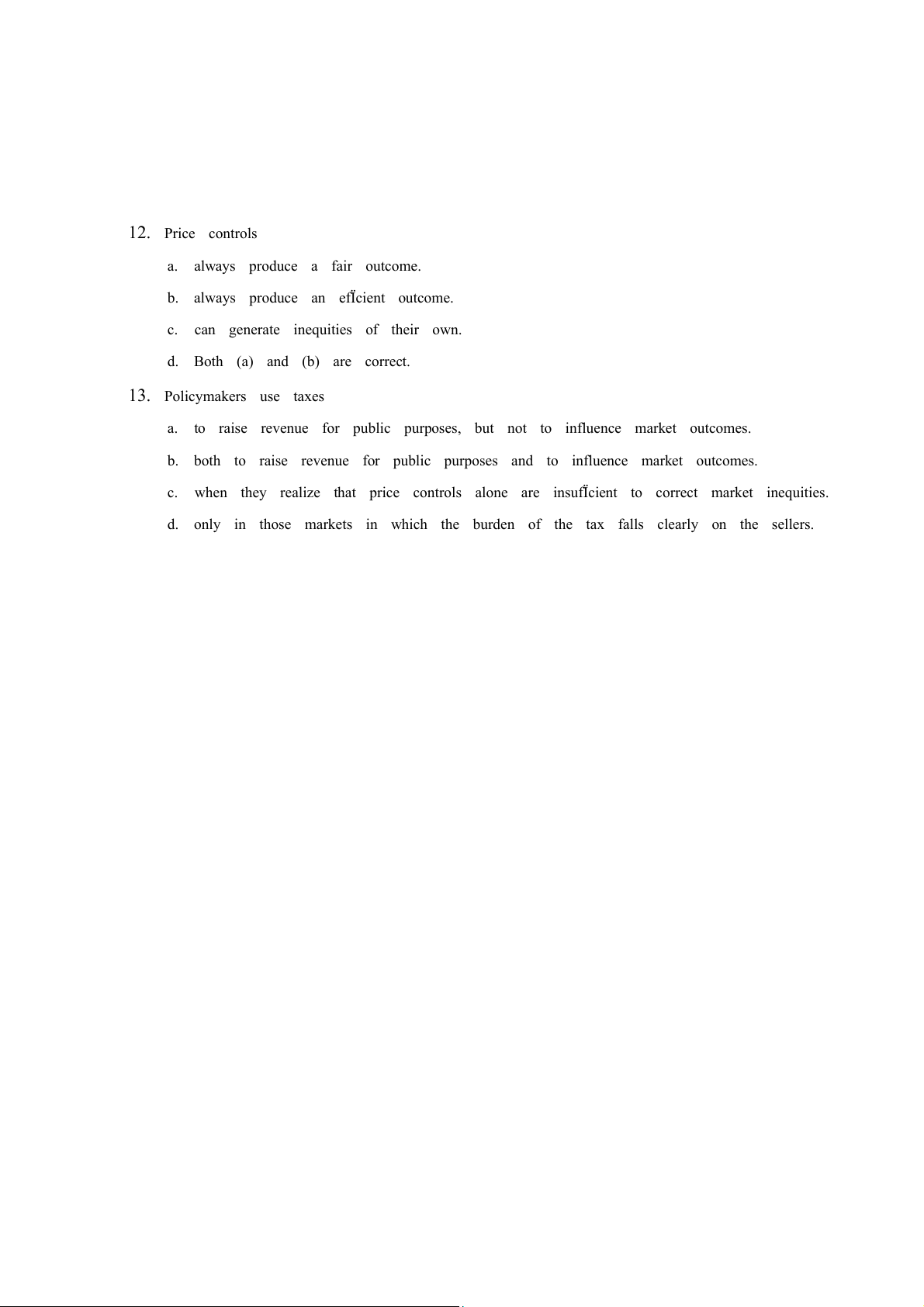
d. All of the above are correct. 12. Price controls
a. always produce a fair outcome.
b. always produce an efÏcient outcome.
c. can generate inequities of their own.
d. Both (a) and (b) are correct. 13. Policymakers use taxes
a. to raise revenue for public purposes, but not to influence market outcomes.
b. both to raise revenue for public purposes and to influence market outcomes.
c. when they realize that price controls alone are insufÏcient to correct market inequities.
d. only in those markets in which the burden of the tax falls clearly on the sellers.
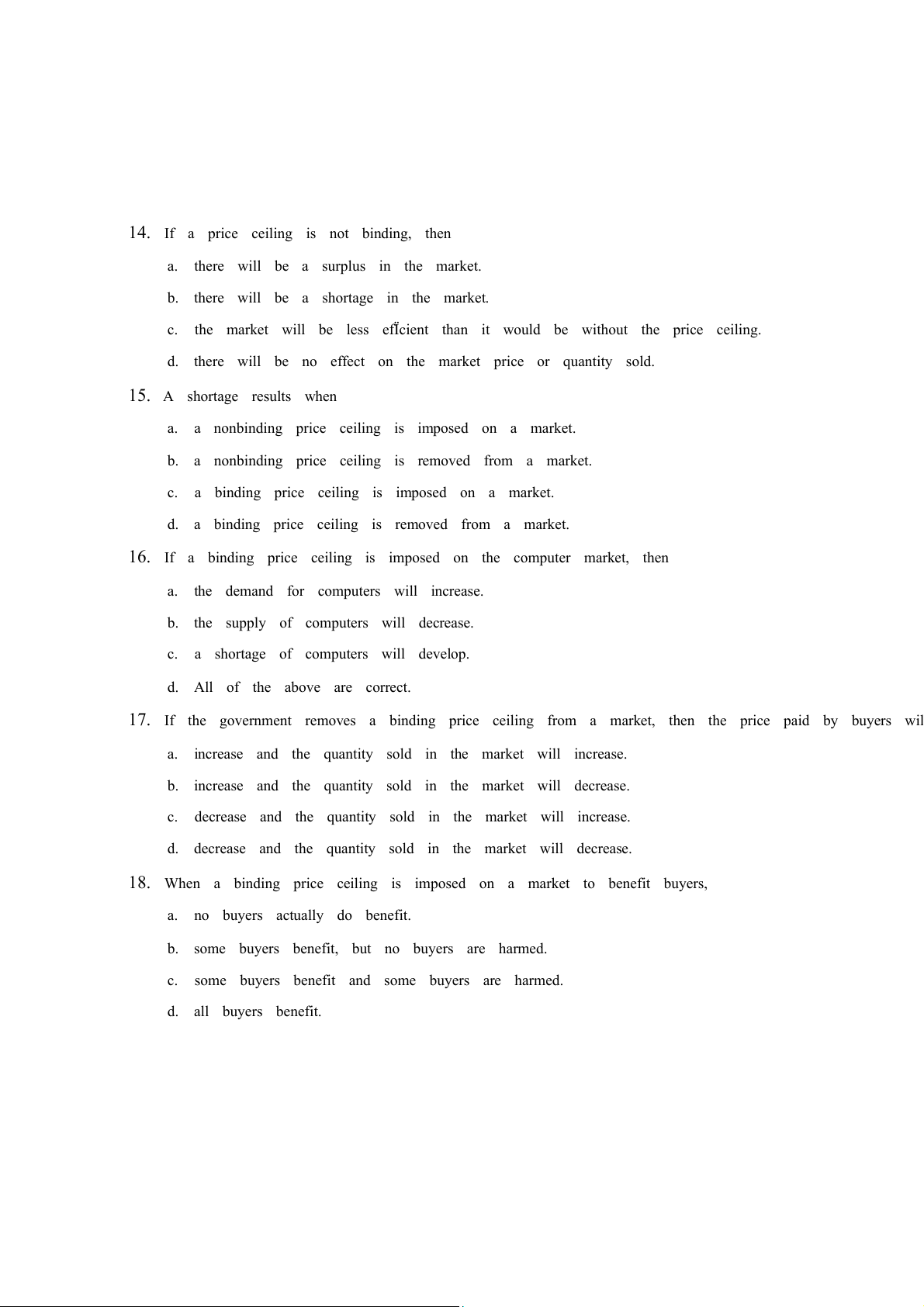
14. If a price ceiling is not binding, then
a. there will be a surplus in the market.
b. there will be a shortage in the market.
c. the market will be less efÏcient than it would be without the price ceiling.
d. there will be no effect on the market price or quantity sold.
15. A shortage results when
a. a nonbinding price ceiling is imposed on a market.
b. a nonbinding price ceiling is removed from a market.
c. a binding price ceiling is imposed on a market.
d. a binding price ceiling is removed from a market.
16. If a binding price ceiling is imposed on the computer market, then
a. the demand for computers will increase.
b. the supply of computers will decrease.
c. a shortage of computers will develop.
d. All of the above are correct.
17. If the government removes a binding price ceiling from a market, then the price paid by buyers wil
a. increase and the quantity sold in the market will increase.
b. increase and the quantity sold in the market will decrease.
c. decrease and the quantity sold in the market will increase.
d. decrease and the quantity sold in the market will decrease.
18. When a binding price ceiling is imposed on a market to benefit buyers,
a. no buyers actually do benefit.
b. some buyers benefit, but no buyers are harmed.
c. some buyers benefit and some buyers are harmed. d. all buyers benefit.
Tài liệu liên quan:
-
Chương 3: độ co giãn và các nhân tố ảnh hưởng | Microeconomics | Trường Đại học Quốc tế, Đại học Quốc gia Thành phố Hồ Chí Minh
5 3 -
Microeconomics Syllabus | Microeconomics | Trường Đại học Quốc tế, Đại học Quốc gia Thành phố Hồ Chí Minh
5 3 -
Microeconomics Course Syllabus & Assessment Details | Microeconomics | Trường Đại học Quốc tế, Đại học Quốc gia Thành phố Hồ Chí Minh
5 3 -
Assignment 3 - Elasticity MCQs and Key Concepts | Microeconomics | Trường Đại học Quốc tế, Đại học Quốc gia Thành phố Hồ Chí Minh
4 2 -
Assignment 2 - Economic Equilibrium Analysis of Fridges and Motorcycles | Microeconomics | Trường Đại học Quốc tế, Đại học Quốc gia Thành phố Hồ Chí Minh
4 2