Understanding Diversity, Motivation, and Teamwork in Organizations | Microeconomics | Trường Đại học Quốc tế, Đại học Quốc gia Thành phố Hồ Chí Minh
Kimberly Ortiz strongly believes in working for a company which promotes diversity. She believes that such organizations are respectful of differences and allow employees more exposure. She recently attended an interview where she was told that the company follows policies which focus on organizational diversity. However, when she finally joined the company, she had a strong feeling that the company's claim was not true. Which of the following, if true, weakens Kimberly's belief that the company does not encourage diversity? Tài liệu được sưu tầm và soạn thảo dưới dạng file PDF để gửi tới các bạn cùng tham khảo, ôn tập đầy đủ kiến thức, chuẩn bị cho các buổi học thật tốt. Mời bạn đọc đón xem!
Môn: Microeconomics 635 tài liệu
Trường: Trường Đại học Quốc tế, Đại học Quốc gia Thành phố Hồ Chí Minh 1.9 K tài liệu
Tác giả:

Preview text:
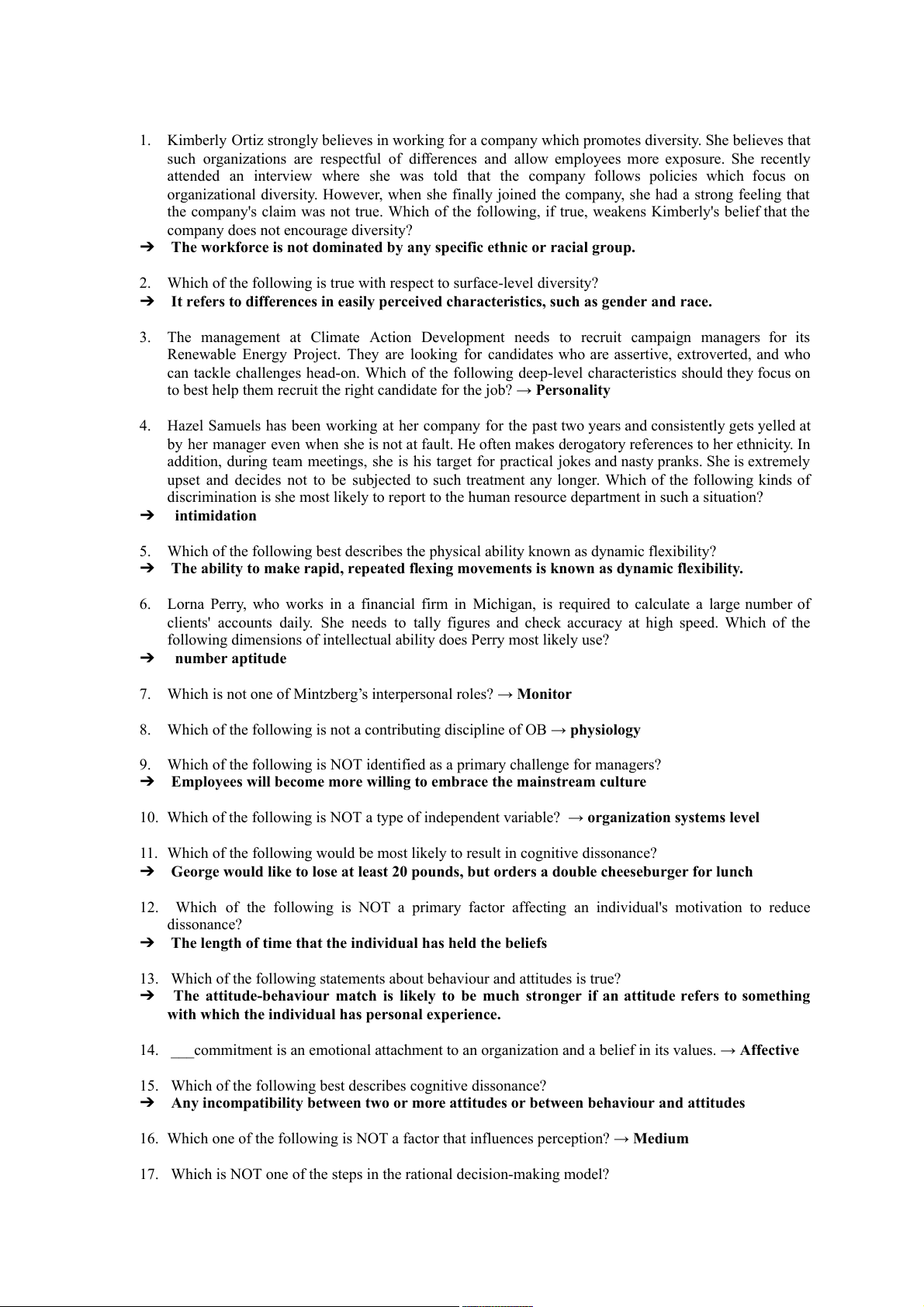
1. Kimberly Ortiz strongly believes in working for a company which promotes diversity. She believes that
such organizations are respectful of differences and allow employees more exposure. She recently
attended an interview where she was told that the company follows policies which focus on
organizational diversity. However, when she finally joined the company, she had a strong feeling that
the company's claim was not true. Which of the following, if true, weakens Kimberly's belief that the
company does not encourage diversity?
➔ The workforce is not dominated by any specific ethnic or racial group.
2. Which of the following is true with respect to surface-level diversity?
➔ It refers to differences in easily perceived characteristics, such as gender and race.
3. The management at Climate Action Development needs to recruit campaign managers for its
Renewable Energy Project. They are looking for candidates who are assertive, extroverted, and who
can tackle challenges head-on. Which of the following deep-level characteristics should they focus on
to best help them recruit the right candidate for the job? → Personality
4. Hazel Samuels has been working at her company for the past two years and consistently gets yelled at
by her manager even when she is not at fault. He often makes derogatory references to her ethnicity. In
addition, during team meetings, she is his target for practical jokes and nasty pranks. She is extremely
upset and decides not to be subjected to such treatment any longer. Which of the following kinds of
discrimination is she most likely to report to the human resource department in such a situation? ➔ intimidation
5. Which of the following best describes the physical ability known as dynamic flexibility?
➔ The ability to make rapid, repeated flexing movements is known as dynamic flexibility.
6. Lorna Perry, who works in a financial firm in Michigan, is required to calculate a large number of
clients' accounts daily. She needs to tally figures and check accuracy at high speed. Which of the
following dimensions of intellectual ability does Perry most likely use? ➔ number aptitude
7. Which is not one of Mintzberg’s interpersonal roles? → Monitor
8. Which of the following is not a contributing discipline of OB → physiology
9. Which of the following is NOT identified as a primary challenge for managers?
➔ Employees will become more willing to embrace the mainstream culture
10. Which of the following is NOT a type of independent variable? → organization systems level
11. Which of the following would be most likely to result in cognitive dissonance?
➔ George would like to lose at least 20 pounds, but orders a double cheeseburger for lunch
12. Which of the following is NOT a primary factor affecting an individual's motivation to reduce dissonance?
➔ The length of time that the individual has held the beliefs
13. Which of the following statements about behaviour and attitudes is true?
➔ The attitude-behaviour match is likely to be much stronger if an attitude refers to something
with which the individual has personal experience.
14. ___commitment is an emotional attachment to an organization and a belief in its values. → Affective
15. Which of the following best describes cognitive dissonance?
➔ Any incompatibility between two or more attitudes or between behaviour and attitudes
16. Which one of the following is NOT a factor that influences perception? → Medium
17. Which is NOT one of the steps in the rational decision-making model?
➔ Selecting the decision that satisfies
18. Which of the following is NOT an organizational constraint on decision-making? → Personality
19. __ occurs when an individual attributes their success to internal factors and failure to external factors ➔ Self-serving bias
20. Jane is concerned about her chances of getting selected for a new job after hearing that her interview
follows that of a highly qualified candidate. This is an example of → contrast effects
21. Processes that account for an individual's intensity, direction, and persistence of effort toward attaining
a goal are collectively known as → motivation
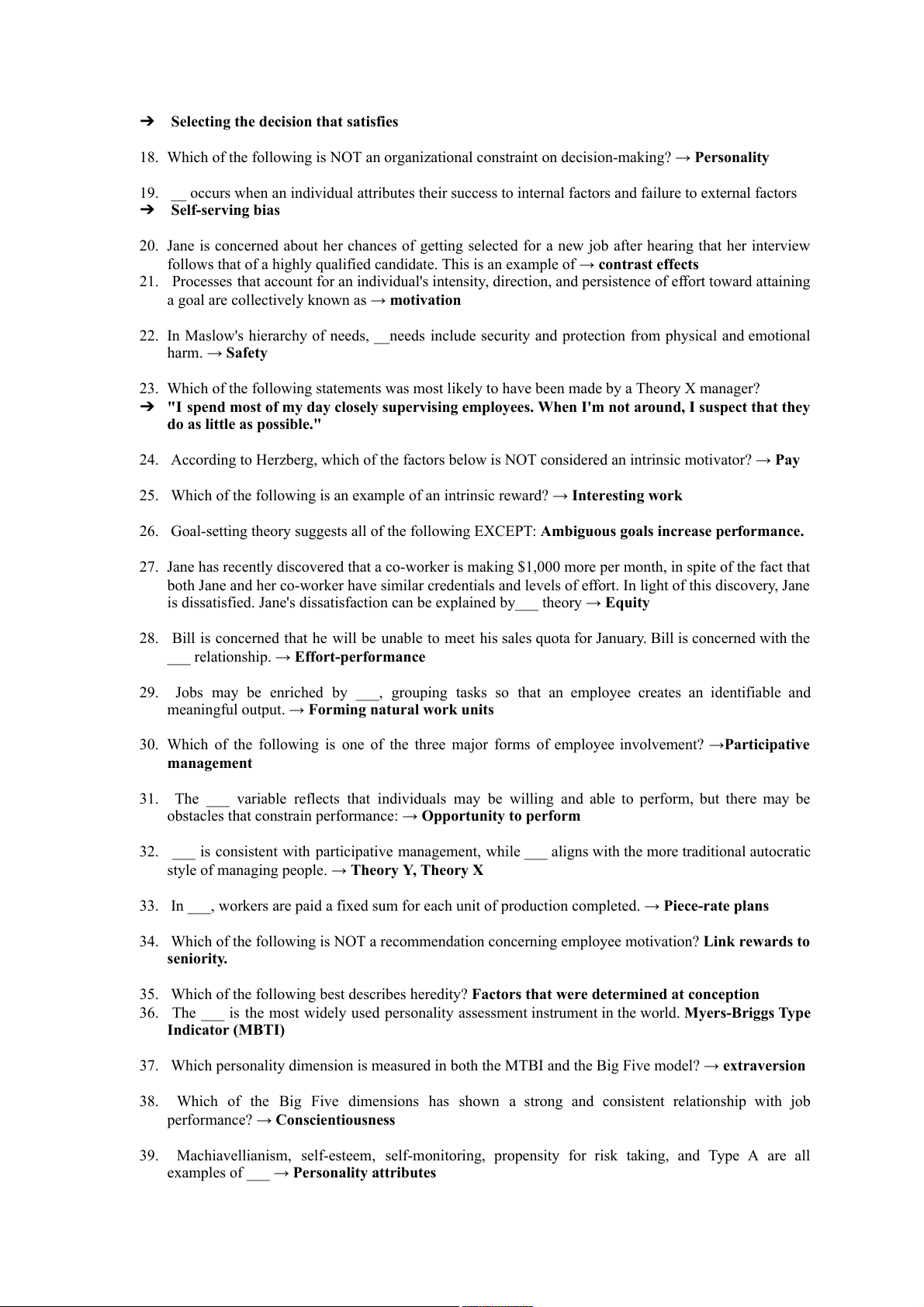
22. In Maslow's hierarchy of needs, __needs include security and protection from physical and emotional harm. → Safety
23. Which of the following statements was most likely to have been made by a Theory X manager?
➔ "I spend most of my day closely supervising employees. When I'm not around, I suspect that they do as little as possible."
24. According to Herzberg, which of the factors below is NOT considered an intrinsic motivator? → Pay
25. Which of the following is an example of an intrinsic reward? → Interesting work
26. Goal-setting theory suggests all of the following EXCEPT: Ambiguous goals increase performance.
27. Jane has recently discovered that a co-worker is making $1,000 more per month, in spite of the fact that
both Jane and her co-worker have similar credentials and levels of effort. In light of this discovery, Jane
is dissatisfied. Jane's dissatisfaction can be explained by___ theory → Equity
28. Bill is concerned that he will be unable to meet his sales quota for January. Bill is concerned with the
___ relationship. → Effort-performance
29. Jobs may be enriched by ___, grouping tasks so that an employee creates an identifiable and
meaningful output. → Forming natural work units
30. Which of the following is one of the three major forms of employee involvement? →Participative management
31. The ___ variable reflects that individuals may be willing and able to perform, but there may be
obstacles that constrain performance: → Opportunity to perform
32. ___ is consistent with participative management, while ___ aligns with the more traditional autocratic
style of managing people. → Theory Y, Theory X
33. In ___, workers are paid a fixed sum for each unit of production completed. → Piece-rate plans
34. Which of the following is NOT a recommendation concerning employee motivation? Link rewards to seniority.
35. Which of the following best describes heredity? Factors that were determined at conception
36. The ___ is the most widely used personality assessment instrument in the world. Myers-Briggs Type Indicator (MBTI)
37. Which personality dimension is measured in both the MTBI and the Big Five model? → extraversion
38. Which of the Big Five dimensions has shown a strong and consistent relationship with job
performance? → Conscientiousness
39. Machiavellianism, self-esteem, self-monitoring, propensity for risk taking, and Type A are all
examples of ___ → Personality attributes
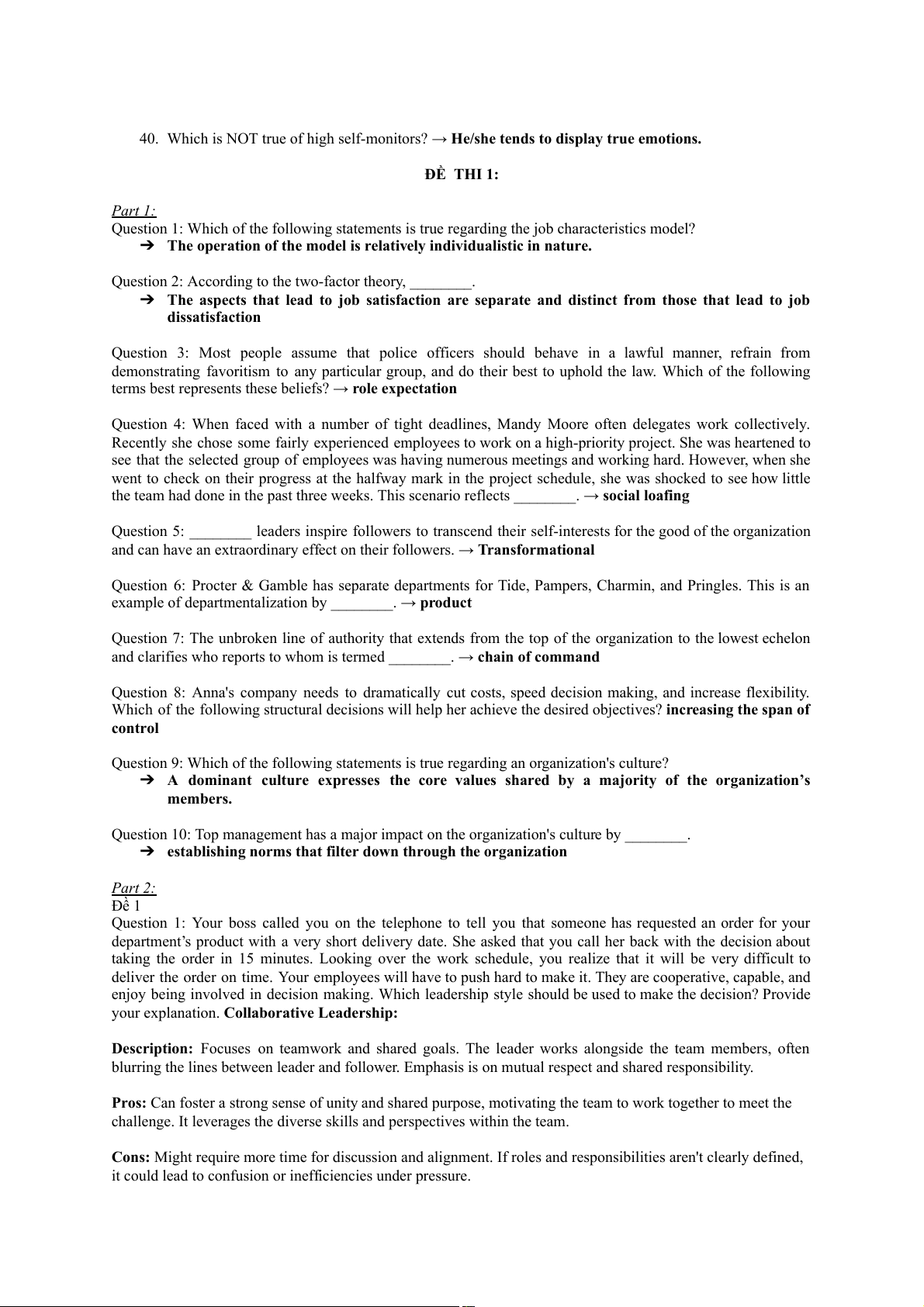
40. Which is NOT true of high self-monitors? → He/she tends to display true emotions. ĐỀ THI 1: Part 1:
Question 1: Which of the following statements is true regarding the job characteristics model?
➔ The operation of the model is relatively individualistic in nature.
Question 2: According to the two-factor theory, ________.
➔ The aspects that lead to job satisfaction are separate and distinct from those that lead to job dissatisfaction
Question 3: Most people assume that police officers should behave in a lawful manner, refrain from
demonstrating favoritism to any particular group, and do their best to uphold the law. Which of the following
terms best represents these beliefs? → role expectation
Question 4: When faced with a number of tight deadlines, Mandy Moore often delegates work collectively.
Recently she chose some fairly experienced employees to work on a high-priority project. She was heartened to
see that the selected group of employees was having numerous meetings and working hard. However, when she
went to check on their progress at the halfway mark in the project schedule, she was shocked to see how little
the team had done in the past three weeks. This scenario reflects ________. → social loafing
Question 5: ________ leaders inspire followers to transcend their self-interests for the good of the organization
and can have an extraordinary effect on their followers. → Transformational
Question 6: Procter & Gamble has separate departments for Tide, Pampers, Charmin, and Pringles. This is an
example of departmentalization by ________. → product
Question 7: The unbroken line of authority that extends from the top of the organization to the lowest echelon
and clarifies who reports to whom is termed ________. → chain of command
Question 8: Anna's company needs to dramatically cut costs, speed decision making, and increase flexibility.
Which of the following structural decisions will help her achieve the desired objectives? increasing the span of control
Question 9: Which of the following statements is true regarding an organization's culture?
➔ A dominant culture expresses the core values shared by a majority of the organization’s members.
Question 10: Top management has a major impact on the organization's culture by ________.
➔ establishing norms that filter down through the organization Part 2: Đề 1
Question 1: Your boss called you on the telephone to tell you that someone has requested an order for your
department’s product with a very short delivery date. She asked that you call her back with the decision about
taking the order in 15 minutes. Looking over the work schedule, you realize that it will be very difficult to
deliver the order on time. Your employees will have to push hard to make it. They are cooperative, capable, and
enjoy being involved in decision making. Which leadership style should be used to make the decision? Provide
your explanation. Collaborative Leadership:
Description: Focuses on teamwork and shared goals. The leader works alongside the team members, often
blurring the lines between leader and follower. Emphasis is on mutual respect and shared responsibility.
Pros: Can foster a strong sense of unity and shared purpose, motivating the team to work together to meet the
challenge. It leverages the diverse skills and perspectives within the team.
Cons: Might require more time for discussion and alignment. If roles and responsibilities aren't clearly defined,
it could lead to confusion or inefficiencies under pressure.
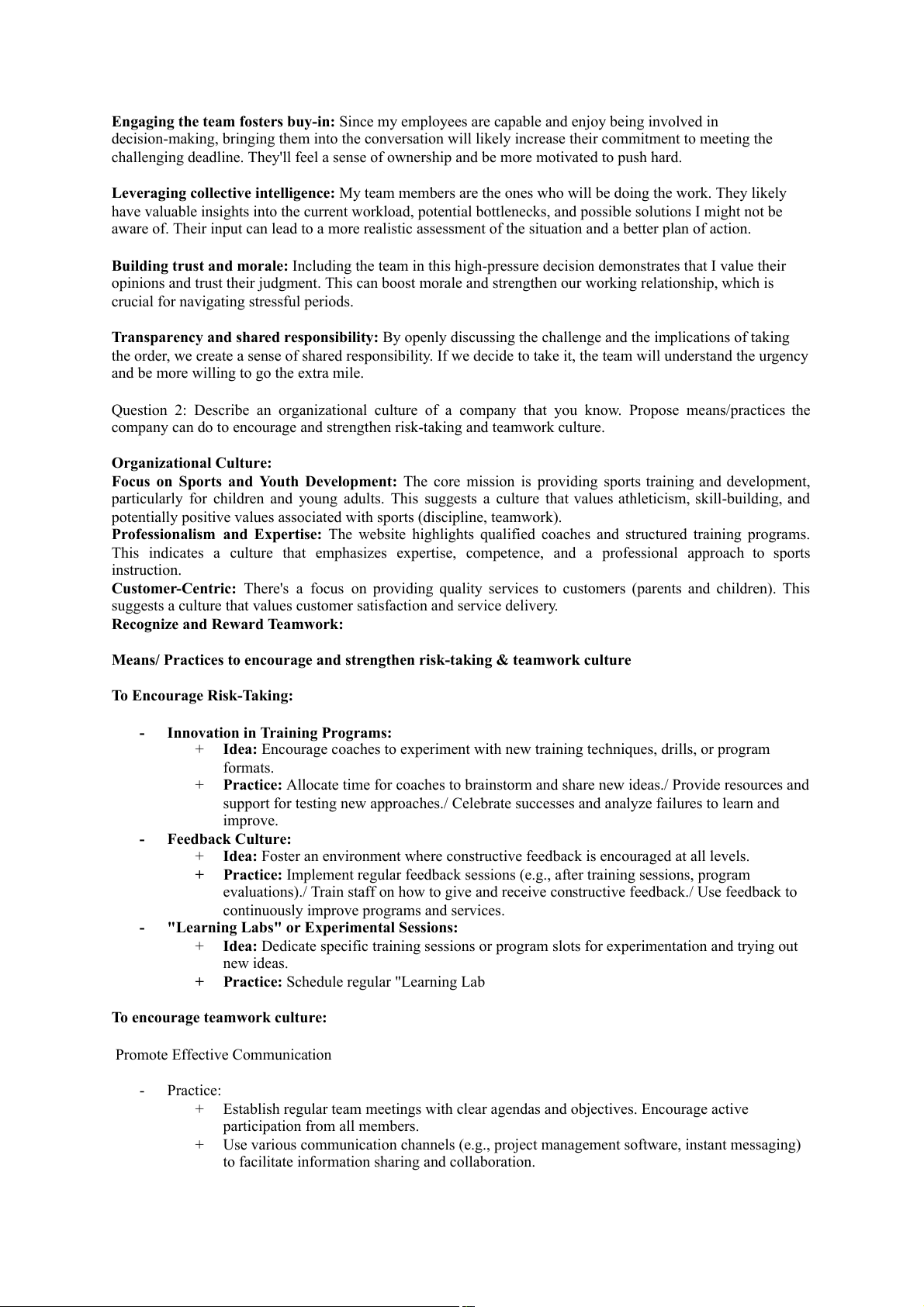
Engaging the team fosters buy-in: Since my employees are capable and enjoy being involved in
decision-making, bringing them into the conversation will likely increase their commitment to meeting the
challenging deadline. They'll feel a sense of ownership and be more motivated to push hard.
Leveraging collective intelligence: My team members are the ones who will be doing the work. They likely
have valuable insights into the current workload, potential bottlenecks, and possible solutions I might not be
aware of. Their input can lead to a more realistic assessment of the situation and a better plan of action.
Building trust and morale: Including the team in this high-pressure decision demonstrates that I value their
opinions and trust their judgment. This can boost morale and strengthen our working relationship, which is
crucial for navigating stressful periods.
Transparency and shared responsibility: By openly discussing the challenge and the implications of taking
the order, we create a sense of shared responsibility. If we decide to take it, the team will understand the urgency
and be more willing to go the extra mile.
Question 2: Describe an organizational culture of a company that you know. Propose means/practices the
company can do to encourage and strengthen risk-taking and teamwork culture. Organizational Culture:
Focus on Sports and Youth Development: The core mission is providing sports training and development,
particularly for children and young adults. This suggests a culture that values athleticism, skill-building, and
potentially positive values associated with sports (discipline, teamwork).
Professionalism and Expertise: The website highlights qualified coaches and structured training programs.
This indicates a culture that emphasizes expertise, competence, and a professional approach to sports instruction.
Customer-Centric: There's a focus on providing quality services to customers (parents and children). This
suggests a culture that values customer satisfaction and service delivery.
Recognize and Reward Teamwork:
Means/ Practices to encourage and strengthen risk-taking & teamwork culture To Encourage Risk-Taking: -
Innovation in Training Programs:
+ Idea: Encourage coaches to experiment with new training techniques, drills, or program formats.
+ Practice: Allocate time for coaches to brainstorm and share new ideas./ Provide resources and
support for testing new approaches./ Celebrate successes and analyze failures to learn and improve. - Feedback Culture:
+ Idea: Foster an environment where constructive feedback is encouraged at all levels.
+ Practice: Implement regular feedback sessions (e.g., after training sessions, program
evaluations)./ Train staff on how to give and receive constructive feedback./ Use feedback to
continuously improve programs and services. -
"Learning Labs" or Experimental Sessions:
+ Idea: Dedicate specific training sessions or program slots for experimentation and trying out new ideas.
+ Practice: Schedule regular "Learning Lab
To encourage teamwork culture:
Promote Effective Communication - Practice:
+ Establish regular team meetings with clear agendas and objectives. Encourage active
participation from all members.
+ Use various communication channels (e.g., project management software, instant messaging)
to facilitate information sharing and collaboration.
+ Train team members in active listening, nonverbal communication, and giving and receiving feedback.
+ Create opportunities for informal communication and social interaction to build relationships and rapport.
Build Trust and Psychological Safety - Practice:
+ Encourage vulnerability and openness by sharing personal experiences and acknowledging mistakes.
+ Practice empathy and understanding by actively listening to and validating team members' feelings and perspectives.
+ Avoid blame and criticism; instead, focus on problem-solving and learning from mistakes.
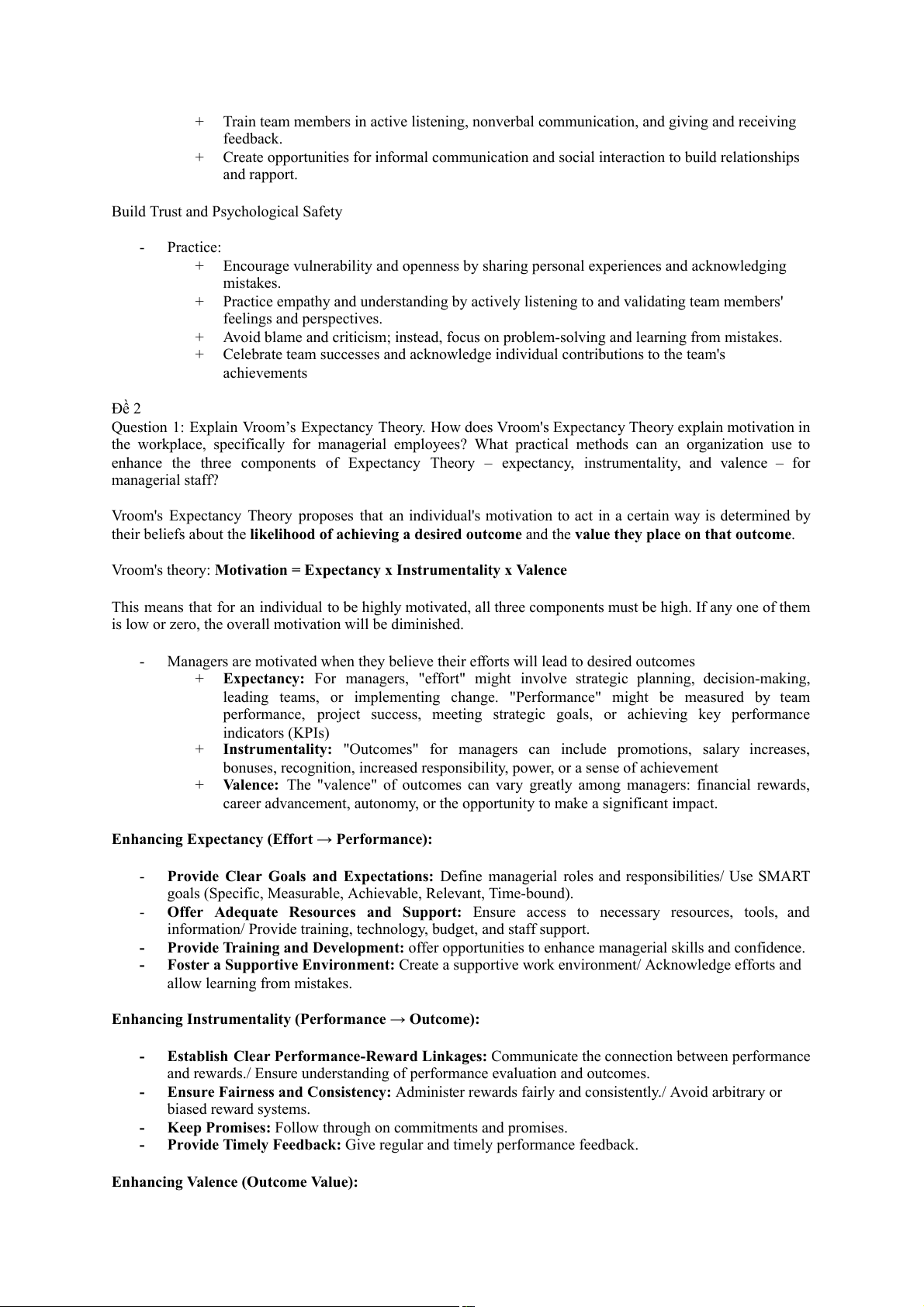
+ Celebrate team successes and acknowledge individual contributions to the team's achievements Đề 2
Question 1: Explain Vroom’s Expectancy Theory. How does Vroom's Expectancy Theory explain motivation in
the workplace, specifically for managerial employees? What practical methods can an organization use to
enhance the three components of Expectancy Theory – expectancy, instrumentality, and valence – for managerial staff?
Vroom's Expectancy Theory proposes that an individual's motivation to act in a certain way is determined by
their beliefs about the likelihood of achieving a desired outcome and the value they place on that outcome.
Vroom's theory: Motivation = Expectancy x Instrumentality x Valence
This means that for an individual to be highly motivated, all three components must be high. If any one of them
is low or zero, the overall motivation will be diminished. -
Managers are motivated when they believe their efforts will lead to desired outcomes
+ Expectancy: For managers, "effort" might involve strategic planning, decision-making,
leading teams, or implementing change. "Performance" might be measured by team
performance, project success, meeting strategic goals, or achieving key performance indicators (KPIs)
+ Instrumentality: "Outcomes" for managers can include promotions, salary increases,
bonuses, recognition, increased responsibility, power, or a sense of achievement
+ Valence: The "valence" of outcomes can vary greatly among managers: financial rewards,
career advancement, autonomy, or the opportunity to make a significant impact.
Enhancing Expectancy (Effort → Performance): -
Provide Clear Goals and Expectations: Define managerial roles and responsibilities/ Use SMART
goals (Specific, Measurable, Achievable, Relevant, Time-bound). -
Offer Adequate Resources and Support: Ensure access to necessary resources, tools, and
information/ Provide training, technology, budget, and staff support. -
Provide Training and Development: offer opportunities to enhance managerial skills and confidence. -
Foster a Supportive Environment: Create a supportive work environment/ Acknowledge efforts and allow learning from mistakes.
Enhancing Instrumentality (Performance → Outcome): -
Establish Clear Performance-Reward Linkages: Communicate the connection between performance
and rewards./ Ensure understanding of performance evaluation and outcomes. -
Ensure Fairness and Consistency: Administer rewards fairly and consistently./ Avoid arbitrary or biased reward systems. -
Keep Promises: Follow through on commitments and promises. -
Provide Timely Feedback: Give regular and timely performance feedback.
Enhancing Valence (Outcome Value): -
Identify Individual Needs and Preferences: Understand what rewards are valued by individual
managers./ Use surveys, interviews, etc., to gather information. -
Offer a Variety of Rewards: Provide a mix of intrinsic (recognition, autonomy, growth) and extrinsic
(pay, bonuses, promotions) rewards. -
Customize Rewards: Customize rewards to individual preferences (where possible)./ Offer flexible benefit options, etc. -
Ensure Rewards Are Significant: Make sure rewards are substantial enough to be motivating.
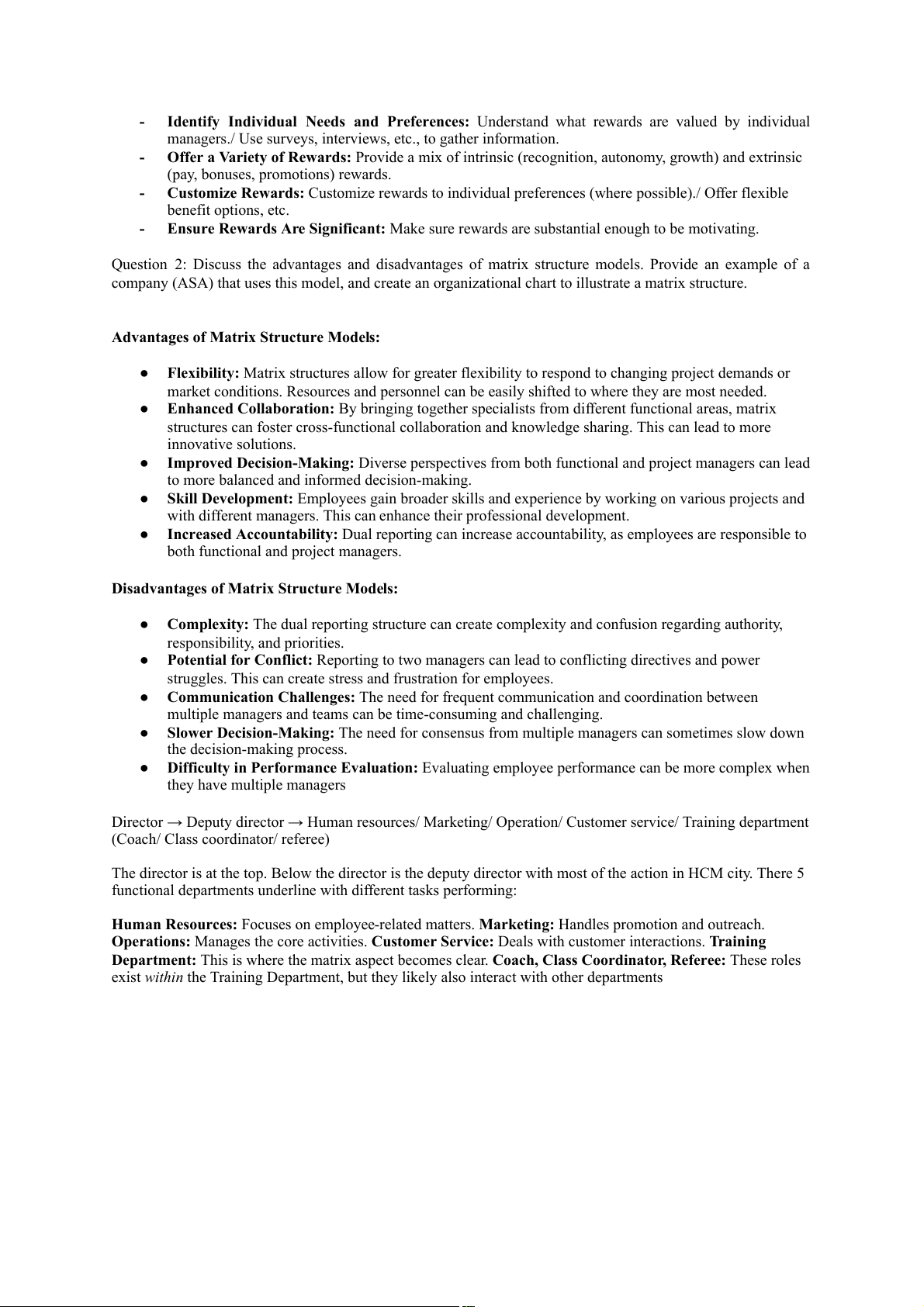
Question 2: Discuss the advantages and disadvantages of matrix structure models. Provide an example of a
company (ASA) that uses this model, and create an organizational chart to illustrate a matrix structure.
Advantages of Matrix Structure Models:
● Flexibility: Matrix structures allow for greater flexibility to respond to changing project demands or
market conditions. Resources and personnel can be easily shifted to where they are most needed.
● Enhanced Collaboration: By bringing together specialists from different functional areas, matrix
structures can foster cross-functional collaboration and knowledge sharing. This can lead to more innovative solutions.
● Improved Decision-Making: Diverse perspectives from both functional and project managers can lead
to more balanced and informed decision-making.
● Skill Development: Employees gain broader skills and experience by working on various projects and
with different managers. This can enhance their professional development.
● Increased Accountability: Dual reporting can increase accountability, as employees are responsible to
both functional and project managers.
Disadvantages of Matrix Structure Models:
● Complexity: The dual reporting structure can create complexity and confusion regarding authority,
responsibility, and priorities.
● Potential for Conflict: Reporting to two managers can lead to conflicting directives and power
struggles. This can create stress and frustration for employees.
● Communication Challenges: The need for frequent communication and coordination between
multiple managers and teams can be time-consuming and challenging.
● Slower Decision-Making: The need for consensus from multiple managers can sometimes slow down the decision-making process.
● Difficulty in Performance Evaluation: Evaluating employee performance can be more complex when they have multiple managers
Director → Deputy director → Human resources/ Marketing/ Operation/ Customer service/ Training department
(Coach/ Class coordinator/ referee)
The director is at the top. Below the director is the deputy director with most of the action in HCM city. There 5
functional departments underline with different tasks performing:
Human Resources: Focuses on employee-related matters. Marketing: Handles promotion and outreach.
Operations: Manages the core activities. Customer Service: Deals with customer interactions. Training
Department: This is where the matrix aspect becomes clear. Coach, Class Coordinator, Referee: These roles
exist within the Training Department, but they likely also interact with other departments
Tài liệu liên quan:
-
Chương 3: độ co giãn và các nhân tố ảnh hưởng | Microeconomics | Trường Đại học Quốc tế, Đại học Quốc gia Thành phố Hồ Chí Minh
6 3 -
Microeconomics Syllabus | Microeconomics | Trường Đại học Quốc tế, Đại học Quốc gia Thành phố Hồ Chí Minh
5 3 -
Microeconomics Course Syllabus & Assessment Details | Microeconomics | Trường Đại học Quốc tế, Đại học Quốc gia Thành phố Hồ Chí Minh
5 3 -
Assignment 3 - Elasticity MCQs and Key Concepts | Microeconomics | Trường Đại học Quốc tế, Đại học Quốc gia Thành phố Hồ Chí Minh
5 3 -
Assignment 2 - Economic Equilibrium Analysis of Fridges and Motorcycles | Microeconomics | Trường Đại học Quốc tế, Đại học Quốc gia Thành phố Hồ Chí Minh
6 3