Understanding Elasticity and Its Applications in Economics | Microeconomics | Trường Đại học Quốc tế, Đại học Quốc gia Thành phố Hồ Chí Minh
Elasticity measures how responsive quantity is to changes in price. ANS: T DIF: 1 REF: 5-0 NAT: Analytic LOC: Elasticity TOP: Price elasticity of demand MSC: Definitional 2. Measures of elasticity enhance our ability to study the magnitudes of changes. ANS: T DIF: 1 REF: 5-0 NAT: Analytic LOC: Elasticity TOP: Price elasticity of demand MSC: Definitional 3. The demand for bread is likely to be more elastic than the demand for solid-gold bread plates. ANS: F DIF: 2 REF: 5-1 NAT: Analytic LOC: Elasticity TOP: Price elasticity of demand MSC: Interpretive 4. In general, demand curves for necessities tend to be price elastic. ANS: F DIF. Tài liệu được sưu tầm và soạn thảo dưới dạng file PDF để gửi tới các bạn cùng tham khảo, ôn tập đầy đủ kiến thức, chuẩn bị cho các buổi học thật tốt. Mời bạn đọc đón xem!
Môn: Microeconomics 635 tài liệu
Trường: Trường Đại học Quốc tế, Đại học Quốc gia Thành phố Hồ Chí Minh 1.9 K tài liệu
Tác giả:






Preview text:
288 Chapter 5 /Elasticity and Its Application Chapter 5 Elasticity and Its Application TRUE/FALSE 1.
Elasticity measures how responsive quantity is to changes in price. ANS: T DIF: 1 REF: 5-0 NAT: Analytic LOC: Elasticity
TOP: Price elasticity of demand MSC: Definitional 2.
Measures of elasticity enhance our ability to study the magnitudes of changes. ANS: T DIF: 1 REF: 5-0 NAT: Analytic LOC: Elasticity
TOP: Price elasticity of demand MSC: Definitional 3.
The demand for bread is likely to be more elastic than the demand for solid-gold bread plates. ANS: F DIF: 2 REF: 5-1 NAT: Analytic LOC: Elasticity
TOP: Price elasticity of demand MSC: Interpretive 4.
In general, demand curves for necessities tend to be price elastic. ANS: F DIF: 1 REF: 5-1 NAT: Analytic LOC: Elasticity
TOP: Price elasticity of demand MSC: Interpretive 5.
In general, demand curves for luxuries tend to be price elastic. ANS: T DIF: 1 REF: 5-1 NAT: Analytic LOC: Elasticity
TOP: Price elasticity of demand MSC: Interpretive 6.
Necessities tend to have inelastic demands, whereas luxuries have elastic demands. ANS: T DIF: 2 REF: 5-1 NAT: Analytic LOC: Elasticity
TOP: Price elasticity of demand MSC: Interpretive 7.
Goods with close substitutes tend to have more elastic demands than do goods without close substitutes. ANS: T DIF: 2 REF: 5-1 NAT: Analytic LOC: Elasticity
TOP: Price elasticity of demand MSC: Interpretive 8.
The demand for Rice Krispies is more elastic than the demand for cereal in general. ANS: T DIF: 2 REF: 5-1 NAT: Analytic LOC: Elasticity
TOP: Price elasticity of demand MSC: Interpretive 9.
The demand for soap is more elastic than the demand for Dove soap. ANS: F DIF: 2 REF: 5-1 NAT: Analytic LOC: Elasticity
TOP: Price elasticity of demand MSC: Interpretive 10.
The demand for gasoline will respond more to a change in price over a period of five weeks than over a period of five years. ANS: F DIF: 2 REF: 5-1 NAT: Analytic LOC: Elasticity
TOP: Price elasticity of demand MSC: Interpretive 11.
Even the demand for a necessity such as gasoline will respond to a change in price, especially over a longer time horizon. ANS: T DIF: 2 REF: 5-1 NAT: Analytic LOC: Elasticity
TOP: Price elasticity of demand MSC: Interpretive 12.
The price elasticity of demand is defined as the percentage change in quantity demanded divided by the percentage change in price. ANS: T DIF: 1 REF: 5-1 NAT: Analytic LOC: Elasticity
TOP: Price elasticity of demand MSC: Definitional 13.
The price elasticity of demand is defined as the percentage change in price divided by the percentage change in quantity demanded. ANS: F DIF: 1 REF: 5-1 NAT: Analytic LOC: Elasticity
TOP: Price elasticity of demand MSC: Definitional
289 Chapter 5 /Elasticity and Its Application 14.
Suppose that when the price rises by 20% for a particular good, the quantity demanded of that good falls by
10%. The price elasticity of demand for this good is equal to 2.0. ANS: F DIF: 2 REF: 5-1 NAT: Analytic LOC: Elasticity
TOP: Price elasticity of demand MSC: Analytical 15.
Suppose that when the price rises by 10% for a particular good, the quantity demanded of that good falls by
20%. The price elasticity of demand for this good is equal to 2.0. ANS: T DIF: 2 REF: 5-1 NAT: Analytic LOC: Elasticity
TOP: Price elasticity of demand MSC: Analytical 16.
If the price of calculators increases by 15 percent and the quantity demanded per week falls by 45 percent as a
result, then the price elasticity of demand is 3. ANS: T DIF: 2 REF: 5-1 NAT: Analytic LOC: Elasticity
TOP: Price elasticity of demand MSC: Applicative 17.
Demand is inelastic if the price elasticity of demand is greater than 1. ANS: F DIF: 1 REF: 5-1 NAT: Analytic LOC: Elasticity TOP: Inelastic demand MSC: Definitional 18.
A linear, downward-sloping demand curve has a constant elasticity but a changing slope. ANS: F DIF: 2 REF: 5-1 NAT: Analytic LOC: Elasticity
TOP: Price elasticity of demand MSC: Interpretive 19.
Price elasticity of demand along a linear, downward-sloping demand curve increases as price falls. ANS: F DIF: 3 REF: 5-1 NAT: Analytic LOC: Elasticity
TOP: Price elasticity of demand MSC: Interpretive 20.
If the price elasticity of demand is equal to 0, then demand is unit elastic. ANS: F DIF: 1 REF: 5-1 NAT: Analytic LOC: Elasticity
TOP: Price elasticity of demand MSC: Definitional 21.
If the price elasticity of demand is equal to 1, then demand is unit elastic. ANS: T DIF: 1 REF: 5-1 NAT: Analytic LOC: Elasticity
TOP: Price elasticity of demand MSC: Definitional 22.
Demand for a good is said to be inelastic if the quantity demanded increases substantially when the price falls by a small amount. ANS: F DIF: 1 REF: 5-1 NAT: Analytic LOC: Elasticity TOP: Inelastic demand MSC: Definitional 23.
The midpoint method is used to calculate elasticity between two points because it gives the same answer
regardless of the direction of the change. ANS: T DIF: 2 REF: 5-1 NAT: Analytic LOC: Elasticity TOP: Midpoint method MSC: Interpretive 24.
The flatter the demand curve that passes through a given point, the more inelastic the demand. ANS: F DIF: 2 REF: 5-1 NAT: Analytic LOC: Elasticity
TOP: Price elasticity of demand MSC: Interpretive 25.
The flatter the demand curve that passes through a given point, the more elastic the demand. ANS: T DIF: 2 REF: 5-1 NAT: Analytic LOC: Elasticity
TOP: Price elasticity of demand MSC: Interpretive 26.
If demand is perfectly inelastic, the demand curve is vertical, and the price elasticity of demand equals 0. ANS: T DIF: 2 REF: 5-1 NAT: Analytic LOC: Elasticity
TOP: Perfectly inelastic demand MSC: Interpretive 27.
If demand is perfectly elastic, the demand curve is horizontal, and the price elasticity of demand equals 1. ANS: F DIF: 2 REF: 5-1 NAT: Analytic LOC: Elasticity TOP: Perfectly elastic demand MSC: Interpretive
Chapter 5 /Elasticity and Its Application 290 28.
Along the elastic portion of a linear demand curve, total revenue rises as price rises. ANS: F DIF: 3 REF: 5-1 NAT: Analytic LOC: Elasticity
TOP: Total revenue | Price elasticity of demand MSC: Interpretive 29.
If a firm is facing elastic demand, then the firm should decrease price to increase revenue. ANS: T DIF: 2 REF: 5-1 NAT: Analytic LOC: Elasticity
TOP: Total revenue | Price elasticity of demand MSC: Applicative 30.
If a firm is facing inelastic demand, then the firm should decrease price to increase revenue. ANS: F DIF: 2 REF: 5-1 NAT: Analytic LOC: Elasticity
TOP: Total revenue | Price elasticity of demand MSC: Applicative 31.
When demand is inelastic, a decrease in price increases total revenue. ANS: F DIF: 2 REF: 5-1 NAT: Analytic LOC: Elasticity
TOP: Inelastic demand | Total revenue MSC: Interpretive 32.
The income elasticity of demand is defined as the percentage change in quantity demanded divided by the percentage change in income. ANS: T DIF: 1 REF: 5-1 NAT: Analytic LOC: Elasticity
TOP: Income elasticity of demand MSC: Definitional 33.
The income elasticity of demand is defined as the percentage change in quantity demanded divided by the percentage change in price. ANS: F DIF: 1 REF: 5-1 NAT: Analytic LOC: Elasticity
TOP: Income elasticity of demand MSC: Definitional 34.
Normal goods have negative income elasticities of demand, while inferior goods have positive income elasticities of demand. ANS: F DIF: 2 REF: 5-1 NAT: Analytic LOC: Elasticity
TOP: Income elasticity of demand MSC: Interpretive 35.
If the income elasticity of demand for a good is negative, then the good must be an inferior good. ANS: T DIF: 1 REF: 5-1 NAT: Analytic LOC: Elasticity
TOP: Income elasticity of demand MSC: Interpretive 36.
If the cross-price elasticity of demand for two goods is negative, then the two goods are substitutes. ANS: F DIF: 2 REF: 5-1 NAT: Analytic LOC: Elasticity
TOP: Cross-price elasticity of demand MSC: Interpretive 37.
If the cross-price elasticity of demand for two goods is negative, then the two goods are complements. ANS: T DIF: 2 REF: 5-1 NAT: Analytic LOC: Elasticity
TOP: Cross-price elasticity of demand MSC: Interpretive 38.
Cross-price elasticity of demand measures how the quantity demanded of one good changes as the price of another good changes. ANS: T DIF: 1 REF: 5-1 NAT: Analytic LOC: Elasticity
TOP: Cross-price elasticity of demand MSC: Definitional 39.
Cross-price elasticity is used to determine whether goods are inferior or normal goods. ANS: F DIF: 2 REF: 5-1 NAT: Analytic LOC: Elasticity
TOP: Cross-price elasticity of demand MSC: Interpretive 40.
Cross-price elasticity is used to determine whether goods are substitutes or complements. ANS: T DIF: 2 REF: 5-1 NAT: Analytic LOC: Elasticity
TOP: Cross-price elasticity of demand MSC: Interpretive
291 Chapter 5 /Elasticity and Its Application 41.
The cross-price elasticity of garlic salt and onion salt is -2, which indicates that garlic salt and onion salt are substitutes. ANS: F DIF: 2 REF: 5-1 NAT: Analytic LOC: Elasticity
TOP: Cross-price elasticity of demand MSC: Interpretive 42.
Price elasticity of supply measures how much the quantity supplied responds to changes in the price. ANS: T DIF: 1 REF: 5-2 NAT: Analytic LOC: Elasticity
TOP: Price elasticity of supply MSC: Definitional 43.
Supply and demand both tend to be more elastic in the long run and more inelastic in the short run. ANS: T DIF: 2 REF: 5-1 | 5-2 NAT: Analytic LOC: Elasticity
TOP: Price elasticities of demand and supply MSC: Interpretive 44.
If the price elasticity of supply is 2 and the quantity supplied decreases by 6%, then the price must have decreased by 3%. ANS: T DIF: 2 REF: 5-2 NAT: Analytic LOC: Elasticity
TOP: Price elasticity of supply MSC: Applicative 45.
Supply is said to be inelastic if the quantity supplied responds substantially to changes in the price, and elastic
if the quantity supplied responds only slightly to price. ANS: F DIF: 1 REF: 5-2 NAT: Analytic LOC: Elasticity
TOP: Price elasticity of supply MSC: Definitional 46.
Supply tends to be more elastic in the short run and more inelastic in the long run. ANS: F DIF: 2 REF: 5-2 NAT: Analytic
TOP: Price elasticity of supply MSC: Interpretive 47.
When the price of knee braces increased by 25 percent, the Brace Yourself Company increased its quantity
supplied of knee braces per week by 75 percent. BYC's price elasticity of supply of knee braces is 0.33. ANS: F DIF: 2 REF: 5-2 NAT: Analytic LOC: Elasticity
TOP: Price elasticity of supply MSC: Applicative 48.
If a supply curve is horizontal, then supply is said to be perfectly elastic, and the price elasticity of supply approaches infinity. ANS: T DIF: 2 REF: 5-2 NAT: Analytic LOC: Elasticity
TOP: Perfectly elastic supply MSC: Interpretive 49.
A government program that reduces land under cultivation hurts farmers but helps consumers. ANS: F DIF: 2 REF: 5-3 NAT: Analytic LOC: Elasticity TOP: Total revenue MSC: Applicative 50.
OPEC failed to maintain a high price of oil in the long run, partly because both the supply of oil and the
demand for oil are more elastic in the long run than in the short run. ANS: T DIF: 2 REF: 5-3 NAT: Analytic LOC: Elasticity
TOP: OPEC | Price elasticity of demand | Price elasticity of supply MSC: Applicative 51.
Drug interdiction, which reduces the supply of drugs, may decrease drug-related crime because the demand for drugs is inelastic. ANS: F DIF: 2 REF: 5-3 NAT: Analytic LOC: Elasticity
TOP: Price elasticity of demand MSC: Applicative
Chapter 5 /Elasticity and Its Application 292 SHORT ANSWER 1.
Consider the following pairs of goods. For which of the two goods would you expect the demand to be more price elastic? Why? a. water or diamonds b.
insulin or nasal decongestant spray c.
food in general or breakfast cereal d.
gasoline over the course of a week or gasoline over the course of a year e.
personal computers or IBM personal computers
ANS:a. Diamonds are luxuries, and water is a necessity. Therefore, diamonds have the more elastic demand. b.
Insulin has no close substitutes, but decongestant spray does. Therefore, nasal decongestant spray has the more elastic demand. c.
Breakfast cereal has more substitutes than does food in general. Therefore, breakfast cereal has the more elastic demand. d.
The longer the time period, the more elastic demand is. Therefore, gasoline over the course of a year has the more elastic demand. e.
There are more substitutes for IBM personal computers than there are for personal computers. Therefore,
IBM personal computers have the more elastic demand. DIF: 2 REF: 5-1 NAT: Analytic LOC: Elasticity
TOP: Price elasticity of demand MSC: Applicative
293 Chapter 5 /Elasticity and Its Application 2.
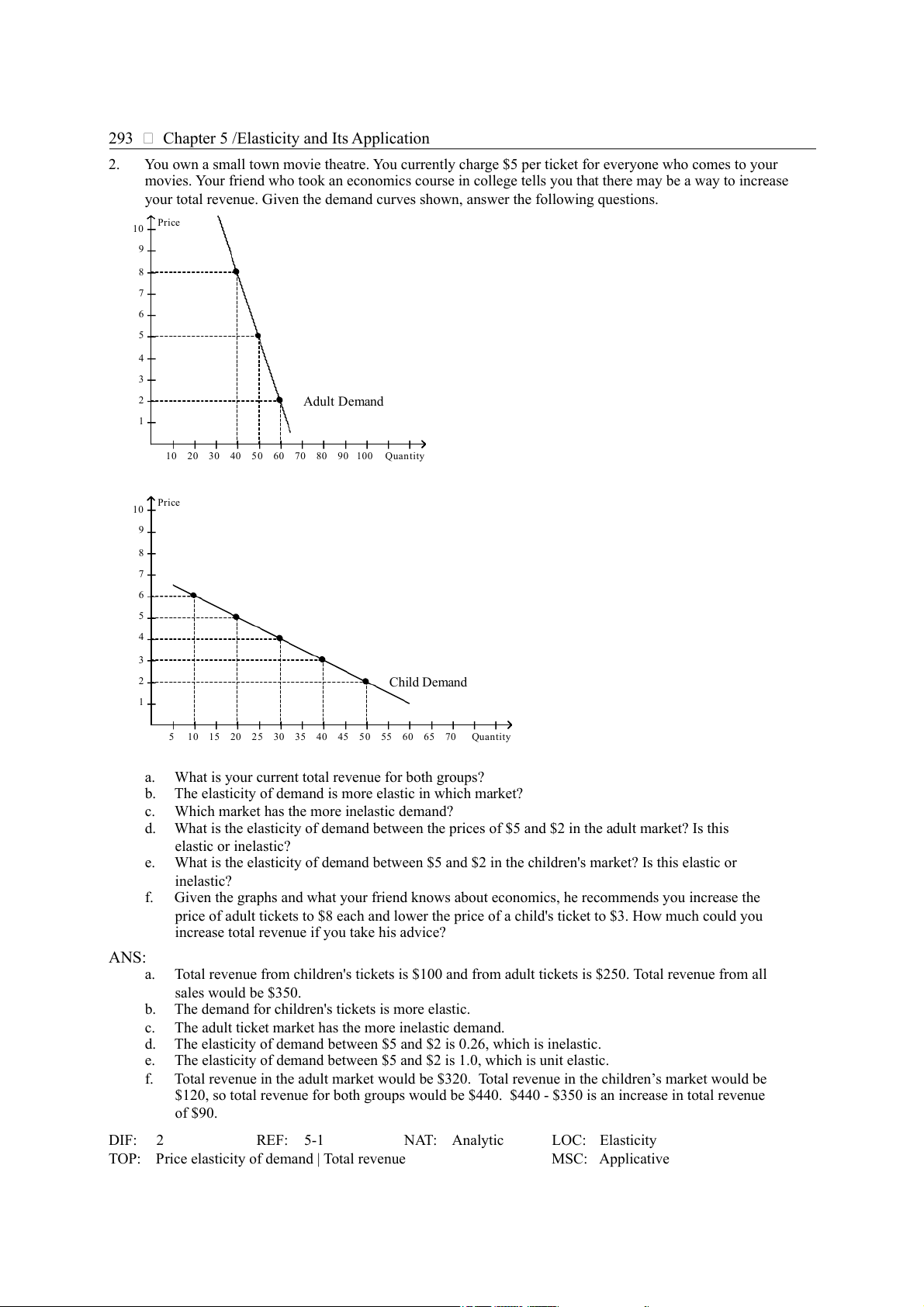
You own a small town movie theatre. You currently charge $5 per ticket for everyone who comes to your
movies. Your friend who took an economics course in college tells you that there may be a way to increase
your total revenue. Given the demand curves shown, answer the following questions. Price 10 9 8 7 6 5 4 3 2 Adult Demand 1 10 20 30 40 50 60 70 80 90 100 Quantity Price 10 9 8 7 6 5 4 3 2 Child Demand 1 5
10 15 20 25 30 35 40 45 50 55 60 65 70 Quantity a.
What is your current total revenue for both groups? b.
The elasticity of demand is more elastic in which market? c.
Which market has the more inelastic demand? d.
What is the elasticity of demand between the prices of $5 and $2 in the adult market? Is this elastic or inelastic? e.
What is the elasticity of demand between $5 and $2 in the children's market? Is this elastic or inelastic? f.
Given the graphs and what your friend knows about economics, he recommends you increase the
price of adult tickets to $8 each and lower the price of a child's ticket to $3. How much could you
increase total revenue if you take his advice?
ANS:a. Total revenue from children's tickets is $100 and from adult tickets is $250. Total revenue from all sales would be $350. b.
The demand for children's tickets is more elastic. c.
The adult ticket market has the more inelastic demand. d.
The elasticity of demand between $5 and $2 is 0.26, which is inelastic. e.
The elasticity of demand between $5 and $2 is 1.0, which is unit elastic. f.
Total revenue in the adult market would be $320. Total revenue in the children’s market would be
$120, so total revenue for both groups would be $440. $440 - $350 is an increase in total revenue of $90. DIF: 2 REF: 5-1 NAT: Analytic LOC: Elasticity
TOP: Price elasticity of demand | Total revenue MSC: Applicative
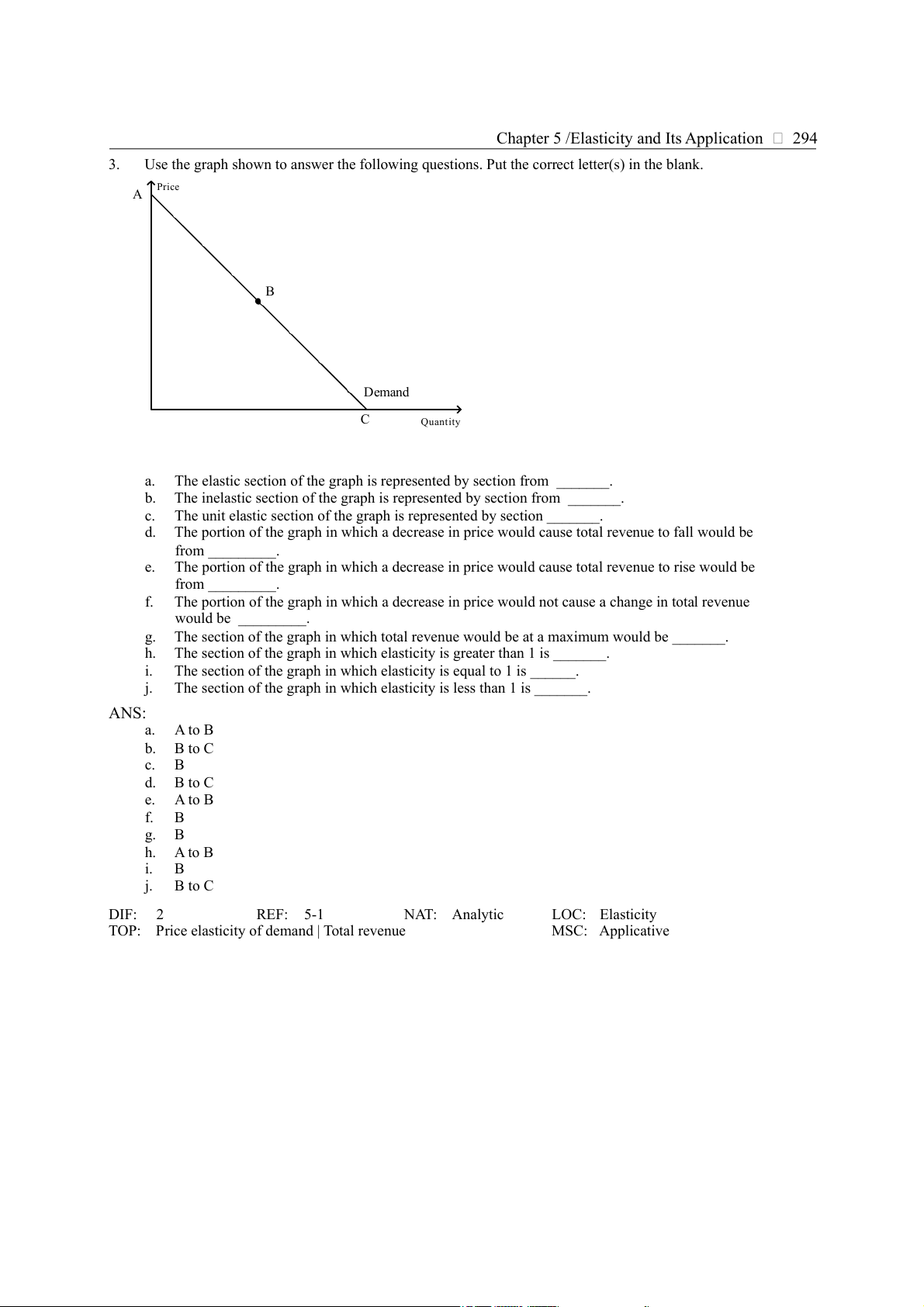
Chapter 5 /Elasticity and Its Application 294 3.
Use the graph shown to answer the following questions. Put the correct letter(s) in the blank. Price A B Demand C Quantity a.
The elastic section of the graph is represented by section from _______. b.
The inelastic section of the graph is represented by section from _______. c.
The unit elastic section of the graph is represented by section _______. d.
The portion of the graph in which a decrease in price would cause total revenue to fall would be from _________. e.
The portion of the graph in which a decrease in price would cause total revenue to rise would be from _________. f.
The portion of the graph in which a decrease in price would not cause a change in total revenue would be _________. g.
The section of the graph in which total revenue would be at a maximum would be _______. h.
The section of the graph in which elasticity is greater than 1 is _______. i.
The section of the graph in which elasticity is equal to 1 is ______. j.
The section of the graph in which elasticity is less than 1 is _______. ANS:a. A to B b. B to C c. B d. B to C e. A to B f. B g. B h. A to B i. B j. B to C DIF: 2 REF: 5-1 NAT: Analytic LOC: Elasticity
TOP: Price elasticity of demand | Total revenue MSC: Applicative
295 Chapter 5 /Elasticity and Its Application 4.
Using the midpoint method, compute the elasticity of demand between points A and B. Is demand along this
portion of the curve elastic or inelastic? Interpret your answer with regard to price and quantity demanded.
Now compute the elasticity of demand between points B and C. Is demand along this portion of the curve elastic or inelastic? Price 22 20 A 18 16 14 B 12 10 8 C 6 4 2 Demand
100 200 300 400 500 600 700 800 900 Quantity ANS:
In the section of the demand curve from A to B, the elasticity of demand would be 2.5. This would be an elastic
portion of the curve. This would mean that for every 1 percent change in price, quantity demanded would change by 2.5 percent.
In the section of the demand curve from B to C, the elasticity of demand would be .75. This would be an inelastic
portion of the curve. This would mean that for every 1 percent change in price, quantity demanded would change by 0.75 percent. DIF: 2 REF: 5-1 NAT: Analytic LOC: Elasticity
TOP: Price elasticity of demand MSC: Applicative 5.
When the Shaffers had a monthly income of $4,000, they usually ate out 8 times a month. Now that the couple
makes $4,500 a month, they eat out 10 times a month. Compute the couple's income elasticity of demand
using the midpoint method. Explain your answer. (Is a restaurant meal a normal or inferior good to the couple?) ANS:
The income elasticity of demand for the Shaffers is 1.89. Since the income elasticity of demand is positive, eating
out would be interpreted as a normal good. DIF: 2 REF: 5-1 NAT: Analytic LOC: Elasticity
TOP: Income elasticity of demand MSC: Applicative 6.
Recently, in Smalltown, the price of Twinkies fell from $0.80 to $0.70. As a result, the quantity demanded of
Ho-Ho's decreased from 120 to 100. What would be the appropriate elasticity to compute? Using the midpoint
method, compute this elasticity. What does your answer tell you? ANS:
The appropriate elasticity to compute would be cross-price elasticity. The cross-price elasticity for this example
would be 1.36. The two goods are substitutes because the cross-price elasticity is positive. DIF: 2 REF: 5-1 NAT: Analytic LOC: Elasticity
TOP: Cross-price elasticity of demand MSC: Applicative
Chapter 5 /Elasticity and Its Application 296
Sec00 - Elasticity and Its Application MULTIPLE CHOICE 1.
In general, elasticity is a measure of a.
the extent to which advances in technology are adopted by producers.
b. the extent to which a market is competitive. c.
how firms’ profits respond to changes in market prices.
d. how much buyers and sellers respond to changes in market conditions. ANS: D DIF: 1 REF: 5-0 NAT: Analytic LOC: Elasticity TOP: Elasticity MSC: Definitional 2. Elasticity is a.
a measure of how much buyers and sellers respond to changes in market conditions.
b. the study of how the allocation of resources affects economic well-being. c.
the maximum amount that a buyer will pay for a good.
d. the value of everything a seller must give up to produce a good. ANS: A DIF: 1 REF: 5-0 NAT: Analytic LOC: Elasticity TOP: Elasticity MSC: Definitional 3.
When studying how some event or policy affects a market, elasticity provides information on the a.
equity effects on the market by identifying the winners and losers.
b. magnitude of the effect on the market. c.
speed of adjustment of the market in response to the event or policy.
d. number of market participants who are directly affected by the event or policy. ANS: B DIF: 2 REF: 5-0 NAT: Analytic LOC: Elasticity TOP: Elasticity MSC: Interpretive 4.
How does the concept of elasticity allow us to improve upon our understanding of supply and demand? a.
Elasticity allows us to analyze supply and demand with greater precision than would be the case in
the absence of the elasticity concept.
b. Elasticity provides us with a better rationale for statements such as “an increase in x will lead to a
decrease in ” than we would have in the absence of the elasticity conc y ept. c.
Without elasticity, we would not be able to address the direction in which price is likely to move in
response to a surplus or a shortage.
d. Without elasticity, it is very difficult to assess the degree of competition within a market. ANS: A DIF: 2 REF: 5-0 NAT: Analytic LOC: Elasticity TOP: Elasticity MSC: Interpretive 5.
When consumers face rising gasoline prices, they typically a.
reduce their quantity demanded more in the long run than in the short run.
b. reduce their quantity demanded more in the short run than in the long run. c.
do not reduce their quantity demanded in the short run or the long run.
d. increase their quantity demanded in the short run but reduce their quantity demanded in the long run. ANS: A DIF: 2 REF: 5-0 NAT: Analytic LOC: Elasticity TOP: Elasticity MSC: Applicative 6.
A 10 percent increase in gasoline prices reduces gasoline consumption by about a.
6 percent after one year and 2.5 percent after five years.
b. 2.5 percent after one year and 6 percent after five years. c.
10 percent after one year and 20 percent after five years.
d. 0 percent after one year and 1 percent after five years. ANS: B DIF: 2 REF: 5-0 NAT: Analytic LOC: Elasticity TOP: Elasticity MSC: Applicative
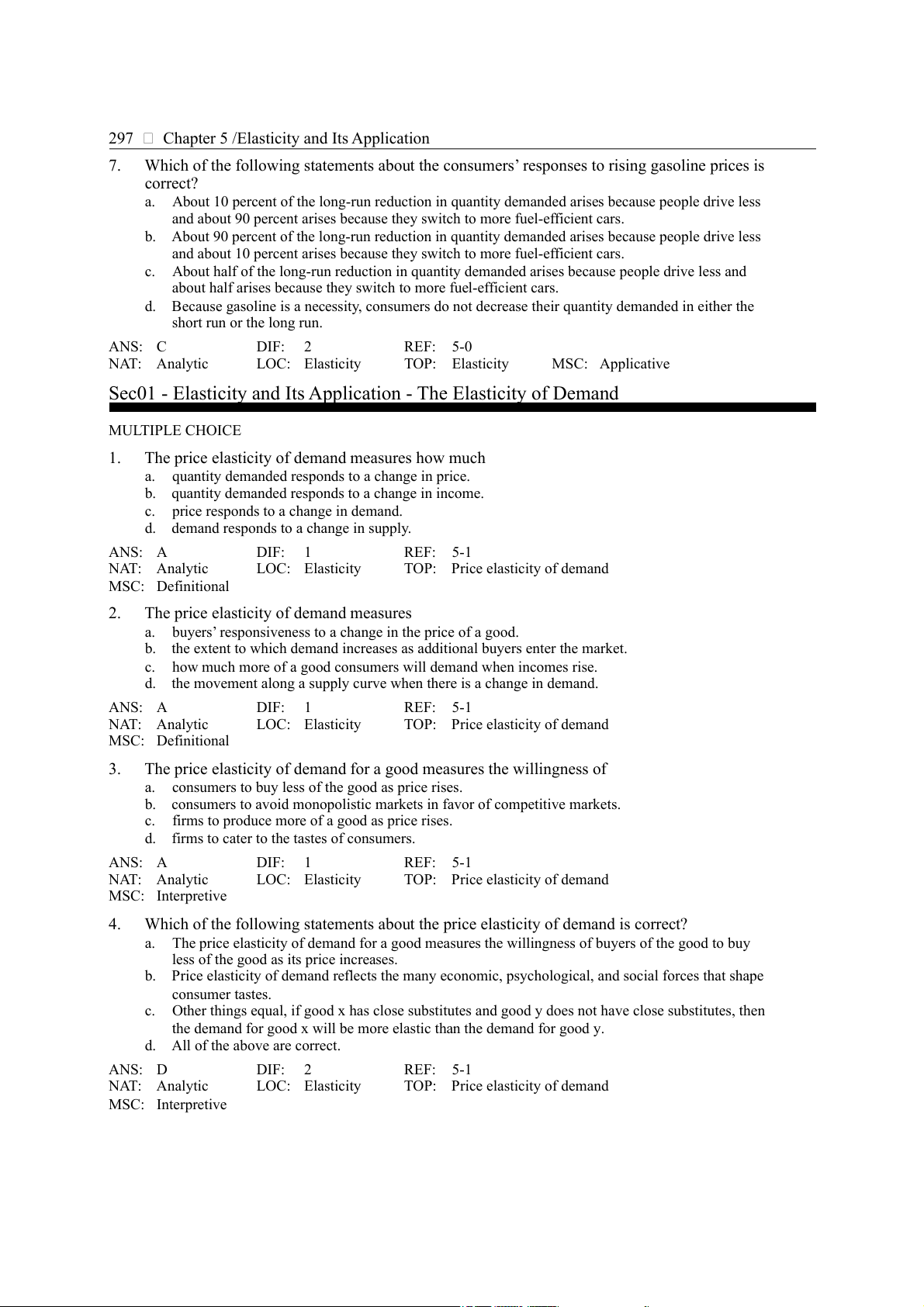
297 Chapter 5 /Elasticity and Its Application 7.
Which of the following statements about the consumers’ responses to rising gasoline prices is correct? a.
About 10 percent of the long-run reduction in quantity demanded arises because people drive less
and about 90 percent arises because they switch to more fuel-efficient cars.
b. About 90 percent of the long-run reduction in quantity demanded arises because people drive less
and about 10 percent arises because they switch to more fuel-efficient cars. c.
About half of the long-run reduction in quantity demanded arises because people drive less and
about half arises because they switch to more fuel-efficient cars.
d. Because gasoline is a necessity, consumers do not decrease their quantity demanded in either the short run or the long run. ANS: C DIF: 2 REF: 5-0 NAT: Analytic LOC: Elasticity TOP: Elasticity MSC: Applicative
Sec01 - Elasticity and Its Application - The Elasticity of Demand MULTIPLE CHOICE 1.
The price elasticity of demand measures how much a.
quantity demanded responds to a change in price.
b. quantity demanded responds to a change in income. c.
price responds to a change in demand.
d. demand responds to a change in supply. ANS: A DIF: 1 REF: 5-1 NAT: Analytic LOC: Elasticity
TOP: Price elasticity of demand MSC: Definitional 2.
The price elasticity of demand measures a.
buyers’ responsiveness to a change in the price of a good.
b. the extent to which demand increases as additional buyers enter the market. c.
how much more of a good consumers will demand when incomes rise.
d. the movement along a supply curve when there is a change in demand. ANS: A DIF: 1 REF: 5-1 NAT: Analytic LOC: Elasticity
TOP: Price elasticity of demand MSC: Definitional 3.
The price elasticity of demand for a good measures the willingness of a.
consumers to buy less of the good as price rises.
b. consumers to avoid monopolistic markets in favor of competitive markets. c.
firms to produce more of a good as price rises.
d. firms to cater to the tastes of consumers. ANS: A DIF: 1 REF: 5-1 NAT: Analytic LOC: Elasticity
TOP: Price elasticity of demand MSC: Interpretive 4.
Which of the following statements about the price elasticity of demand is correct? a.
The price elasticity of demand for a good measures the willingness of buyers of the good to buy
less of the good as its price increases.
b. Price elasticity of demand reflects the many economic, psychological, and social forces that shape consumer tastes. c.
Other things equal, if good x has close substitutes and good does not have close substitutes, then y
the demand for good x will be more elastic than the demand for good y.
d. All of the above are correct. ANS: D DIF: 2 REF: 5-1 NAT: Analytic LOC: Elasticity
TOP: Price elasticity of demand MSC: Interpretive
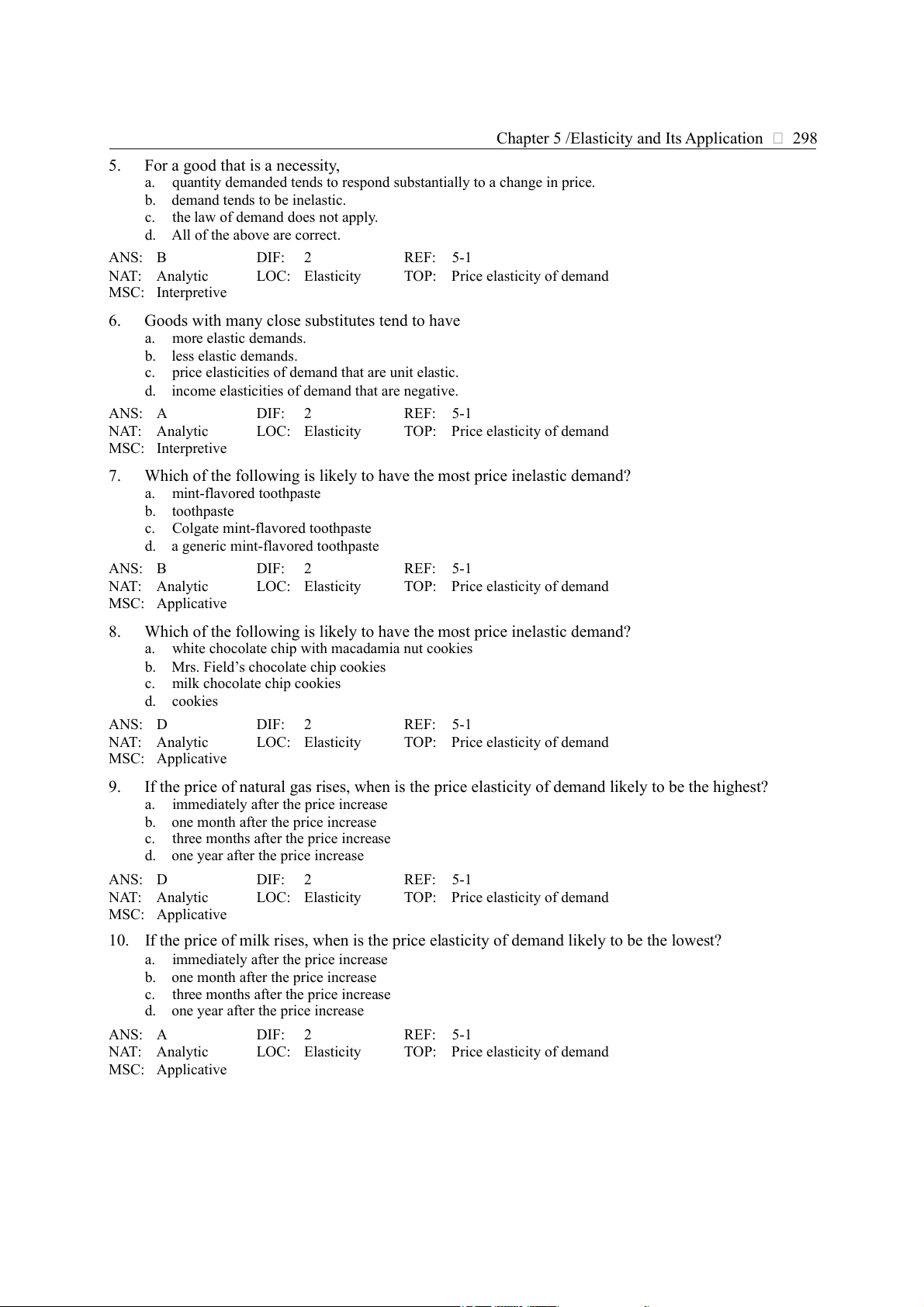
Chapter 5 /Elasticity and Its Application 298 5.
For a good that is a necessity, a.
quantity demanded tends to respond substantially to a change in price.
b. demand tends to be inelastic. c.
the law of demand does not apply.
d. All of the above are correct. ANS: B DIF: 2 REF: 5-1 NAT: Analytic LOC: Elasticity
TOP: Price elasticity of demand MSC: Interpretive 6.
Goods with many close substitutes tend to have a. more elastic demands. b. less elastic demands. c.
price elasticities of demand that are unit elastic.
d. income elasticities of demand that are negative. ANS: A DIF: 2 REF: 5-1 NAT: Analytic LOC: Elasticity
TOP: Price elasticity of demand MSC: Interpretive 7.
Which of the following is likely to have the most price inelastic demand? a. mint-flavored toothpaste b. toothpaste c.
Colgate mint-flavored toothpaste
d. a generic mint-flavored toothpaste ANS: B DIF: 2 REF: 5-1 NAT: Analytic LOC: Elasticity
TOP: Price elasticity of demand MSC: Applicative 8.
Which of the following is likely to have the most price inelastic demand? a.
white chocolate chip with macadamia nut cookies
b. Mrs. Field’s chocolate chip cookies c. milk chocolate chip cookies d. cookies ANS: D DIF: 2 REF: 5-1 NAT: Analytic LOC: Elasticity
TOP: Price elasticity of demand MSC: Applicative 9.
If the price of natural gas rises, when is the price elasticity of demand likely to be the highest? a.
immediately after the price increase
b. one month after the price increase c.
three months after the price increase
d. one year after the price increase ANS: D DIF: 2 REF: 5-1 NAT: Analytic LOC: Elasticity
TOP: Price elasticity of demand MSC: Applicative
10. If the price of milk rises, when is the price elasticity of demand likely to be the lowest? a.
immediately after the price increase
b. one month after the price increase c.
three months after the price increase
d. one year after the price increase ANS: A DIF: 2 REF: 5-1 NAT: Analytic LOC: Elasticity
TOP: Price elasticity of demand MSC: Applicative
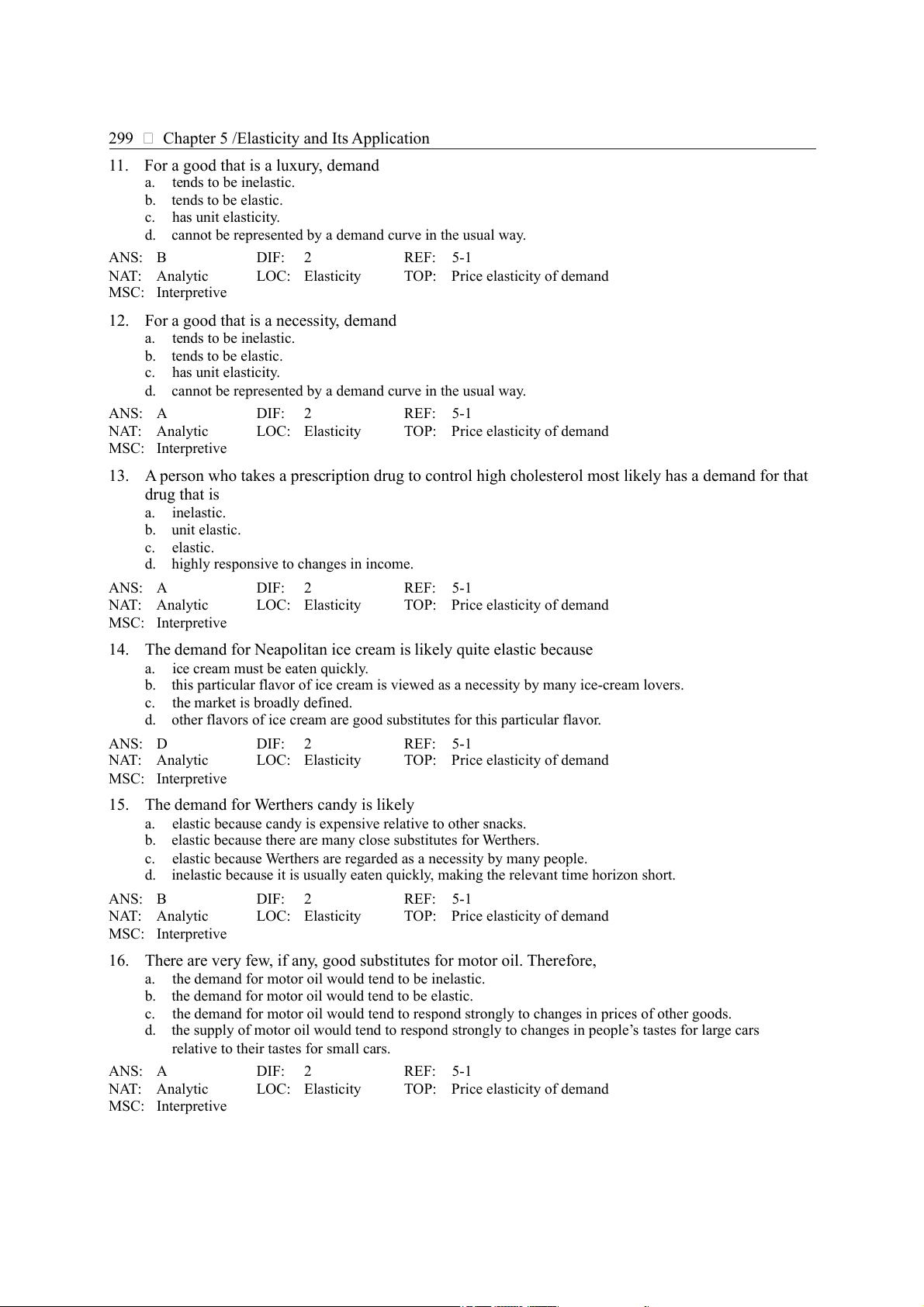
299 Chapter 5 /Elasticity and Its Application
11. For a good that is a luxury, demand a. tends to be inelastic. b. tends to be elastic. c. has unit elasticity.
d. cannot be represented by a demand curve in the usual way. ANS: B DIF: 2 REF: 5-1 NAT: Analytic LOC: Elasticity
TOP: Price elasticity of demand MSC: Interpretive
12. For a good that is a necessity, demand a. tends to be inelastic. b. tends to be elastic. c. has unit elasticity.
d. cannot be represented by a demand curve in the usual way. ANS: A DIF: 2 REF: 5-1 NAT: Analytic LOC: Elasticity
TOP: Price elasticity of demand MSC: Interpretive
13. A person who takes a prescription drug to control high cholesterol most likely has a demand for that drug that is a. inelastic. b. unit elastic. c. elastic.
d. highly responsive to changes in income. ANS: A DIF: 2 REF: 5-1 NAT: Analytic LOC: Elasticity
TOP: Price elasticity of demand MSC: Interpretive
14. The demand for Neapolitan ice cream is likely quite elastic because a.
ice cream must be eaten quickly.
b. this particular flavor of ice cream is viewed as a necessity by many ice-cream lovers. c. the market is broadly defined.
d. other flavors of ice cream are good substitutes for this particular flavor. ANS: D DIF: 2 REF: 5-1 NAT: Analytic LOC: Elasticity
TOP: Price elasticity of demand MSC: Interpretive
15. The demand for Werthers candy is likely a.
elastic because candy is expensive relative to other snacks.
b. elastic because there are many close substitutes for Werthers. c.
elastic because Werthers are regarded as a necessity by many people.
d. inelastic because it is usually eaten quickly, making the relevant time horizon short. ANS: B DIF: 2 REF: 5-1 NAT: Analytic LOC: Elasticity
TOP: Price elasticity of demand MSC: Interpretive
16. There are very few, if any, good substitutes for motor oil. Therefore, a.
the demand for motor oil would tend to be inelastic.
b. the demand for motor oil would tend to be elastic. c.
the demand for motor oil would tend to respond strongly to changes in prices of other goods.
d. the supply of motor oil would tend to respond strongly to changes in people’s tastes for large cars
relative to their tastes for small cars. ANS: A DIF: 2 REF: 5-1 NAT: Analytic LOC: Elasticity
TOP: Price elasticity of demand MSC: Interpretive
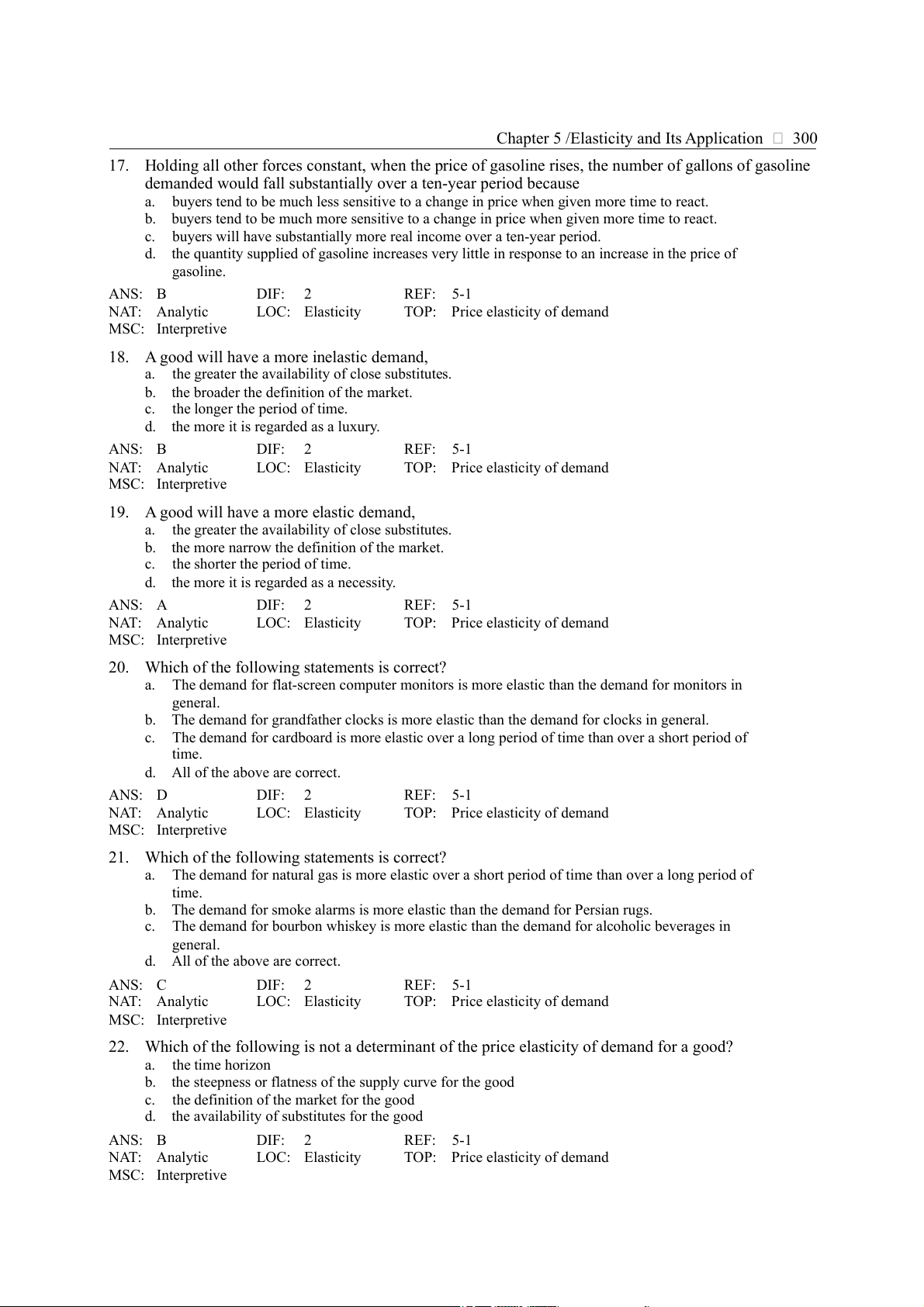
Chapter 5 /Elasticity and Its Application 300
17. Holding all other forces constant, when the price of gasoline rises, the number of gallons of gasoline
demanded would fall substantially over a ten-year period because a.
buyers tend to be much less sensitive to a change in price when given more time to react.
b. buyers tend to be much more sensitive to a change in price when given more time to react. c.
buyers will have substantially more real income over a ten-year period.
d. the quantity supplied of gasoline increases very little in response to an increase in the price of gasoline. ANS: B DIF: 2 REF: 5-1 NAT: Analytic LOC: Elasticity
TOP: Price elasticity of demand MSC: Interpretive
18. A good will have a more inelastic demand, a.
the greater the availability of close substitutes.
b. the broader the definition of the market. c. the longer the period of time.
d. the more it is regarded as a luxury. ANS: B DIF: 2 REF: 5-1 NAT: Analytic LOC: Elasticity
TOP: Price elasticity of demand MSC: Interpretive
19. A good will have a more elastic demand, a.
the greater the availability of close substitutes.
b. the more narrow the definition of the market. c.
the shorter the period of time.
d. the more it is regarded as a necessity. ANS: A DIF: 2 REF: 5-1 NAT: Analytic LOC: Elasticity
TOP: Price elasticity of demand MSC: Interpretive
20. Which of the following statements is correct? a.
The demand for flat-screen computer monitors is more elastic than the demand for monitors in general.
b. The demand for grandfather clocks is more elastic than the demand for clocks in general. c.
The demand for cardboard is more elastic over a long period of time than over a short period of time.
d. All of the above are correct. ANS: D DIF: 2 REF: 5-1 NAT: Analytic LOC: Elasticity
TOP: Price elasticity of demand MSC: Interpretive
21. Which of the following statements is correct? a.
The demand for natural gas is more elastic over a short period of time than over a long period of time.
b. The demand for smoke alarms is more elastic than the demand for Persian rugs. c.
The demand for bourbon whiskey is more elastic than the demand for alcoholic beverages in general.
d. All of the above are correct. ANS: C DIF: 2 REF: 5-1 NAT: Analytic LOC: Elasticity
TOP: Price elasticity of demand MSC: Interpretive
22. Which of the following is not a determinant of the price elasticity of demand for a good? a. the time horizon
b. the steepness or flatness of the supply curve for the good c.
the definition of the market for the good
d. the availability of substitutes for the good ANS: B DIF: 2 REF: 5-1 NAT: Analytic LOC: Elasticity
TOP: Price elasticity of demand MSC: Interpretive
301 Chapter 5 /Elasticity and Its Application
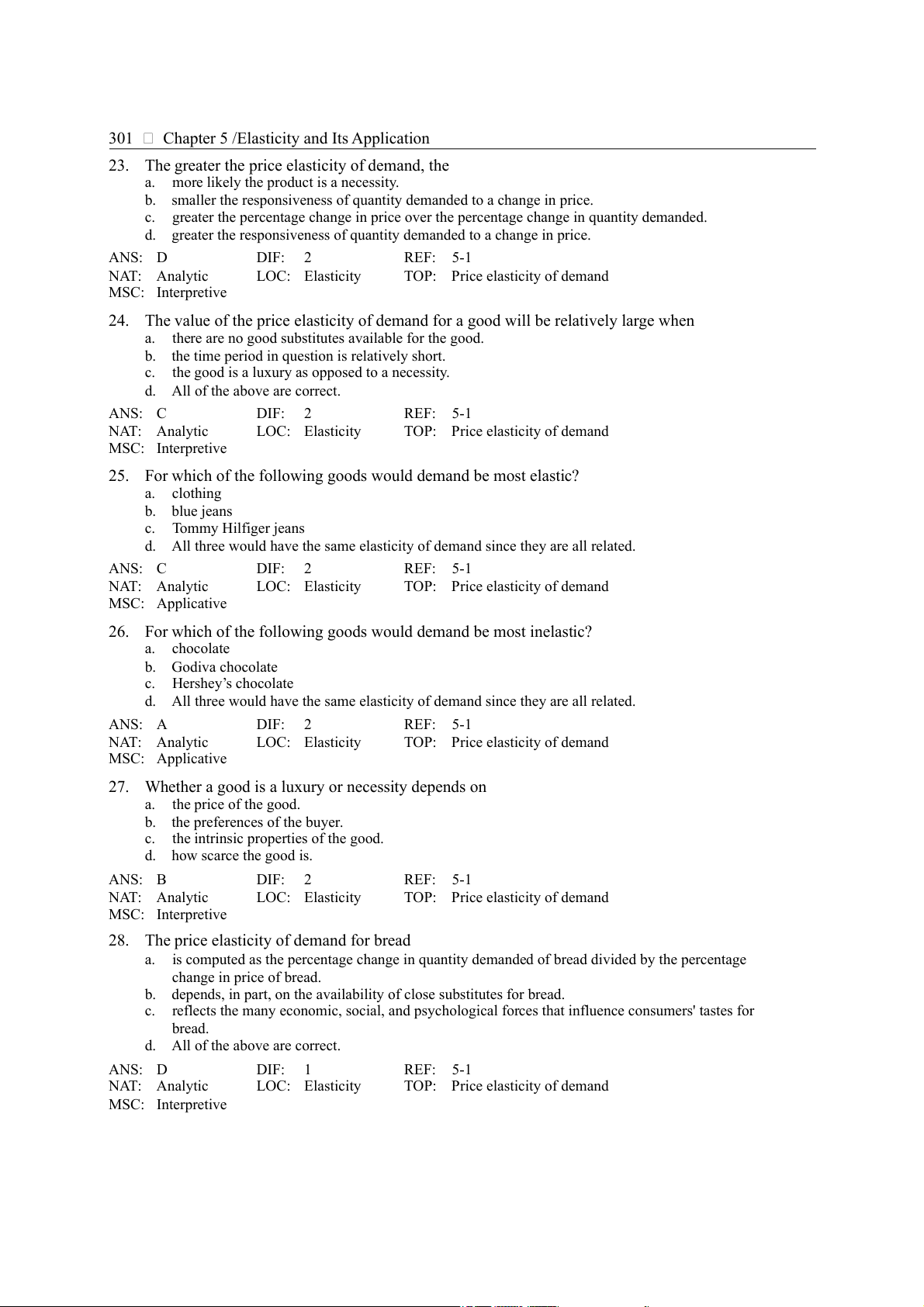
23. The greater the price elasticity of demand, the a.
more likely the product is a necessity.
b. smaller the responsiveness of quantity demanded to a change in price. c.
greater the percentage change in price over the percentage change in quantity demanded.
d. greater the responsiveness of quantity demanded to a change in price. ANS: D DIF: 2 REF: 5-1 NAT: Analytic LOC: Elasticity
TOP: Price elasticity of demand MSC: Interpretive
24. The value of the price elasticity of demand for a good will be relatively large when a.
there are no good substitutes available for the good.
b. the time period in question is relatively short. c.
the good is a luxury as opposed to a necessity.
d. All of the above are correct. ANS: C DIF: 2 REF: 5-1 NAT: Analytic LOC: Elasticity
TOP: Price elasticity of demand MSC: Interpretive
25. For which of the following goods would demand be most elastic? a. clothing b. blue jeans c. Tommy Hilfiger jeans
d. All three would have the same elasticity of demand since they are all related. ANS: C DIF: 2 REF: 5-1 NAT: Analytic LOC: Elasticity
TOP: Price elasticity of demand MSC: Applicative
26. For which of the following goods would demand be most inelastic? a. chocolate b. Godiva chocolate c. Hershey’s chocolate
d. All three would have the same elasticity of demand since they are all related. ANS: A DIF: 2 REF: 5-1 NAT: Analytic LOC: Elasticity
TOP: Price elasticity of demand MSC: Applicative
27. Whether a good is a luxury or necessity depends on a. the price of the good.
b. the preferences of the buyer. c.
the intrinsic properties of the good. d. how scarce the good is. ANS: B DIF: 2 REF: 5-1 NAT: Analytic LOC: Elasticity
TOP: Price elasticity of demand MSC: Interpretive
28. The price elasticity of demand for bread a.
is computed as the percentage change in quantity demanded of bread divided by the percentage change in price of bread.
b. depends, in part, on the availability of close substitutes for bread. c.
reflects the many economic, social, and psychological forces that influence consumers' tastes for bread.
d. All of the above are correct. ANS: D DIF: 1 REF: 5-1 NAT: Analytic LOC: Elasticity
TOP: Price elasticity of demand MSC: Interpretive
Chapter 5 /Elasticity and Its Application 302
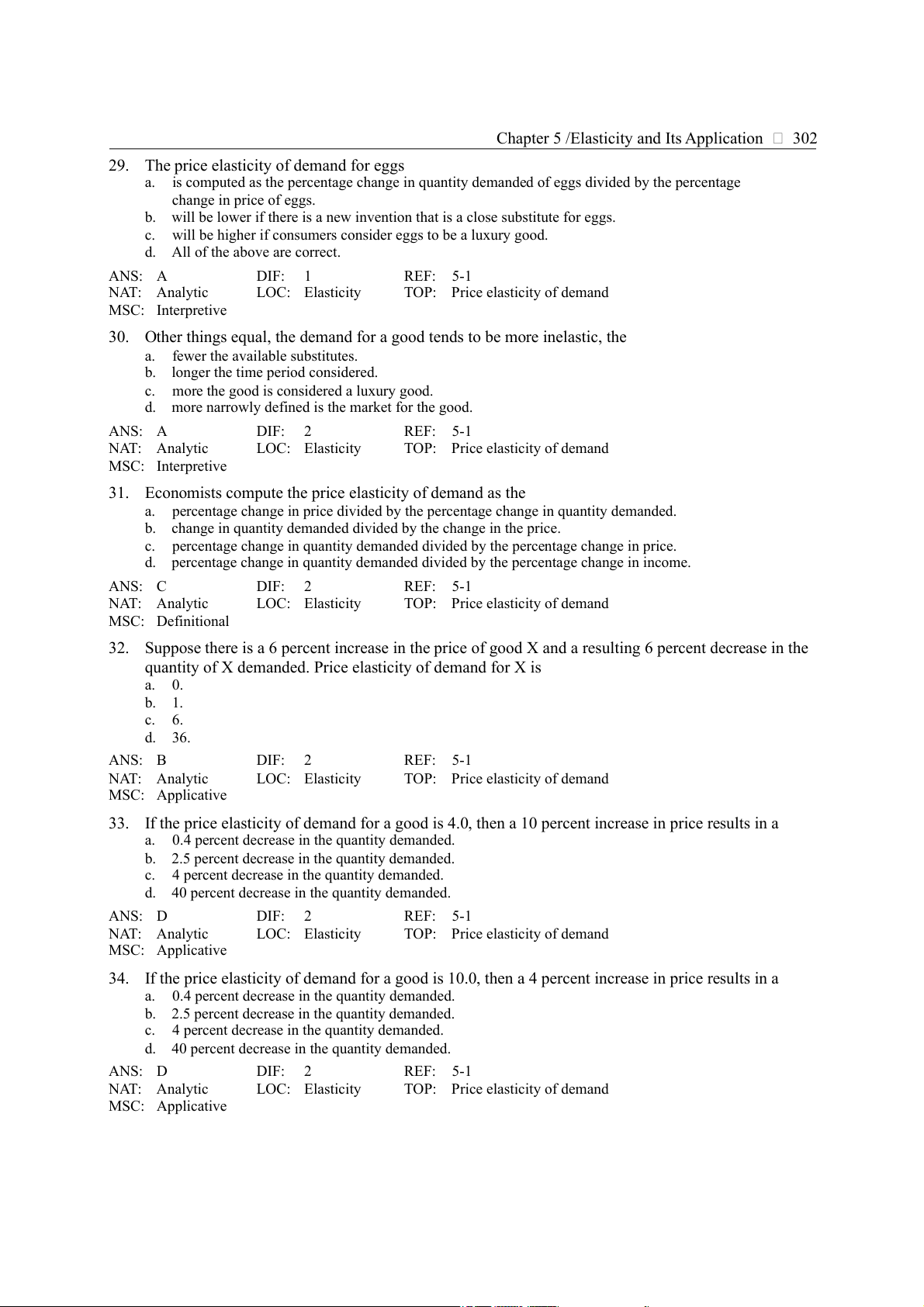
29. The price elasticity of demand for eggs a.
is computed as the percentage change in quantity demanded of eggs divided by the percentage change in price of eggs.
b. will be lower if there is a new invention that is a close substitute for eggs. c.
will be higher if consumers consider eggs to be a luxury good.
d. All of the above are correct. ANS: A DIF: 1 REF: 5-1 NAT: Analytic LOC: Elasticity
TOP: Price elasticity of demand MSC: Interpretive
30. Other things equal, the demand for a good tends to be more inelastic, the a.
fewer the available substitutes.
b. longer the time period considered. c.
more the good is considered a luxury good.
d. more narrowly defined is the market for the good. ANS: A DIF: 2 REF: 5-1 NAT: Analytic LOC: Elasticity
TOP: Price elasticity of demand MSC: Interpretive
31. Economists compute the price elasticity of demand as the a.
percentage change in price divided by the percentage change in quantity demanded.
b. change in quantity demanded divided by the change in the price. c.
percentage change in quantity demanded divided by the percentage change in price.
d. percentage change in quantity demanded divided by the percentage change in income. ANS: C DIF: 2 REF: 5-1 NAT: Analytic LOC: Elasticity
TOP: Price elasticity of demand MSC: Definitional
32. Suppose there is a 6 percent increase in the price of good X and a resulting 6 percent decrease in the
quantity of X demanded. Price elasticity of demand for X is a. 0. b. 1. c. 6. d. 36. ANS: B DIF: 2 REF: 5-1 NAT: Analytic LOC: Elasticity
TOP: Price elasticity of demand MSC: Applicative
33. If the price elasticity of demand for a good is 4.0, then a 10 percent increase in price results in a a.
0.4 percent decrease in the quantity demanded.
b. 2.5 percent decrease in the quantity demanded. c.
4 percent decrease in the quantity demanded.
d. 40 percent decrease in the quantity demanded. ANS: D DIF: 2 REF: 5-1 NAT: Analytic LOC: Elasticity
TOP: Price elasticity of demand MSC: Applicative
34. If the price elasticity of demand for a good is 10.0, then a 4 percent increase in price results in a a.
0.4 percent decrease in the quantity demanded.
b. 2.5 percent decrease in the quantity demanded. c.
4 percent decrease in the quantity demanded.
d. 40 percent decrease in the quantity demanded. ANS: D DIF: 2 REF: 5-1 NAT: Analytic LOC: Elasticity
TOP: Price elasticity of demand MSC: Applicative
303 Chapter 5 /Elasticity and Its Application
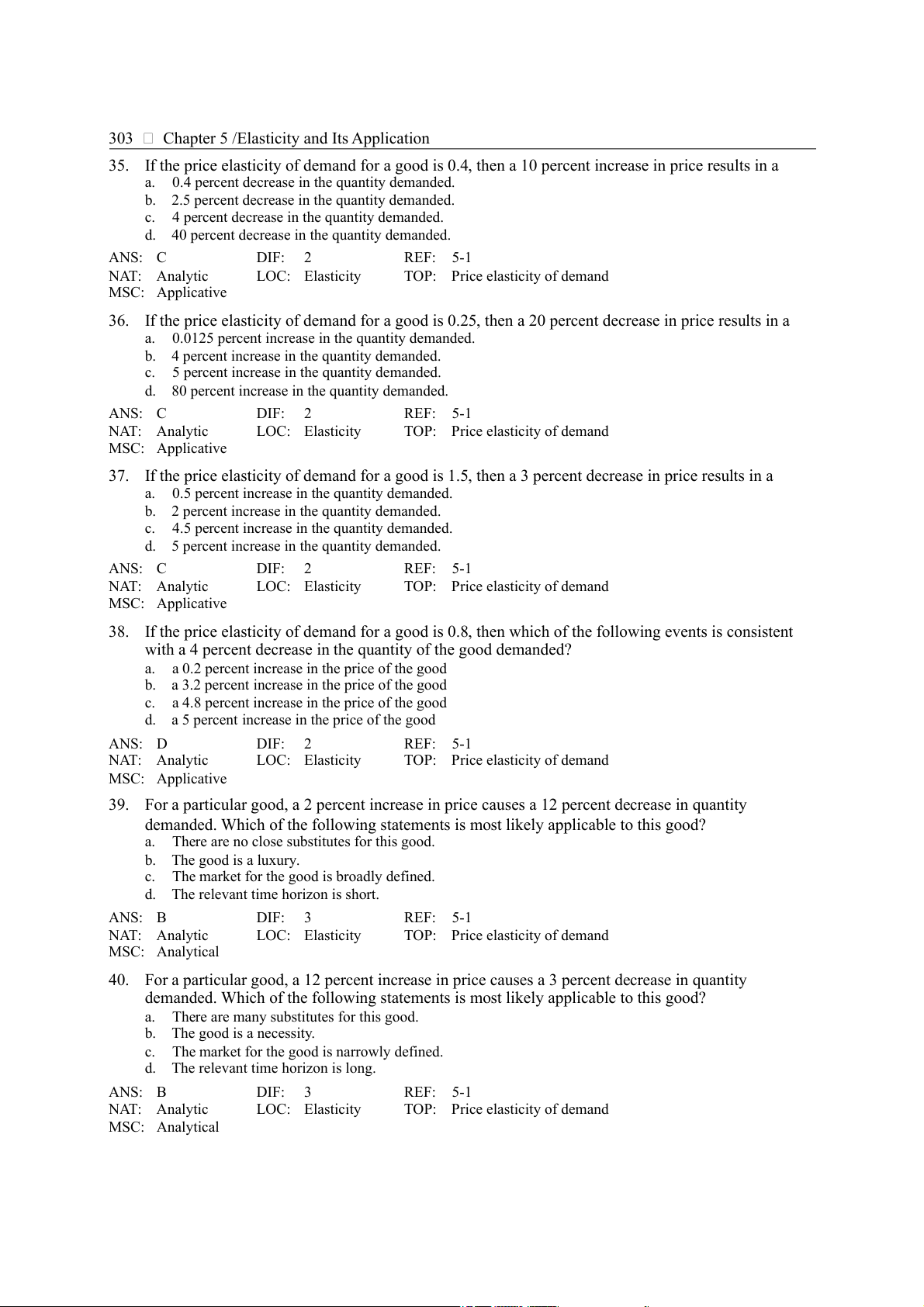
35. If the price elasticity of demand for a good is 0.4, then a 10 percent increase in price results in a a.
0.4 percent decrease in the quantity demanded.
b. 2.5 percent decrease in the quantity demanded. c.
4 percent decrease in the quantity demanded.
d. 40 percent decrease in the quantity demanded. ANS: C DIF: 2 REF: 5-1 NAT: Analytic LOC: Elasticity
TOP: Price elasticity of demand MSC: Applicative
36. If the price elasticity of demand for a good is 0.25, then a 20 percent decrease in price results in a a.
0.0125 percent increase in the quantity demanded.
b. 4 percent increase in the quantity demanded. c.
5 percent increase in the quantity demanded.
d. 80 percent increase in the quantity demanded. ANS: C DIF: 2 REF: 5-1 NAT: Analytic LOC: Elasticity
TOP: Price elasticity of demand MSC: Applicative
37. If the price elasticity of demand for a good is 1.5, then a 3 percent decrease in price results in a a.
0.5 percent increase in the quantity demanded.
b. 2 percent increase in the quantity demanded. c.
4.5 percent increase in the quantity demanded.
d. 5 percent increase in the quantity demanded. ANS: C DIF: 2 REF: 5-1 NAT: Analytic LOC: Elasticity
TOP: Price elasticity of demand MSC: Applicative
38. If the price elasticity of demand for a good is 0.8, then which of the following events is consistent
with a 4 percent decrease in the quantity of the good demanded? a.
a 0.2 percent increase in the price of the good
b. a 3.2 percent increase in the price of the good c.
a 4.8 percent increase in the price of the good
d. a 5 percent increase in the price of the good ANS: D DIF: 2 REF: 5-1 NAT: Analytic LOC: Elasticity
TOP: Price elasticity of demand MSC: Applicative
39. For a particular good, a 2 percent increase in price causes a 12 percent decrease in quantity
demanded. Which of the following statements is most likely applicable to this good? a.
There are no close substitutes for this good. b. The good is a luxury. c.
The market for the good is broadly defined.
d. The relevant time horizon is short. ANS: B DIF: 3 REF: 5-1 NAT: Analytic LOC: Elasticity
TOP: Price elasticity of demand MSC: Analytical
40. For a particular good, a 12 percent increase in price causes a 3 percent decrease in quantity
demanded. Which of the following statements is most likely applicable to this good? a.
There are many substitutes for this good. b. The good is a necessity. c.
The market for the good is narrowly defined.
d. The relevant time horizon is long. ANS: B DIF: 3 REF: 5-1 NAT: Analytic LOC: Elasticity
TOP: Price elasticity of demand MSC: Analytical
Chapter 5 /Elasticity and Its Application 304
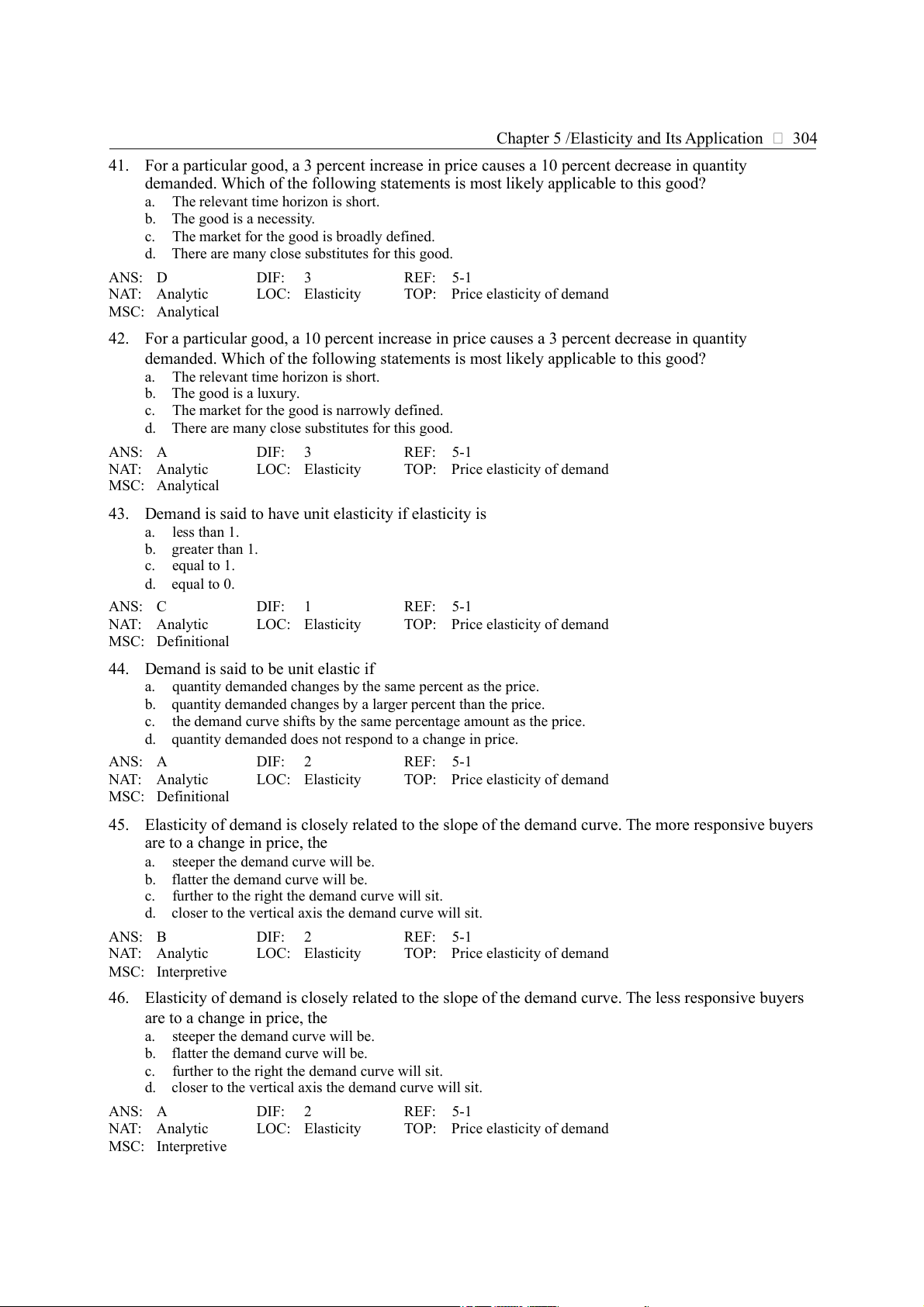
41. For a particular good, a 3 percent increase in price causes a 10 percent decrease in quantity
demanded. Which of the following statements is most likely applicable to this good? a.
The relevant time horizon is short. b. The good is a necessity. c.
The market for the good is broadly defined.
d. There are many close substitutes for this good. ANS: D DIF: 3 REF: 5-1 NAT: Analytic LOC: Elasticity
TOP: Price elasticity of demand MSC: Analytical
42. For a particular good, a 10 percent increase in price causes a 3 percent decrease in quantity
demanded. Which of the following statements is most likely applicable to this good? a.
The relevant time horizon is short. b. The good is a luxury. c.
The market for the good is narrowly defined.
d. There are many close substitutes for this good. ANS: A DIF: 3 REF: 5-1 NAT: Analytic LOC: Elasticity
TOP: Price elasticity of demand MSC: Analytical
43. Demand is said to have unit elasticity if elasticity is a. less than 1. b. greater than 1. c. equal to 1. d. equal to 0. ANS: C DIF: 1 REF: 5-1 NAT: Analytic LOC: Elasticity
TOP: Price elasticity of demand MSC: Definitional
44. Demand is said to be unit elastic if a.
quantity demanded changes by the same percent as the price.
b. quantity demanded changes by a larger percent than the price. c.
the demand curve shifts by the same percentage amount as the price.
d. quantity demanded does not respond to a change in price. ANS: A DIF: 2 REF: 5-1 NAT: Analytic LOC: Elasticity
TOP: Price elasticity of demand MSC: Definitional
45. Elasticity of demand is closely related to the slope of the demand curve. The more responsive buyers are to a change in price, the a.
steeper the demand curve will be.
b. flatter the demand curve will be. c.
further to the right the demand curve will sit.
d. closer to the vertical axis the demand curve will sit. ANS: B DIF: 2 REF: 5-1 NAT: Analytic LOC: Elasticity
TOP: Price elasticity of demand MSC: Interpretive
46. Elasticity of demand is closely related to the slope of the demand curve. The less responsive buyers are to a change in price, the a.
steeper the demand curve will be.
b. flatter the demand curve will be. c.
further to the right the demand curve will sit.
d. closer to the vertical axis the demand curve will sit. ANS: A DIF: 2 REF: 5-1 NAT: Analytic LOC: Elasticity
TOP: Price elasticity of demand MSC: Interpretive
305 Chapter 5 /Elasticity and Its Application
47. The flatter the demand curve through a given point, the a.
greater the price elasticity of demand at that point.
b. smaller the price elasticity of demand at that point. c.
closer the price elasticity of demand will be to the slope of the curve.
d. greater the absolute value of the change in total revenue when there is a movement from that point
upward and to the left along the demand curve. ANS: A DIF: 3 REF: 5-1 NAT: Analytic LOC: Elasticity
TOP: Price elasticity of demand MSC: Analytical
48. The smaller the price elasticity of demand, the a.
steeper the demand curve will be through a given point.
b. flatter the demand curve will be through a given point. c.
more strongly buyers respond to a change in price between any two prices P1 and P2.
d. smaller the decrease in equilibrium price when the supply curve shifts rightward from S1 to S2. ANS: A DIF: 3 REF: 5-1 NAT: Analytic LOC: Elasticity
TOP: Price elasticity of demand MSC: Analytical
49. When quantity moves proportionately the same amount as price, demand is a.
elastic, and the price elasticity of demand is 1.
b. perfectly elastic, and the price elasticity of demand is infinitely large. c.
perfectly inelastic, and the price elasticity of demand is 0.
d. unit elastic, and the price elasticity of demand is 1. ANS: D DIF: 2 REF: 5-1 NAT: Analytic LOC: Elasticity
TOP: Price elasticity of demand MSC: Interpretive
50. Jean-Paul says that he will spend exactly 75 cents a day on M&Ms, regardless of the price of
M&Ms. Jean-Paul’s demand for M&Ms is a. perfectly elastic. b. unit elastic. c. perfectly inelastic.
d. None of the above answers is correct. ANS: B DIF: 2 REF: 5-1 NAT: Analytic LOC: Elasticity
TOP: Price elasticity of demand MSC: Interpretive
51. As we move downward and to the right along a linear, downward-sloping demand curve, a.
slope and elasticity both remain constant.
b. slope changes but elasticity remains constant. c.
slope and elasticity both change.
d. slope remains constant but elasticity changes. ANS: D DIF: 2 REF: 5-1 NAT: Analytic LOC: Elasticity
TOP: Price elasticity of demand MSC: Interpretive
52. When we move upward and to the left along a linear, downward-sloping demand curve, price elasticity of demand a.
first becomes smaller, then larger. b. always becomes larger. c. always becomes smaller.
d. first becomes larger, then smaller. ANS: B DIF: 2 REF: 5-1 NAT: Analytic LOC: Elasticity
TOP: Price elasticity of demand MSC: Interpretive
Chapter 5 /Elasticity and Its Application 306
53. The price elasticity of demand changes as we move along a a. horizontal demand curve. b. vertical demand curve. c.
linear, downward-sloping demand curve.
d. All of the above are correct. ANS: C DIF: 2 REF: 5-1 NAT: Analytic LOC: Elasticity
TOP: Price elasticity of demand MSC: Interpretive
54. The difference between slope and elasticity is that a.
slope is a ratio of two changes, and elasticity is a ratio of two percentage changes.
b. slope is a ratio of two percentage changes, and elasticity is a ratio of two changes. c.
slope measures changes in quantity demanded more accurately than elasticity.
d. none of the above; there is no difference between slope and elasticity. ANS: A DIF: 2 REF: 5-1 NAT: Analytic LOC: Elasticity
TOP: Price elasticity of demand MSC: Interpretive
55. According to a New York Times article published in November 2005, author Anna Bernasek asserts
that a 10 percent increase in the price of gasoline leads to a decline in the quantity demanded of about a. 0.01 percent. b. 2 percent. c. 20 percent. d. 200 percent. ANS: B DIF: 2 REF: 5-1 NAT: Analytic LOC: Elasticity
TOP: Price elasticity of demand MSC: Interpretive
56. According to a New York Times article published in November 2005, author Anna Bernasek asserts
that a 10 percent increase in the price of electricity leads to a decline in the quantity demanded of about a. 0.01 percent. b. 3 percent. c. 30 percent. d. 300 percent. ANS: B DIF: 2 REF: 5-1 NAT: Analytic LOC: Elasticity
TOP: Price elasticity of demand MSC: Interpretive
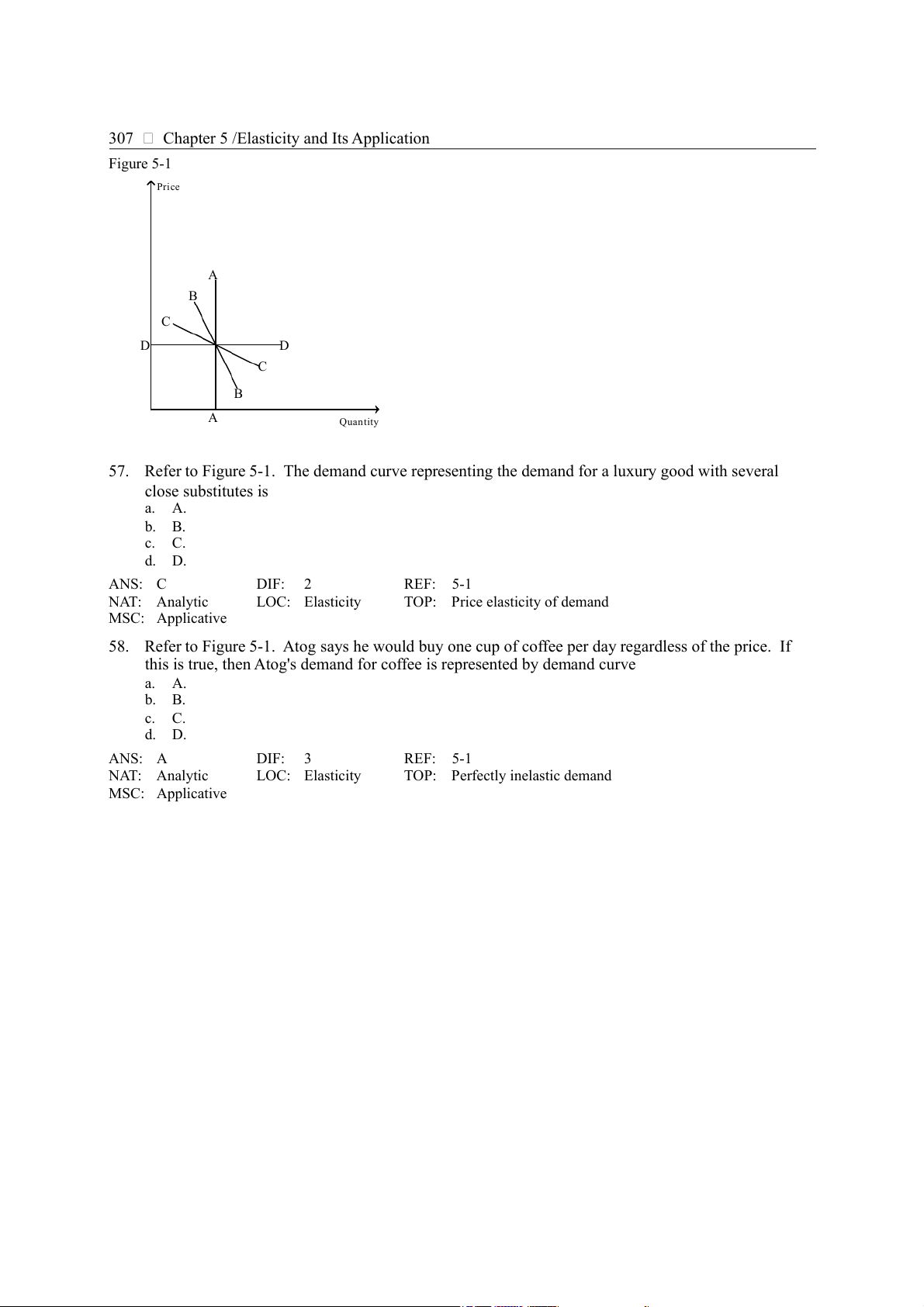
307 Chapter 5 /Elasticity and Its Application Figure 5-1 Price A B C D D C B A Quantity
57. Refer to Figure 5-1. The demand curve representing the demand for a luxury good with several close substitutes is a. A. b. B. c. C. d. D. ANS: C DIF: 2 REF: 5-1 NAT: Analytic LOC: Elasticity
TOP: Price elasticity of demand MSC: Applicative
58. Refer to Figure 5-1. Atog says he would buy one cup of coffee per day regardless of the price. If
this is true, then Atog's demand for coffee is represented by demand curve a. A. b. B. c. C. d. D. ANS: A DIF: 3 REF: 5-1 NAT: Analytic LOC: Elasticity
TOP: Perfectly inelastic demand MSC: Applicative
Tài liệu liên quan:
-
Chương 3: độ co giãn và các nhân tố ảnh hưởng | Microeconomics | Trường Đại học Quốc tế, Đại học Quốc gia Thành phố Hồ Chí Minh
3 2 -
Microeconomics Syllabus | Microeconomics | Trường Đại học Quốc tế, Đại học Quốc gia Thành phố Hồ Chí Minh
3 2 -
Microeconomics Course Syllabus & Assessment Details | Microeconomics | Trường Đại học Quốc tế, Đại học Quốc gia Thành phố Hồ Chí Minh
3 2 -
Assignment 3 - Elasticity MCQs and Key Concepts | Microeconomics | Trường Đại học Quốc tế, Đại học Quốc gia Thành phố Hồ Chí Minh
3 2 -
Assignment 2 - Economic Equilibrium Analysis of Fridges and Motorcycles | Microeconomics | Trường Đại học Quốc tế, Đại học Quốc gia Thành phố Hồ Chí Minh
3 2