Understanding Monopoly and Market Structures | Microeconomics | Trường Đại học Quốc tế, Đại học Quốc gia Thành phố Hồ Chí Minh
An imperfectly competitive firm is one A. that attempts but fails to compete perfectly. B. with the ability to set price at any level it wishes. C. that possesses some degree of control over its price. D. that faces perfectly inelastic demand. 2. Pure monopoly exists when A. many firms produce a good with no close substitutes. B. a single firm produces a good with no close substitutes. C. a single firm is present in the market. D. a single firm produces a good with many close substitutes. Tài liệu được sưu tầm và soạn thảo dưới dạng file PDF để gửi tới các bạn cùng tham khảo, ôn tập đầy đủ kiến thức, chuẩn bị cho các buổi học thật tốt. Mời bạn đọc đón xem!
Môn: Microeconomics 635 tài liệu
Trường: Trường Đại học Quốc tế, Đại học Quốc gia Thành phố Hồ Chí Minh 1.9 K tài liệu
Tác giả:

Preview text:
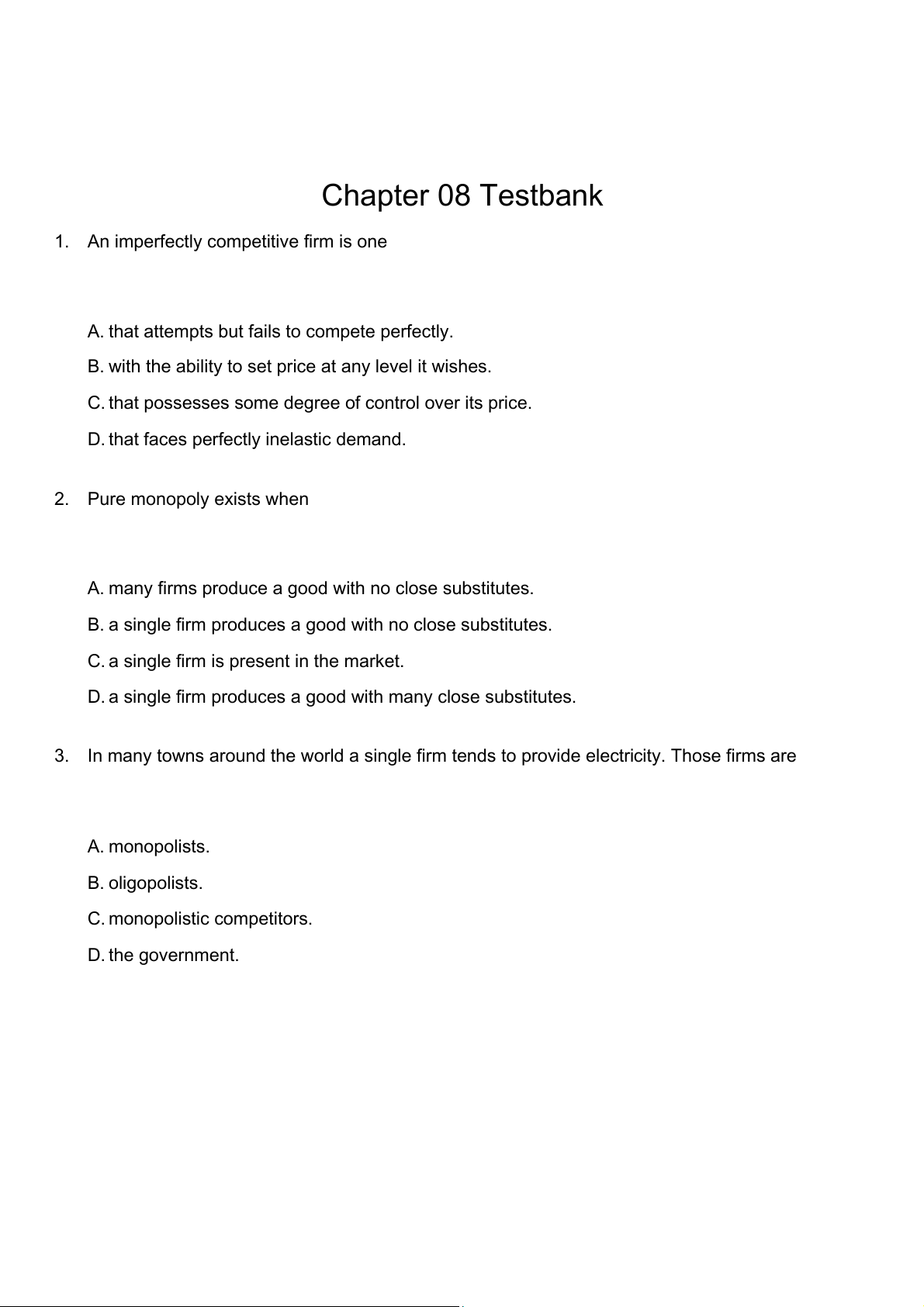
Chapter 08 Testbank
1. An imperfectly competitive firm is one
A. that attempts but fails to compete perfectly.
B. with the ability to set price at any level it wishes.
C. that possesses some degree of control over its price.
D. that faces perfectly inelastic demand. 2. Pure monopoly exists when
A. many firms produce a good with no close substitutes.
B. a single firm produces a good with no close substitutes.
C. a single firm is present in the market.
D. a single firm produces a good with many close substitutes.
3. In many towns around the world a single firm tends to provide electricity. Those firms are A. monopolists. B. oligopolists. C. monopolistic competitors. D. the government.
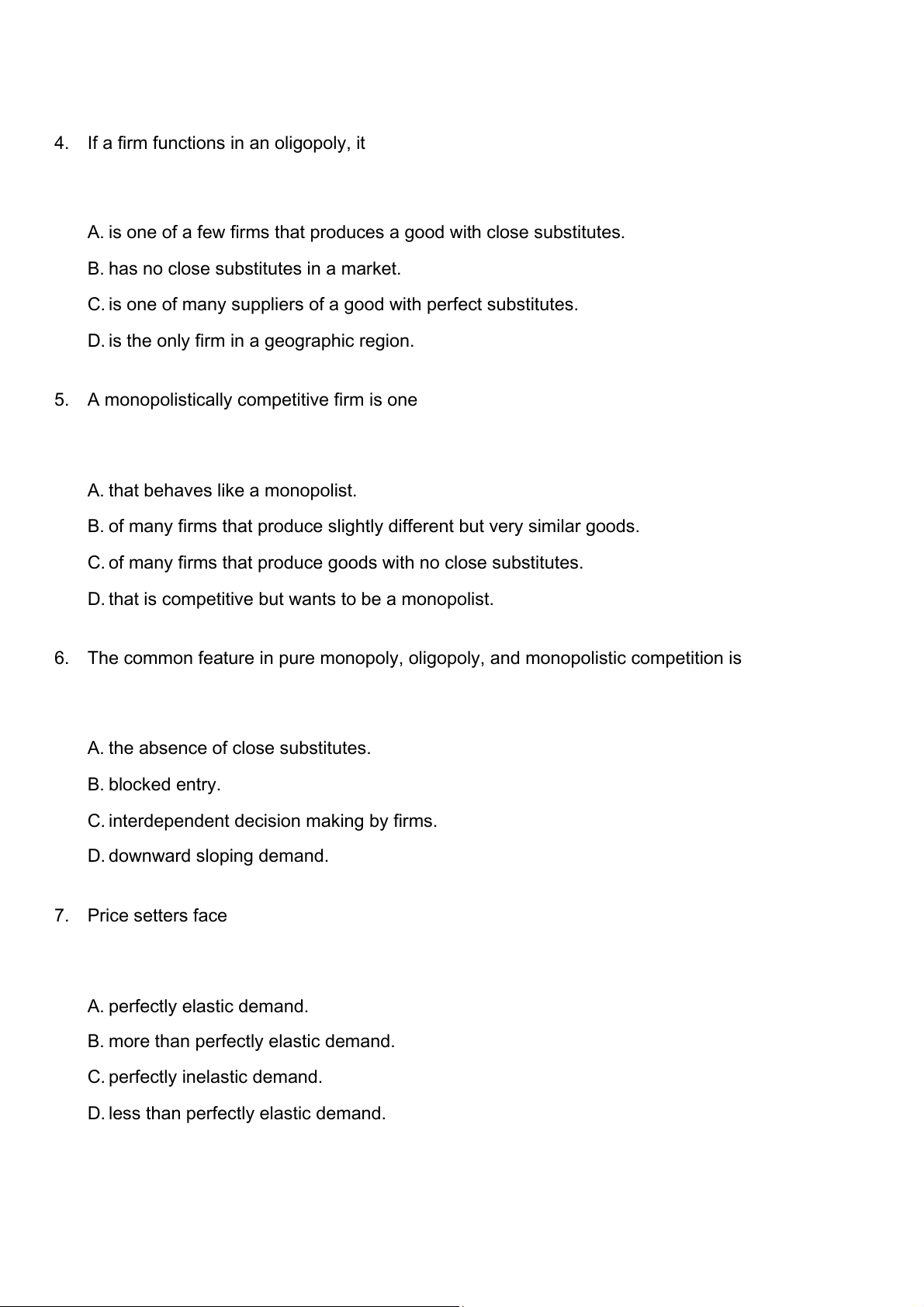
4. If a firm functions in an oligopoly, it
A. is one of a few firms that produces a good with close substitutes.
B. has no close substitutes in a market.
C. is one of many suppliers of a good with perfect substitutes.
D. is the only firm in a geographic region.
5. A monopolistically competitive firm is one
A. that behaves like a monopolist.
B. of many firms that produce slightly different but very similar goods.
C. of many firms that produce goods with no close substitutes.
D. that is competitive but wants to be a monopolist.
6. The common feature in pure monopoly, oligopoly, and monopolistic competition is
A. the absence of close substitutes. B. blocked entry.
C. interdependent decision making by firms. D. downward sloping demand. 7. Price setters face A. perfectly elastic demand.
B. more than perfectly elastic demand.
C. perfectly inelastic demand.
D. less than perfectly elastic demand.
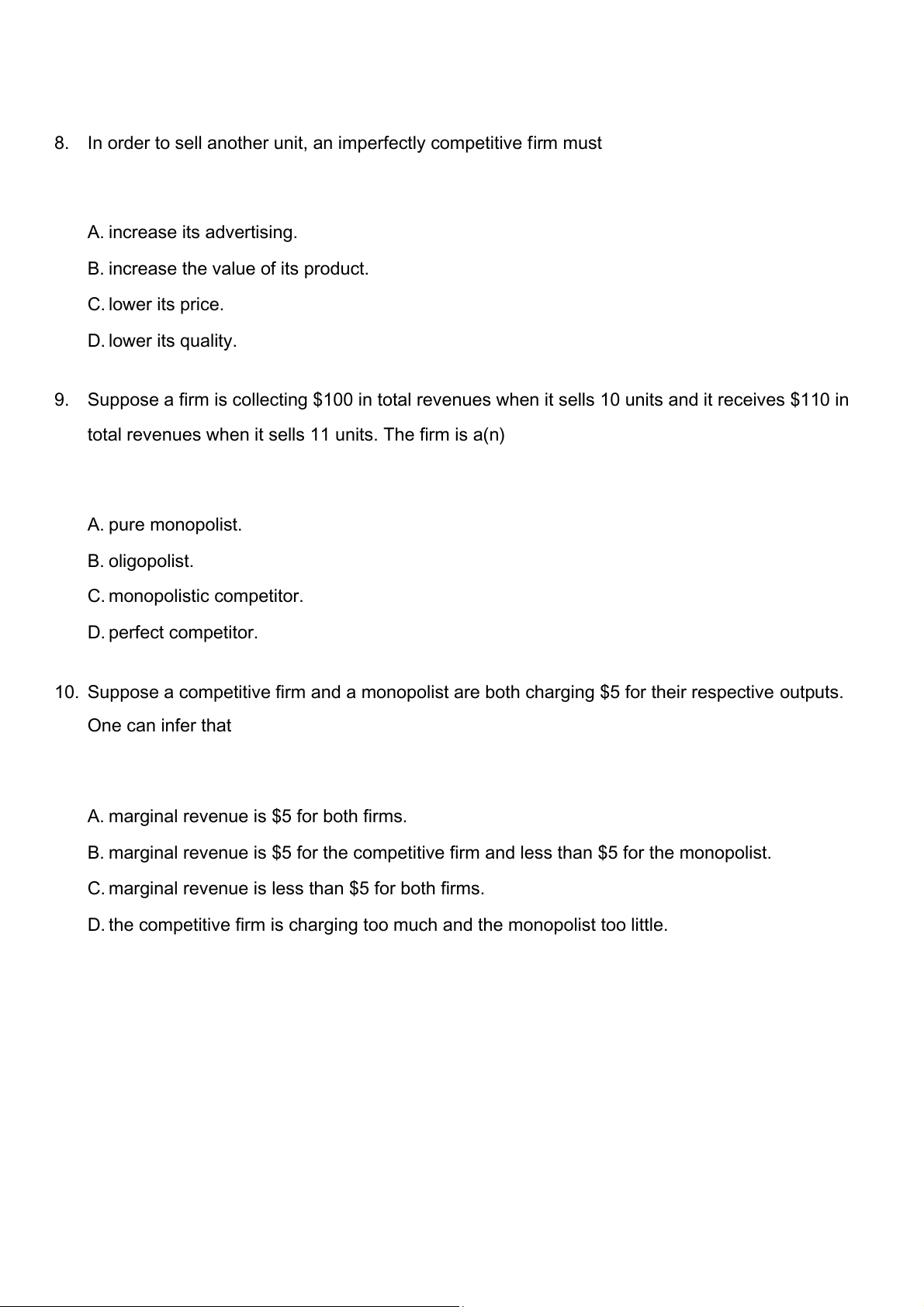
8. In order to sell another unit, an imperfectly competitive firm must A. increase its advertising.
B. increase the value of its product. C. lower its price. D. lower its quality.
9. Suppose a firm is collecting $100 in total revenues when it sells 10 units and it receives $110 in
total revenues when it sells 11 units. The firm is a(n) A. pure monopolist. B. oligopolist. C. monopolistic competitor. D. perfect competitor.
10. Suppose a competitive firm and a monopolist are both charging $5 for their respective outputs. One can infer that
A. marginal revenue is $5 for both firms.
B. marginal revenue is $5 for the competitive firm and less than $5 for the monopolist.
C. marginal revenue is less than $5 for both firms.
D. the competitive firm is charging too much and the monopolist too little.
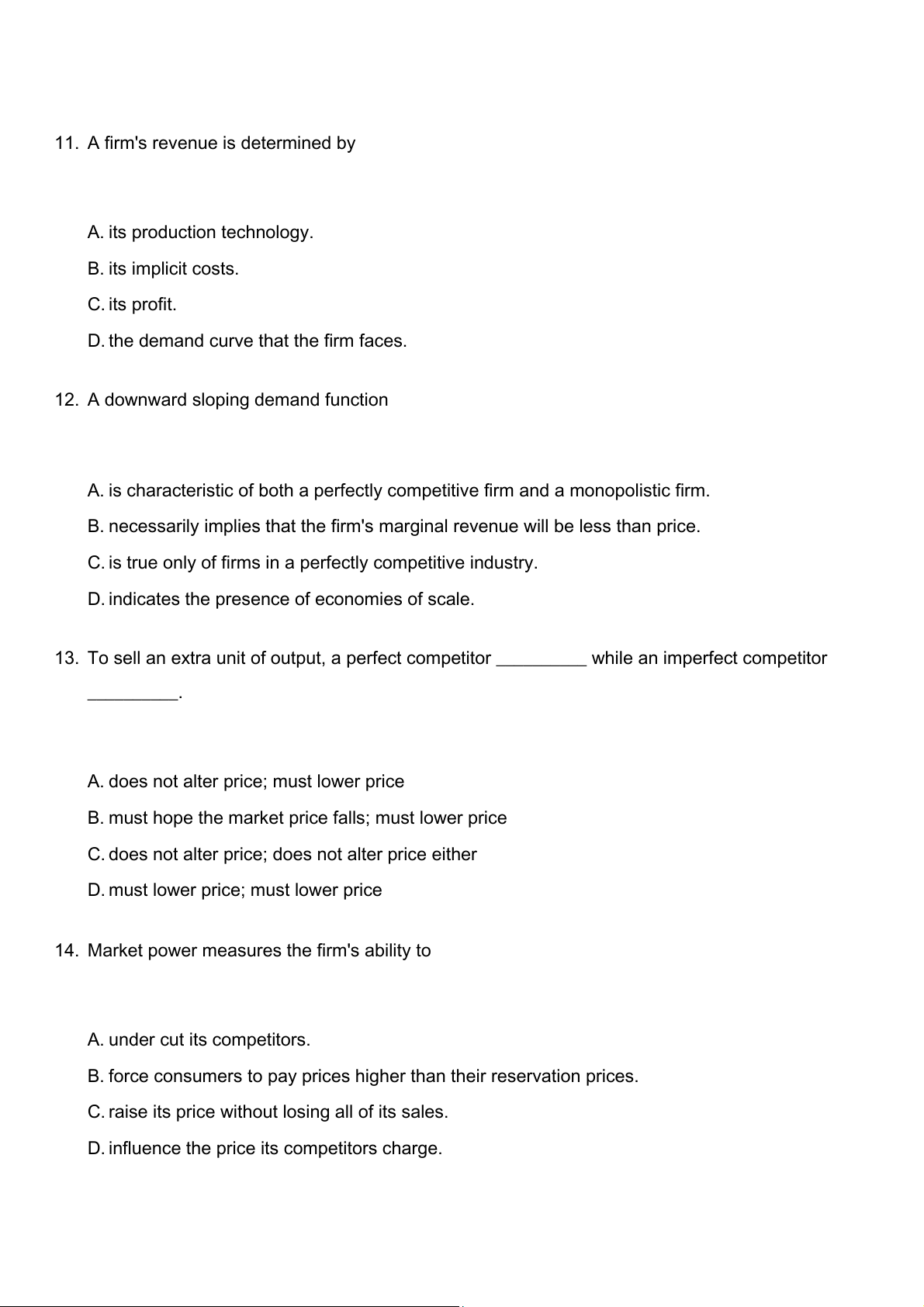
11. A firm's revenue is determined by A. its production technology. B. its implicit costs. C. its profit.
D. the demand curve that the firm faces.
12. A downward sloping demand function
A. is characteristic of both a perfectly competitive firm and a monopolistic firm.
B. necessarily implies that the firm's marginal revenue will be less than price.
C. is true only of firms in a perfectly competitive industry.
D. indicates the presence of economies of scale.
13. To sell an extra unit of output, a perfect competitor __________ while an imperfect competitor __________.
A. does not alter price; must lower price
B. must hope the market price falls; must lower price
C. does not alter price; does not alter price either
D. must lower price; must lower price
14. Market power measures the firm's ability to A. under cut its competitors.
B. force consumers to pay prices higher than their reservation prices.
C. raise its price without losing all of its sales.
D. influence the price its competitors charge.
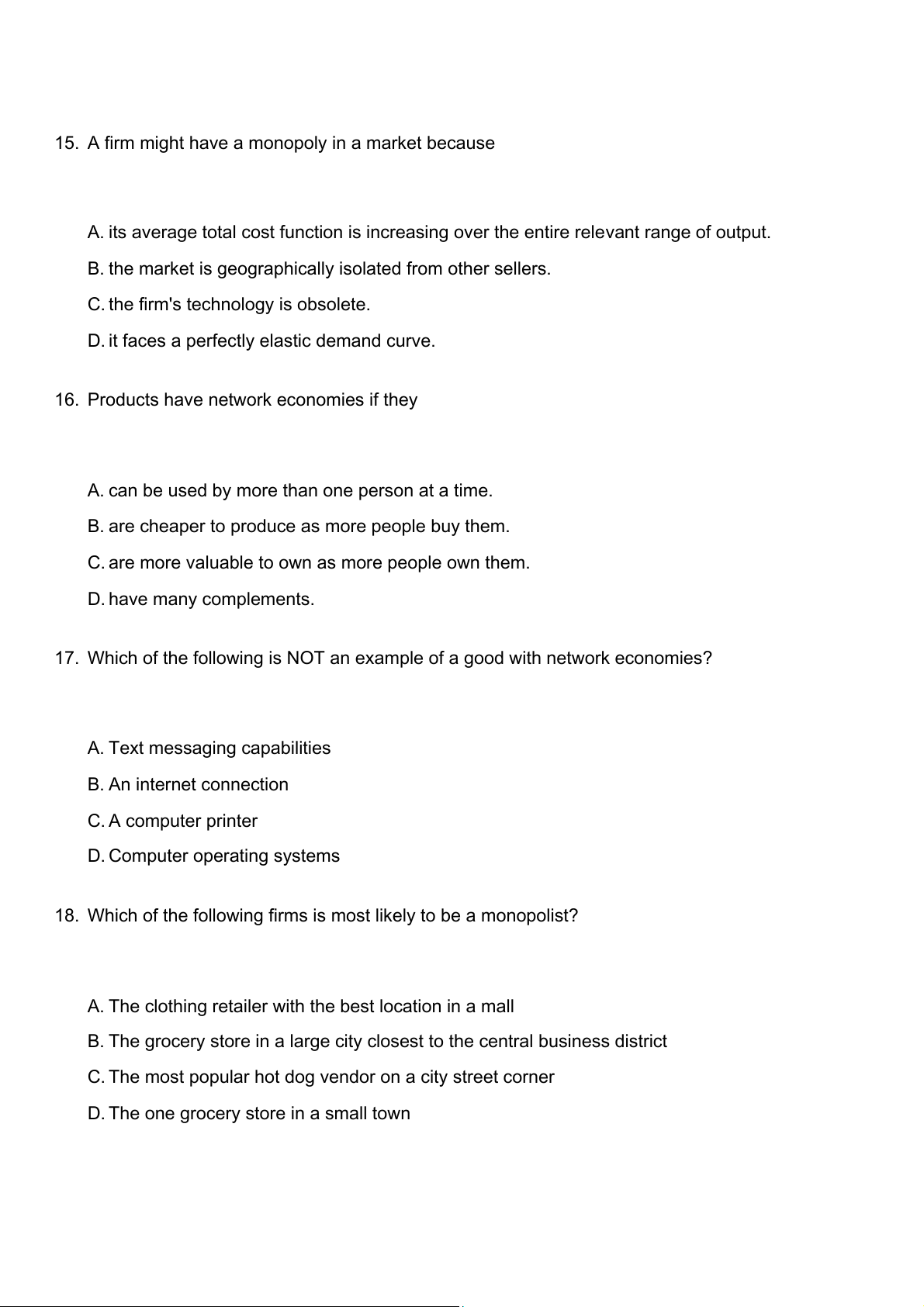
15. A firm might have a monopoly in a market because
A. its average total cost function is increasing over the entire relevant range of output.
B. the market is geographically isolated from other sellers.
C. the firm's technology is obsolete.
D. it faces a perfectly elastic demand curve.
16. Products have network economies if they
A. can be used by more than one person at a time.
B. are cheaper to produce as more people buy them.
C. are more valuable to own as more people own them. D. have many complements.
17. Which of the following is NOT an example of a good with network economies?
A. Text messaging capabilities B. An internet connection C. A computer printer D. Computer operating systems
18. Which of the following firms is most likely to be a monopolist?
A. The clothing retailer with the best location in a mall
B. The grocery store in a large city closest to the central business district
C. The most popular hot dog vendor on a city street corner
D. The one grocery store in a small town
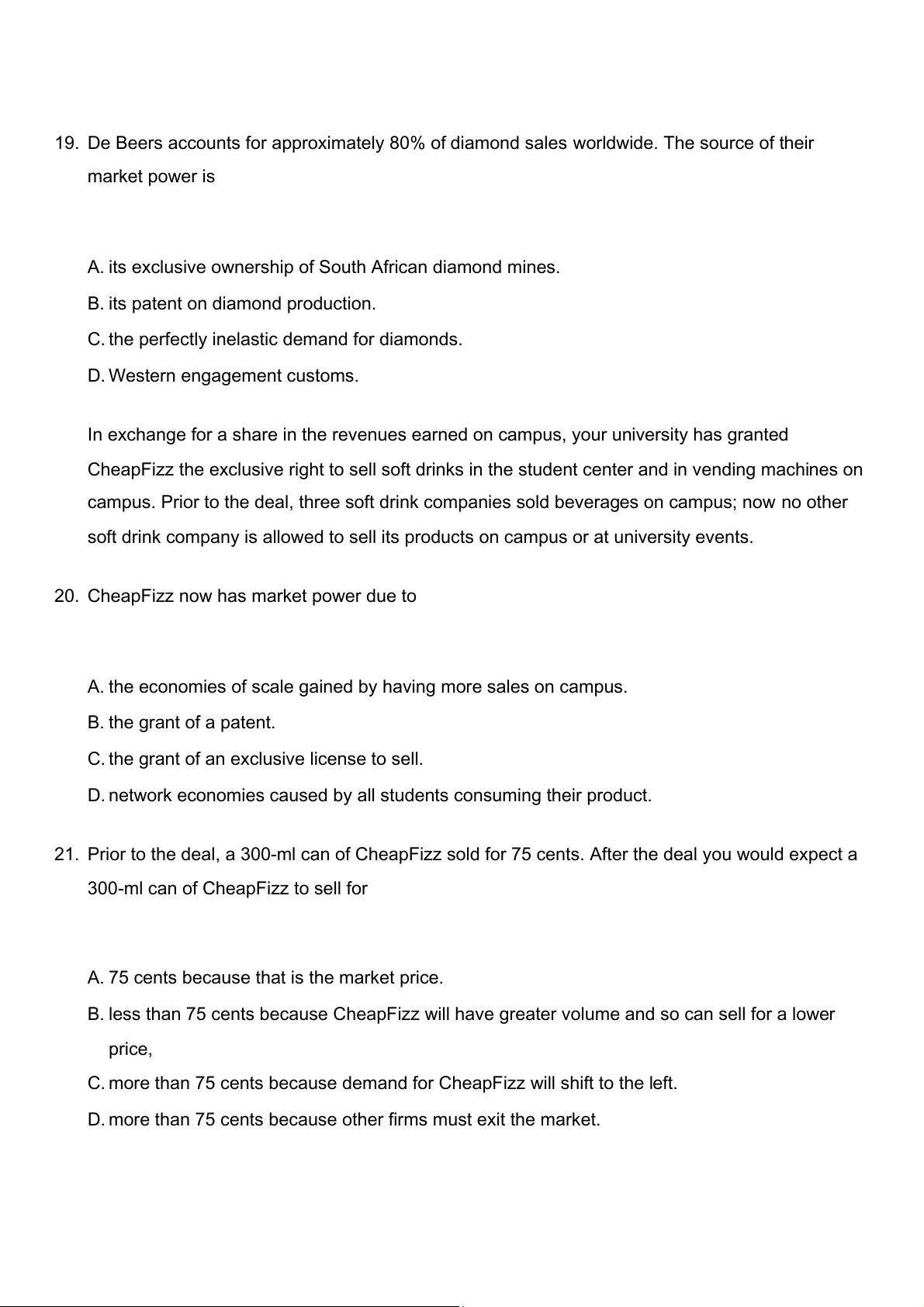
19. De Beers accounts for approximately 80% of diamond sales worldwide. The source of their market power is
A. its exclusive ownership of South African diamond mines.
B. its patent on diamond production.
C. the perfectly inelastic demand for diamonds.
D. Western engagement customs.
In exchange for a share in the revenues earned on campus, your university has granted
CheapFizz the exclusive right to sell soft drinks in the student center and in vending machines on
campus. Prior to the deal, three soft drink companies sold beverages on campus; now no other
soft drink company is allowed to sell its products on campus or at university events.
20. CheapFizz now has market power due to
A. the economies of scale gained by having more sales on campus. B. the grant of a patent.
C. the grant of an exclusive license to sell.
D. network economies caused by all students consuming their product.
21. Prior to the deal, a 300-ml can of CheapFizz sold for 75 cents. After the deal you would expect a
300-ml can of CheapFizz to sell for
A. 75 cents because that is the market price.
B. less than 75 cents because CheapFizz will have greater volume and so can sell for a lower price,
C. more than 75 cents because demand for CheapFizz will shift to the left.
D. more than 75 cents because other firms must exit the market.
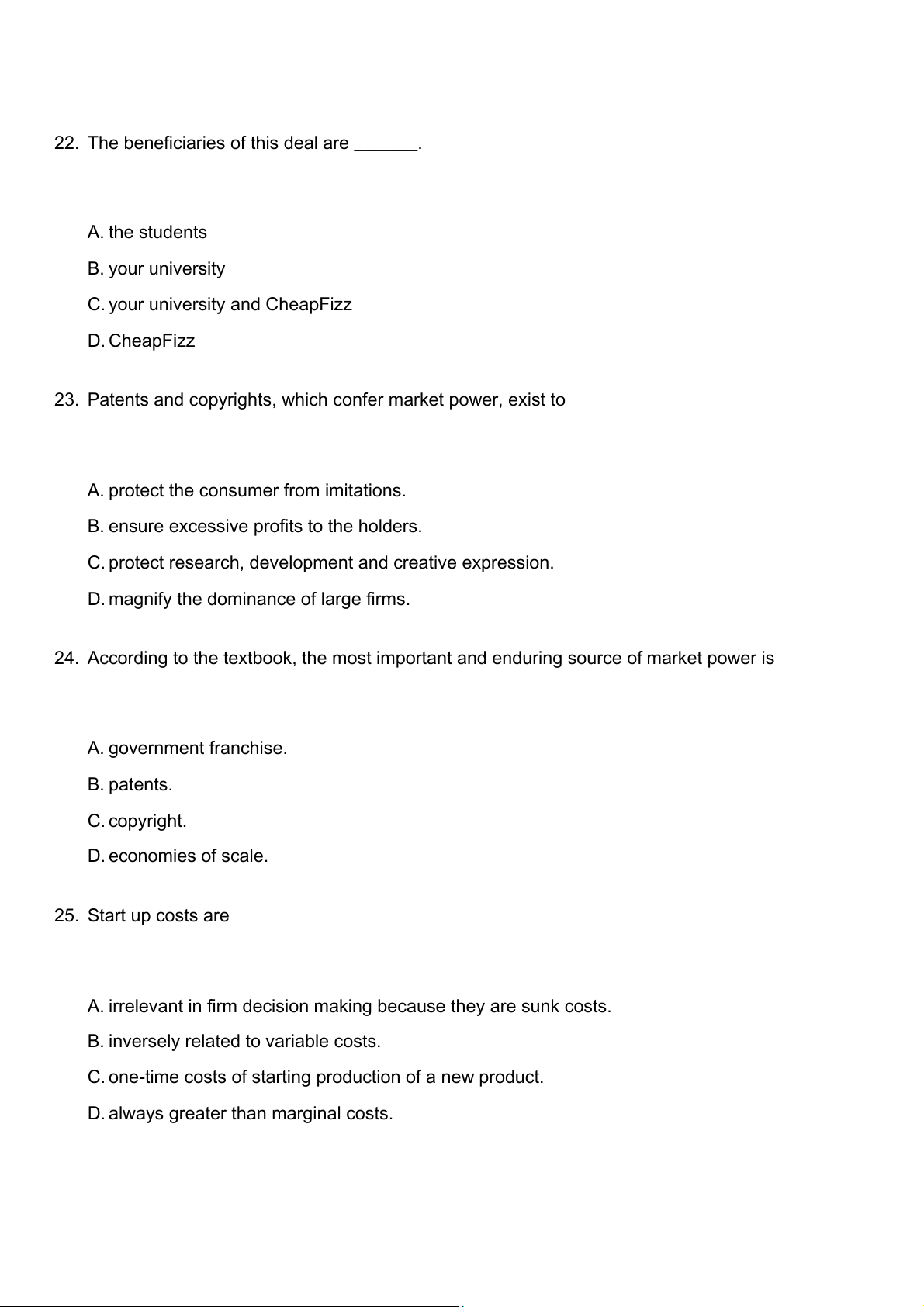
22. The beneficiaries of this deal are _______. A. the students B. your university
C. your university and CheapFizz D. CheapFizz
23. Patents and copyrights, which confer market power, exist to
A. protect the consumer from imitations.
B. ensure excessive profits to the holders.
C. protect research, development and creative expression.
D. magnify the dominance of large firms.
24. According to the textbook, the most important and enduring source of market power is A. government franchise. B. patents. C. copyright. D. economies of scale. 25. Start up costs are
A. irrelevant in firm decision making because they are sunk costs.
B. inversely related to variable costs.
C. one-time costs of starting production of a new product.
D. always greater than marginal costs.
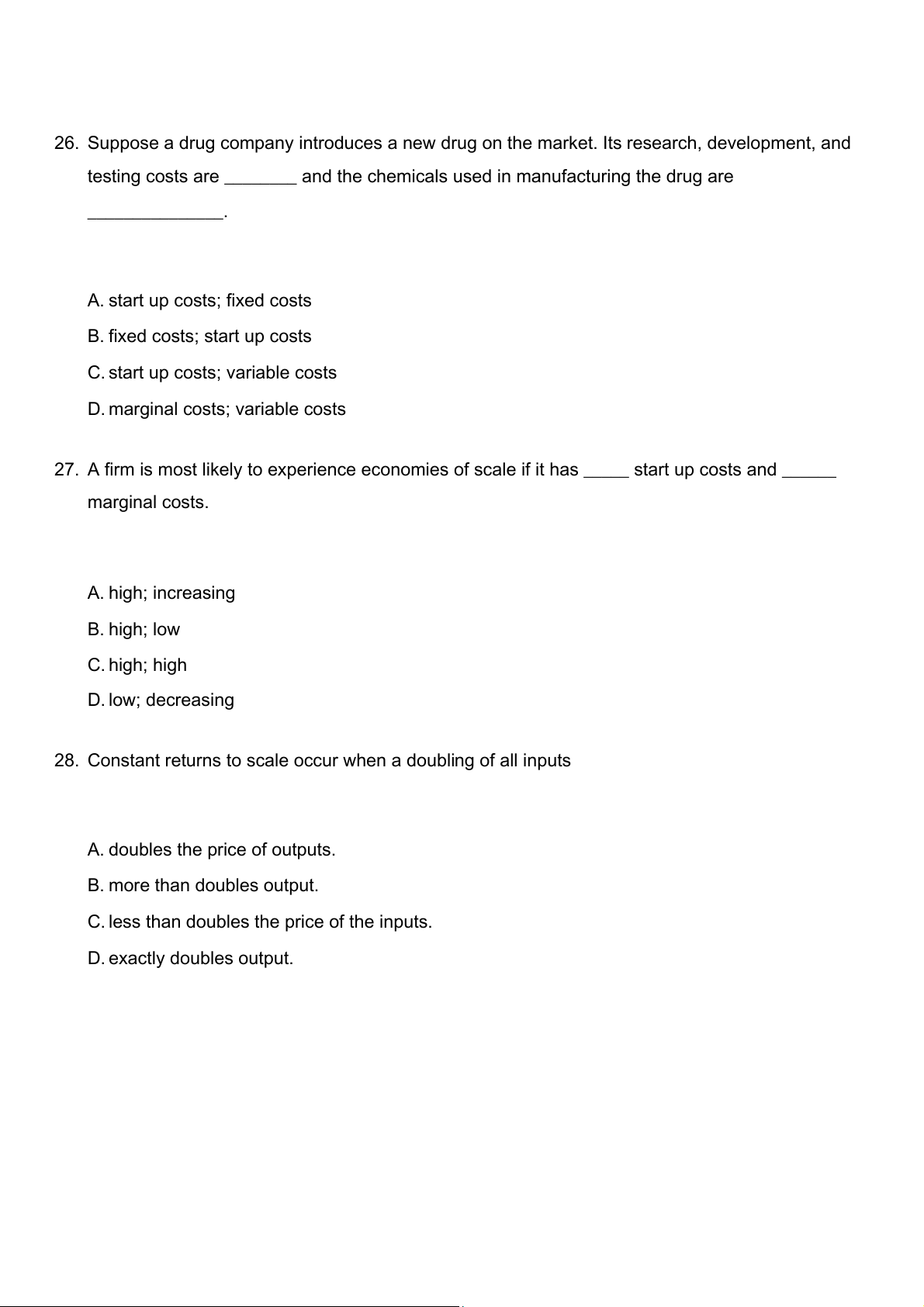
26. Suppose a drug company introduces a new drug on the market. Its research, development, and
testing costs are ________ and the chemicals used in manufacturing the drug are _______________.
A. start up costs; fixed costs
B. fixed costs; start up costs
C. start up costs; variable costs
D. marginal costs; variable costs
27. A firm is most likely to experience economies of scale if it has _____ start up costs and ______ marginal costs. A. high; increasing B. high; low C. high; high D. low; decreasing
28. Constant returns to scale occur when a doubling of all inputs
A. doubles the price of outputs. B. more than doubles output.
C. less than doubles the price of the inputs. D. exactly doubles output.
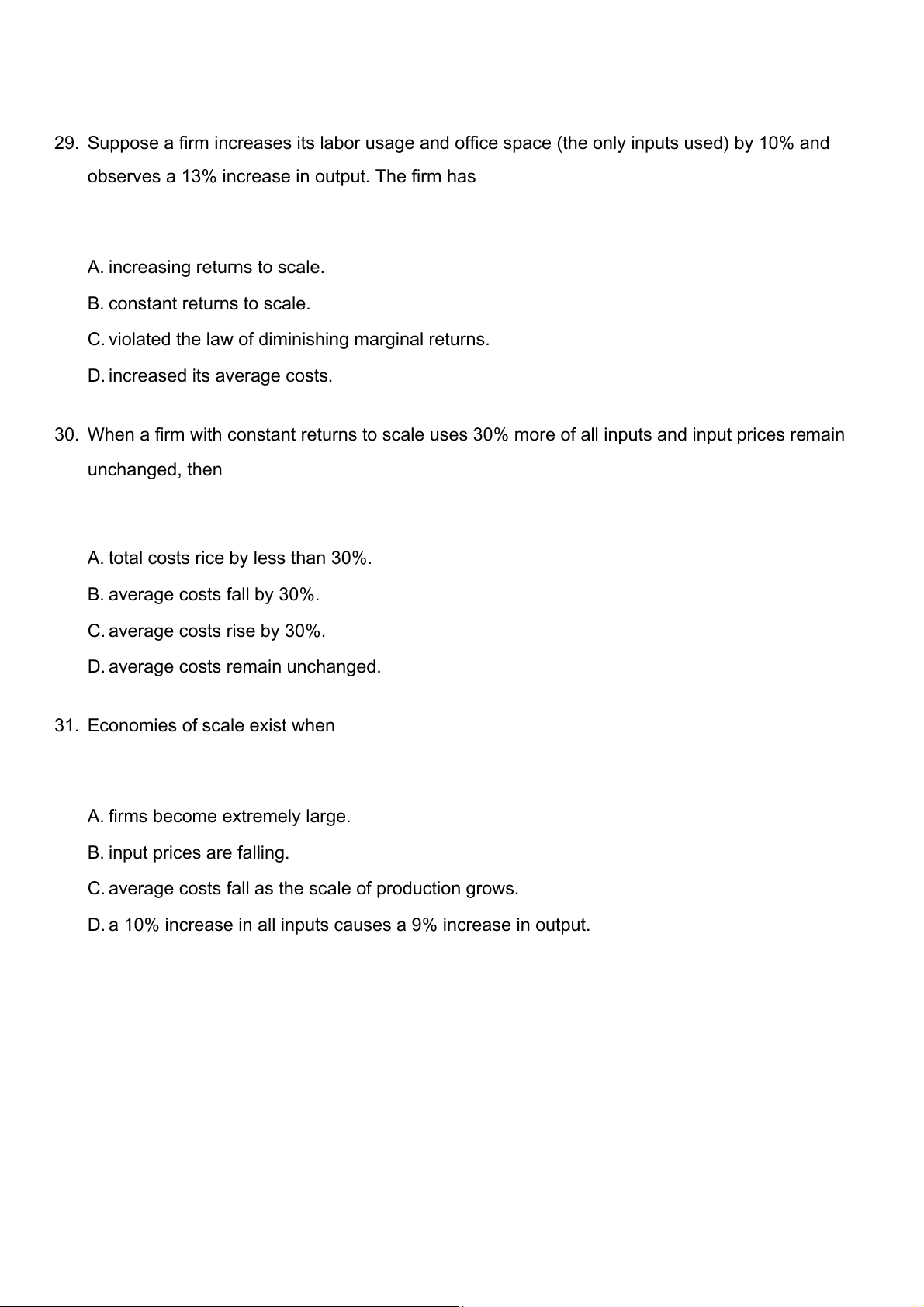
29. Suppose a firm increases its labor usage and office space (the only inputs used) by 10% and
observes a 13% increase in output. The firm has
A. increasing returns to scale. B. constant returns to scale.
C. violated the law of diminishing marginal returns.
D. increased its average costs.
30. When a firm with constant returns to scale uses 30% more of all inputs and input prices remain unchanged, then
A. total costs rice by less than 30%. B. average costs fall by 30%. C. average costs rise by 30%.
D. average costs remain unchanged.
31. Economies of scale exist when
A. firms become extremely large. B. input prices are falling.
C. average costs fall as the scale of production grows.
D. a 10% increase in all inputs causes a 9% increase in output.
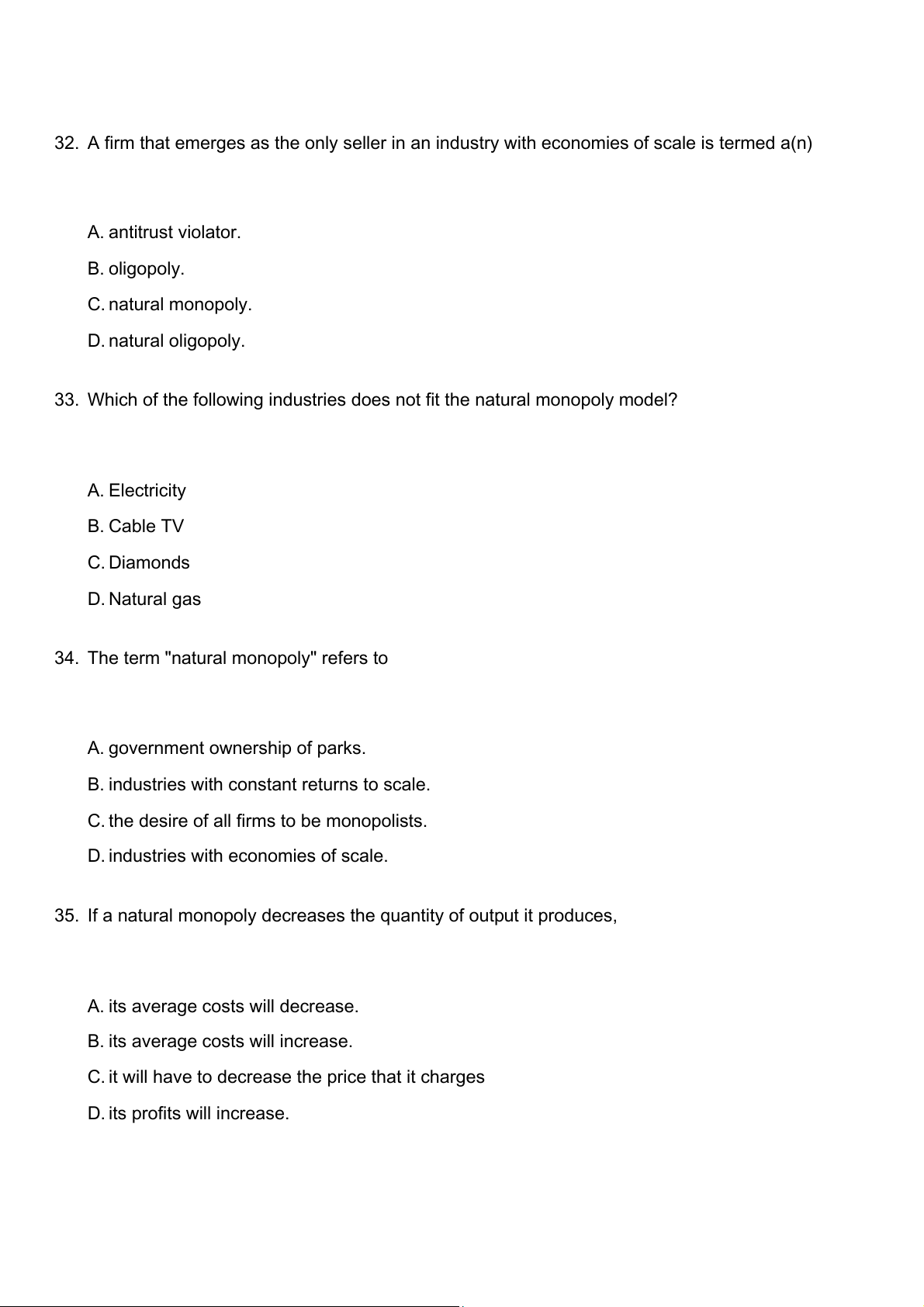
32. A firm that emerges as the only seller in an industry with economies of scale is termed a(n) A. antitrust violator. B. oligopoly. C. natural monopoly. D. natural oligopoly.
33. Which of the following industries does not fit the natural monopoly model? A. Electricity B. Cable TV C. Diamonds D. Natural gas
34. The term "natural monopoly" refers to
A. government ownership of parks.
B. industries with constant returns to scale.
C. the desire of all firms to be monopolists.
D. industries with economies of scale.
35. If a natural monopoly decreases the quantity of output it produces,
A. its average costs will decrease.
B. its average costs will increase.
C. it will have to decrease the price that it charges D. its profits will increase.
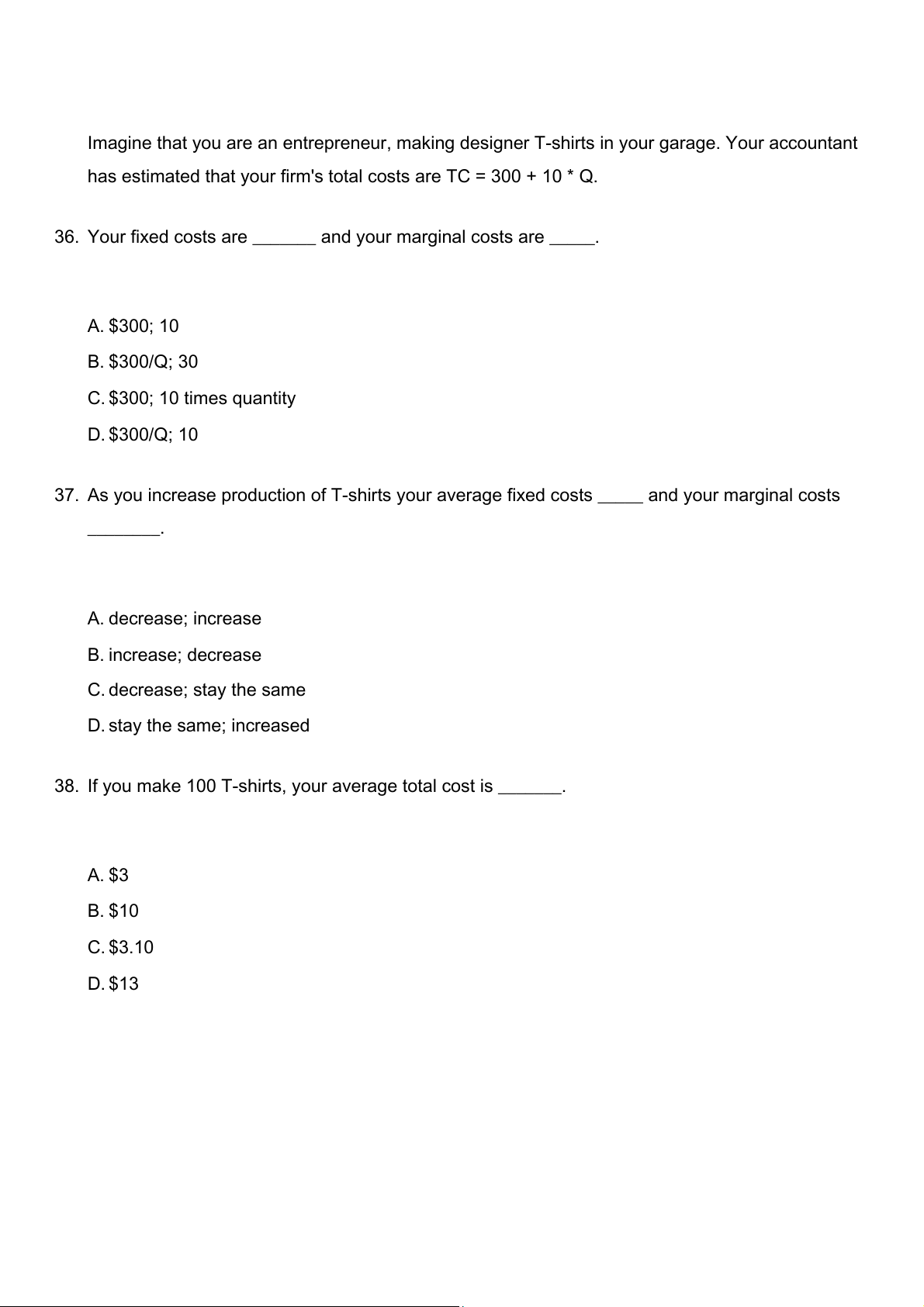
Imagine that you are an entrepreneur, making designer T-shirts in your garage. Your accountant
has estimated that your firm's total costs are TC = 300 + 10 * Q.
36. Your fixed costs are _______ and your marginal costs are _____. A. $300; 10 B. $300/Q; 30 C. $300; 10 times quantity D. $300/Q; 10
37. As you increase production of T-shirts your average fixed costs _____ and your marginal costs ________. A. decrease; increase B. increase; decrease C. decrease; stay the same D. stay the same; increased
38. If you make 100 T-shirts, your average total cost is _______. A. $3 B. $10 C. $3.10 D. $13
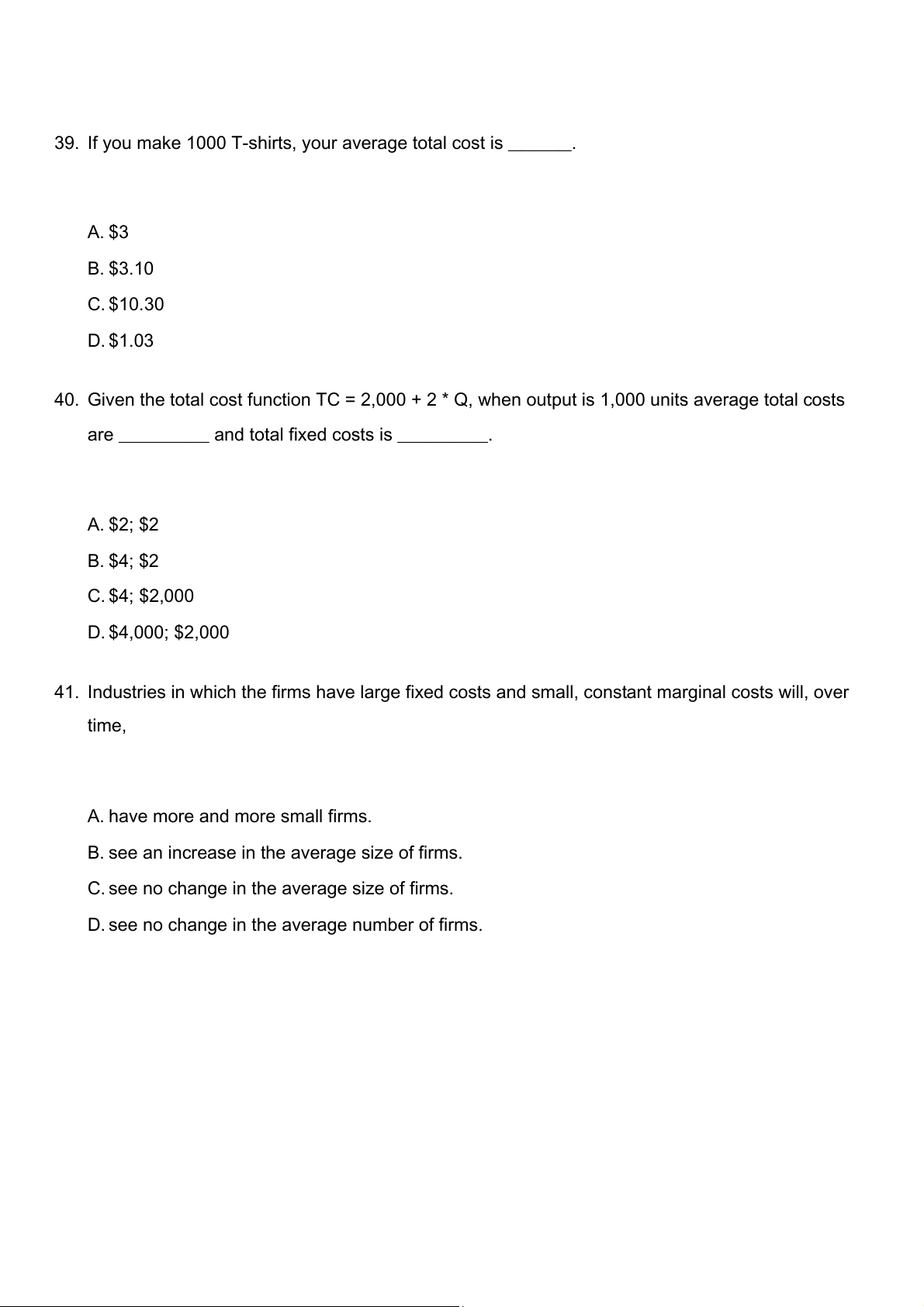
39. If you make 1000 T-shirts, your average total cost is _______. A. $3 B. $3.10 C. $10.30 D. $1.03
40. Given the total cost function TC = 2,000 + 2 * Q, when output is 1,000 units average total costs
are __________ and total fixed costs is __________. A. $2; $2 B. $4; $2 C. $4; $2,000 D. $4,000; $2,000
41. Industries in which the firms have large fixed costs and small, constant marginal costs will, over time,
A. have more and more small firms.
B. see an increase in the average size of firms.
C. see no change in the average size of firms.
D. see no change in the average number of firms.
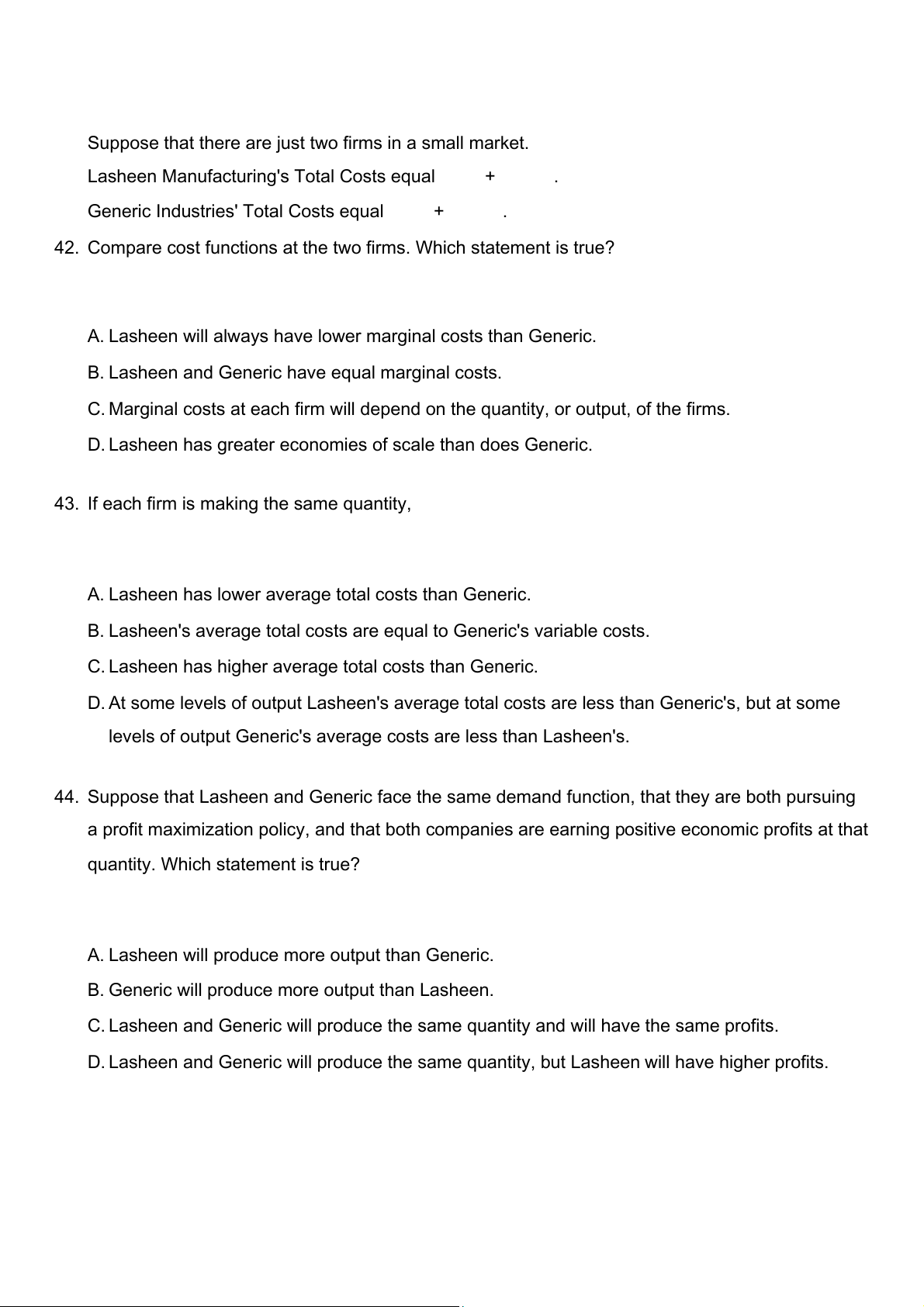
Suppose that there are just two firms in a small market.
Lasheen Manufacturing's Total Costs equal $100 + $3 Qty.
Generic Industries' Total Costs equal $500 + $3 Qty.
42. Compare cost functions at the two firms. Which statement is true?
A. Lasheen will always have lower marginal costs than Generic.
B. Lasheen and Generic have equal marginal costs.
C. Marginal costs at each firm will depend on the quantity, or output, of the firms.
D. Lasheen has greater economies of scale than does Generic.
43. If each firm is making the same quantity,
A. Lasheen has lower average total costs than Generic.
B. Lasheen's average total costs are equal to Generic's variable costs.
C. Lasheen has higher average total costs than Generic.
D. At some levels of output Lasheen's average total costs are less than Generic's, but at some
levels of output Generic's average costs are less than Lasheen's.
44. Suppose that Lasheen and Generic face the same demand function, that they are both pursuing
a profit maximization policy, and that both companies are earning positive economic profits at that
quantity. Which statement is true?
A. Lasheen will produce more output than Generic.
B. Generic will produce more output than Lasheen.
C. Lasheen and Generic will produce the same quantity and will have the same profits.
D. Lasheen and Generic will produce the same quantity, but Lasheen will have higher profits.
45. The primary objective of a monopolist is to
A. charge the highest possible price. B. maximize total revenues. C. minimize total costs. D. maximize profits.
46. Both the perfectly competitive firm and the monopolist find that
A. price and marginal revenue are the same.
B. they can sell all they want to at the market price.
C. it is best to expand production until the benefits and costs of the last unit produced are equal.
D. price is less than marginal revenue.
47. For all firms, the additional revenue collected from the sale of one additional unit of output is A. price. B. average revenue. C. marginal profit. D. marginal revenue.
48. When a perfect competitor sells additional units, __________, and when a monopolist sells additional units, ___________
A. total revenues always rise; total revenues may rise, fall, or remain unchanged.
B. total revenues remain unchanged; total revenues always rise.
C. marginal revenues stay the same; marginal revenues rise.
D. total revenues always rise; total revenues always fall.
49. If a firm collects $80 in revenues when it sells 4 units, $100 in revenues when it sells 5 units, and
$120 when it sells 6 units, one can infer the firm is more likely to be A. a perfect competitor. B. a monopolistic competitor. C. an oligopolist. D. a monopolist.
50. If a firm collects $90 in revenues when it sells 4 units, $100 in revenues when it sells 5 units, and
$105 when it sells 6 units, one can infer the firm is likely to be A. a perfect competitor. B. a cost minimizer.
C. a perfect competitor or a monopolist. D. a monopolist.
51. For perfectly competitive firms price _____ marginal revenue; for monopolists price ____ marginal revenue. A. equals; equals B. equals; is less than C. is less than; equals D. equals; is greater than
52. The demand curve for a perfectly competitive firm is __________ while the demand curve for a monopolist is __________.
A. perfectly elastic; downward sloping B. vertical; downward sloping
C. perfectly elastic; perfectly inelastic
D. perfectly inelastic; perfectly elastic
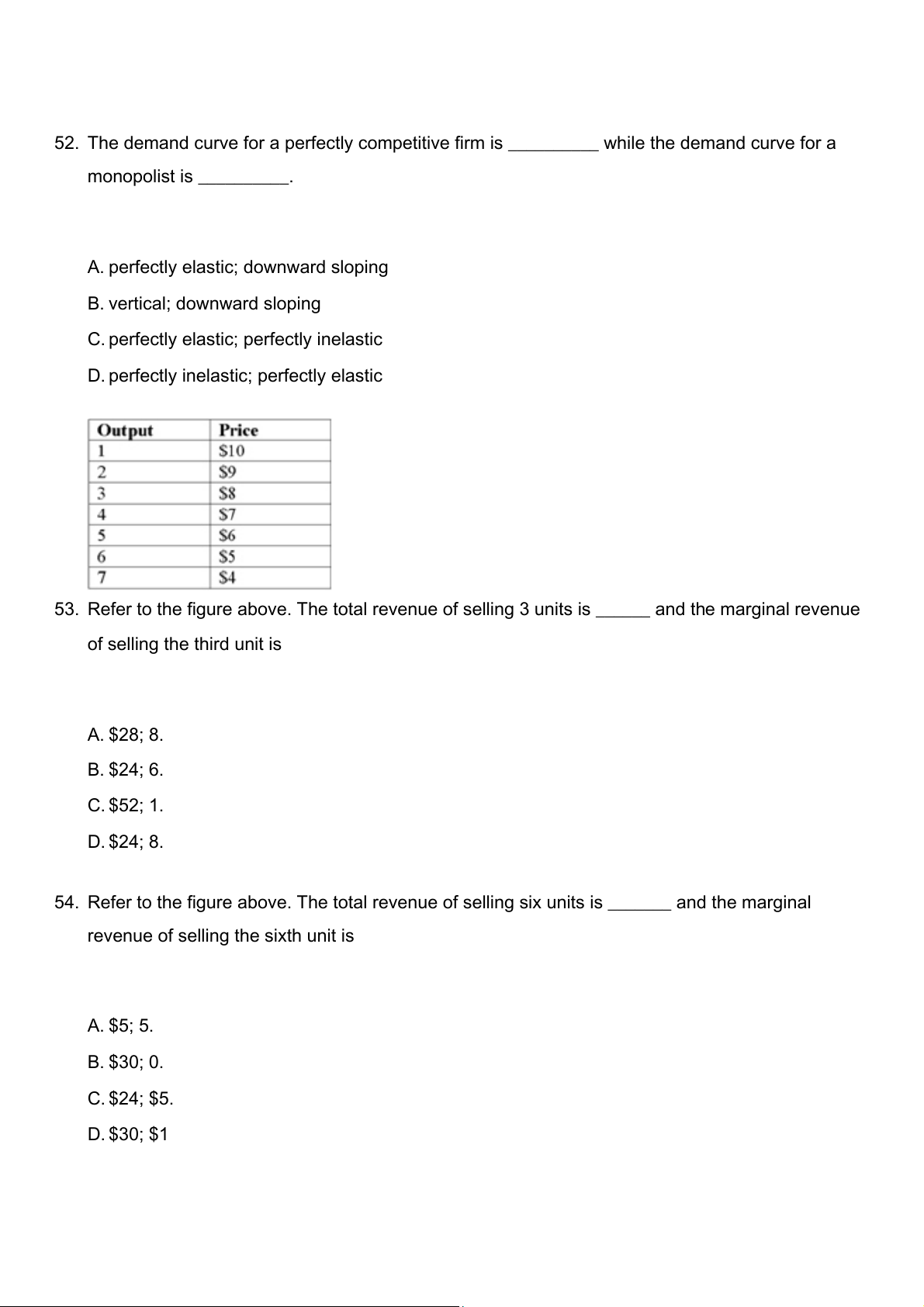
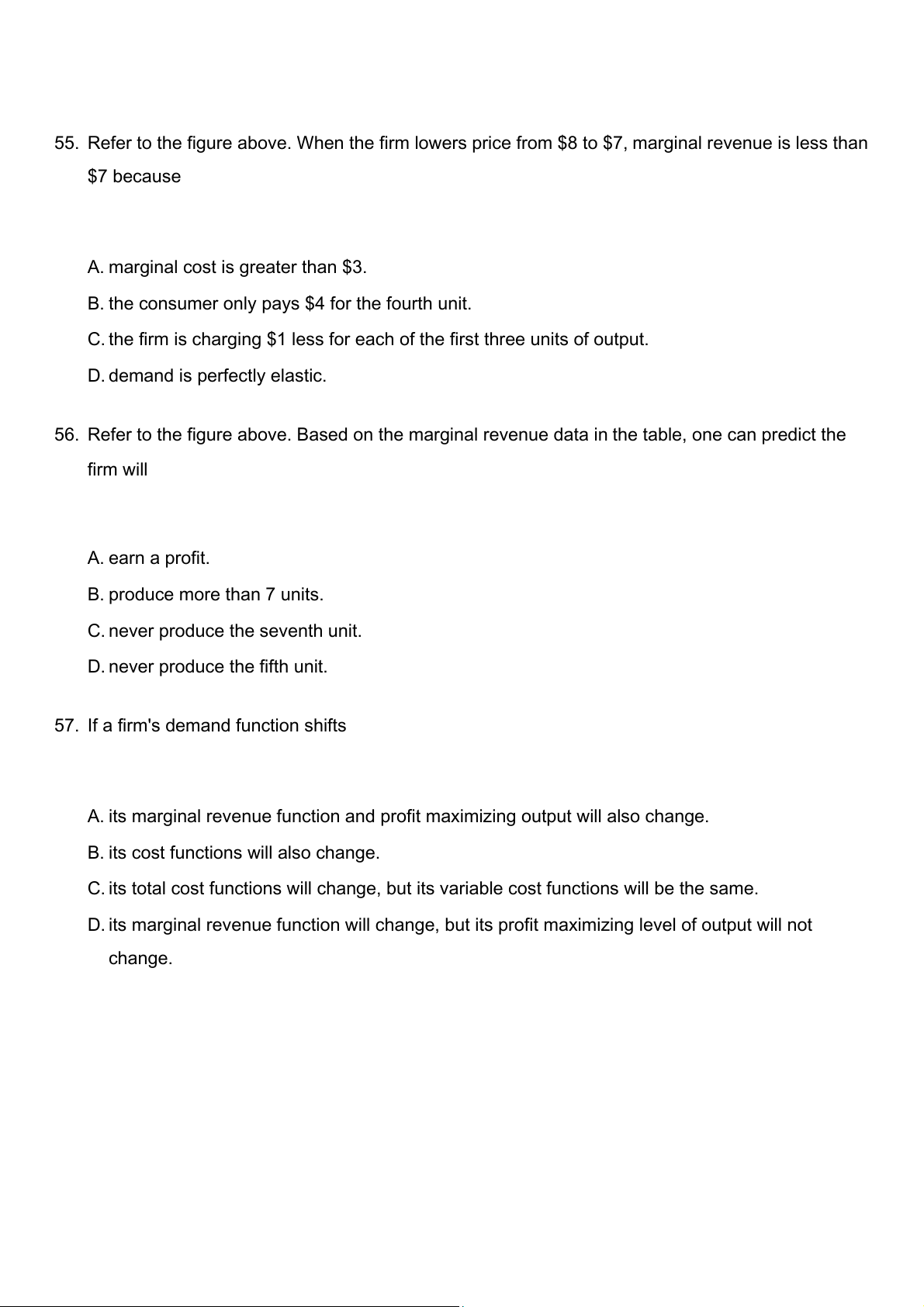
53. Refer to the figure above. The total revenue of selling 3 units is ______ and the marginal revenue of selling the third unit is A. $28; 8. B. $24; 6. C. $52; 1. D. $24; 8.
54. Refer to the figure above. The total revenue of selling six units is _______ and the marginal
revenue of selling the sixth unit is A. $5; 5. B. $30; 0. C. $24; $5. D. $30; $1
55. Refer to the figure above. When the firm lowers price from $8 to $7, marginal revenue is less than $7 because
A. marginal cost is greater than $3.
B. the consumer only pays $4 for the fourth unit.
C. the firm is charging $1 less for each of the first three units of output.
D. demand is perfectly elastic.
56. Refer to the figure above. Based on the marginal revenue data in the table, one can predict the firm will A. earn a profit. B. produce more than 7 units.
C. never produce the seventh unit.
D. never produce the fifth unit.
57. If a firm's demand function shifts
A. its marginal revenue function and profit maximizing output will also change.
B. its cost functions will also change.
C. its total cost functions will change, but its variable cost functions will be the same.
D. its marginal revenue function will change, but its profit maximizing level of output will not change.
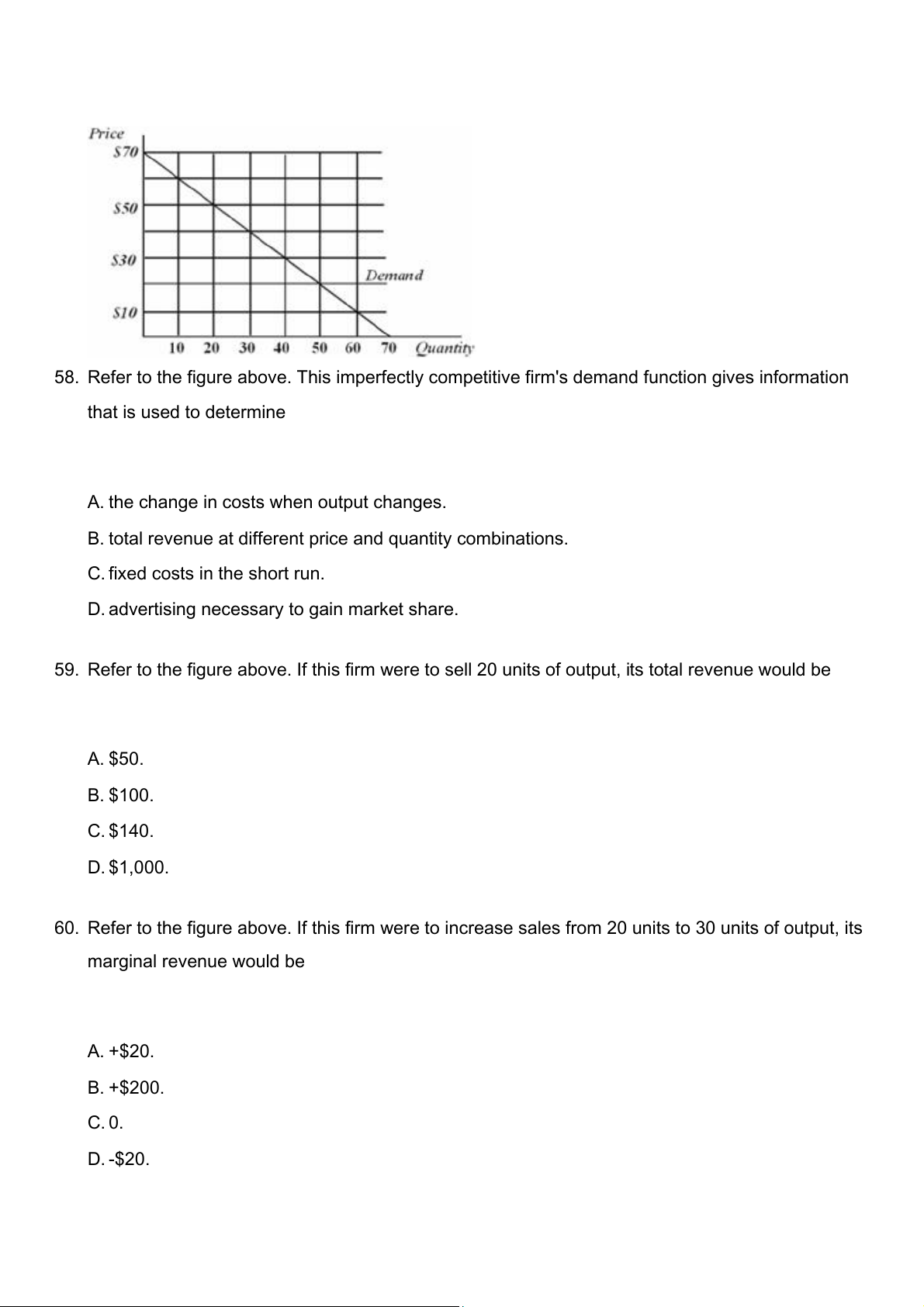
58. Refer to the figure above. This imperfectly competitive firm's demand function gives information that is used to determine
A. the change in costs when output changes.
B. total revenue at different price and quantity combinations.
C. fixed costs in the short run.
D. advertising necessary to gain market share.
59. Refer to the figure above. If this firm were to sell 20 units of output, its total revenue would be A. $50. B. $100. C. $140. D. $1,000.
60. Refer to the figure above. If this firm were to increase sales from 20 units to 30 units of output, its marginal revenue would be A. +$20. B. +$200. C. 0. D. -$20.
61. Refer to the figure above. This firm would maximize its profits by selling
A. 10 units and charging $70, the highest price on its demand function.
B. 40 units, the point at which Total Revenue is greatest.
C. the number of units at which Marginal Revenue minus Marginal Cost is greatest.
D. the number of units at which Marginal Revenue equals Marginal Cost.
62. Refer to the figure above. If this monopolistic firm's marginal cost is constant at $30, its profit maximizing output is A. 50 units. B. 40 units. C. 20 units. D. 30 units.
63. Refer to the figure above. This firm's marginal revenue function would intersect the horizontal axis at a quantity of _______. A. 70 B. 50 C. 20 D. 35
64. Once a firm has determined the quantity of output it wishes to sell, the price it can charge is determined by
A. the cost of making the product. B. the firm's demand curve.
C. market demand for the product minus cost.
D. the explicit cost of making the product plus the implicit costs incurred by the firm owner.
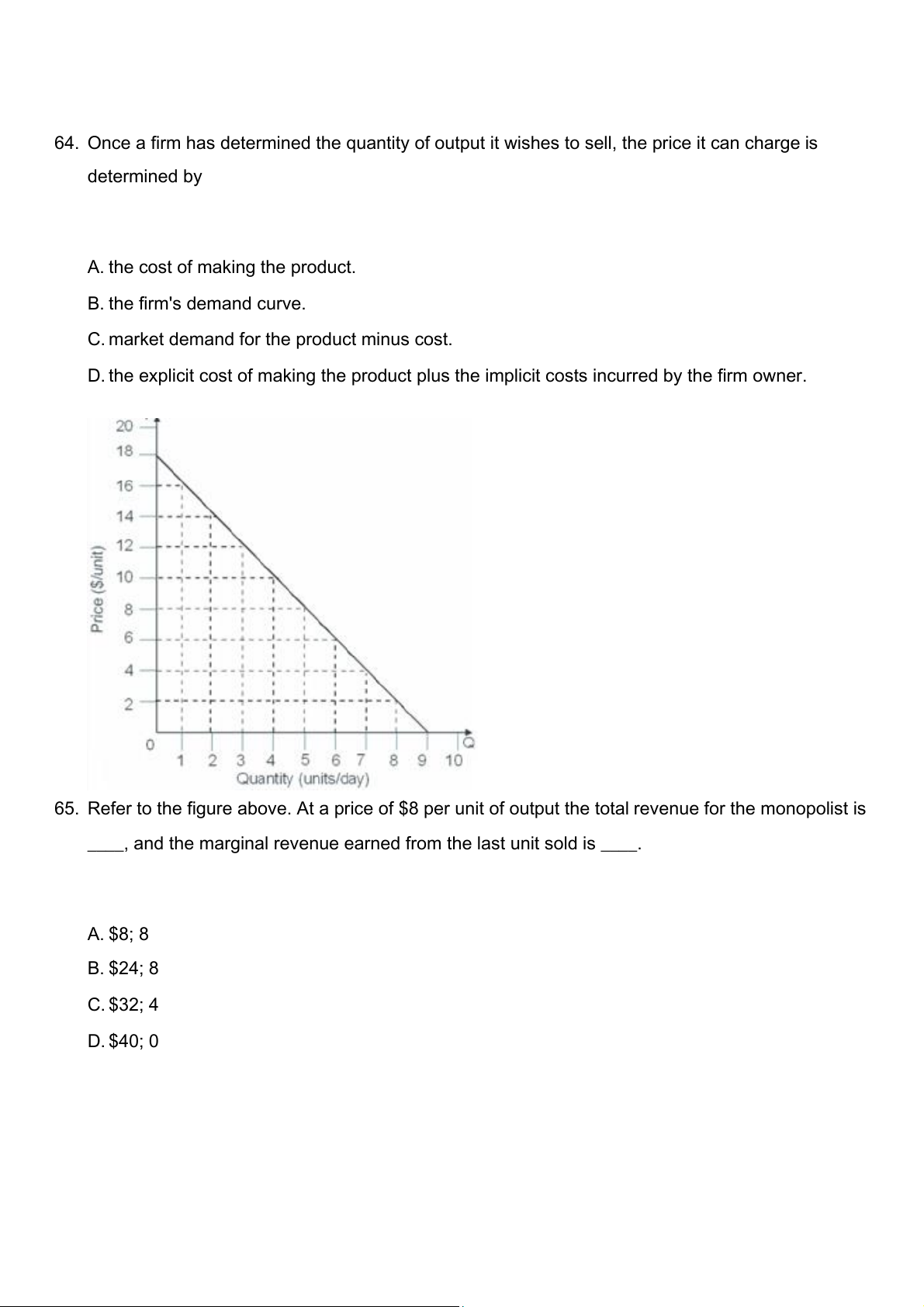
65. Refer to the figure above. At a price of $8 per unit of output the total revenue for the monopolist is
____, and the marginal revenue earned from the last unit sold is ____. A. $8; 8 B. $24; 8 C. $32; 4 D. $40; 0
Tài liệu liên quan:
-
Chương 3: độ co giãn và các nhân tố ảnh hưởng | Microeconomics | Trường Đại học Quốc tế, Đại học Quốc gia Thành phố Hồ Chí Minh
4 2 -
Microeconomics Syllabus | Microeconomics | Trường Đại học Quốc tế, Đại học Quốc gia Thành phố Hồ Chí Minh
4 2 -
Microeconomics Course Syllabus & Assessment Details | Microeconomics | Trường Đại học Quốc tế, Đại học Quốc gia Thành phố Hồ Chí Minh
4 2 -
Assignment 3 - Elasticity MCQs and Key Concepts | Microeconomics | Trường Đại học Quốc tế, Đại học Quốc gia Thành phố Hồ Chí Minh
4 2 -
Assignment 2 - Economic Equilibrium Analysis of Fridges and Motorcycles | Microeconomics | Trường Đại học Quốc tế, Đại học Quốc gia Thành phố Hồ Chí Minh
4 2