Understanding Monopoly and Profit Maximization | Microeconomics | Trường Đại học Quốc tế, Đại học Quốc gia Thành phố Hồ Chí Minh
The monopolist will produce the amount of product where the firm will maximize their profit ↔ 𝑀𝑅 = 𝑀𝐶. → The quantity that the monopolist will produce is 6 where 𝑀𝑅 ≈ 𝑀𝐶. c. The price that the monopolist will charge is $5.5. d. At the price of $5.5, the profit will be 𝜋 = 𝑇𝑅 − 𝑇𝐶 = 33 − 16 = $17. Tài liệu được sưu tầm và soạn thảo dưới dạng file PDF để gửi tới các bạn cùng tham khảo, ôn tập đầy đủ kiến thức, chuẩn bị cho các buổi học thật tốt. Mời bạn đọc đón xem!
Môn: Microeconomics 635 tài liệu
Trường: Trường Đại học Quốc tế, Đại học Quốc gia Thành phố Hồ Chí Minh 1.9 K tài liệu
Tác giả:

Preview text:
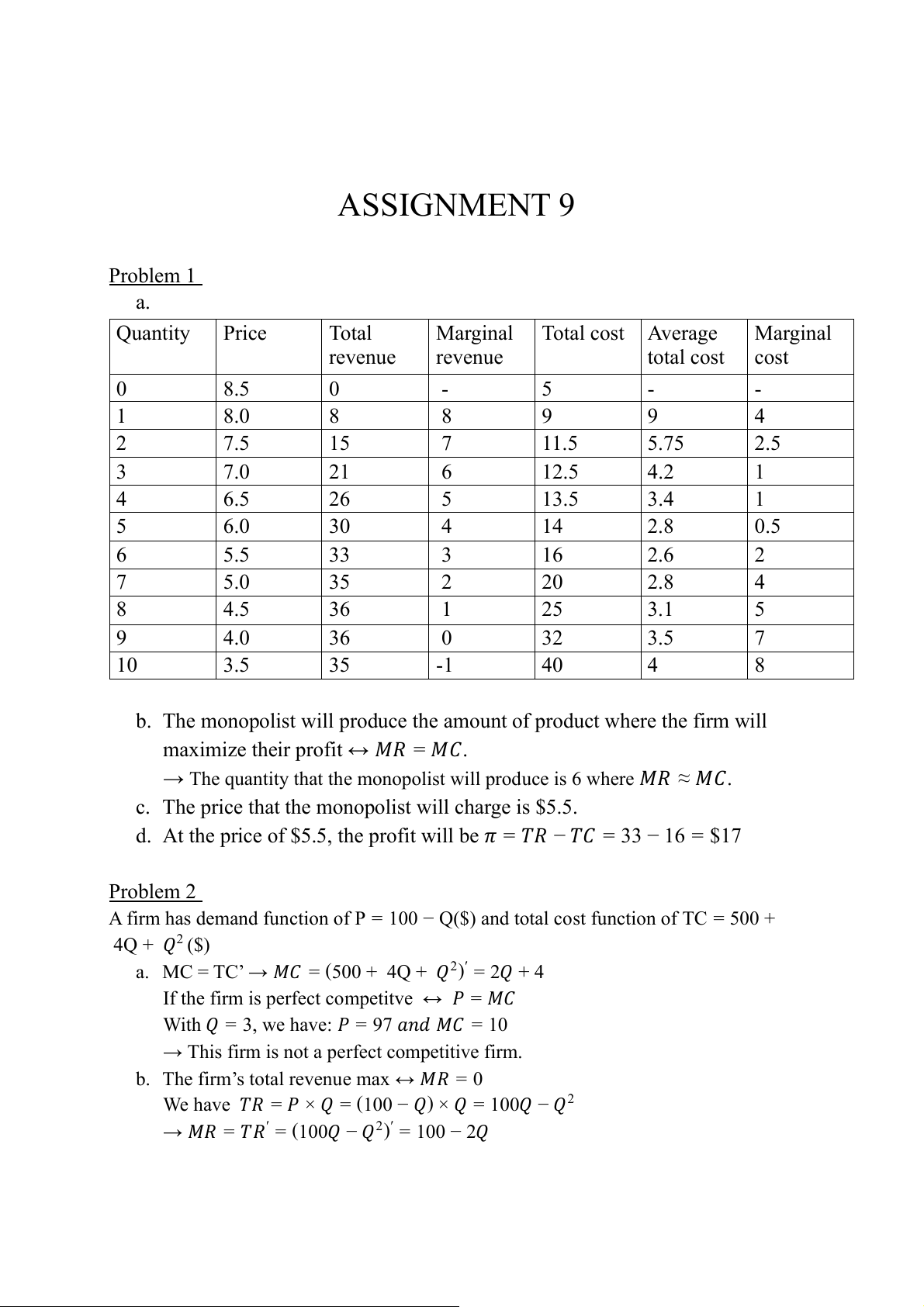
ASSIGNMENT 9 Problem 1 a. Quantity Price Total Marginal Total cost Average Marginal revenue revenue total cost cost 0 8.5 0 - 5 - - 1 8.0 8 8 9 9 4 2 7.5 15 7 11.5 5.75 2.5 3 7.0 21 6 12.5 4.2 1 4 6.5 26 5 13.5 3.4 1 5 6.0 30 4 14 2.8 0.5 6 5.5 33 3 16 2.6 2 7 5.0 35 2 20 2.8 4 8 4.5 36 1 25 3.1 5 9 4.0 36 0 32 3.5 7 10 3.5 35 -1 40 4 8
b. The monopolist will produce the amount of product where the firm will
maximize their profit ↔ 𝑀𝑅 = 𝑀𝐶.
→ The quantity that the monopolist will produce is 6 where 𝑀𝑅 ≈ 𝑀𝐶.
c. The price that the monopolist will charge is $5.5.
d. At the price of $5.5, the profit will be 𝜋 = 𝑇𝑅 − 𝑇𝐶 = 33 − 16 = $17 Problem 2
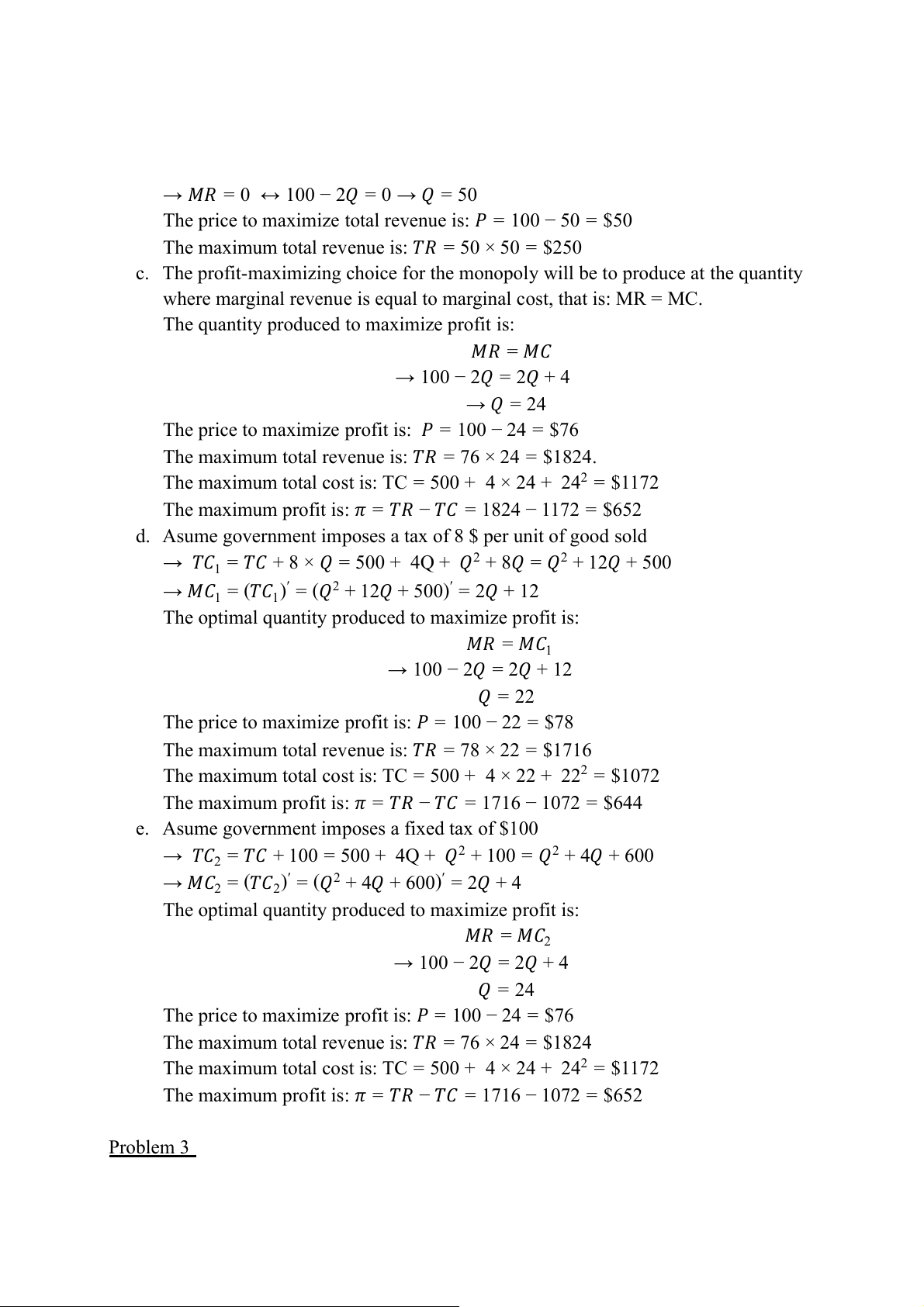
A firm has demand function of P = 100 − Q($) and total cost function of TC = 500 + 4Q + 𝑄2 ($)
a. MC = TC’ → 𝑀𝐶 = (500 + 4Q + 𝑄2)′ = 2𝑄 + 4
If the firm is perfect competitve ↔ 𝑃 = 𝑀𝐶
With 𝑄 = 3, we have: 𝑃 = 97 𝑎𝑛𝑑 𝑀𝐶 = 10
→ This firm is not a perfect competitive firm.
b. The firm’s total revenue max ↔ 𝑀𝑅 = 0
We have 𝑇𝑅 = 𝑃 × 𝑄 = (100 − 𝑄) × 𝑄 = 100𝑄 − 𝑄2
→ 𝑀𝑅 = 𝑇𝑅′ = (100𝑄 − 𝑄2)′ = 100 − 2𝑄
→ 𝑀𝑅 = 0 ↔ 100 − 2𝑄 = 0 → 𝑄 = 50
The price to maximize total revenue is: 𝑃 = 100 − 50 = $50
The maximum total revenue is: 𝑇𝑅 = 50 × 50 = $250
c. The profit-maximizing choice for the monopoly will be to produce at the quantity
where marginal revenue is equal to marginal cost, that is: MR = MC.
The quantity produced to maximize profit is: 𝑀𝑅 = 𝑀𝐶 → 100 − 2𝑄 = 2𝑄 + 4 → 𝑄 = 24
The price to maximize profit is: 𝑃 = 100 − 24 = $76
The maximum total revenue is: 𝑇𝑅 = 76 × 24 = $1824.
The maximum total cost is: TC = 500 + 4 × 24 + 242 = $1172
The maximum profit is: 𝜋 = 𝑇𝑅 − 𝑇𝐶 = 1824 − 1172 = $652
d. Asume government imposes a tax of 8 $ per unit of good sold → 𝑇𝐶 2
1 = 𝑇𝐶 + 8 × 𝑄 = 500 + 4Q + 𝑄 + 8𝑄 = 𝑄2 + 12𝑄 + 500
→ 𝑀𝐶1 = (𝑇𝐶1)′ = (𝑄2 + 12𝑄 + 500)′ = 2𝑄 + 12
The optimal quantity produced to maximize profit is: 𝑀𝑅 = 𝑀𝐶1
→ 100 − 2𝑄 = 2𝑄 + 12 𝑄 = 22
The price to maximize profit is: 𝑃 = 100 − 22 = $78
The maximum total revenue is: 𝑇𝑅 = 78 × 22 = $1716
The maximum total cost is: TC = 500 + 4 × 22 + 222 = $1072
The maximum profit is: 𝜋 = 𝑇𝑅 − 𝑇𝐶 = 1716 − 1072 = $644
e. Asume government imposes a fixed tax of $100
→ 𝑇𝐶2 = 𝑇𝐶 + 100 = 500 + 4Q + 𝑄2 + 100 = 𝑄2 + 4𝑄 + 600
→ 𝑀𝐶2 = (𝑇𝐶2)′ = (𝑄2 + 4𝑄 + 600)′ = 2𝑄 + 4
The optimal quantity produced to maximize profit is: 𝑀𝑅 = 𝑀𝐶2 → 100 − 2𝑄 = 2𝑄 + 4 𝑄 = 24
The price to maximize profit is: 𝑃 = 100 − 24 = $76
The maximum total revenue is: 𝑇𝑅 = 76 × 24 = $1824
The maximum total cost is: TC = 500 + 4 × 24 + 242 = $1172
The maximum profit is: 𝜋 = 𝑇𝑅 − 𝑇𝐶 = 1716 − 1072 = $652 Problem 3
A monopoly has a demand function of P = 15 − Q ($) and total cost function of TC = 7Q.
We have MC = TC’ → 𝑀𝐶 = (7Q)′ = 7
TR = 𝑃 × 𝑄 = (15 − 𝑄)𝑄 = 15𝑄 − 𝑄2
→ 𝑀𝑅 = 𝑇𝑅′ = (15𝑄 − 𝑄2)′ = 15 − 2𝑄
a. The profit-maximizing choice for the monopoly will be to produce at the quantity
where marginal revenue is equal to marginal cost, that is: MR = MC.
The quantity produced to maximize profit is: 𝑀𝑅 = 𝑀𝐶 → 15 − 2𝑄 = 7 𝑄 = 4
The price to maximize profit is: 𝑃 = 15 − 4 = $11
The maximum total revenue is: 𝑇𝑅 = 11 × 4 = $44.
The maximum total cost is: TC = 7 × 4 = $28
The maximum profit is: 𝜋 = 𝑇𝑅 − 𝑇𝐶 = 44 − 28 = $16.
Market power of this firm is: 𝐿 = 𝑃−𝑀𝐶 = 11−7 = 4 (0 ≤ 4 ≤ 1: 𝑡ℎỏ𝑎 𝑚ã𝑛) 𝑃 11 11 11
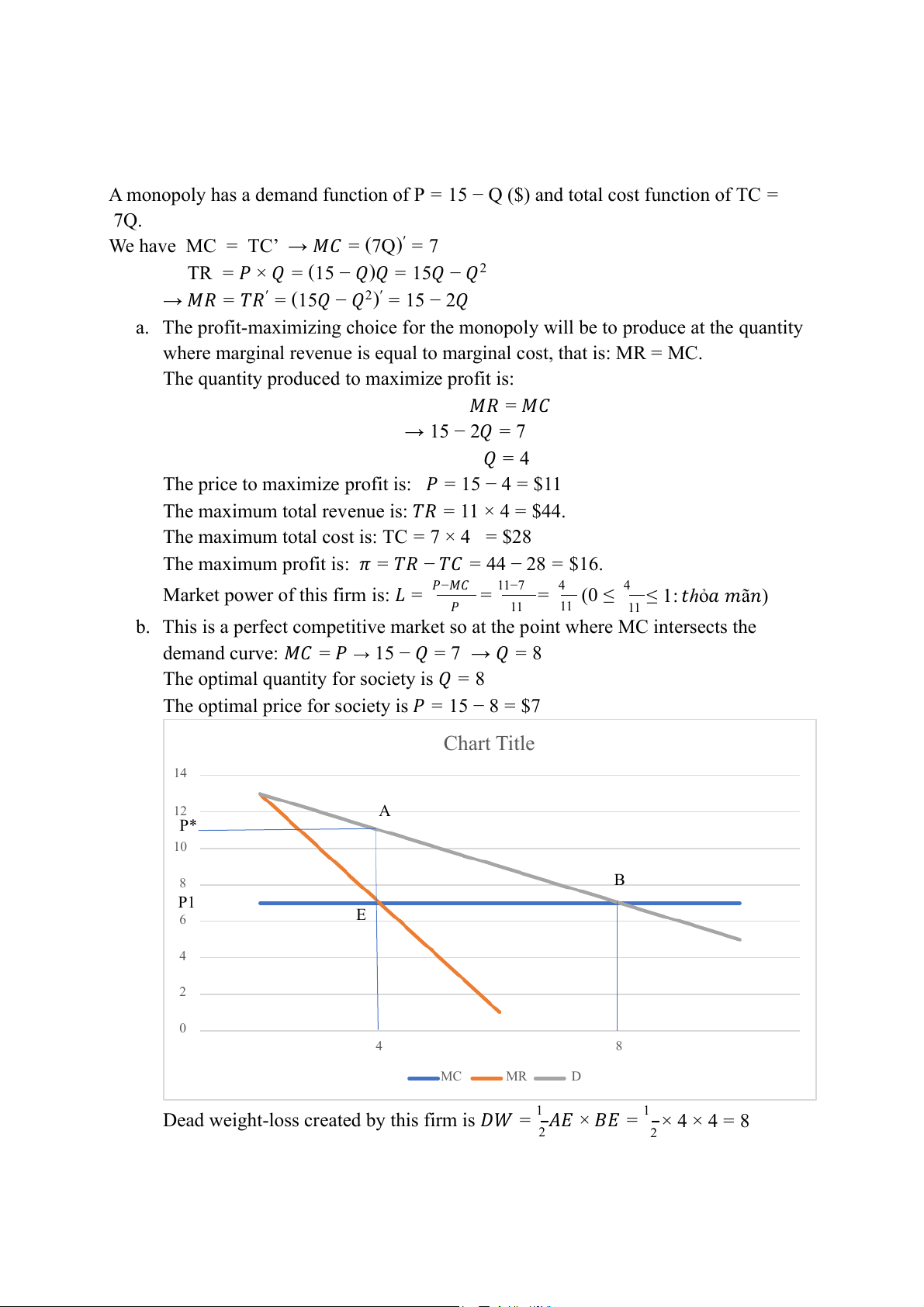
b. This is a perfect competitive market so at the point where MC intersects the
demand curve: 𝑀𝐶 = 𝑃 → 15 − 𝑄 = 7 → 𝑄 = 8
The optimal quantity for society is 𝑄 = 8
The optimal price for society is 𝑃 = 15 − 8 = $7 Chart Title 14 12 A P* 10 8 B P1 6 E 4 2 0 4 8 MC MR D
Dead weight-loss created by this firm is 𝐷𝑊 = 1 𝐴𝐸 × 𝐵𝐸 = 1 × 4 × 4 = 8 2 2 Problem 4
A monopolist has demand function of 𝑃 = 100 − 𝑄 and cost functions of 𝐴𝑉𝐶 = 𝑄 + 4; 𝐹𝐶 = 200.
𝐴𝑉𝐶 = 𝑄 + 4 → 𝑉𝐶 = 𝐴𝑉𝐶 × 𝑄 = (𝑄 + 4)𝑄 = 𝑄2 + 4𝑄
→ 𝑇𝐶 = 𝑉𝐶 + 𝐹𝐶 = 𝑄2 + 4𝑄 + 200
→ 𝑀𝐶 = 𝑇𝐶′ = (𝑄2 + 4𝑄 + 200)′ = 2𝑄 + 4
𝑇𝑅 = 𝑃 × 𝑄 = (100 − 𝑄) × 𝑄 = 100𝑄 − 𝑄2
→ 𝑀𝑅 = 𝑇𝑅′ = (100𝑄 − 𝑄2)′ = −2𝑄 + 100
a. Optimal output level that maximizes profit is : 𝑀𝑅 = 𝑀𝐶
→ −2𝑄 + 100 = 2𝑄 + 4 → 𝑄 = 24
The price to maximize profit is: 𝑃 = 100 − 24 = $76
The maximum total revenue is: 𝑇𝑅 = 76 × 24 = $1824.
The maximum total cost is: TC = 242 + 4 × 24 + 200 = $872
The maximum profit is: 𝜋 = 𝑇𝑅 − 𝑇𝐶 = 1824 − 872 = $952.
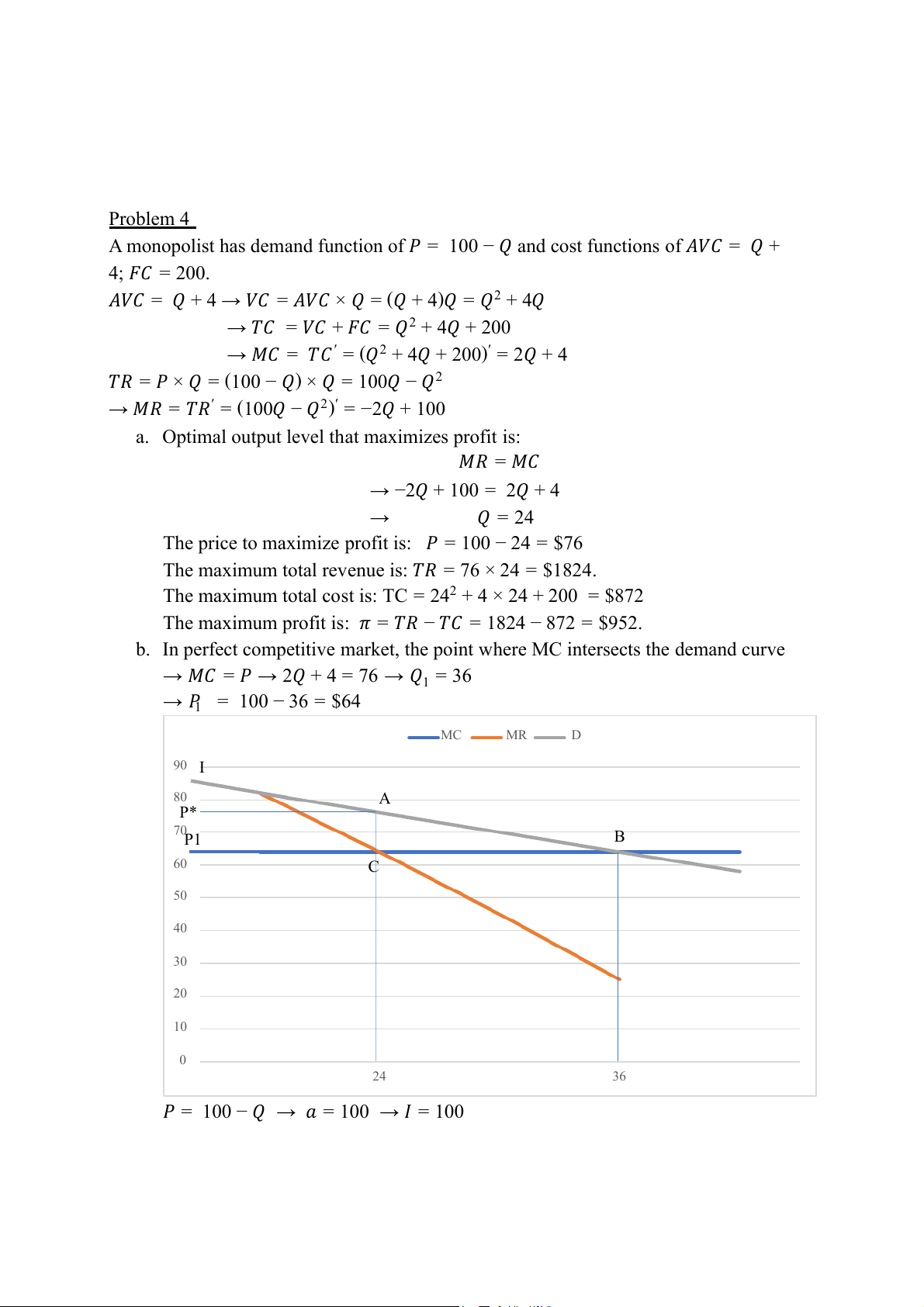
b. In perfect competitive market, the point where MC intersects the demand curve
→ 𝑀𝐶 = 𝑃 → 2𝑄 + 4 = 76 → 𝑄1 = 36 → 𝑃1 = 100 − 36 = $64 MC MR D 90 I 80 A P* 70P1 B 60 C 50 40 30 20 10 0 24 36
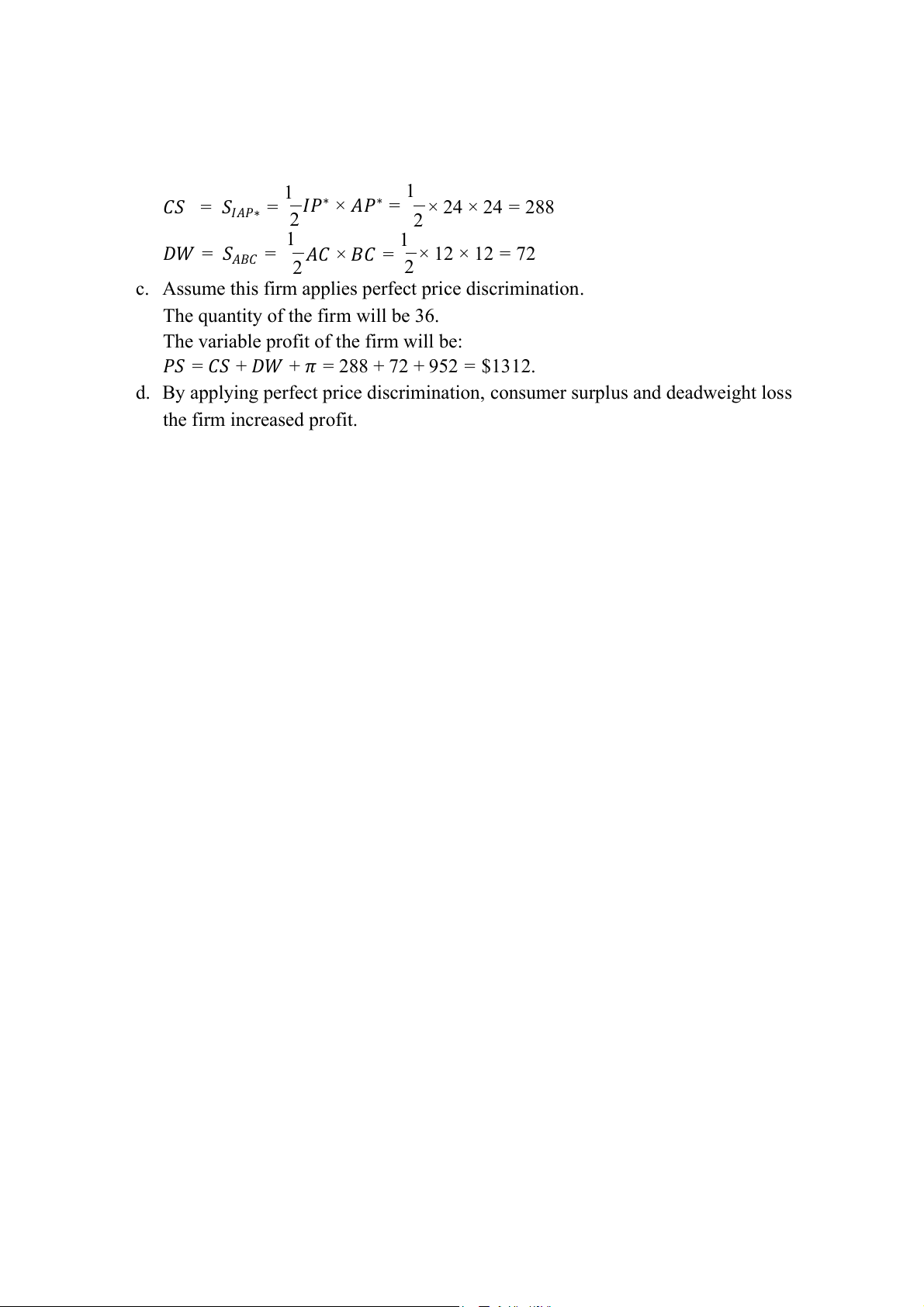
𝑃 = 100 − 𝑄 → 𝑎 = 100 → 𝐼 = 100 1 1 𝐶𝑆 = 𝑆 = 𝐼𝑃∗ × 𝐴𝑃∗ = × 24 × 24 = 288 𝐼𝐴𝑃∗ 2 2 1 1 𝐷𝑊 = 𝑆 = × 12 × 12 = 72 𝐴𝐵𝐶 𝐴𝐶 × 𝐵𝐶 = 2 2
c. Assume this firm applies perfect price discrimination.
The quantity of the firm will be 36.
The variable profit of the firm will be:
𝑃𝑆 = 𝐶𝑆 + 𝐷𝑊 + 𝜋 = 288 + 72 + 952 = $1312.
d. By applying perfect price discrimination, consumer surplus and deadweight loss the firm increased profit.
Tài liệu liên quan:
-
Chương 3: độ co giãn và các nhân tố ảnh hưởng | Microeconomics | Trường Đại học Quốc tế, Đại học Quốc gia Thành phố Hồ Chí Minh
3 2 -
Microeconomics Syllabus | Microeconomics | Trường Đại học Quốc tế, Đại học Quốc gia Thành phố Hồ Chí Minh
3 2 -
Microeconomics Course Syllabus & Assessment Details | Microeconomics | Trường Đại học Quốc tế, Đại học Quốc gia Thành phố Hồ Chí Minh
3 2 -
Assignment 3 - Elasticity MCQs and Key Concepts | Microeconomics | Trường Đại học Quốc tế, Đại học Quốc gia Thành phố Hồ Chí Minh
3 2 -
Assignment 2 - Economic Equilibrium Analysis of Fridges and Motorcycles | Microeconomics | Trường Đại học Quốc tế, Đại học Quốc gia Thành phố Hồ Chí Minh
3 2