Venezuela Economic Crisis: Answer Key to Tutorial Questions 4 | Microeconomics | Trường Đại học Quốc tế, Đại học Quốc gia Thành phố Hồ Chí Minh
The diagram can show either a shift inwards in the PPF as the economic growth is negative and the productive potential changes or a movement to a point further inside the curve as unemployment increase. 2. If a fall in the price of oil leads to a fall in export earnings, this means that the price elasticity of demand is inelastic because a fall in price has réulted in a lower percentage rise in sales. Tài liệu được sưu tầm và soạn thảo dưới dạng file PDF để gửi tới các bạn cùng tham khảo, ôn tập đầy đủ kiến thức, chuẩn bị cho các buổi học thật tốt. Mời bạn đọc đón xem!
Môn: Microeconomics 635 tài liệu
Trường: Trường Đại học Quốc tế, Đại học Quốc gia Thành phố Hồ Chí Minh 1.9 K tài liệu
Tác giả:

Preview text:
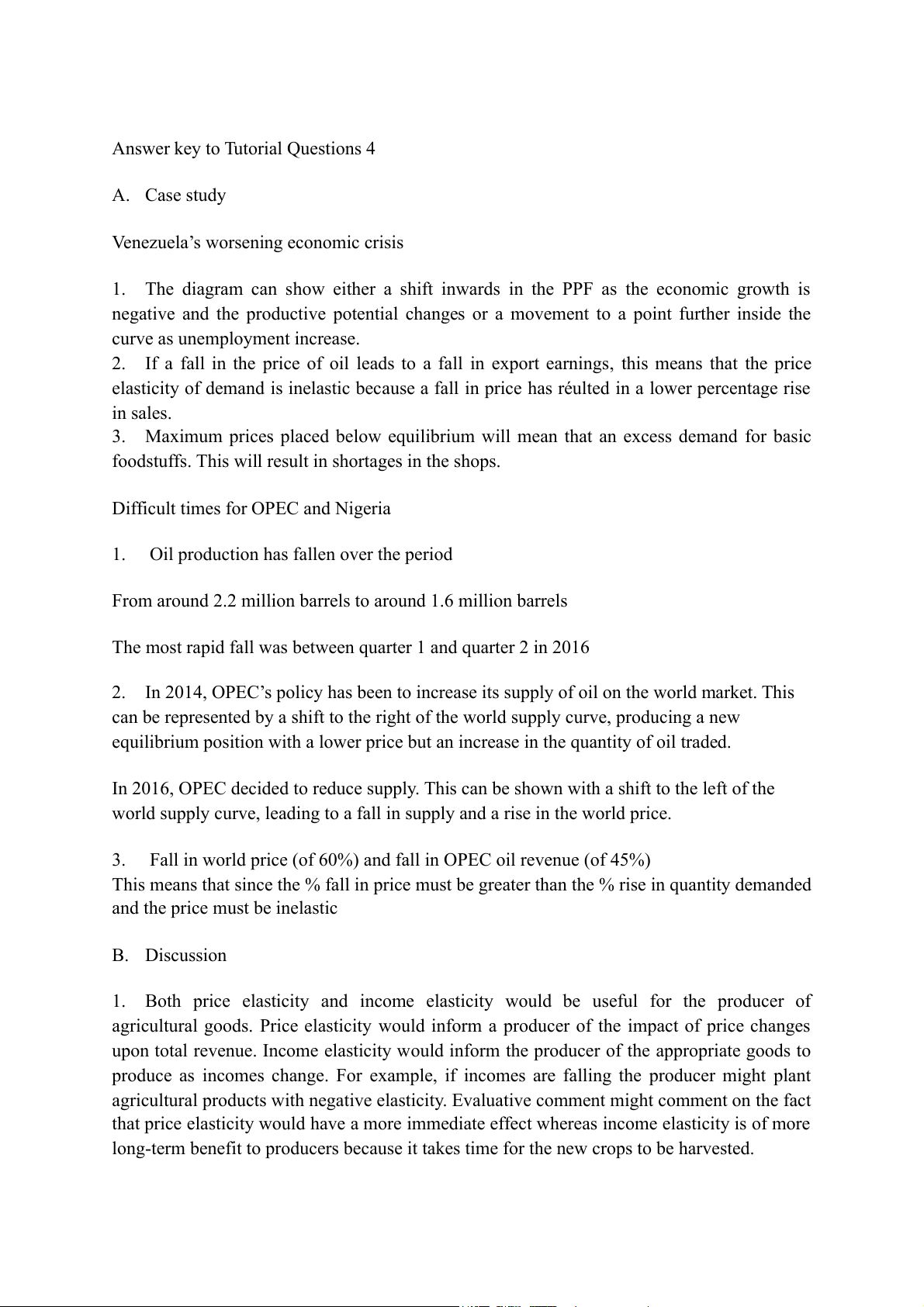
Answer key to Tutorial Questions 4 A. Case study
Venezuela’s worsening economic crisis
1. The diagram can show either a shift inwards in the PPF as the economic growth is
negative and the productive potential changes or a movement to a point further inside the
curve as unemployment increase.
2. If a fall in the price of oil leads to a fall in export earnings, this means that the price
elasticity of demand is inelastic because a fall in price has réulted in a lower percentage rise in sales.
3. Maximum prices placed below equilibrium will mean that an excess demand for basic
foodstuffs. This will result in shortages in the shops.
Difficult times for OPEC and Nigeria
1. Oil production has fallen over the period
From around 2.2 million barrels to around 1.6 million barrels
The most rapid fall was between quarter 1 and quarter 2 in 2016
2. In 2014, OPEC’s policy has been to increase its supply of oil on the world market. This
can be represented by a shift to the right of the world supply curve, producing a new
equilibrium position with a lower price but an increase in the quantity of oil traded.
In 2016, OPEC decided to reduce supply. This can be shown with a shift to the left of the
world supply curve, leading to a fall in supply and a rise in the world price.
3. Fall in world price (of 60%) and fall in OPEC oil revenue (of 45%)
This means that since the % fall in price must be greater than the % rise in quantity demanded
and the price must be inelastic B. Discussion
1. Both price elasticity and income elasticity would be useful for the producer of
agricultural goods. Price elasticity would inform a producer of the impact of price changes
upon total revenue. Income elasticity would inform the producer of the appropriate goods to
produce as incomes change. For example, if incomes are falling the producer might plant
agricultural products with negative elasticity. Evaluative comment might comment on the fact
that price elasticity would have a more immediate effect whereas income elasticity is of more
long-term benefit to producers because it takes time for the new crops to be harvested.
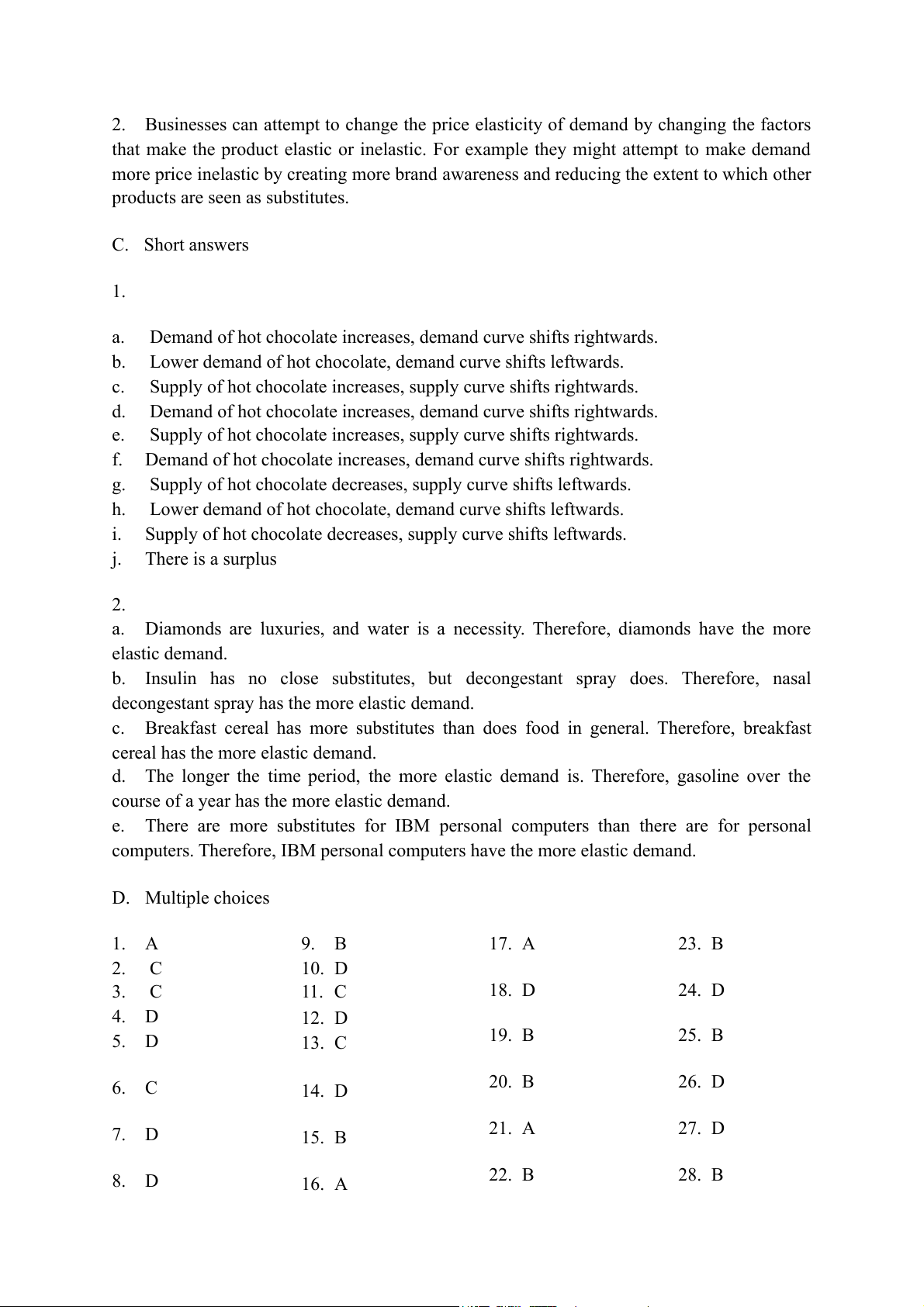
2. Businesses can attempt to change the price elasticity of demand by changing the factors
that make the product elastic or inelastic. For example they might attempt to make demand
more price inelastic by creating more brand awareness and reducing the extent to which other
products are seen as substitutes. C. Short answers 1.
a. Demand of hot chocolate increases, demand curve shifts rightwards.
b. Lower demand of hot chocolate, demand curve shifts leftwards.
c. Supply of hot chocolate increases, supply curve shifts rightwards.
d. Demand of hot chocolate increases, demand curve shifts rightwards.
e. Supply of hot chocolate increases, supply curve shifts rightwards. f.
Demand of hot chocolate increases, demand curve shifts rightwards.
g. Supply of hot chocolate decreases, supply curve shifts leftwards.
h. Lower demand of hot chocolate, demand curve shifts leftwards. i.
Supply of hot chocolate decreases, supply curve shifts leftwards. j. There is a surplus 2.
a. Diamonds are luxuries, and water is a necessity. Therefore, diamonds have the more elastic demand.
b. Insulin has no close substitutes, but decongestant spray does. Therefore, nasal
decongestant spray has the more elastic demand.
c. Breakfast cereal has more substitutes than does food in general. Therefore, breakfast
cereal has the more elastic demand.
d. The longer the time period, the more elastic demand is. Therefore, gasoline over the
course of a year has the more elastic demand.
e. There are more substitutes for IBM personal computers than there are for personal
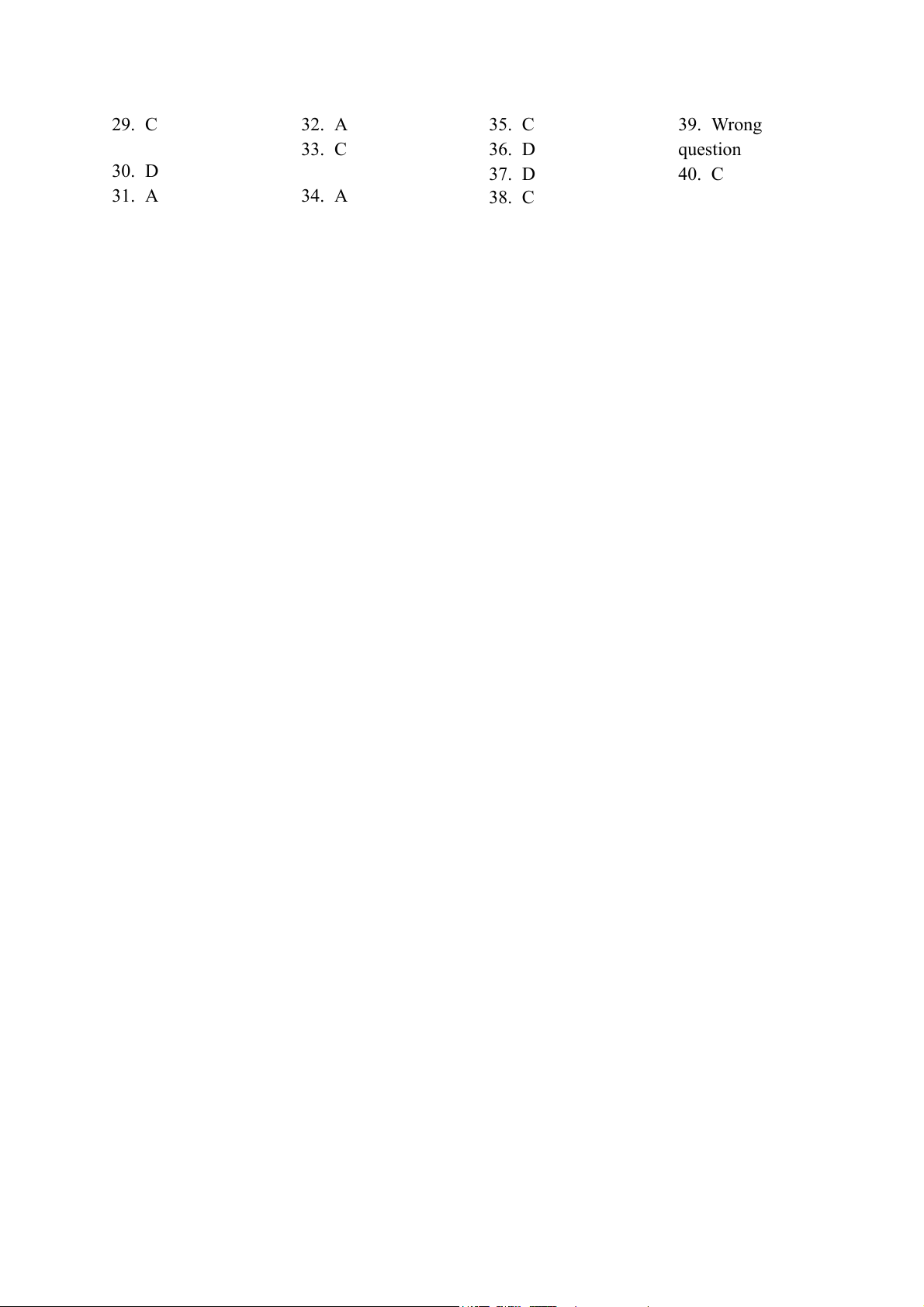
computers. Therefore, IBM personal computers have the more elastic demand. D. Multiple choices 1. A 9. B 17. A 23. B 2. C 10. D 3. C 11. C 18. D 24. D 4. D 12. D 5. D 13. C 19. B 25. B 6. C 14. D 20. B 26. D 7. D 15. B 21. A 27. D 8. D 16. A 22. B 28. B 29. C 32. A 35. C 39. Wrong 33. C 36. D question 30. D 37. D 40. C 31. A 34. A 38. C
Tài liệu liên quan:
-
Chương 3: độ co giãn và các nhân tố ảnh hưởng | Microeconomics | Trường Đại học Quốc tế, Đại học Quốc gia Thành phố Hồ Chí Minh
3 2 -
Microeconomics Syllabus | Microeconomics | Trường Đại học Quốc tế, Đại học Quốc gia Thành phố Hồ Chí Minh
3 2 -
Microeconomics Course Syllabus & Assessment Details | Microeconomics | Trường Đại học Quốc tế, Đại học Quốc gia Thành phố Hồ Chí Minh
3 2 -
Assignment 3 - Elasticity MCQs and Key Concepts | Microeconomics | Trường Đại học Quốc tế, Đại học Quốc gia Thành phố Hồ Chí Minh
3 2 -
Assignment 2 - Economic Equilibrium Analysis of Fridges and Motorcycles | Microeconomics | Trường Đại học Quốc tế, Đại học Quốc gia Thành phố Hồ Chí Minh
3 2